

















UA-56202873-1
Page 432

Are Sikhs for or against nuclear weapons?

1
    Image by Dr StClaire / Pixabay
By Gurmukh Singh | OPINION |

The author was approached by CND Peace Education to give a Sikh view about nuclear weapons and disarmament. The faith response is for school religious education (RE) teachers and aimed at middle and senior school students. The topic is complex and the author hopes that the RE teachers would study and simplify further according to student age groups.

The short questionnaire is limited to a few words against each question. Below are some relevant introductory thoughts shared with the readers followed by the completed questionnaire. A link to an article by the author referred to by Campaign for Nuclear Disarmament (CND), can be helpful for RE teachers and senior students to understand the Sikh approach to war and peace.

INTRODUCTORY DISCUSSION

Sikhi (Sikhism) allows armed defence as a last resort when all other means for securing peace have failed. The only peace acceptable to Sikhi is genuine peace which secures human freedom and dignity in a just society. Sikh activism is aimed towards the establishment and defence of such an ideal society.

Armed defence is also confirmed by the principle of “Degh Tegh Fateh” meaning victory of the cauldron defended by the sword of justice. Here, literally, degh, is the large metal container (ਕੜਾਹਾ) for cooking community food (langar) in the community kitchen. Therefore, “Degh” symbolises the sharing principle in Sikh tradition. It represents a way of life, of sharing with those in need and community service, a social system which is defended by Tegh, the protective sword of justice of the Khalsa Panth.

Tegh is symbolised by the Sikh sword, “Kirpan”. The word means “the benevolent defender of honour or human dignity”. Kirpan also represents all weapons intended to be used for defence only; and, ultimately, the divine power which protects the defenceless.

Un-armed Sikh response to aggression: This is also the place to summarise un-armed response to aggression in Sikhi tradition enshrined in the unique Sikhi concept of martyrdom (shaheedi). It can be distinguished from “ahimsa”, the principle of not causing harm to other living things. It is certainly not “satyagraha” as a policy of passive political resistance practised by Mahatma Gandhi against British rule in India. Satyagraha strategy relied on threat of fast unto death (maran-barat). That strategy is anti-Sikhi. Often, there is doubt about the effectiveness of such self-inflicted death. In any case, many such maran-barats are just political gimmicks.

Below is a summary of the Sikhi concept of martyrdom from my revision of earlier publication Guru Tegh Bahadur: The True Story (sikhmissionarysociety.org).

The Guru preached realization of the higher spiritual and moral truths above material attachments, physical pain, passions and pleasure. By contrast, the Indian idea of vairag was based on dislike for worldly life. Shankracharya preached contempt for worldly pursuits and recommended isolation from temporal living. He believed that only such detachment from the world can induce a state of vairag.

The Guru’s concept of vairag was based on love for the Creator Being above worldly attachments and pursuits. God-love was then translated into love and sacrifice for God’s creation.

The Sikhi concept of martyrdom, sacrifice in God-love for the righteous cause and assertion of the human right to free choice to seek own path to God is the message of Guru Tegh Bahadur’s martyrdom. In one sense, Guru Tegh Bahadur’s holy hymns bring together the best of ancient Indian thought relating to detachment (vairag), albeit, re-interpreted, and the Greek-Abrahamic concept of martyrdom (shaheedi).

To quote Gurbachan Singh Talib: “In the Guru’s teaching an added element, which is the crown of the higher life, is the pursuit of the ideal without flinching uptill the stage where it may become martyrdom…..The dimension of the reality of physical evil, which neither prayer nor miracle may avert, but which must execute its potential movement, is what makes Guru Tegh Bahadur’s teaching so deeply touching and of such value to our time in which miracles of the kind narrated in mythology are not known to occur……This implies not their [devotees’] rescue from the power of tyrants and oppressors, but the triumph of their spirit and the fulfilment of their ideals despite their physical destruction.” (Fauja Singh and Gurbachan Singh Talib, Guru Tegh Bahadur Martyr and Teacher, p1975)

CND PEACE EDUCATION RELIGIOUS LEADERS’ QUESTIONNAIRE

Are you for or against nuclear weapons? Why? (Here, the justification should describe one’s own personal opinion, and can be brief, to allow for deeper enquiry in the later questions) 50 words.

As a Sikh, I am for multilateral nuclear disarmament but against unilateral surrender of power to totalitarian regimes. Nuclear weapons are a glaring misuse of God-given knowledge, a global threat to human existence and a major distraction from human progress towards an ideal global society.

How has your faith informed your opinion on nuclear disarmament? 100 words

Sikh teachings tell me that human life is precious and that human beings have the God-given right to live with dignity. However, as a last resort, to struggle against oppression to the death is better than living a life without dignity. Therefore, to quote the Tenth Master, Guru Gobind Singh, “When all peaceful means fail, armed resistance against oppression is justified.” The Sikh Kirpan, meaning: the sword which defends human dignity, also symbolizes armed defence of an egalitarian way of life against all weapons – conventional or nuclear. Global nuclear disarmament depends on tackling the root causes of war by diverting human thought and energy away from material ambition and greed, to God-centred moral values and truthful living. [Article link: A Sikh Approach to War and Peace (sikhmissionarysociety.org) ]

Is there a particular teaching that you consider to be important regarding nuclear weapons? E.g. a parable, verse, practice or belief. 100 words

As nuclear weapons are a modern invention, world religions can only be guided by general principles. Guru Nanak’s compositions lamenting the carnage caused by Babur, the Mughal invader of India, are instructive. The compassionate Guru implored the Creator Being that if a powerful aggressor is faced by an equally powerful defender then there is no cause for complaint. However, when ordinary households are left defenceless and will be killed, they deserve divine intervention. No one should be left defenceless against conventional or nuclear weapons while human endeavours for global peace continue.

Does your faith have a history of working against weapons of mass destruction? If so, can you give examples? 50 words

Sikh teachings, history and activism are about peaceful co-existence and defence of human diversity and dignity. There is no distinction between knives and nukes if used for aggression. Therefore, in forums and peace movements, Sikhs oppose use of all weapons which are not solely for self-defence of individuals and people (communities and nations).

Can you share something from your faith that exemplifies your faith’s approach to peace and nonviolence? E.g. a particular belief, story, practice or writing. 100 words

Sikh teachings enshrined in the Sikh Holy Scripture, Guru Granth Sahib, include those of Muslim and Hindu saints. A Guru martyr, Guru Tegh Bahadur, gave his life in defence of the universal principle of religious freedom. At that time the aggressor was Muslim Emperor, Aurungzeb, forcing Hindus to convert to Islam. Yet, Muslim saints have a place of honour in Sikh teachings as mentioned above. Guru Granth Sahib exemplifies world peace and full acceptance of human diversity. Historical Sikh non-violent campaigns – the morchas – against colonial rule won applause from leaders like Mahatma Gandhi and also from the colonial British themselves.

What does a peaceful future look like to you? 1 or 2 sentences.

A peaceful future is well illustrated in Guru Granth Sahib as one when no one inflicts pain on another. It is a future in which global citizens have no worries (Begumpura concept) and they can move around fearlessly and freely.


Gurmukh Singh OBE, a retired UK senior civil servant, chairs the Advisory Board of The Sikh Missionary Society UK. Email: sewauk2005@yahoo.co.uk. Click here for more details on the author.

* This is the opinion of the writer, organisation or publication and does not necessarily represent the views of Asia Samachar.


RELATED STORY:

Sikhi: The Path for the New Age (Asia Samachar, 17 May 2020)

How coronavirus can change the world (Asia Samachar, 29 April 2020)


ASIA SAMACHAR is an online newspaper for Sikhs / Punjabis in Southeast Asia and beyond. Facebook | WhatsApp +6017-335-1399 | Email: editor@asiasamachar.com | Twitter | Instagram | Obituary announcements, click here |

How Malaysian Sikhs react to mental health? A new study has some answers

0
Heeran Kaur (Background sketch by Chenspec / Pixabay)
By Asia Samachar Team | MALAYSIA |

How do Sikhs in Malaysia react to mental health? Well, a recent study may shine some light on the topic.

For a start, Sikhs hesitate in seeking out professional help and fear going into therapy. They are also ashamed when they need to engage mental health professionals for help.

On the bright side, younger Sikhs – those in the 20s and 30s – are ready and willing to engage mental health professionals. They also see positive changes in how they view themselves after getting mental health support.

These are some of the outcomes of what is believed to be the first full-blown study on the lived experiences of Sikhs in Malaysia seeking support for mental health.

“I was delighted that every single person I had spoken with had experienced growth on their journeys. It is a testament to my belief that the therapy process, when done correctly, has tremendous potential for leaving clients in a better place than before they embarked on their voyages. That belief guides my work ethic as a licensed counsellor,” counsellor and therapist Heeran Kaur tells Asia Samachar.

The lawyer-turned-mental health advocate had presented a paper on the topic at the International Seminar of Counselling and Well-Being (ISCWB 2020), organised by Universiti Malaya, in November 2020.

The qualitative study involved six Sikhs who either presently were in therapy or had been in therapy before.

Asked what were some key outcomes of the study, Heeran said the study noted some hesitance in seeking out professional help. For one, some participants felt ashamed approaching mental health professionals.

“Most had a tendency of comparing themselves to family members and friends within the Punjabi community including people they knew from gurdwaras and samelans [Gurmat camps] which made them question their own competence at managing their issues.

“For instance, they highlighted how they perceived themselves as weak and judged themselves harshly for considering professional support. They wondered how it was that the people they knew were seemingly able to cope with challenges without resorting to consulting professionals,” she said.

She noted that the participants were not able to pinpoint with accuracy whether the people they were referencing were actually coping well or had sought some form of support that participants were not aware of.

The people interviewed also reported feeling afraid going into therapy. The findings revealed that while a few were apprehensive because they feared the unfamiliar, others felt fearful of what might happen in therapy including being forced to face things they may not want to address.

“Some reported discomfort at opening up to strangers while others elaborated how frightening it was to confront their issues. Meanwhile, others were afraid of changes that may follow after therapy. A few were concerned about showing their vulnerabilities, weaknesses and inadequacies while others feared being cornered and attacked,” she said.

As a counsellor and therapist, Heeran said her work ranges from providing talk therapy to psycho education (basically giving current information regarding mental health including latest research, findings, therapies) and conducting treatments for clients.

She also supports paying clients who range from young children to teenagers and adults to the elderly. Some common areas include depression, anxiety and grief & loss.

Heeran can be contacted at +6016 335 9209 or heerankaur1@gmail.com.


RELATED STORY:

Dr Sangeeta powers formation of mental health foundation (Asia Samachar, 20 Aug 2020)


ASIA SAMACHAR is an online newspaper for Sikhs / Punjabis in Southeast Asia and beyond. Facebook | WhatsApp +6017-335-1399 | Email: editor@asiasamachar.com | Twitter | Instagram | Obituary announcements, click here |

Canadian Sikh minister quits Cabinet to focus on family

0
“No longer my boss, always my friend.” – Navdeep sahred this photo of him with Trudeau on 12 Jan 2021
By Asia Samachar Team | CANADA |

A Canadian Sikh lawmaker has decided to call it quits from the high level politics with a decision to “step away as a cabinet minister”.

Navdeep Singh Bains, 43, earlier last week announced that the 2019 general elections was his last, and that he was withdrawing from the Cabinet helmed by Prime Minister Justin Trudeau.

He has served as the Minister of Innovation, Science and Industry for the last five years.

Along with national defence minister Harjit Singh Sajjan, Bains is one of the most visible Sikh politician in Canadian politics.

They were among four Indo-Canadians roped into Trudeau’s Cabinet after the 2019 elections. The list also included Bardish Kaur Chagger as Minister of Diversity and Inclusion and Youth and Anita Anand as Minister of Public Services and Procurement.

“As many of you know, family is the most important thing in my life. They have sacrificed so much in the last 17 years,” Navdeep said in a social media broadcast on Jan 12.

“The last year has been hard on families. My daughters, who are in Grade 5 and Grade 8, have needed me more in the last year. And I needed them, too. It is time for me to put my family first, and I couldn’t be happier about it.

“I’m very grateful for the trust the community has shown me. We are strong, diverse and vibrant. Representing you has been one of the great privileges of my life.”

In a tweet, he referred to Trudeau as such: “No longer my boss, always my friend.”

The move is surprising considering his age. And time will tell if there were other reasons.

This week, the Indian media channels reported that Bains’ departure from national politics was linked to corruption. The reports were not backed by any credible information other than falling back on earlier reported allegations.

Senator Linda Frum, a former journalist who had shared one of the Indian news reports, then apologies. She tweeted: “I owe @NavdeepSBains an apology. I retweeted an article about him from a non-reputable source in India. I should have checked the source first, as is my usual practice. I was wrong and I do unreservedly apologize. I wish him well in his retirement.”

In response, Bains said: “As someone who has faced this many times in my political career, we all have a responsibility to reject disinformation from foreign actors. This is not a partisan issue. Working together we can make sure interference doesn’t affect a fact-based public dialogue.”

A Canada-based writer Rupa Subramanya tweeted: “Zee media is a dangerous Indian government mouthpiece. No one sensible should defend their journalism if you can even call it that. It’s bizarre that a Canadian domestic political issue appeared on Zee. Very unusual but noteworthy.”

A media commentator, Sarbjit Kaur, tweeted: “Good of you to apologize but reading that article with its huge laundry list of everything from telecomms to temples in other Provinces being Bains’ fault should have tipped you off. ? I’m surprised they didn’t write that he caused COVID-19.”

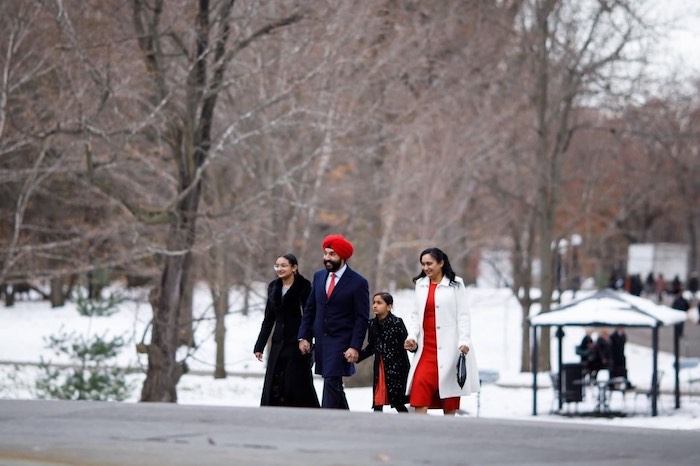
Navdeep Singh Bains and family – Photo: Bain’s LinkedIn
RELATED STORY:

Trudeau taps four Indo-Canadians for his new cabinet (Asia Samachar, 22 Nov 2019)


ASIA SAMACHAR is an online newspaper for Sikhs / Punjabis in Southeast Asia and beyond. Facebook | WhatsApp +6017-335-1399 | Email: editor@asiasamachar.com | Twitter | Instagram | Obituary announcements, click here |

Court diary of Maharaja Ranjit Singh

0
Court diary of Maharaja Ranjit Singh
By Asia Samachar Team | PAKISTAN |

PANJABI CULTURE | A daily diary from court of Maharaja Ranjit Singh written by Faqeer Syed Aziz-ud-Din. Written in Persian script, the court language of Maharaja, it captures court’s routine matters. – Source: text and photo from India Pakistan Heritage Club Facebook page


RELATED STORY:

Maharaja Ranjit Singh named 20 world’s greatest leaders (Asia Samachar, 3 Jan 2020)


ASIA SAMACHAR is an online newspaper for Sikhs / Punjabis in Southeast Asia and beyond. Facebook | WhatsApp +6017-335-1399 | Email: editor@asiasamachar.com | Twitter | Instagram | Obituary announcements, click here |
Pritam Kaur (1935-2021), Sentul

LAST RESPECT: 20 Jan 2021 (Wed), 12.30pm-1.30pm, at Crematorium Jalan Loke Yew (Shamshan Bhoomi), Kuala Lumpur. SASKAAR / CREMATION: 1.30 pm, 20 Jan 2021 (Wed), Crematorium Jalan Loke Yew (Shamshan Bhoomi) | Malaysia

Jehaa chiri lekheaa tehaa human kemaaeh, ghale aaveh naankaa sadhe uth jaaey (SGGS, 1239)

ਜੇਹਾ ਚੀਰੀ ਲਿਖਿਆ ਤੇਹਾ ਹੁਕਮੁ ਕਮਾਹਿ ॥ ਘਲੇ ਆਵਹਿ ਨਾਨਕਾ ਸਦੇ ਉਠੀ ਜਾਹਿ ॥੧॥

PRITAM KAUR A/P TARA SINGH

12.2.1935 – 19.1.2021

Village: Dolo Nanggal Punjab, originally from sentul.

Husband: Capt. (R) Mukhtiar Singh

Children / Spouses:

Dato Dr Rajbans Singh & Datin Rajinder Gill

Rajvinder Kaur (Vindi)

Dato Rajpal Singh & Datin Sukhmendar Kaur (Sheena)

Grandchildren:
Updash Singh
Benita Raj Kaur
Hartrisha Kaur
Harsoneesha Kaur
Nevrita Raj Kaur

Last Respects: 20 Jan 2021 (Wed), 12.30pm-1.30pm, at Crematorium Jalan Loke Yew (Shamshan Bhoomi)

Saskar/Cemation: 1.30 pm, 20 Jan 2021 (Wed), Crematorium Jalan Loke Yew (Shamshan Bhoomi)

Contact:

Dato Rajpal Singh +60192691144

Updash Singh +60 17 237 3871

Jagdave Singh +60 12 288 7386

MESSAGE FROM FAMILY:

Our dear Pritam Kaur will be remembered by everyone in the family. We will always hold onto the warm and wonderful memories that we had with her. Pritam Kaur was & will always be a very loving, caring and beautiful person.

Pritam Kaur was famously known for teaching in Guru Nanak Punjabi school Sentul until 1962. She was the youngest teacher with a qualification of ‘giani’ from the university of Amritsar. She had many students, who still remember her for the teacher she was.

The family also requests everyone to observe Covid-19 SOP requirements where they apply.


| Entry: 19 Jan 2021 | Source: Family

ASIA SAMACHAR is an online newspaper for Sikhs / Punjabis in Southeast Asia and beyond. Facebook | WhatsApp +6017-335-1399 | Email: editor@asiasamachar.com | Twitter | Instagram | Obituary announcements, click here |

Into the Future: Gurdwara that walks

0
By Vishal J. Singh | GURDWARA DESIGN |

The dawn of the third decade of the 21st century is here.

Here we are in January, in the year 2021, still grappling with a worldwide pandemic that has brought so much of the world to a halt. Our lives have been severely disrupted, some more than others, but in one way or another, we’ve all been affected. Looking at the current situation, it is hard to imagine how humanity will finally unshackle itself from this curse of this virus, but despite how depressing the present may seem, there is always a glimmer of hope on the horizon. Looking for the silver lining in the clouds right now is a challenging task undoubtedly, but let us all remember that as followers of the glorious Sikh faith, we must always practice and renew our commitment to the philosophy of ‘Chardi Kala’, meaning of course to always be in high spirits, no matter what challenges that we may face.

No room for despondency, no room for pessimism. That is who we are

A better future may feel like a distant dream at the moment, and as impossible as it may seem, sooner or later it will knock on our front door and show up at the entrance. As Einstein once said “I never think of the future. It comes soon enough,”. Before it does however, it has always been an exciting prospect to playfully imagine what the world will look like years from now.

“Are we finally going to see flying cars? Will there be mega-cities floating in the sky? Will versatile robots make rotia for us in the morning before we leave for work?” Such playful and eccentric propositions to dream of certainly, but human ingenuity and creativity has taken us far in the past. And based on the achievements of that past, there is no reason not to assume that even greater marvels are on their way, and thanks to visionaries like Isaac Asimov, Jules Verne, Arthur C. Clark and so many more who provided inspiration for such dreams, some of them might be here sooner rather than later. 

In architecture, too, the future has always been a tantalizing concept to explore, and back in the 1960s, there was one particular group of forward thinking architects, called Archigram based in the UK, that proposed radical ideas in modern design, such as designing entire cities that could “walk” from one area to another, to help and service the population where it may be needed. Thinking of the future and the radicals who worked at Archigram, had then led me to ponder on how Gurdwaras could be designed decades in to the future and what incredible technological innovations can be incorporated into its structure.

The following design is a purely whimsical attempt to imagine an ultra-futuristic Gurdwara that marries some of the ideas that Archigram proposed, specifically on how a building can “walk” from one locale to another to allow for the entire complex to be mobile to help the Sanggat achieve a particular purpose where it may be necessary. As usual, this is a purely fanciful exercise in ‘architectural day dreaming’, and a hypothetical attempt to predict future building trends all the way in 2050 assuming of course, you and I are still alive 3o years from now.

Imagine if you may, as we look towards a more hopeful and promising future, what astonishing technological innovations can we expect that will truly make our jaws drop in the coming days. These innovations will affect a wide range of industries, and construction too will see its fair share of incredible ideas and advancements that will shape the architecture of the future. Human beings are after all a surprisingly resilient species, and although there is simply no way of knowing for sure what tomorrow will bring, it never hurts to keep our fingers crossed and our spirits high to face the challenges of the future and be triumphant over all adversity.

It this proposal, the most striking feature of this Gurdwara will be its ability to transport itself wherever it may need to be, to service the Sanggat as and how required. The entire complex is built as a series of light-weight slender metal frames joined together that are attached to giant wheels, like the legs on an insect, and will consist of a Darbar Sahib, Langgar Hall and the relevant administration and accommodation quarters.

The Gurdwara projects an ultra-futuristic appearance, which takes inspiration from the aesthetic that modern technology projects, namely a generally clean, white look with some flair added on, angular lines and bold forms, and although it may seem complex, celebrates simplicity and the notion of movement in its overall design.

The Gurdwara will have 2 entrances connected to an elevated main corridor that leads to the Darbar Sahib and the Langgar Hall. The Nishan Sahib is placed at where the main entrance is located, while the secondary entrance allows direct access to the administration and accommodation quarters for quick and convenient access and to allow for the disabled on wheelchairs to enter the complex as well.

The Darbar Sahib (on the left) and the Langgar Hall (on the right) are covered with a series of seamless geometric panels that can open and close to allow for a controlled amount of sunlight to enter its interiors. This is an energy efficient design strategy, and a lightly tinted orange glass roof encapsulates its enclosure and acts as the main roof for the Gurdwara.

Here too, the wheels that allow for mobility for the entire Gurdwara is shown, where the Darbar Sahib (on the left) and the Langgar Hall (on the right) are located. Both these halls are supported by a series of angled walls with red and orange light – based panels and the direction of the wheels of course can be adjusted to any degree to allow for complete 360 degree freedom of vehicular movement.

This proposal, eccentrically referred to as the called “The Walking Gurdwara” is an idea that seeks to transcend the very solid notion that buildings are stationary objects, fixed permanently in one area in the urban landscape, for the rest of its life. The proposal also seeks to explore the possibility that buildings can be designed to move from one area to another to accommodate a variety of functions, such as to escape sudden natural disasters like floods or to service a new segment of the population that may need a new building for a multitude of reasons, including hospitals, schools, hostels and of course, houses of worship.

Ultimately, there really is no telling what will happen in 1 year from now, much less a jump 3o years into an unknowable future. Although we must remain hopeful and do our best to face each day as it arrives, we can certainly, on our way to the middle half of the century, dream, prepare and commit ourselves to a better future, and aided with the gift of Chardi Kala, and with the power of our imagination, and our innate sense of resilience and resourcefulness, we truly can overcome the challenges we are now facing and march to more promising future for all mankind.

And lest we forget, it is after all, who we are.

Stay safe. Waheguru Bless.

The next proposal will imagine designing a Gurdwara built in the highlands to accommodate mini – samelans, workshops and camps to continuously foster a sense of community among Sikh youth.

Vishal J. Singh, an aspiring architect, holds a Bachelor of Architecture Degree from Infrastructure University Kuala Lumpur and enjoys engaging in architecture and its theories as his first love.

* This is the opinion of the writer, organisation or publication and does not necessarily represent the views of Asia Samachar.


RELATED STORY:

Bridging The Old And The New (Asia Samachar, 1 Dec 2020)


ASIA SAMACHAR is an online newspaper for Sikhs / Punjabis in Southeast Asia and beyond. Facebook | WhatsApp +6017-335-1399 | Email: editor@asiasamachar.com | Twitter | Instagram | Obituary announcements, click here |

Post-truth make belief allure of fascist dictators

0
I’m pissed… I’m tired of people that cannot find reality because they have been so brainwashed by a senile narcissistic CON MAN and his merry band of grifters…So this is it….This is my LINE IN THE SAND….If right now at this point you STILL follow Trump… if you still have an imaginary friend named Q or a racist cartoon frog pinned as your twitter avatar… BYE you are NOTHING to me… You have ZERO value to me as a friend…- Text/Sketch by Evangeline Ling
By Gurnam Singh | OPINION |

For sure, aesthetics, which finds its expression in secular and religious forms, is what nourishes our subjective selves, intellectual curiosity, imagination and creative impulse. It is impossible to imagine human existence devoid of language, culture, and art. But, it is material reality that determines if we live or die; even academics like me, who ply the aesthetics of writing, need to eat, pay our bills and have money to purchase the devices through which we communicate our ideas. Put another way, if our brain is starved of oxygen and blood, then our minds become extremely limited, if not extinguished altogether.

Contrary to some philosophical beliefs, we are real and the world in which we experience our existence is real. Indeed, it was the assertion that existence is simply illusory that constitutes a central cirque of the prevailing Brahmanical world view by Guru Nanak and Sikh teachings more generally. According to Sikhi, the visible world (Kudrat) and the laws of nature that govern material existence is a manifestation of the universal divine entity, and therefore real, but not finite. That is to say, the world of mass, form, space, time and motion is real. However, most critically, as science itself has revealed, what we can detect, measure and comprehend represents only one transient aspect of reality and not the totality of existence.

MORE ON THE SKECTH, GO HERE

And therefore to abandon reason, rationality, empiricism and truth is not advisable and can potentially leave the door open for reactionary ideas and conspiracy theories to flourish. But it seems that, for a complex set of reasons, humanity as reached a point where any consensus about what constitutes reality or truth is being seriously undermined in what is characterised as a ‘post truth’ world. If this is indeed the case, then we all need to heed the thoughts of Timothy Snyder (2019) who in his book ‘On Tyranny’ argues, ‘post truth’ is ‘pre-fascism’ and that the abandonment of facts can lead to the abandon of freedom. And most importantly this state of affairs can leads us down a slippery slope towards fascism.

In a previous age, though coming at this question from a different angle, the philosopher Walter Benjamin makes a similar observation. Fascism, he argues, “attempts to organize the newly created proletarian masses without affecting the property structure which the masses strive to eliminate. Fascism sees its salvation in giving these masses not their rights, but instead a chance to express themselves. The masses have a right to change property relations; Fascism seeks to give them an expression while preserving property.” (Walter Benjamin (1936) The Work of Art in the Age of Mechanical Reproduction).

Though Benjamin was reflecting on Hitler’s rise to power in Germany in the 1930’s, which he witnessed first hand, his observations that fascism both feeds and feeds off the aesthetics of discontent is exactly what Is happening in the US today Trump, India under Modi and in many other, though importantly not all, ‘countries’ of the world. There is no doubt that a resurgence of authoritarian nationalism, majoritarianism and nativism is losing a serious challenge to liberal democracy.

The key passage in Benjamin’s analysis is ‘Fascism attempts to organize the newly created proletarian masses without affecting the property structure which the masses strive to eliminate. Fascism sees its salvation in giving these masses not their rights.” Here Benjamin is pointing out that fascists are not really interested in improving ordinary peoples lives; they are simply interested in building solidarity through fermenting resentment, something that was evident in abundance during the storming of the US Senate building by white supremacists who had been fed a diet of lies and untruths by Donald Trump, who for the past 5 years during his election campaign and subsequent presidency.

In reality, fascists like Trump are not interested in equality or redistribution of wealth upwards, but consolidating power in the hands of a few. And they trade in a post truth aesthetic to comfort and ultimately deceive the victims of oppression. In this regard, ‘post truth’ is the new opium of the masses. And because the appeal is to ‘faith’ in a messiah or dictator, rather than reasoned policies, one can see a close relationship between extreme nationalism, fundamentalism (secular or religious), racism and fascism and new age pseudoscience.

Some argue that the ‘post truth’ zeitgeist is a direct consequence of social media and the collapse of print media and objective independent journalism. However, a counter argument might be that there has never been a period where the media has been totally free and in some senses it is much freer now that in the past. However, there is the problem of eco chambers which can easily be created in social media platforms. The real problem is the way our educational system, as a consequence of neoliberal reforms, has been reduced to training for employment opportunities rather than to nurture curiosity, criticality and creativity.

And so, to those who find themselves drawn towards the rhetoric of the likes of Trump and Modi, all I can say, don’t just listen to their words, observe their actions! Let’s not forget that whilst talking about uplifting the poor of India, Modi has actually abandoned the farmers, who make up over 60% of the population. As for Trump, after inciting his followers to storm to the US Senate he set off in the opposite direction and later put out a statement condemning their actions! Modi is no friend of the vast majority of ordinary Hindus and Trump has no regard to the many many white supremacists, who have suffered badly from his incompetence and policies.

In a world where information is being generated in an exponential scale, tragically, real knowledge and truth is being drowned out and our lives are being reduced to simply consuming opinions rather than critically engaging in truth claims. And so, my appeal to those trapped in dead end of post truth thinking, try to nurture an attitude of respective curiosity, do not to take anything your read on face value, engage critically with ideas, seek out alternatives and only then decide what you think. Belief must come after reason otherwise it becomes blind faith.

[Gurnam Singh is an academic activist dedicated to human rights, liberty, equality, social and environmental justice. He is an Associate Professor of Sociology at University of Warwick, UK. He can be contacted at Gurnam.singh.1@warwick.ac.uk]

* This is the opinion of the writer and does not necessarily represent the views of Asia Samachar.


RELATED STORY:

The dangerous rise of fascism in India (Asia Samachar, 10 Jan 2021)


ASIA SAMACHAR is an online newspaper for Sikhs / Punjabis in Southeast Asia and beyond. Facebook | WhatsApp +6017-335-1399 | Email: editor@asiasamachar.com | Twitter | Instagram | Obituary announcements, click here |

Sardarni Dalip Kaur (1934-2021), Johor Bahru

PATH DA BHOG: 10am – 12.00noon, 23 January 2021 (Saturday), at Gurdwara Sahib Johor Bahru and thereafter followed by Guru Ka Langar | Malaysia

SARDARNI DALIP KAUR D/O BESAKAR SINGH

1934 – 11.1.2021

Village: Nathoke, Moga

Spouse: Late Sardar Maktiar Singh Dakha. PIS. (Johor Bahru)

Children/Spouse:
Jasbir Singh / Grace Muncada Sekhon
Amarjit Kaur
Gurjit Kaur
Ranjit Singh
Kuldip Kaur (Dr) / Lt Col Suvinder Singh (R)
Sukdave Kaur / Prem Singh
Jagjit Singh / Sukhjit Kaur
Late Manjit Singh USA / Manraaj Kaur

Grandchildren/Spouse: Joshua, Simran / Sanjay, Harmeet, Pavan, Kanchan, Amar, Roshan, Sanam

Great Grandchild: Jaiveer Singh

Path Da Bhog: 10am – 12.00 noon, 23 January 2021 (Saturday), at Gurdwara Sahib Johor Bahru and thereafter followed by Guru Ka Langar.

Contacts:

Jagjit Singh  -0167987499

Jasbir Singh – 0172000388

The family also requests everyone to observe Covid-19 SOP requirements where they apply.


| Entry: 18 Jan 2021 | Source: Family

ASIA SAMACHAR is an online newspaper for Sikhs / Punjabis in Southeast Asia and beyond. Facebook | WhatsApp +6017-335-1399 | Email: editor@asiasamachar.com | Twitter | Instagram | Obituary announcements, click here |

Sardarni Harbans Kaur Khaira (1939-2021), Sungai Petani

PATH DA BHOG: 23 January 2021 (Saturday), 9am – 12noon, at Gurdwara Sahib Bestari Jaya (Batang Berjuntai), Selangor and thereafter followed by Guru Ka Langar | Malaysia

SARDARNI HARBANS KAUR D/O GUNDAR SINGH 

07.11.1939 – 11.01.2021

Village: Sehron, Tarn Taran.

With a very heavy heart, we wish to inform that our beloved Wife/Mom/Grandmother passed away peacefully on 11th January 2021.

“You will forever be in the memories of family and friends. We keep you in our thoughts and prayers as you make your way to Waheguru Ji. We pray your soul Rest In Peace and blessed by Waheguru Ji.”

Forever loved and cherished by:

Husband: Sardar Bachan Singh Johl AMK BKM PJK JP (Sungai Petani, Kedah).

Children / Spouses :

Ajmer Singh.

Navinder Kaur / Dr Daljeet Singh.

Lt Col Amrit Singh / Inderjitpal Kaur.

Datin Bhalveen Kaur / Dato Bhaldesh Singh.

Grandchildren:  Melinder Kaur, Hashvinder Singh, Harvinder Singh, Jaslynn Kaur, Reshveen Kaur, Jasmeen Kaur, Gurraaj Singh, Aveleen Kaur, Jairaaj Singh.

Brothers: Naranjan Singh (Deceased), Nermal Singh, Darshan Singh, Saran Singh, Gurunam Singh.

Sisters: Naranjan Kaur (Nanjo), Sarjit Kaur (Jit), Gurbachan Kaur (Gano).

Saskaar / Cremation: 12 January 2021 (Tuesday) at Sungai Petani, Kedah.

Sahej Path Da Bhog: 23 January 2021 (Saturday), 9am – 12noon, at Gurdwara Sahib Bestari Jaya (Batang Berjuntai), Selangor and thereafter followed by Guru Ka Langar.

Contact:

Lt Col Amrit – 012 623 3734

Datin Bhalveen – 012 398 8647

We would like to express our sincere gratitude to everyone who have conveyed their heartfelt condolences, prayers and loving support rendered during the bereavement. Due to MCO and RMCO and in line with the government’s restrictions, the family is aware on the difficulties in interstate movement whilst this Gurdwara has also imposed attendance limitations due to the Covid-19 pandemic. Hence, only the immediate family members and relatives will be able to attend the Sahej Path Da Bhog. We humbly understand if you are unable to attend personally however do offer your prayers from wherever you are. We also request everyone to observe Covid-19 SOP requirements throughout the Sahej Path Da Phog.

| Entry: 17 Jan 2021 | Source: Family

ASIA SAMACHAR is an online newspaper for Sikhs / Punjabis in Southeast Asia and beyond. Facebook | WhatsApp +6017-335-1399 | Email: editor@asiasamachar.com | Twitter | Instagram | Obituary announcements, click here |

Hazrat Mian Mir – Great Sufi Saint

0
By Bhupinder ‘Bo’ Singh | OPINION |

Sri Harmandir Sahib, also known as The Golden Temple in Amritsar has become the world famous religious center of the Sikhs. The name Golden Temple has been given to it because of its gold foil plating on the walls. But the original building was made from burnt bricks and the original name given by the founder Guru Arjan Dev Ji was Harmandir. The word Harmandir means temple of God. In Guru Ji’s vision, the temple would become repository of the Sikh faith, and hallowed symbol of resoluteness of the faith.

A BRIEF HISTORY OF HARMANDIR

Guru Amar Das Ji (1479 – 1574), the third Guru; after having acquired a piece of land assigned the work of construction of Sarovar (water body tank) to the fourth Guru Ram Das Ji (1534-1581). The work of tank excavation was started in 1570 and completed in 1577. The work of enlarging the tank along with the brick lining the sarovar walls as the tank was known by was completed by fifth Guru Arjan Dev Ji (1563 -1606). The water tank was called Amrit Sarover by Guru Ji. The word means lake of immortality. Guru Arjan Dev Ji conceptualized the architectural design of the Harmandir to be built in the middle of the tank. Most historical records and verbal traditions confirm that the foundation brick was laid by Hazrat Mian Mir (1550 –1635) of Lahore in 1588. His full name was Baba Sain Mir Mohammed Sahib; and he was leader of Qadiri Sufi order of Islam faith. But there are some, who believe that actual foundation brick was laid by Guru Arjan Dev Ji himself. They believe that this story of Mian Mir laying the foundation was made up by Butay Shah (real name Ghulam Muhaiyuddin) in 1848 in his Persian history book on Punjab “Tavarikh-i-Punjab.” The construction work of Harmandir Sahib was started in 1589 and completed in 1601. The Temple is described by Ian Kerr, and other scholars, as a mixture of the Indo-Islamic Mughal and the Hindu Rajput architecture. It is amazing to note that despite the Harimandir is in the water body, still there is no dampness because of seepage. This is a salute to engineering acumen employed there. The salient features of the design are:

  1. Traditionally temples in India had single entrance facing east. Here, Guru Ji incorporated four doors opening in all four geographical directions as a welcoming gesture to all without any distinction of caste, creed or faith.
  2. The devotees become the volunteer labor work force and their donations provided the finances to fund the purchases of the building material.
  3. The plinth level is below the ground level indicating that the visitor has to get lower, implying become humble to visit this center of spirituality. Again this was unique as the traditionally temple buildings are at higher level than ground with steps leading to it. Here we can see that the traditional approach was completely reversed.
HAZRAT MIAN MIR

As mentioned above by most accounts, he is said to have laid the foundation brick at the invitation of Guru Arjan Dev Ji. Without trying to solve that issue we will be looking into his life. He was born in Siyostan, Dist. Dadu, in Sind, where he spent his early childhood. He got his primary education in Suluk [=journeying along the spiritual path of return to the source (God)] from his mother Rabia Basaria. He became an orphan at the age of seven. At the age of twelve, he took the oath of allegiance in the Qadiria Order known as ‘Bayat’ at the hands of Sheikh Khizer Siyostani. With the permission Sheikh Siyostani, he arrived in Lahore in 1575, at the age of 25. He had further education in Lahore and became known as a scholar, as well as an accomplished spiritual person.

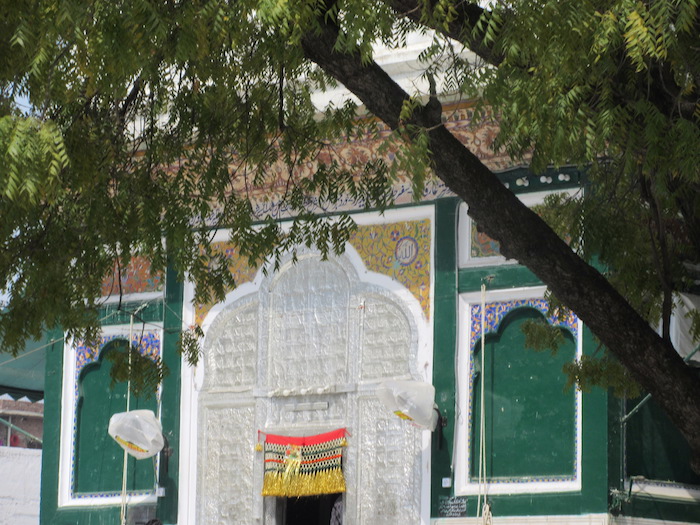
Mazar Mian Mir Lahore -Photo: Bhupinder Singh

Guru Arjan Dev Ji was born in 1563, as third and youngest child of Guru Ram Das. He was sent by his father, Guru Ram Das Ji to Lahore in 1579, to represent him at the wedding of his nephew Sihari Mall’s son. Arjan Dev Ji spent about 3 years there, as his instructions were to only return when called back. He was to set up congregations in and around Lahore, and preach there. Upon return back from Lahore after test by Guru Ram Das Ji, he was anointed as successor Guru on 16 September 1581. It was during his stay in Lahore that he came in contact with Hazrat Main Mir and two became very close. Mian Mir and Arjan Dev Ji were both very spiritually inclined and would engage in exchange of ideas. He believed in ‘Wahdat-Al-Wajood’ which means “The unity of All Existence” or “The Oneness of Being”. This principle was also preached by Guru Nanak Dev Ji and all the subsequent Gurus. So, we can see that there was alignment of the thought process as well. Guru Arjan Dev Ji said that there is God’s light in everyone – high or low, so we should not discriminate based on status, caste, or faith. Guru Ji expressed about this idea in these words:

ਸਗਲ ਬਨਸਪਤਿ ਮਹਿ ਬੈਸੰਤਰੁ ਸਗਲ ਦੂਧ ਮਹਿ ਘੀਆ ॥

ਊਚ ਨੀਚ ਮਹਿ ਜੋਤਿ ਸਮਾਣੀ ਘਟਿ ਘਟਿ ਮਾਧਉ ਜੀਆ ॥੧॥

ਸੰਤਹੁ ਘਟਿ ਘਟਿ ਰਹਿਆ ਸਮਾਹਿਓ ॥

ਪੂਰਨ ਪੂਰਿ ਰਹਿਓ ਸਰਬ ਮਹਿ ਜਲਿ ਥਲਿ ਰਮਈਆ ਆਹਿਓ ॥੧॥ ਰਹਾਉ ॥

ਗੁਣ ਨਿਧਾਨ ਨਾਨਕੁ ਜਸੁ ਗਾਵੈ ਸਤਿਗੁਰਿ ਭਰਮੁ ਚੁਕਾਇਓ ॥

ਸਰਬ ਨਿਵਾਸੀ ਸਦਾ ਅਲੇਪਾ ਸਭ ਮਹਿ ਰਹਿਆ ਸਮਾਇਓ ॥੨॥੧॥੨੯॥

“Sagal banasapat meh baisantar sagal dhoodh meh gheeaa. Uooch neech meh jot samaanee ghaT ghaT maadhau jeeaa. 1. Santahau ghaT ghaT rahiaa samaahio. Pooran poor rahio sarab meh jal thal ramieeaa aahi-o. 1. Rahaau. Gun nidhaan naanak jas gaavai satigur bharam chukaio. Sarab nivaasee sadhaa alepaa sabh meh rahiaa samaio. 2.1.29.” (SGGS, Pg. No. 617) 

Translation: (Just as) Fire is contained in all firewood, and butter is contained in all milk. (Same way) God’s Light is contained in the high and the low (caste); the Lord is in the hearts of all beings. 1. (Remember) O Saints, He is pervading and permeating in each and every heart. The Perfect God is completely permeating in everyone, everywhere; He is (even) pervading in the water and the land. 1. Pause. The True Guru has dispelled his doubt, (so) Nanak sings the Praises of the Lord, the treasure of excellence. The Lord is pervading everywhere, permeating in all, and yet, He is detached from all. 2.1.29.

When Guru Arjan Dev Ji was arrested on fabricated charges at the instigations of Meharban, son of Guru Ji’s oldest brother Prithi Chand, he was assigned to Chandu in Lahore. Emperor Jahangir was also informed that his son, who had rebelled against him, was given shelter by Guru Ji. According to Jahangir’s autobiography titled Tuzak-e-Jahangir, he records; “Many times it occurred to me to put a stop to this vain affair or to bring him into the assembly of the people of Islam.” So, on May 20, 1606 he passed an order to Murtaza Khan in Lahore that property of Guru Ji be confiscated and he should be killed in keeping with Islamic law of ‘Yasa’. The ‘Yasa’ law means that literally no drop of blood should drop on the floor, thus allowing for capital punishment. After passing the orders he left for Kashmir. Murtaza’s forces arrested Guru Ji from Amritsar.

Guru Ji was made to sit on red hot iron plate and burning sand was poured over his bare body. Next day, he was made to take a dip in a big cauldron of boiling water in peak summer. When Mian Mir heard about the atrocities inflicted, he rushed to the ghastly scene and cried out that “I cannot bear to see these horrors being inflicted on you.” He offered to demolish the tyrant rule and raze city of Lahore where such crimes were being perpetuated.” Guru Ji remained calm and said; “You are perturbed too soon. This is will of my Master (God), and I cheerfully submit and surrender to his sweet will.”

After Guru Arjan Dev Ji’s martyrdom, the sixth Guru Hargobind Ji (1595 – 1644) was incarcerated to Gwalior fort by Emperor Jahangir between the years 1617 and 1619 (2years and 3 months). Guru Ji was just twenty-two years old; at the time he was imprisonment. Mian Mir impressed upon Jahangir that earlier Guru Arjan was tortured to death by his cruel orders and now Guru Hargobind Ji has been wrongly imprisoned. Through the offices of Mian Mir and Wazir Khan, Governor of Punjab; Jahangir was convinced to release Guru Ji. Jahangir sent Wazir Khan to Gwalior to personally deliver the message of release. Guru Ji arrival in Amritsar upon release was celebrated as “Bandhi Chor Diwas”.

In Lahore, Qazi Rustam Khan of Mozang, had abducted a young girl named Kamala from her parents and was raising her as a slave, including giving her Islamic education. She was sent to Mian Mir for higher education. There she had learnt few verses of Gurbani and she used to recite those daily. During plague time in Lahore Guru Hargobind, came with his Sikhs to take care of patients with their own hands. She praised the work of Sikhs and the Guru in midst of her family setting. This incensed Rustam who called her infidel for praising Sikhs. Qazi Rustam in consultation with other Qazis issued an edict (Fatwa) for the execution of Kaulan (Punjabi word for Kamla). Rustam’s wife informed Mian Mir of the edict. Mian Mir suggested to her to seek protection of Guru Hargobind. Hearing the suggestion Kaulan sent a letter to Guru Ji who was nearby, still in Lahore. Guru Ji made immediate plans to rescue her from her living hell. He instructed the maid to let Kaulan Ji know that he would come near the house, but she must escape the house herself and wait for Him outside. Once she had left the house of her own free-will it was then be the Guru’s job to protect her always. As Guru Ji approached her house on his horse Mata Kaulan Ji was waiting. She had climbed out of the top window with the help of the maid servant. Guru Ji brought her back to Amritsar in 1626 and got her nursed back to health. Guru Ji had a separate accommodation built for her there. She used to spend all her time in meditation and study. Soon the devotion of the Guru’s new charge, earned the respect of the Guru’s Sikhs, who took to calling her Mata Kaulan. To immortalize the memory of Mata Kaulan’s resolve to remain firm on her words, the Guru constructed a pool named Kaulsar in 1627 A.D. Bibi Kaulan died at Kartarpur in 1630 A.D. There is Mozang Gurudwara in Lahore in her memory where she had spent time before her rescue to Amritsar.

Mian Mir breathed his last in his cell in Anarkali, Lahore in 1635 CE at the ripe age of 85. He was buried at place known as Hashimpur, Lahore which is now known as ‘Darbar Mian Mir’ in Lahore Cantt. Guru Hargobind visited Lahore and participated in his funeral rites. Sir Muhammad Iqbal in his book Asrar-e-Khudi said about Mian Mir; “His shrine is the wealth of faith for the soil of our city Lahore and a luminous torch of the light of right guidance for us.”

REFERENCES
  1. Singh, Patwant. The Golden Temple. Time Books International, New Delhi (1988)
  2. Aziz, Quddisa Sirruhul. Hadrat Mian Mir Qadri: Life and Teachings. Wabastgan Darbar-e-Aalya. Camp Darul-Ehsan, Samundri Road, Faisalabad
  3. Puri, J. R. & Shangari, T. R. The life of Bulleh Shah (talks about Mian Mir paying foundation stone of Harmandir Sahib). Academy of the Punjab in North America (Apna) website.
  4. Singh, Dharam. Guru Arjan Dev. Punjabi University, Patiala (2007)
  5. Singh, Satbir. Prathak Har (in Punjabi). New Book Co., Jalandhar, Eight Edition (2009)
  6. Singh, Inderjit ‘Kamikaze’. Guru Arjan Adorns the Throne. Sikh Foundation (2006)
  7. Sikh Religion. Sikh Missionary Center, Detroit (1990)
  8. https://goldentempleamritsar.org/famous-temples-in-india/amritsar/golden-temple/history.php
  9. https://whc.unesco.org/en/tentativelists/1858/


Bhupinder ‘Bo’ Singh, Houston. Born in Bhamo, Myanmar, he now lives in Houston, US, where he runs a manufacturing company formed with his son. A mechanical engineer by training, he has authored a number of books, including Connecting with the Master – A collection of essays on topics related to Sikhism (2006) and In Bully’s Eyes – An Illustrated Children’s book on Bullying (2019).

* This is the opinion of the writer and does not necessarily represent the views of Asia Samachar.

RELATED STORY:

Memorials erected, historical heritage erased (Asia Samachar, 18 Dec 2020)


ASIA SAMACHAR is an online newspaper for Sikhs / Punjabis in Southeast Asia and beyond. Facebook | WhatsApp +6017-335-1399 | Email: editor@asiasamachar.com | Twitter | Instagram | Obituary announcements, click here |