A cold wave swept Delhi on Sunday (Dec 20) with the city recording its coldest morning this season. The mercury hit 3.4 degrees Celsius but it failed to dampen the mood of the farmers’ gathering around a couple of Delhi entry points in their call for the government to retracts three controversial farm laws passed in September.
The Safdarjung Observatory, which provides representative data for the city, recorded a minimum of 3.4 degrees Celsius, five notches below the normal, on Sunday morning, an India Meteorological Department official said, reports The Tribune India. The maximum temperature is likely to settle around 22 degrees Celsius, the official said.
Some groups have reached out to the protesting farmers – who marched to Delhi in tractors, trolleys and other means of transportation and are sleeping in them – with insulated and waterproof tents. See here.
Panjab farmers at Singhu border, Delhi – Photo: BSB Photography
ASIA SAMACHAR is an online newspaper for Sikhs / Punjabis in Southeast Asia and beyond.Facebook | WhatsApp +6017-335-1399 | Email: editor@asiasamachar.com | Twitter | Instagram | Obituary announcements, click here |
“All Reality is-es 1. Presence. Creative Power. Without fear. Without hate. Changeless. Form of Perfection. Necessity. Self-powered. Grace.”
These words are often called the Mool Mantar as some Sikhs have used them as mantras or chants. They are considered Mool or ‘the root’ as they appear at the beginning of the scripture, the Guru Granth Sahib. They appear in full 33 times in the Guru Granth Sahib, the Sikh scripture, either in this full form and 569 times in the shorter form, “All Reality is-es 1Grace.”
It is for this reason that the religion named Sikhism by the British is also known as Gurmat or Way of the Guru, a way of grace. The original text was written joined up so that none would be able to add anything. The division of words is, therefore, an act of interpretation even before we try to understand the meaning of the words.
Full form: ikoankarsat nam kartapurakh nirbao nirvair akal murat ajuni saibhang gurprasad
Short form: ikoankarsat gurprasad
The full form is often the first prayer a Sikh learns. It is a song from the unstruck melody (anhad naad) playing in the heart of the universe. Affirming it (jap) we join in the choir of saints of many worlds for the thread of one reality strings the universe and multiverses.
‘All Reality is One’ is a cleaner read. However, it can be taken as a passive description of reality whereas what is being described is the active process of Being. Equally, the number ‘1’ is more accurate as the symbol used in the Guru Granth Sahib is the numeral ‘1’ rather than the word ‘One’.
Noting that “All Reality is-es One” has many implications. First of all, this world is not a dream world from which we should seek to escape. Cutting oneself off from worldly concerns like family life or politics to focus exclusively on spiritual matters is not recommended. Sikhi is a meeri-peeri system meaning that spiritual and worldly life are seen as two aspects of the same One Reality. This also affects the attitude towards science. One can accept that we are made of chemical-biological processes while asserting that these physical properties simultaneously have a mental aspect that makes it possible to speak of humans as ‘persons’ with selves. This is an idea of unity with dual properties, for example, meeri and peeri, or science and selves. It is not a substance dualism with Sikhs believing in an ‘otherworld’ up in space or a world of supernatural speculation that one calls ‘faith’. Moreover, this is not a world that is static, it is dynamic as the One is-es it. Finally, it reveals the purpose of life. It is to be real/authentic or “sachiara”, to connect to the One Reality (ikoankarsat). The question posed early on in the scripture is how to become “sachiara”. The answer is to follow the Will (hukam) that inscribes our being (likhia naal). In other words, follow our common sense to make good choices in response to the undeserved chances that the Universe in its love for us (grace/gurprasad) continually throws our way. There are no bad people, there are people who are out of tune with themselves and Life.
The idea of “Presence” means that for all its emphasis on One (Sikhi uses the numeral ‘1’ to emphasise 1ness), Sikhi is panentheistic rather than monotheistic. The world is not lacking or empty; rather the Presence is the center around which everything moves. The Presence is felt in the same common-sense way that we feel that our selves are real, that other humans are persons, or that the external world is real. That is to say that we cannot prove that the external world is real. For example, if we were in a dream or a computer simulation like ‘The Matrix’ our senses suggesting it is so could easily be manipulations by our own minds or artificial intelligence. The point is that such common sense beliefs are the frameworks by which we effortlessly have being in the world. We can question whether the world, the self or other selves exist but it has no meaning as our lives have to be based on the common sense that they do. The only purpose it serves is to reveal the limits of knowledge and demarcate the contours of common sense.
Common sense is referred to as ‘mat‘ while ‘man‘ refers to the mind, self or ego. The cauldron of the mind is stirred by the sword of intellect. Losing the barrier of ego allows the force of Grace to flow through this space at this time and raise the intellect. When the Word of common sense flows in this cauldron and the sword of intellect is stirred with skill, Amrit, the mead of immortality, is made. While we reject common sense the self-space is sealed off from the sense of the universe and our senseless self becomes a swamp, a painful trap for the living.
Knowledge is something we develop within the framework of common sense. It is not possible to have knowledge about the framework, in the sense of propositional knowledge but we may have experiential knowledge. People who have experienced something “know what they are talking about” and can recognise others who have shared experiences while others are speculating. Experiential knowledge of the Presence, whether as sunnya (zero, the void), or 1 is celebrated in the Guru Granth Sahib in which 36 non-Sikhs saints, including Muslims, Hindus and those who assert they have no religion have contributed, while priestly debate and speculation is disparaged, “each one thinks they are smarter than the other.” This is one interpretation of Guru Nanak’s statement that, “There is no Hindu, no Muslim.” This is natural religion, the same religion that began with “the first breath” as Guru Nanak says in the Siddha Gosht, his dialogue with Buddhist monks, the only inter-faith dialogue collected in a scripture. Awakening to the Presence within brings us to a richer, fuller, real and fulfilled life for the “divine light” lives in us as “fragrance within a flower, reflection in a mirror, fire inside wood.” The unity of mystical experience as the basis for a global society lies in contrast with the uniformity of religious belief promoted within countries or across the world.
The “Creative Power” at the heart of the universe suggests life, colour, music, difference. “Without fear” suggests completeness, “Without hate” suggests inclusion. We draw limits on ourselves, usually due to where society draws the limit on us. “Us” is usually set up against “them”. These key words in the Mool Mantar tell us that 1 and 0 are not binary oppositions. Rather they interchange in an endless play of Infinity.
Change. Essence. Necessity. These three things govern our world. If we change from baby to young man to middle aged to old man who are we really, are these stages ‘real’ or are the boundaries fluid? What is it that changes, what stays the same, what is our essence? Why must this happen? and, more intriguing, what is “must”? Why “must” anything? Surely randomness is more likely with all attempts to make sense of a random existence desperate projections of individual selves or collective agreements?
When one thing changes to another, it “dies”. Being Akaal or deathless, the Zero-One is changeless. Being Murat or Form, this is the Essential hub around which Everything creatively turns. This is the Necessity that grounds laws of science and our common sense being. It is perfect and is not “born” as something else; hence, outside the circle of birth. Being Perfect it is Self-Powered and non-needy.
However, it does have desire, indeed Love, for its Essential nature is Grace. The Way is Grace. The 1Force reaches out in love to everything. Those connected to it cultivate virtue as common sense. This is an ethic of love, for “only those who Love know the Lord.” The space of self, and this time now becomes the Presence filled Kingdom. The Khalsa or citizen Sikh is one owned directly by the Guru, Grace allowing Love to heal, open and uplift them. While the universal spirit owns and moves the Khalsa knight, they move the world in a spiritual revolution of social, person to person, relations, in a direction that is feminist, inclusive, rational, playful and respecting of the sovereignty of the individual’s experience of reality, the being of beings.
Ranvir Singh is a UK-based human rights activist and member of Akaal Purkh Ki Fauj. The article first appeared here.
ASIA SAMACHAR is an online newspaper for Sikhs / Punjabis in Southeast Asia and beyond.Facebook | WhatsApp +6017-335-1399 | Email: editor@asiasamachar.com | Twitter | Instagram | Obituary announcements, click here |
Jord Mela for 1st year Barsi on 27 December 2020 (Sunday), 10am to 11.30 am, at Gurdwara Sahib Sungai Besi (Shapha) Kuala Lumpur
| Entry: 19 Dec 2020 | Source: Family
ASIA SAMACHAR is an online newspaper for Sikhs / Punjabis in Southeast Asia and beyond.Facebook | WhatsApp +6017-335-1399 | Email: editor@asiasamachar.com | Twitter | Instagram | Obituary announcements, click here |
“After this I need a bath to cleanse (read: purify) myself.”
“You need to do one Japji Sahib path for what you have just said.”
“We accept unquestioningly any order coming from the Akal Takhat.”
“Baba Ji says so.”
You may have heard the above statements in casual conversations amongst Sikhs. Are they rooted in the teachings of the Sikh Gurus? Are they aligned to Sikh thinking?
Some of the remarks can be explained away without even invoking Sikhi. Plain and simple reasoning will get you the answer. But for some others, you may need to deep dive into Sikh teaching and Sikh history to get the answers. Talking about the Akal Takhat, for example, requires appreciation of Sikh philosophy and history. What was the intent of sixth guru, Guru Hargobind Sahib? When discussing chants and mantras, Gurbani should be the best guide as far as a Sikh is concerned.
But taking a cue from Gurbani is not so straight forward for most of us who are unable to decipher direct the Sikh scripture. Then there is the gap in our understanding of Sikh principles?
Worst still, what if our present understanding of Sikhi is jaundiced? A newly released book, ‘The Hijacking of Sikhi‘, suggests so. It claims that a good many of us have got it wrong when it comes to understanding the basic building blocks of the Sikh faith.
Now, that’s a mighty big claim to make.
In the very opening chapter, author Dr Karminder Singh writes: “Sikhi as it is practiced today, is no longer the Sikhi that was taught to us by our Gurus. It is a spirituality that stands distorted, corrupted and tainted. Its scripture – Gurbani – has been distorted through vedic and puranic slants in interpretations and translations; its history muddled in unbelievable tales or miracles called Sakhis; it’s general conduct dictated by an institutionalised clergy – a group that was soundly critiqued by our Gurus and excluded from Sikhi; and its religious practices consist primarily of those smuggled in from rejected and discarded rituals of pre-1469 faiths. It’s a faith that has been hijacked from its unique path and equally distinct goals.”
Distorted, corrupted and tainted? Practicing what the Guru actually discarded, all in the name of Sikhi? Now, those are pretty damning statements.
So, has the author got it right?
Karminder, a son of a granthi and a sharp mind who has just retired from the Malaysian civil service, admits that he had got it wrong before. He has written extensively on Sikhi since the 1980s. Ask him now and he will tell you to discard his earlier work. Burn them! He tells us why he no longer subscribes to his own writings of the earlier years.
This time, though, he may be onto something. The 17 chapters, running over 420 pages, stitches together his more recent writings, fortified further with argument as to what has gone wrong in transmitting Sikhi for so long now.
FIVE SIKHI BOOKS: The Hijacking of Sikhi (420 pages), Understanding Sidh Goshat (271), Understanding Anand (162), Understanding Asa Di Vaar (289), and, Understanding Nitnem: Jup, Sodar and Sohela. (308).
The books can be ordered online or self-collected from local distributors. Readers of Asia Samachar can go to the online store at www.sikhivicharforum.org for the details. To order, click here (Malaysia) and here (other countries).
To purchase in Malaysia, call Pritam Singh (+6016-2162474) or Jarnail Singh Arshi (+6016-6114397). Price: RM100 for the full set (minus delivery)
Karminder and I are both from Malaysia. And our paths have crossed each other since the late 1980s due to our involvements in Sikh activities. I have in the past disagreed with him on a number of things. Even today, there a few things that I would do differently.
But I highly recommend this, and four other books, that he penned and published recently. I say this as someone who has spent many hours with the author, as a student of his Gurmat classes some years ago, and a fellow seeker of the Sikhi path.
The books are a result of years of deep reflection and constant questioning of the what is the essence of Guru Nanak’s message.
SANTS GALORE
In the book, Karminder claims that the sant class is the ‘ultimate hijackers’ of Sikhi today. Now, doesn’t that puts us in a mud puddle. Every other Sikh seem to have a resident ‘baba’ or ‘sant’. Instead of being the guiding lights in our lives, the author suggests that they are bad company. The book provides us an opportunity to reassess that relationship. It will provide you a fresh perspective and allow you to step back and see how the ‘sant’ class came into the picture. Some will dismiss this exercise outright for their baba knows best. Others may quiver in sheer fear of the baba. “What if Baba ji says something harsh, je Baba ji kooi bachaan keh-de-vay,” they may mull.
But it is time we reevaluate the relationship and see if the ‘love affair’ with the sant and baba is Guru-inspired? On this, Karminder has outlined how the sant and the baba seeped deep into our psyche.
AKAL TAKHAT
During the Gurmat classes, it was never a one way street. Karminder would run the class, present slides that captured his hours of research and thinking. And some of the students would challenge the presentations, leading to a healthy exchange of views.
True to his style, Karminder does not mince his words, even in the footnotes! In one of them, at page 55, he refers to Gurbilas Patshahi 6 as an ‘ugly book’ and calls out Guriqbal Singh a ‘deviant’ preacher’. What is the purpose of that book (Gurbilas Patshahi 6)? Karminder suggests that its ‘primary contribution’ was to ‘create an institution called the Akal Takhat and make it available for control of the of the nirmalas. It would ‘serve as a tool of religious subjugation, as a headquarters for the clergy and doctrinal control through the issuing of edicts and ex-communication.’
For most Sikhs, we have taken for granted the existence of the Akal Takhat, usually regarded as the supreme Sikh authority. Most Sikhs would shudder to even question edicts that may come their way from the Amritsar-based body, let alone question its very existence. So, when Karminder writes these words on page 55, he is making a damning statement. So, it is?
He is raising some serious questions. To many, the author is a pain in the you-know-where bordering a rabble-rouser.
But let’s face it. Have we really examined the Sikhi concoction handed down to us? Have we stepped back and asked even some basic questions? Why are we doing this? What is the purpose of that? And who decided on them? You know, such queries.
If Akal Takhat is not what has been presented to us all this while, then there are a good many things that we have to relook. A good many things! They impact our lives.
‘The Hijacking of Sikhi‘ is no easy read. But it is an essential read for those who want to examine if they’ve got their Sikh understanding right.
Hb Singh is a Kuala Lumpur-based journalist with some experience in dealing with Sikh organisations, both from within and outside.
* This is the opinion of the writer, organisation or publication and does not necessarily represent the views of Asia Samachar.
ASIA SAMACHAR is an online newspaper for Sikhs / Punjabis in Southeast Asia and beyond.Facebook | WhatsApp +6017-335-1399 | Email: editor@asiasamachar.com | Twitter | Instagram | Obituary announcements, click here |
Farmers’ converge at the edge of Delhi -Photo: BSP Photography
Oponion by Rupi Kaur | WASHINGTON TIMES |
My people laugh at tyrants.
Punjabis today say, “When Alexander the Great attempted to invade, Punjab sent him packing. What’s a Modi to an Alexander the Great?”
For Sikhs, dissent against oppression is nothing new. We resisted the Mughals for 300 years. We birthed a global resistance against colonial British rule, including one that stretched from the fields of Northern California to the villages of Punjab, called the Ghadar Movement. My parents’ generation survived the 1984 Sikh genocide and the decade of state-sponsored violence and extrajudicial killings that followed.
Indian Prime Minister Narendra Modi now joins the long historical list of tyrants Punjab has taken on.
In September, Modi’s Bharatiya Janata Party (BJP) hastily passed three farm bills, with the stated intent of liberalizing the country’s agrarian sector. Farmers see these bills as a ploy to hand over the sector to Modi’s billionaire supporters, such as Mukesh Ambani and Gautam Adani. On Nov. 25, tens of thousands of Punjabi farmers and farmworkers began marching towards the country’s capital, New Delhi. As they peacefully crossed into neighboring Haryana, they were met with tear gas, water cannons, police batons and road barriers. Now, as winter sets in, not even a bitter, bone-chewing cold has stopped a million protesters from planting their feet at Delhi’s borders.
My aunt, like most members of my family in Punjab, is a small-scale farmer. More than half of India’s workforce is in farming, with 85 percent of farmers owning less than five acres. “They can try to take everything we have, they’ve tried before,” my aunt told us over the phone weeks ago; She had just returned from a protest in her village, “But our spirit will never extinguish.”
Punjab’s tradition of resilient defiance is on full display, and it is a sight to behold.
Protesters have traveled hundreds of miles by bicycle and tractor, many saying they’re prepared to stay for at least six months if they have to. The resistance is intersectional; Mazdoors, landless farm laborers, and members of the Dalit community who have long faced systemic caste-based discrimination are present. Women are leading the way. Farmers from neighboring states such as Haryana, Rajasthan and Madhya Pradesh have joined. Protesters from ages 7 to 90 rise from their makeshift beds as the morning cold continues to bite; some protesters are dying of the cold. Those marching are singing spiritual kirtan. Menstrual products are being freely distributed, and efforts to feed the poor in surrounding areas are currently underway.People gather to cut vegetables for langar (the Sikh practice of making and serving free meals). The community has set up blood donation clinics, gyms and book distributions. Through music and poetic verse, protesters call out the Modi government and India’s corporate billionaires.
This protest is beginning to look more and more like a revolution.
[Rupi Kaur is a poet and the author of “home body.” She lives in Toronto. Read the full article (Washington Times, 16 Dec 2020), here]
Women clearly present at farmers’ protest. A Sikh lady talking to her family at the back of a trolley at the Singhu border, Delhi – Photo: Akshay Kapoor
ASIA SAMACHAR is an online newspaper for Sikhs / Punjabis in Southeast Asia and beyond.Facebook | WhatsApp +6017-335-1399 | Email: editor@asiasamachar.com | Twitter | Instagram | Obituary announcements, click here |
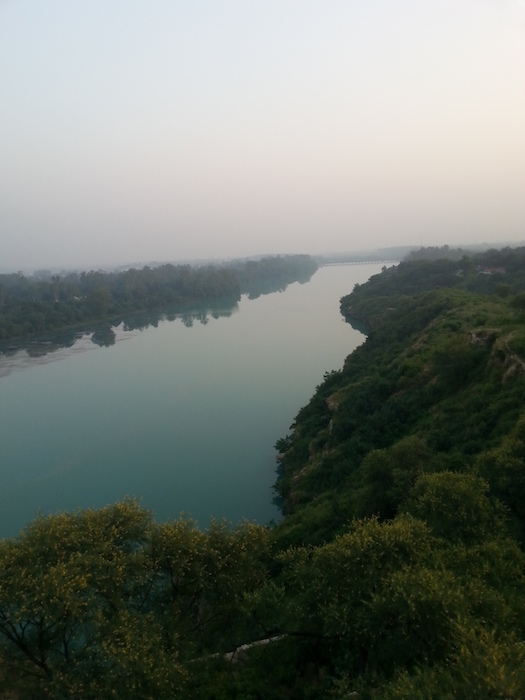
Vibhaur, located about 18Km from Anandpur Sahib – Photo: Bhupinder Singh
By Bhupinder ‘Bo’ Singh | OPINION |
Many a times while reading Gurbani, I wonder about the situation, circumstances and place the very words I am reading now were uttered by Guru Sahib. Even the search for historical evidence becomes futile as those evidences have not been preserved. Many of these historical locations have been left behind during partition; now have a limited functionality cum accessibility, as they are now “Evacuee Property” in Pakistan. But when I heard about the place where Guru Gobind Singh Ji composed the Bani of Chaupai Sahib, I always wanted to visit this place known as Vibhaur Sahib. I was blessed with the opportunity to visit the auspicious place on 25 October 2016. Guru Ji’s “Charan choh” made this place auspicious and his reciting the bani of Chaupai Sahib has immortalized it. Chaupai Sahib was composed by Guru Ji during his stay here about a year before Amrit Sanchar in 1699 CE.
This bani is truly significant as it is part of our daily prayer and also part of banis recited during preparation of Amrit. This bani is a supplication to Almighty, yet one can feel that Guru Ji is having heart to heart conversation with God. The words coming out of Guru Ji’s mouth are a word portrait of state of his mind. The title of the composition can be translated as:
Kabiyo = Poet
Bach = Words
Benti = Prayer
Chaupai = Four line verse (Quartet)
The poetic composition starts as a supplication that asks for blessings and protection from God. Then Guru Ji prays that may all my desires be fulfilled, and obtain God’s Love and Mediation. The heart’s desire is that my heart may be at your feet, and request nurture me as your own. Now, if we can visualize the natural environment and the surrounding ambience that spawned that state of mind. Fortunately for us we can go there and touch the rocks, hills, trees that have the privilege of being the environment that created this unique composition, a conversation with God. Additionally by going there we can also breathe that same fresh mountain air that gave birth to Chaupai Sahib. That place is Vibhaur, about 18 kilometers from Anandpur Sahib in Nangal, Punjab.
The natural beauty, the mountain air, the undulating hills and valleys makes one’s jaw drop in awe and wonder. The spell binding natural beauty calms the mind, sooths the nerves. Only one question kept popping in my head, where is the spot where Guru wrote this magnificent composition? Imagine the meditative pose of Guru Ji, the leaves quivering in the blowing cool breeze and with a pen in hand Guru Ji having the conversation with God. The curiosity and inquisitiveness to witness the serenity of the spot turned into disappointment, when I discovered that the special spot has been replaced with a marble edifice in the name of a befitting memorial. So, in the name of creation of a memorial the serenity, auspiciousness, natural beauty, historical marker has been destroyed only to be replaced with brick, concrete and marble structure.
The most Gurudwaras buildings are look-alike in terms of architectural concept, facade and appearance. While the efforts of organizations and individuals spearheading the efforts to build a fitting memorial in the midst of mountains are really appreciated, but it saddens my heart to say that we have robbed history, from our future generation. Whereas this visit could turn back the time machine taking us to experience the times of Guru Sahib, now has become a visit to another look alike Gurudwara, but with a historical association. The pain was deeply felt in the heart as to why are robbing ourselves of our own history? Just the thought of us robbing our own future generation brought the tears down my cheek. We cannot blame anybody else for the perpetual loss that we are creating in name of marble and gold edifice. We as a community have a collective failure in preserving and nurturing our history. We have failed our future generations. The piece of history that could inspire generations, fire the flames of faith has become just another Gurudwara building. Sometimes the structural integrity of the original may be in jeopardy or the structure may be in a severely dilapidated condition that the original cannot be salvaged. In such a situation an exact replica using suitable construction material of the original can be created, thus history preserved.
If we look at the deeds of Gurus we can see they not only preserved their own bani, but also compiled it in a fashion that it is preserved for posterity unaltered. Yet we as the followers of the Gurus cannot even preserve the spot where the history was created. Our Gurus were builders of cities, townships, communities, and we cannot even preserve the spots associated with our Gurus. Are we really followers of our Gurus? What a pathetic state? Our Gurus have uttered bani in different situations, different places and addressed varied issues/subjects. Yet, we hardly have any historical evidence of the place and the context in which the particular bani was uttered.
The saddest part is wherever we have a solid historical legacy of the place where the bani was uttered; we have erased it in the name of preservation. Our history is young only 550 years old, yet we have failed preserve it. We cannot claim that historical setting of single place has been preserved. Every place associated with a confirmed historical setting has been decimated and replaced with a Gurudwara building of marble and gold. It is undoubtedly a reflection of reverence, faith and desire to preserve the legacy. Yet when we visit these places, we feel the vacuum created by the loss of historical evidence and context. Most of these buildings have an architectural consistency, but these are lacking the touch of geographical landscape blending, and use of local construction material of the times to make them authentic. Today as we visit these historical places we will notice that the memorials are relatively a new construction and they do not project the historical relevance or let the history talk to us. The marble and gold structure is gagging the historical surroundings from speaking to us directly. The plants, trees, soil, rocks and the topography that witnessed the history have been erased to make room for memorial. The memorials may not be able to talk, yet they can convey a lot to the visitors and pilgrims, which has been deprived. As the experience that they absorbed then, if preserved would have talked to our hearts. That transfer of experience would have enriched our experience there, and would have nurtured our commitment and growth. Alas, we have inflicted enough damage upon ourselves in terms of lost historical legacy and destroyed relics which can’t be replaced.
It is truly a sad commentary on the psyche of the Sikhs, who have failed to preserve the history associated with their Gurus. We can start from the birth place of our first Guru in Nanakana Sahib, to the resting place of tenth Guru in Nanded and we cannot find any original historical buildings left. We can extend the sad story to include the legacy of four Sahibzades of Guru Gobind Singh.
If the others have tried to rob us of our legacy we could blame them, but when we have spearheaded, contributed towards the lost legacy, who should be blamed? We do not have anybody else to blame. It is time for us the wake up and change our psyche and approach on modernization and preservation of historical relics. Let us refrain from destroying the historical evidence and geographical flavor in the name of a befitting memorial. There is room for both to co-exist, where the preservation and modernization can complement each other. The befitting memorial is welcome addition but it should not be over the ruined historical evidence.
Moving forward we should change our approach and create a befitting memorial where the central piece and main attraction is historical evidence and relics. There are many museums around the world where the settings are modern yet the history has been preserved or recreated as an exact replica of the times. The flavor of the times has been recaptured for enriching our experience of the visit the place. We cannot enhance the beauty of the original structure by deploying modern architectural techniques, and in the process deprive ourselves of historical relevance. Let us make a change our approach and become preserver of history and not those who over saw the destruction of historical evidence.
Bhupinder ‘Bo’ Singh, Houston. Born in Bhamo, Myanmar, he now lives in Houston, US, where he runs a manufacturing company formed with his son. A mechanical engineer by training, he has authored a number of books, including Connecting with the Master – A collection of essays on topics related to Sikhism (2006) and In Bully’s Eyes – An Illustrated Children’s book on Bullying (2019).
* This is the opinion of the writer, organisation or publication and does not necessarily represent the views of Asia Samachar.
ASIA SAMACHAR is an online newspaper for Sikhs / Punjabis in Southeast Asia and beyond.Facebook | WhatsApp +6017-335-1399 | Email: editor@asiasamachar.com | Twitter | Instagram | Obituary announcements, click here |
Indian hockey team captain Manpreet Singh and Illi Najwa Saddique after their marriage in Jalandhar on 16 Dec 2020
By Asia Samachar Team | INDIA |
Indian hockey team captain Manpreet Singh and his Malaysian fiancée Illi Najwa Saddique got married in Punjab on Wednesday (Dec 16) after an eight year courtship.
Manpreet, 28, appeared at the Jalandhar gurdwara dressed in a Panjabi wedding suit and a red turban while Illi, 27, was in a gorgeous Panjabi bridal costume.
Their love story goes back to 2012 when Manpreet first met Illi during the Sultan of Johor Cup. He was the captain of the Indian side while Illi was amongst the spectators. The couple got engaged two years later on 26 February 2014.
Illi, hailing from a Pakistan Muslim family, has been a frequent visitor to Manpreet’s village in Mithapur in Punjab, India, since they began dating.
The 27-year-old Manpreet began his captaincy when he led the Indian side to Asia Cup gold, ending a 10-year old draught for the tournament.
ASIA SAMACHAR is an online newspaper for Sikhs / Punjabis in Southeast Asia and beyond.Facebook | WhatsApp +6017-335-1399 | Email: editor@asiasamachar.com | Twitter | Instagram | Obituary announcements, click here |
MONTEK SINGH AHLUWALIA: Indian economist – PHOTO / SINGAPORE FORUM 2015
By Asia Samachar Team | INDIA |
The Indian Government is ‘walking into a trap’ when it pushed forward agricultural reforms without consulting the farmers and at a time when the nation is battling the Covid-19 pandemic.
“It should have been better managed, politically,” former deputy chairman of the Planning Commission Montek Singh Ahluwalia told an Indian broadcast talkshow. “We need reforms. But like the 1991 reforms, get the farmers on board.”
Just as in 1991 when India undertook reforms, the economist said there was a similar need to generate consensus on agriculture marketing reforms as well as in agriculture.
“India’s agricultural productivity is half of what it is in nearby countries. The way we use water is ridiculous. We have lots and lots of problems – farmers not getting enough credit, etc, etc. So we need a complete revamping on agriculture, rethinking on agriculture, which would also have to include diversification [of crops],” he told The Print’s national affairs editor Jyoti Malhotra.
https://youtu.be/qB7RR_tCRUo
“We are producing more food grains that what we actually need. Food grain stock is two-and-a-half times what they call the norm.”
In a report prepared for Panjab state government for the medium term, Montek said they had suggested diversification and stop producing as much rice which was destroying the ecology.
“Panjab has to diversify. It cannot go on producing rice to the extent that it is doing because that is simply destroying the ecology of Panjab. Water being pulled out is huge.
“We had said that farmers had to be reassured that they will get a market. You can’t just do this by a diktat. We had told the Panjab government, why not do what Haryana is doing: pay Rp7,000 per acre to any Panjab farmer who wants to switch from rice to something else. Find ways of making them switch,” he said.
He added that the report had also suggested Panjab become the national seed capital for, say, potatoes and a few other things.
“Dairy is a major element for Panjab’s diversification. Panjab is the largest producer in India and it has the lowest portion of processed milk,” he said.
On corporations, one of the key concerns of the farmers’ protesting against three farm laws passed in September, Montek said: “You need to watch the corporates, and strengthen the hands of the farmer.”
Montek is author of Backstage: The Story behind India’s High Growth Years which was published last year.
ASIA SAMACHAR is an online newspaper for Sikhs / Punjabis in Southeast Asia and beyond.Facebook | WhatsApp +6017-335-1399 | Email: editor@asiasamachar.com | Twitter | Instagram | Obituary announcements, click here |
The death of a Nanaksar group leader on the sidelines of the on-going Indian farmers’ protest is far from an open-and-shut case.
Initially suspected to be a suicide by gun shot, the death yesterday (Dec 16) of Baba Ram Singh, known as the Nanaksar Singhra Karnal Wale, has raised a number of questions, including those concerning the supposed suicide note found by the body.
A solo-operated Panjab online television, which claimed that it had sources connected to the post mortem, has suggested that there may be more than what meets the eye on the incident.
In a report today, SinghNaad TV & Radio said it understood that there were delays in making the police report, and that the report was done in Panipat whereas the incident took place in Sonipat.
“From insider information that we have received, we understand that Baba’s close aides were not with him when the incident occurred,” reported anchor Prahbdeep Singh.
He also alleged that Ram had left one of the Nanaksar centres some months ago after one of his aides was hospitalised for suspected poisoning.
In an initial report yesterday, PTC News reported that the Sikh preacher was believed to have committed suicide at the Kundli Border incident, one of the Delhi spots where thousands of farmers from across India are converging to force the government to withdraw three controversial farm laws.
ASIA SAMACHAR is an online newspaper for Sikhs / Punjabis in Southeast Asia and beyond.Facebook | WhatsApp +6017-335-1399 | Email: editor@asiasamachar.com | Twitter | Instagram | Obituary announcements, click here |
A Sikh preacher is believed to have committed suicide today (Dec 16) at the Kundli Border, one of the Delhi spots where thousands of farmers from across India are converging to force the government to withdraw three controversial farm laws.
Baba Ram Singh, known as the Nanaksar Singhra Karnal Wale, had shot himself and left behind a suicide note, reports PTC News.
In the alleged suicide note, he had written that he was anguished with the state of the farmers, and noted that the federal government was paying no heed to the ongoing protest.
ASIA SAMACHAR is an online newspaper for Sikhs / Punjabis in Southeast Asia and beyond.Facebook | WhatsApp +6017-335-1399 | Email: editor@asiasamachar.com | Twitter | Instagram | Obituary announcements, click here |



























 Hb Singh is a Kuala Lumpur-based journalist with some experience in dealing with Sikh organisations, both from within and outside.