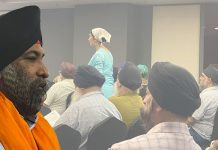
Harvindar Singh has been chairman of Budget Commentary and Tax Information since 2014. He is holding the edition for 2021
By Asia Samachar Team | MALAYSIA |
The lower house of the Malaysian Parliament yesterday (Dec 15) passed the Federal government’s proposed budget in a much watched event as the opposition parties attempted to derail the major legislation.
Away from the limelight, a Sikh tax expert had been labouring away with a large team to produce a definitive guide to the budget and tax details coming out of the budget proposals.
Harvindar Singh has been chairman of Budget Commentary and Tax Information – a booklet produced jointly by professional bodies together with the main accounting firms in Malaysia – since 2014. This latest booklet, a much sought after document in the industry, marks the seventh edition under his belt.
“This booklet is very popular and can be found on the table of every finance person in Malaysia. It is also used as a quick reference guide by the income tax officers and officers of other government agencies,” said Harvindar, the tax partner at Harvey & Associates and SCS Global Consulting Sdn Bhd.
The 387 page booklet is produced jointly by three professional bodies along with the main accounting firms in Malaysia. The bodies are Malaysian Institute of Accountants (MIA), Chartered Tax Institute Of Malaysia (CTIM) and Malaysian Institute of Certified Public Accountants (MICPA) .
Harvindar led a team of about 80 professionals from the various firms and professional bodies in the collaborative effort to publish the annual booklet.
“It is quite a heavy responsibility as every script that appears in the booklet requires my final review and approval,” he told Asia Samachar.
The booklet carries key tax updates and details of the proposed amendments as announced in the Malaysia’s 2021 federal budget and useful information on practically all aspects of Malaysian taxation.
“It truly is an honour to be given this role and I have tried to play my small part in the successful production of the booklets. I am grateful for the support given by the whole team from the various firms and professional bodies,” he said.
Harvindar, a Fellow of The Chartered Association of Certified Accountants, is a member of the MIA and Chartered Tax Institute of Malaysia.
He started his professional career as a tax consultant in PricewaterhouseCoopers (PwC) in 1994. In 2001, he moved to Ernst & Young (EY).
After a six year stint, he left in 2006 to set up his own firm Harvey & Associates dabbling in all areas of taxation, including cross border taxation, tax audits and investigations, tax advisory, seminars and appearing at the Special Commissioners of Income Tax for tax cases that were brought to the courts.
In 2009, he was invited to join as the tax partner in SCS Global Consulting (M) Sdn Bhd, a boutique firm that provides accounting, consulting and taxation services to Japanese clients. Over the years, it has grown to have a presence in 16 countries, mostly in Asia and also in the Netherlands, the US, and Australia.
“I am blessed to have great partners who I have worked with for more than 11 years and long may this partnership continue,” he said.
PASSION FOR KNOWLEDGE SHARING
While at PwC and EY, Harvindar was active in conducting in-house training, a trait he has held on until today. “I’m passionate about knowledge-sharing,” he said.
He noted that his involvement in the seminar and training route had forced him to ensure that he was always trying to be technically sound and up to date with the industry developments.
“This helps me keep abreast of developments in the tax field as well as reach out to taxpayers that might need my expertise,” he said.
Over the years, he has also served as a chief examiner for Chartered Tax Institute Of Malaysia (CTIM).
Harvindar was born in 1969 in Sentul, Kuala Lumpur. His father Chanan Singh retired as an engineer with national broadcaster Radio Television Malaysia (RTM) while his mother Gian Kaur was a housewife. Chanan had also volunteered for many years at the Selayang gurdwara.
In his spare time, Harvindar plays the harmonium, tabla and sings Sikh hymns.
ASIA SAMACHAR is an online newspaper for Sikhs / Punjabis in Southeast Asia and beyond.Facebook | WhatsApp +6017-335-1399 | Email: editor@asiasamachar.com | Twitter | Instagram | Obituary announcements, click here |
PATH DA BHOG: 26 Dec 2020 (Saturday), from 10am-12noon, at Wadda Gurdwara Sahib Ipoh | Malaysia
JAG SINGH A/L LATE SWARAN SINGH
(7.1.1941 – 16.12.2020)
Village: Makowal, Punjab
Wife: Kalwant Kaur a/p Late Puran Singh
Children: Sangeetajit Kaur, Kavitajit Kaur, Suniljit Singh, Surajpal Singh, Kim
Sons and daughters-in-law, grandchildren, beloved relatives , supportive neighbours & friends.
Path da Bhog: 26 Dec 2020 (Saturday), from 10am-12noon, at Wadda Gurdwara Sahib Ipoh
Contact:
Sunil +60 12 217 2504
Suraj +012-3021726
| Entry: 16 Dec 2020 | Source: Family
ASIA SAMACHAR is an online newspaper for Sikhs / Punjabis in Southeast Asia and beyond.Facebook | WhatsApp +6017-335-1399 | Email: editor@asiasamachar.com | Twitter | Instagram | Obituary announcements, click here |
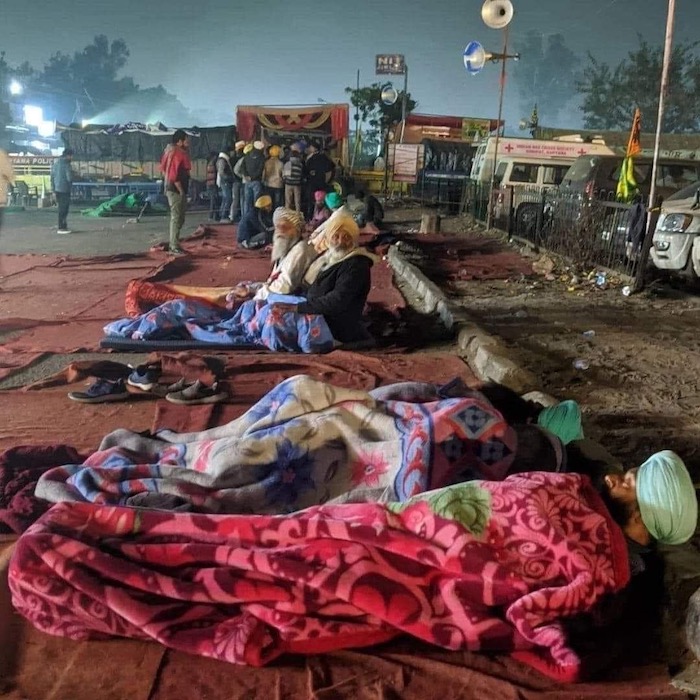
Bone chilling nights: The minimum or night time temperature in New Delhi dropped to 4.1 degrees Celsius on Tuesday (Dec 15), the lowest during the season this year, and a good five degrees lower than the normal temperature for this time of the year. The India Meteorological Department (IMD) has forecasted the mercury will fall further over the next three days, both during night and day – Photo: Amaan Singh Bali
By Aman Singh Bali | INDIA |
#FarmersProtest
LATEST UPDATES FROM THE PRESS CONFERENCE BY THE FARM UNIONS
1. 20th will be marked as Remembrance Day for all the farmers who have given their life during this 20day struggle. All the farmers will be remembered at district level by protesting farmers. 11am-2pm will be dedicated to shaheeds of morcha.
2. All India Kisan Sabha (AIKS) vice-president Inderjit Singh said that we will strengthen our agitation. We have already blocked Del-Jaipur highway and freed 150 toll plazas.
3. Unity of Punjab & Haryana irks centre because their entire politics is based on divide rule. They should come and see how BJP is treated in HR
4. Bharatiya Kisan Union (BKU) national secretary Yudhvir Singh said that we won’t let the sacrifice of farmers go in vain and they will be remembered in history as martyrs.
5. Government is trying to divide farmers by playing farmers against farmers. They bring their own MP’s & workers as farmers to give false impression.
6. Prime Minister Narendra Modi has not said a word about us, all he has managed to say is that we are misguided people. Do you think this is the way to resolve things? Union leader said that when we were at Jantar Mantar, PM was recording Mann ki Baat, there have been PM’s who walked to kisans.
7. Our demands are simple and we will had already sent them a demand charter since day one. If they still demand the reply on their rejected proposal we will send that.
8. Government is saying that they won’t take the law’s back and we maintain that until the laws are taken back we will not move an inch. They can use force if they want. We elected the wrong PM, he is servant not god. Bills are for us and we reject those.
9. The winter Parliament session is cancelled gives a clear indication of how rattled the government is at the moment.
10. Government calls us one thing or the other every new day, their agencies are free to investigate anything and they will go empty handed as well. Their tactics won’t work.
11. Their policemen might have had Covid-19 but no one on this side of the barricades has infection. All the people who died were not Covid+, we have post-mortem reports of all who died here.
Extracted from @amaanbali tweet at 9pm (Malaysia/Singapore), 7.30pm (India), 1pm London on Tuesday, 15 Dec 2020
ASIA SAMACHAR is an online newspaper for Sikhs / Punjabis in Southeast Asia and beyond.Facebook | WhatsApp +6017-335-1399 | Email: editor@asiasamachar.com | Twitter | Instagram | Obituary announcements, click here |
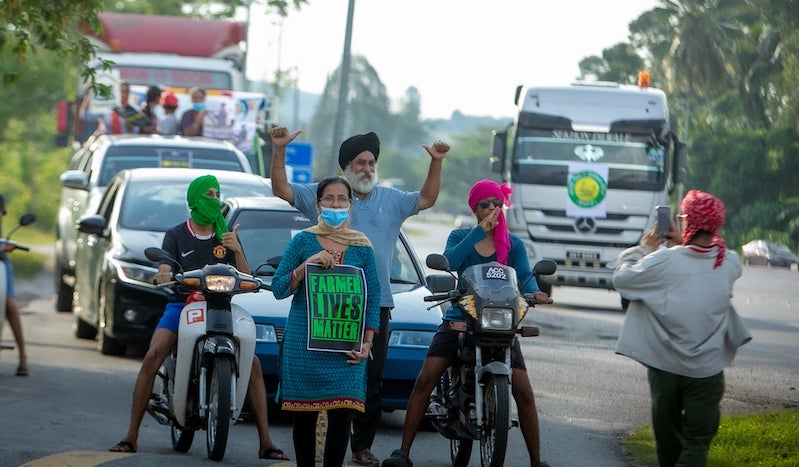
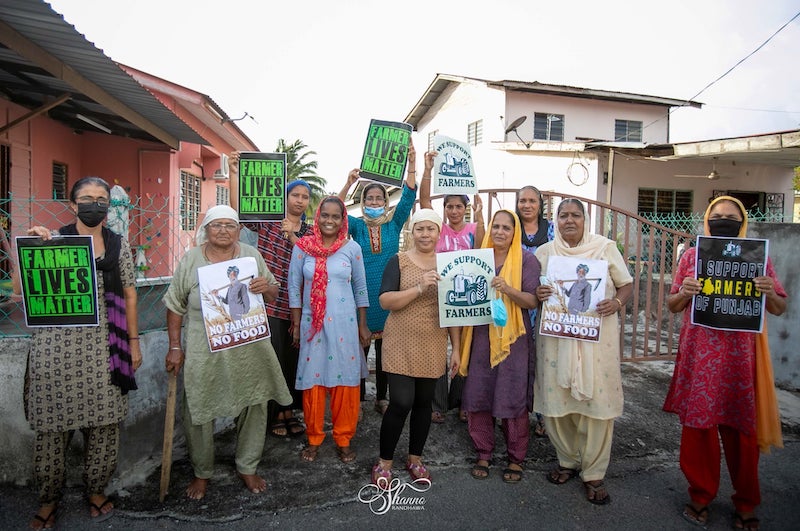
Tanjung Tualang Sikh Settlement show support to Indian farmers – Photo: Shanno Randhawa
Photos by Shanno Randhawa | MALAYSIA |
They may be more than 3,000 kilometers away, but a small Sikh community in a small town in Perak was eager to show their support for the farmers’ protesting against some farm laws in India.
Tanjung Tualang Sikh Settlement came alive a fortnight ago on Dec 6 when its Sikh residents gathered for their own morcha.
They held banners ‘Farmers Lives Matter’, ‘No Farmers No Food’ and ‘We Support Farmers’ as they rode on trucks, cars and motorbikes around the small town about 40km south of Ipoh.
Local photographer Shanno Randhawa captured the moments. Go to her Facebook page to see more of the action.
Tanjung Tualang Sikh Settlement show support to Indian farmers – Photo: Shanno Randhawa
ASIA SAMACHAR is an online newspaper for Sikhs / Punjabis in Southeast Asia and beyond.Facebook | WhatsApp +6017-335-1399 | Email: editor@asiasamachar.com | Twitter | Instagram | Obituary announcements, click here |
Singapore Sikh documentary ’The Saint Soldier’ made a splash at the Global Indian Film Festival when it picked up the Best Feature Documentary Award.
The documentary, directed by Upneet Kaur-Nagpal of Uptake Media and co-produced by Simranjit Singh, showcases the life of Singapore’s first Sikh Bhai Maharaj Singh.
The Sikhs in Singapore trace their origin to the ‘saint soldier’ from Punjab who was hailed as one of the most ‘wanted’ men during the 19th century Anglo-Sikh wars. He was exiled to Singapore as a state prisoner in 1850 after his infamous arrest by the British. More than 160 years since his death in Outram Prison, he is still widely remembered, and revered.
ASIA SAMACHAR is an online newspaper for Sikhs / Punjabis in Southeast Asia and beyond.Facebook | WhatsApp +6017-335-1399 | Email: editor@asiasamachar.com | Twitter | Instagram | Obituary announcements, click here |
Beloved relatives, supportive neighbours and friends.
Path Da Bhog: 20 December 2020 (Sunday), from 9.30 am to 12.00 pm, at GURDWARA SAHIB TANJUNG RAMBUTAN, PERAK
For enquiries please contact:
Karamjit Singh 016-5080221
Ajitpal Singh 016-6001366
| Entry: 15 Dec 2020 | Source: Family
ASIA SAMACHAR is an online newspaper for Sikhs / Punjabis in Southeast Asia and beyond.Facebook | WhatsApp +6017-335-1399 | Email: editor@asiasamachar.com | Twitter | Instagram | Obituary announcements, click here |
“A struggle whose greatness and potentiality is little realised is being carried on in the Indian province of the Punjab, between the Government and the property-holders on one side, and the insurgent peasants known as the Akali Sikhs on the other. This struggle is not a new one; it has been going on continuously, though less spectacularly, for many years. But of late it has broken out in such a form as to merit the august attention of the London Times and similar organs of Imperialism”.
One might be forgiven for thinking that the above observation refers to the current Panjabi Sikh famers agitation, but it is in fact from an article written by Evelyn Roy published by the Communist (18 Nov 1922). However, it has an uncanny resemblance to the current struggle and offers some insight into the Sikh Panjabi psyche and general abhorrence towards unjust imperial rule and private property and greed.
For weeks we have seen unpresented scenes of an estimated 1 million farmers, mostly from the Panjab, but also Haryana, UP and Rajasthan, laying siege on Delhi, the national capital of India. Their demand is simple, the withdrawal of the 3 Faming Ordinances that were passed by the BJP Government that in their opinion will lead to the corporate takeover of the farming sector and an end to their way of life.
In response, the government is claiming that the opposite will be the case and that the farmers have nothing to fear. They argue that the Panjab farmers refusing to change with the times, that they have simply misunderstood the policy, which is about reforming an old system that is not fit for the needs of a modern global industrial economy.
So who is right and what might be the imprecations for adopting the neoliberal corporate model favoured by the Modi Government, and what alternatives do the Panjabi farmers have?
INDIA’S PLANS FOR GROWTH
According to the World Bank, in 1987, the GDP of India was similar to that of China; in 2019, China’s GDP was almost 5 times greater than India’s and this rate of growth has established China as the 2nd largest economy in the world. Since coming to power in 2014 and then again with a landslide victory in 2019, the Narendra Modi BJP Government in India has clearly been troubled by the relative lack of economic development.
Whilst distancing himself from what he regards as an ’authoritarian’ Chinese system, Modi has sought to extoll what he sees are the democratic and anti-imperial virtues of India. In this context, he regularly argues India is not interested in emulating China and that his government has its own unique plan for economic development. Ironically, despite his boasts of upholding liberal democratic principles, many of his policies, such as the Citizen Amendment Act and the Jammu and Kashmir Reorganisation Act both passed in 2019 or the 3 farmers ordinances recently passed under the cover of COVID 19, paint a different picture.
Narendra Modi’s plan to turn India into an economic giant is largely built around a policy of economic liberalisation and large scale privatisation of public services and assets of the economy. Ironically, just as the neoliberal model seems to have reached its zenith, first with the collapse of the banks in 2008 and more recently, with the impact of COVID 19 and the massive intervention of states, Modi is forging ahead with his plan to open up India to corporate neoliberal capitalism.
Underpinning these policies is a deeper ideological imperative encapsulated in the Hindutva nationalist idea to promote a national identity, both cultural and economy. This is captured in a speech given by Narendra Modi during the India Republic Day speech on August 15, 2019. In the context of the revocation of the special status, or limited autonomy, granted under Article 370 of the Indian Constitution to Jammu and Kashmir, he talked about the necessity to build ‘One nation, One Constitution, One system’!
Whether one adopts a state capitalist approach taken by China, or a neoliberal US style model, economic success is intimately linked to rapid cultural transformation, of which perhaps the farming sector, especially small scale domestic farming, will be most impacted.
Despite the Green Revolution and associated technological advances in farming, both Panjab is still largely a rural state with over 65% of farms classed as small or semi-medium. In others words, small scale farming remains the backbone of the Panjabi economy and culture clearly any policy that threatens this will lead to an unprecedented existential threat for the farmers and other sectors, such labourers, middlemen, book-keepers, transporters, small shopkeepers and traders. Backing these claims, former World Bank chief and Indian economist, Kaushik Basu has been quoted as suggesting the new farm bills are flawed and they will end up serving corporate interests more than farmers. For Basu, the ordinances are ill thought out and are “a ‘good-looking’ step in a ‘bad direction’ and may lead to crony capitalism and eventual financial instability”.
Indian farmers’ press conference at Singhu border, Delhi
IMPACT OF INDUSTRIALISATION
One of the arguments being made by the Modi government is the need to accelerate India’s development and competitive edge in the global economy. Inevitably, tied to achieving efficiencies of scale as well as opening up new non-agricultural employment is the process of modernisation and industrialisation. This represents the process of change that leads to social, economic and cultural transformation from an agrarian society into an industrial society. Most significantly, this involves extensive re-organisation of work and the economy for the purpose of manufacturing and mass production, storage and distribution.
The first transformation from an agricultural to an industrial economy is known as the Industrial Revolution and took place from the mid-18th to early 19th century in certain areas in Europe and North America. This lead to huge changes in the social structure, the main one being a transition from farm work to factory related activities. Amongst other things, this had huge disruptive effects on peoples personal lives and prosperity. It distorted the family system as most people were compelled to move from villages and rural areas into the rapidly growing cities. The role of women shifted from essentially being home cares to employed workers, which also has an impact on reducing the number of children per household.
In the 1950’s the American Sociologist Talcott Parsons noted that in pre-industrial societies there existed extended family structures spanning many generations, who largely remained in the same geographical location; In industrialised context, because children reaching adulthood are more mobile and tend to relocate to where jobs exist, extended family bonds become more tenuous and social solidarity becomes weakened. It could be argued that such changes have been happening amongst Panjabis in the diaspora for decades.
RESISTANCE TO INDUSTRIALISATION AND CORPORATISM
Along with the move towards industrialisation and particularly capitalist imperialism, there has been resistance, which as at best resulted in revolution, stopping the changes and significant concessions or significant defeat of the resistance. Prof Pritam Singh from Oxford University has recently argued that there is a need to contextualise the current farmers’ revolt against agro-business capitalism whose interests are being articulated by the Modi regime, it is critical to understand the meaning of the idea of the ‘vanguard’. This is an idea that was coined by the Russian revolutionary leader Leninist who argued that in any revolutionary struggle, vanguardism is a strategy where leadership comes from class-conscious and politically advanced sections of the proletariat.
In every egalitarian movement, Singh argues, there is one section which is the most advanced and provides that leadership which articulates the interests, aspirations and even emotions of other revolting sections of society. Accordingly, In today’s India, the Punjabi and Haryanvi farmers represent the vanguard of the entire farming community in India and other sections of society associated directly or indirectly with farming (even the urban middle class consuming food produced by these farmers and farm workers).
Though the focus of the current movement is on the issue of farming, a noted at the outset of this article, a closer examination of Panjabi history reveals a deep rooted culture of resistance against imperialism and oppression, be it economic, cultural or physical. From the Punjabi Sufi poets such as Shah Hussain and Bulleh Shah, who spoke vehemently against religious clergy, Hindu and Muslim alike, to the folk hero Dullah Bhatti, who took up arms against the Mogul Emperor Akbar to protect the revenue from his land.
And of course, any discussion on Punjabi identity, as Prof Puran Singh notes, is empty without reference to the intervention of the Sikh Gurus. When Puran Singh wrote that ‘ann da swaad we naam da swaad hai’ (the pleasure that comes from eating grain is the same pleasure that comes with Naam) he was highlighting the fact that even daily eating of grain in Punjab is considered heavenly because as the tongue tastes it, our words and thoughts are divinely transformed. As well as cementing the relationship between the farmer, the land and the divine, Guru Nanak, by seeking to dissolve fixed religious identities, superstitious beliefs and caste oppression, commenced what has been termed the ‘Sikh revolution’.
This was a continuous revolution that was advanced by each of the 10 Gurus, culminating with Guru Gobind Singh led an armed revolt against murderous rule of emperor Aurangzeb, which led to the rise of Banda Singh Bahadur and the first Khalsa rule in 1709 and eventual destruction of the Mogul Empire. In terms of the present day Panjabi farmers struggle there is an intimate link to this period for it was Banda Singh Bahadur who abolished the Zamindari and Taluqdari system gave the peasant farmers proprietorship of their own land, the same land that their decedents are trying to defend from the corporates.
And of course, it this same revolutionary spirit that infused the Panjabi contribution to the struggle against British Imperialist during the first half of the 20th Century resulting in the massive dipropionate contribution in the independence movement and the immortalisation of figures such as, Kartar Singh Sarabha, Udham Singh and Bhagat Singh, who were all put to death for challenging British imperialism.
TURNING THE CURRENT SITUATION IN INDIA
By the end of the 20th century, East Asia (South Korea, Taiwan, Singapore, Japan, Hong King) had become one of the most recently industrialised regions of the world. And for the past 30 years we have seen the BRICS states (Brazil, Russia, India, China and South Africa) undergoing dramatic process of industrialisation.
The 3 farming ordinances passed by the BJP government represent a wider an attempt by Modi to emulate the success of China in its transformation from a rural peasant economy. The rural population of India is currently over 70%, though there has been a slow decline over the past 20 years. Contrast this to China, where today the majority of the people live in Urban settings, the rural population has declined from 52 to 40% in the past 10 years.
But there is one fundamental difference between India and China. Whereas modern India was envisaged as a nation of nations, where diversity in terms of ethnicity, religion and language was celebrated. In contrast, under the Han dynasty and later under Communism, a singular culture was forged through a policy of extreme homogenisation, which included mass killings, forced migrations, erasure off intellectual diversity, and monopolisation of history writing. The latest example is the case of over 1 million Uighur Muslims, who are currently being subjected to what the Chinese authorities euphemistically term ‘re-education’.
Indian authorities blocking highway with trailers – Photo: Sandeep / Punyaab twitter
SO, WHERE DOES PANJAB GO IN THIS CURRENT SCENARIO? A 10-POINT PLAN.
Whilst the political situation on the ground is unstable there is no doubt that there is no return to the status quo and we are looking at a completely transformed landscape when it comes both to the internal politics of Panjab and the relations between the centre and Panjab and indeed, other states of India. So what concrete steps can we take to ensure a future for Panjab? Below I offer a 10 point strategy as a basis for encourage some progressive solutions towards a non-violent revolution.
1) We need to recognise that Modi’s plan for economic development and industrialisation is fundamentally linked to Hinduva, that is a project to construct a new pan Indian national and cultural identity, will result in the erasure of regional culture and identity on an unprecedented scale.
2) Given that there is strong evidence of the collusion of two establishment political parties, the Akali Dal and Congress, with Modi’s Hindutva corporate capitalist model, there needs to be a new united progressive political force in Panjab that is able to represent and articulate the spirit and aspirations of the Panjabi farmers as demonstrated on the ground.
3) In rejecting this move, we cannot simply argue for the status quo. In some senses the current moveably the Modi Government was the final straw that broke the camel’s back, and removing the 3 ordinances can but provide temporary relief. What we need is an alternative model rooted in the natural and cultural capital of Panjab, its people, its land and its natural resources.
4) Though the detail of an alternative approach to the centralising Hinduva Nationalist policy of will need to be decided by the citizens of Panjab, here are some suggestions for the underpinning principles, which are based on the deep philosophical traditions of our Guru’s, Suffi’s and Bhagat’s, such as:
‘Kirat Karni’ – Valuing and encouraging Honest labour – intellectual and manual. Minimal wage, ethical employment practices etc.
‘Wand Shakna’ – controls on wealth accumulation through progressive taxation and universal public services and education.
‘Namm Japan’ – Stimulation of the mind. Education system that nurtures holistic world view.
‘Pani pita’ – Clean and reliable water supply – massive investments in recycling and sewerage treatment.
‘Mata Dharat’ – Massive move towards organic farming, indigenous farming, diversification of crops.
5) Along with these overarching philosophical principles, I suggest we need to radically change the crops that are grown to give Panjabi farmers greater economic returns whilst maintaining the fertility of the land. Since India is now self-sufficient in terms of wheat and rice, two of the most common crops in Panjab, farmers could be move away from feeding mass market to niche market on an international scale. Take for example the turmeric (curcumin) market, which in the US has gone from 40 million dollars to 100 million dollars in the last 8 years and worldwide from 2.7 billion dollars to 5 billion dollars today.
6) We should seek to massively expanded is the service sector and tourism. Panjab has plenty of sun, a rich historical and cultural legacy, and it is the gateway to states like Jammu & Kashmir and Himachal Pradesh for tourist destinations. However, despite these assets the state has not been successful in attracting visitors from other parts of the country or abroad.
7) One of the factors that has suffocated development of Panjab is the proximity to the Pakistan border on the West and the natural barrier of the Himalayan mountains to North and East. Work towards opening up the Panjab Pakistan border as well as opening up routes through and beyond Kashmir in to Central Asia and China, could have transformative effects on confidence, peace, investment, tourism and trade.
8) Because of modern technology, small scale faming in its present form simply is not economically viable and maintain the status quo is no solution. Because of its location and the green revolution, Panjab has come late to the process of industrialisation. But the lack of heavy industrialisation of Panjab provides an opportunity not to repeat the mistakes of the industrialised west and the attendant cultural and environmental devastation.
9) We need to recognise that the ‘green-revolution’ has been an ecological disaster for Panjab and we need to learn the lessons. In doing so there is a need to develop a new economic model – eco-cooperative model. Panjab can be an experiment of a state that has given directly from a rural economy to a green high-tech economy.
10) There is a need to establish a Green Panjab Investment Bank that can provide funds for social enterprises and also farmers co-ops. The Panjabi diaspora can help massively – they have invested in the past in property and land and they will invest in the future, but they must have confidence in integrity of systems, processes and governance.
A FINAL THOUGHT!
Where the current crisis might end up is anybody’s guess, but there are signs that both sides are digging in for the long run. Unless PM Modi commits the mistake of launching some kind of violent repression, in which case we may well see the break-up of India, then some kind of short term deal, where each side claims victory, is the most likely scenario. However, as the history of Panjab and the Sikhs shows, most imperial rulers have lived to regret picking a fight with a people for whom death is desirable to a life of bondage and slavery. Ironically, in his haste to get the 3 ordinances through under the cover of COVID 19, and having secured the patronage of much of the mainstream political class of Panjab, including both the Akali Dal and Congress, he may just have awoken a sleeping lion that, if history is to be believed, may just end up destroying him his Hinduva Neoliberal project.
[Gurnam Singh is an academic activist dedicated to human rights, liberty, equality, social and environmental justice. He is an Associate Professor of Sociology at University of Warwick, UK. He can be contacted at Gurnam.singh.1@warwick.ac.uk]
* This is the opinion of the writer and does not necessarily represent the views of Asia Samachar.
ASIA SAMACHAR is an online newspaper for Sikhs / Punjabis in Southeast Asia and beyond.Facebook | WhatsApp +6017-335-1399 | Email: editor@asiasamachar.com | Twitter | Instagram | Obituary announcements, click here |
Hemkunt Foundation volunteers provide water-proof tents to farmers protesting at Singhu border, Delhi – Photo: Hemkunt Foundation
More insulated and waterproof tents are constantly being added throughout the night as well which can now accommodate 225 people
It’s almost midnight with the temperature being 12C and our team is constantly adding tents to the tent city we have set up at Singhu Border for the farmers. – Text/Photo: Hemkunt Foundation via Twitter @Hemkunt_Fdn
ASIA SAMACHAR is an online newspaper for Sikhs / Punjabis in Southeast Asia and beyond.Facebook | WhatsApp +6017-335-1399 | Email: editor@asiasamachar.com | Twitter | Instagram | Obituary announcements, click here |
SINGU BORDER, DELHI: I wasn’t there for too long but this was legit the loudest and probably the only loud person I came across. He was scolding someone for not having his own washing soap. Maybe I was at the wrong protest. – Text/Photo: Taranveer Singh
By AmaanBali | OPINION |
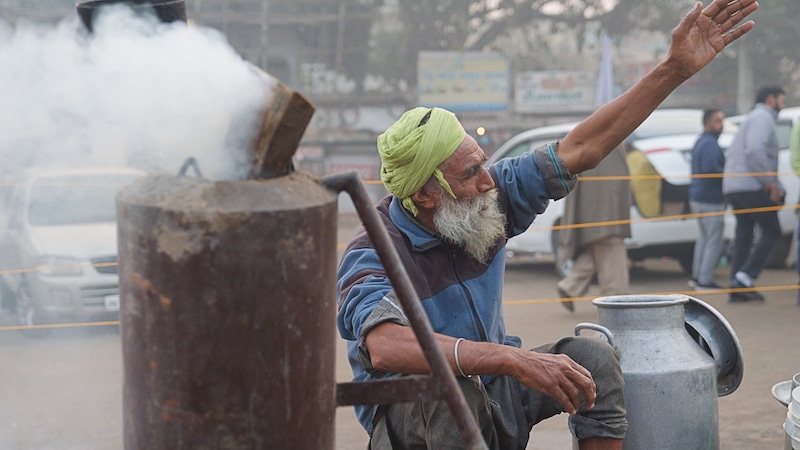
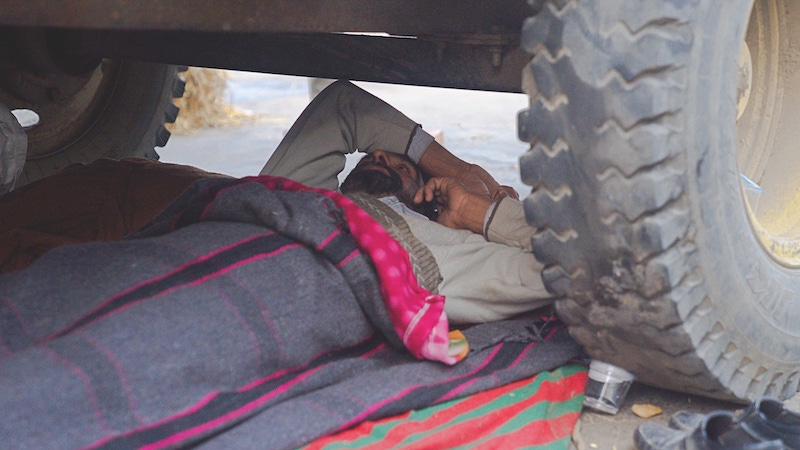
The Farmers in India are protesting against the three farm laws and two ordinances on the borders of Delhi. The protests started back in July when ordinances were brought on 6th June. The media has not only failed to acknowledge and accept that there were any protests since last five months but has also gone into a vicious campaign to discredit and malign the protesting farmers.
Why is media playing the State’s Agent.
This needs to be looked into from a very broad context and not the left-right rhetoric that is prevalent in India. The entire role of media can be understood and summed up as Denial-Malign-Discredit-Prove them wrong. Here is an important discussion to understand the propagandas that media has been parroting all around the clock.
The farmers protests has entered day 17 today and mainstream media continues to attack the farmers in one way or the other. We take a look at some of the vicious lies and propaganda that even the state affiliated media has propagated in these 17 days.
1. THEY ARE KHALISTANIS AND NOT FARMERS.
This is an important tool in india to discredit any movement by attaching it with a symbol and then beating that symbol all day along. The news channels including Zee, India Tv, Republic and many others in local languages interpreted that the farmers movement is those of Khalistanis because of posters of Sant Jarnail Singh Bhindranwale in the protests. It is important to understand here that the spread of protests is immense and it is literally like a shopping mall where you can go and buy any story you like. If you are fishing for Khalistan story you will get it, if you are fishing for Congress story you will get it. The media in this case decided to choose what they wanted to focus on. There were Bhindranwale posters in the protests and no one is apologetic about it, it’s not what the movement is and it is not even the point or talking. But what media ignores is the tall glaring posers of Bhagat Singh, Rajguru, Sukhdev or Shaheed Udham Singh. This explains that there is certain motive behind the coverage that state sponsored media carries on. This vicious campaign was given impetus by some infamous journalists like Barkha Dutt by putting words into Deep Sidhu’s mouth and wanting him to condemn a dead man after 36 years. The question is who benefits from beating the dead horse after 36 years? Why isn’t Barkha so vocal about asking for justice for 1984 victims if she is so interested in the gone era and has no agenda?
LEFT, KHALISTANI GROUPS FUELLING FARMER PROTESTS TO DERAIL ECONOMY: INTELLIGENCE SOURCES
Amid the ongoing ‘Dilli Chalo’ protests against the Centre’s agriculture reform laws, top intelligence sources said left-wing groups were attempting to derail the economy by fuelling the agitation.
They said Left and Khalistani groups were behind “systematic attack on political leadership” in India and abroad. They added that Khalistani groups had the support of Pakistan’s ISI towards a “social media narrative”.
The sources said there were thousands of fake profiles of Sikhs with their IP address pointed to Lahore and Karachi, and added that protesters did not “understand” the farm laws and were “fed with wrong information”.
They added the farmers should be “considerate” towards the industries suffering because of the protests, and that farm laws in any case would “not be repealed”. Source: News18.com (13 Dec 2020)
2. THEY ARE CONGRESS PEOPLE AND NOT FARMERS
This campaign was concurrent with the Khalistan one and only the thinkers of campaign can explain how can people be congressmen and Khalistanis at the same time. This was given air on lot of news channels on prime time with their lackeys parroting it out about how congress was behind these protests. For those who are not aware this is again a very important mechanism deployed in India to discredit any dissent by labelling it as congress sponsored. Narendra Modi’s government has a huge mandate of people and as such congress has struggled to keep its power very strong. It has struggled to keep its key areas intact even in the small elections of democracy. This has been interpreted by many thinkers as demise of congress. So any dissent in the country if associated with congress is considered as a move by congress to keep itself alive or revive itself against the popular mandate. Most people won’t even look at dissent news if it is congress organised. But here is the catch, not only have the farm unions managed to keep congress out of the protests but they have been very vocal about keeping all parties out of protests as well. In order to understand the protests against the congress and SAD read this
3. THIS IS SHAHEEN BAGH PART 2
Shaheen Bagh protests were against the CAA and NRC. Farm unions have maintained it from day one that they have nothing to do with anything but farm laws. Whatever their personal thinking or opinion is about CAA, they have been vocal about keeping protests about Farm laws only. Old videos of Sikhs protesting against CAA were dug by media aided by BJP’s IT cell that works in complicity with government and its handles are followed by the likes of Prime minister himself. These videos were used to give an impression to gullible audience that these protests are like Shaheen Bagh ones and that the bigger motive is CAA and NRC. A lot of hardwork was done by BJP IT cell followed by likes of PM and Amit Shah in Creating polarisation by singling out muslims in the Farmers protests. Facebook profiles of Muslim men were profiled and linked to farmers protests. Aim? Discredit and sabotage the protests
Photo: Taranveer Singh
4. THESE ARE RICH FARMER PROTESTS
It is very important to understand that media failed in all its campaigns to malign the protesting farmers because intel agencies gave statements that there is no link of Farmers protests with anti India elements. A new vicious campaign was started to divide the farmers into rich and poor. The select videos of farmers in SUV and cars were shown in loop with parroting and surprise that farmers can’t be rich. This however leads us to an entire different argument on why People in Indian cities don’t know anything about Punjab and Haryana. The state procurement data and MSP is cited along with monoculture of paddy and wheat by pseudo experts. Some of them even talk about tax free schemes and subsidies and make it appear as some sort of favour to the farmer. Interestingly no one questioned that why can’t Punjab model he applied in Bihar if it’s making people rich? Bihar on the other hand has shown how badly it affects the farmers if Mandis stop to exist.
5. NOT ALL FARMERS
This is the latest in the line after all the propaganda failed. Not that they have stopped with the other propagandas but this one is parroted by the self acclaimed experts on Tv and all the BJP ministers. The talks between government and Farm union leaders failed for the 5th time or let’s say remained inconclusive leading to frustration of Government and it’s agents. The proposal sent by government after Amit Shah’s meeting with Farm unions was rejected and agitation has been intensified. The government has taken its turn to go full guns blazing with narrative that bills benefit most farmers and that it is select few farmers from Punjab and Haryana who are protesting. In the press conference by Piyush Goyal and Narendra Tomar where they explained the government’s proposal, they were very vocal about how only Punjab is protesting. This narrative has been built in recent few days to create a sentiment that bills are good. To further this, some groups of Haryana that are politically motivated have given memorandum to Agriculture minister in support of bills. This new tactic of putting farmer against farmer is going on all day on Tv news and all of government’s sympathisers on social media. The narrative however has no basis because the movement is supported by 500 unions from across the nation. Those trying to make it Punjab only movement have either not studied the movement or have their agendas.
It might be surprising to many people reading this but this is how dissent is curbed in India. It is painted in one way or other and then the public support behind it falls leading to fall of the movements. It is however unfortunate that media that is supposed to play its role as an unbiased pillar is playing in the laps of government.
Born and raised in Kashmir, AmaanBali is working on an upcoming book ‘Growing up on the right side of Kashmir History’. The article first appeared at his blog.
ASIA SAMACHAR is an online newspaper for Sikhs / Punjabis in Southeast Asia and beyond.Facebook | WhatsApp +6017-335-1399 | Email: editor@asiasamachar.com | Twitter | Instagram | Obituary announcements, click here |
Senior civil servant Harjeet Singh has been promoted to deputy secretary general (finance) at Malaysia’s health ministry.
Prior to this, he was the director general of Public Complaints Bureau in the Prime Minister’s Department since March 2016.
Harjeet, 57, joined the Malaysian civil service in August 1989 as an assistant secretary of the Selangor state economic planning unit.
He previously served as deputy sec-gen at two ministries between August 2001 and June 2016. They were the Ministry of Energy, Green Technology and Water and Ministry of Women, Family and Community Development (MWFCD).
Harjeet was born in Kota Bharu, Kelantan. His father Hardev Singh retired as a police sargeant while his mother Shavinder Kaur was a housewife.
He is married to Amreeta Kaur who is a director at the Petaling Jaya City Council. They have two girls and one boy.
ASIA SAMACHAR is an online newspaper for Sikhs / Punjabis in Southeast Asia and beyond.Facebook | WhatsApp +6017-335-1399 | Email: editor@asiasamachar.com | Twitter | Instagram | Obituary announcements, click here |