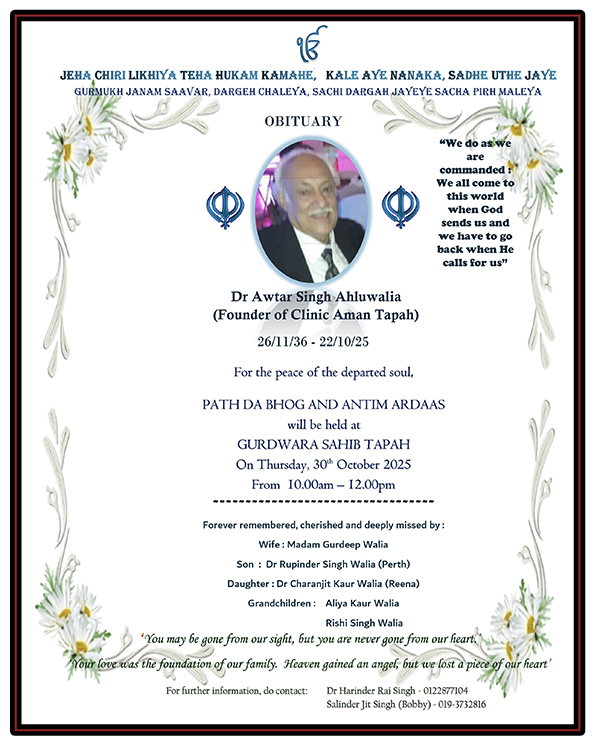
| Entry: 22 Oct 2025; Updated 25 Oct 2025 | Source: Family
ASIA SAMACHAR is an online newspaper for Sikhs / Punjabis in Southeast Asia and beyond. You can leave your comments at our website, Facebook, Twitter, and Instagram. We will delete comments we deem offensive or potentially libelous. You can reach us via WhatsApp +6017-335-1399 or email: asia.samachar@gmail.com. For obituary announcements, click here
One of the great gifts that distinguishes humans from all other living organisms is our capacity to think about time and space. We have evolved the remarkable ability to conceptualise temporal realms, that is to look beyond the immediate moment and wonder about beginnings, endings, and eternity. Our astonishing brain allows us to contemplate the profound question: Where did we come from?
From the earliest humans, whose awe is still etched in cave paintings and ancient monuments such as the pyramids of Egypt, our gaze has turned instinctively to the heavens in search of an answer to this fundamental existential question. As the cosmologist Carl Sagan once observed, “Exploration is in our nature. We began as wanderers, and we are wanderers still… We have lingered long enough on the shores of the cosmic ocean. We are ready at last to set sail for the stars.”
This single question of origin and destiny cuts across the boundaries of science, philosophy, literature, art, and religion. From poetry to physics, from scripture to space science, the human quest for meaning is constant and compelling.
The Scientific Pursuit of the “First Cause”
Science, through patient observation and the rigour of reason, has given us extraordinary insights into our origins. The theory of evolution, for instance, explains how life diversified from simple forms into the vast complexity we see today. There is every reason to believe that the theory of evolution, not only governs the emergence of complex life forms on Earth, but across the entire universe.
If Darwinian evolutionary theory offers a compelling explanation for the origins of life on Earth and perhaps beyond, then modern cosmology, has without serious detraction confirmed the universe’s expansion from a super-dense state nearly 13.8 billion years ago to the expanding universe we see today. There is no dispute that science has given an accurate measurable starting point for the beginning of the universe in time.
Yet, when it comes to the ultimate beginning, the very moment of creation, science encounters a profound limit. The question, “What was before the beginning?” or rather “What caused the Big Bang?” takes us to the edge of known physics, where our most reliable laws begin to collapse.
At this frontier, scientists wrestle with what is known as the singularity or a point of infinite density where space and time as we understand them cease to exist. Theories such as Loop Quantum Cosmology (LQC) suggest that the Big Bang may not have been a beginning at all, but rather a “Big Bounce” or a rebirth from a prior, contracting universe.
Stephen Hawking went further, proposing that if one traces time backwards, it gradually transforms into space, much like how travelling south eventually leads to the South Pole, beyond which there is no further “south.” In this model, the universe has no boundary in time; it simply is!
In essence, currently science points toward a self-contained, cyclical, or boundary-less cosmos, one where time itself may lose meaning. It is here that Sikh philosophy offers a remarkably complimentary perspective.
Sikhi and the First Cause
If modern cosmology removes the need for a temporal beginning, Sikhi transcends the very concept of temporality itself. The Sikh understanding of creation begins not with time, but with Timelessness.
In Sikh thought, God is referred to as Akaal Purakh (ਅਕਾਲ ਪੁਰਖ). The name itself holds the key: Akaal (ਅਕਾਲ) means “beyond time” (A- meaning “without,” and Kaal meaning “time”) and Purakh (ਪੁਰਖ) means “Being” or “Pervading Spirit.” Thus, Akaal Purakh (ਅਕਾਲ ਪੁਰਖ) is the Timeless Being, the Eternal Reality that exists beyond the reach of time and space.
Creation, as we ordinarily understand it, is a process bound by time. Every act of making, from a star forming to a house being built, requires a sequence: a before, a during, and an after. Scientific explanations, whether of the Big Bang or of evolution, all describe processes unfolding within the dimension of time.
But if a Being exists outside time, that is, if It is Akaal (ਅਕਾਲ) , then the notions of “before,” “after,” or “beginning” simply do not apply. By defining God as Akaal Purakh (ਅਕਾਲ ਪੁਰਖ), Sikhi does not describe a deity that appeared first in time, but rather the Source from which time itself arises. God is not one more object within the cosmos; God is the timeless foundation upon which the cosmos, incorporating everything the existed before time, duting time and beyond time. As Guru Nanak proclaims ਆਦਿ ਸਚੁ ਜੁਗਾਦਿ ਸਚੁ॥ ਹੈ ਭੀ ਸਚੁ ਨਾਨਕ ਹੋਸੀ ਭੀ ਸਚੁ॥੧॥ True in the beginning, True throughout the ages, True here and now, O Nanak, forever and ever True.
The Self-Existent Reality
The opening verse of the Guru Granth Sahib (ਗੁਰੂ ਗ੍ਰੰਥ ਸਾਹਿਬ), known as the Mool Mantar (ਮੂਲ ਮੰਤਰ), describes the nature of this Divine Reality:
Ik ōaṅkār sat nām kartā purakh nirbhau nirvair akāl mūrat ajūnī saibhaṅ gur prasād.
Here, Saibhang (ਸੈਭੰ) means self-existent, self-created or self-illuminated. Guru Nanak makes it clear that the Divine does not require a creator, for the Divine is the ground of all existence.
When we ask “Who created God?” we are applying temporal logic, that is the logic of beginnings and endings, to a Being that exists beyond time. In doing so, we impose a limitation that the very definition of Akaal (ਅਕਾਲ) transcends.
Akaal Purakh (ਅਕਾਲ ਪੁਰਖ), then, is the ultimate philosophical and metaphysical stopping point. It is the end of the infinite regress of causes. The Divine is not an event within creation but the timeless essence behind it. God did not come from somewhere or sometime, but simply is, eternally and boundlessly.
Conclusion: Two Languages of Wonder
Science and Sikhi, though speaking different languages, are united in their reverence for mystery and truth. Science seeks to describe how the universe came to be; Sikhi contemplates why it exists at all.
Where science reaches the boundary of time, Sikhi points beyond time itself. One looks outward, tracing the universe’s expansion; the other looks inward, toward the Eternal Presence that pervades all.
In the end, both paths are expressions of the same human impulse, to understand our place in the grand design. Whether through observing the Cosmos through a telescope or meditation and contemplation, we continue the same ancient journey: the quest to know what it means to be part of this vast, wondrous, and timeless cosmos.
Gurnam Singh is an academic activist dedicated to human rights, liberty, equality, social and environmental justice. He is an Associate Professor of Sociology at University of Warwick, UK. He can be contacted at Gurnam.singh.1@warwick.ac.uk
* This is the opinion of the writer and does not necessarily represent the views of Asia Samachar.
ASIA SAMACHAR is an online newspaper for Sikhs / Punjabis in Southeast Asia and beyond. You can leave your comments at our website, Facebook, Twitter, and Instagram. We will delete comments we deem offensive or potentially libelous. You can reach us via WhatsApp +6017-335-1399 or email: asia.samachar@gmail.com. For obituary announcements, click here
Delhi fireworks for Diwali – Photo: Amarjeet Kumar Singh Facebook
Thick smog blanketed India’s capital on Tuesday (Oct 21), the morning after Diwali celebrations filled the night sky with fireworks, pushing air pollution in New Delhi to hazardous levels.
Despite restrictions, revelers across the city set off firecrackers late into Monday night, adding clouds of smoke and fine particulate matter to the already polluted air. The mix of post-festivity emissions, seasonal crop-burning haze, and stagnant weather conditions trapped pollutants close to the ground.
By early Tuesday, the city’s Air Quality Index (AQI) had surged past 350 in several neighborhoods—categorised as “severe” and dangerous to breathe. Health experts warned that exposure at such levels far exceeds the World Health Organization’s daily recommended limit and poses serious respiratory risks, especially for children and the elderly.
Toxic air in India’s capital hit more than 56 times the UN health limit early Tuesday, after fireworks for the Hindu festival of Diwali worsened air pollution, reports AFP.
The Supreme Court, the nation’s top court. last week eased a blanket ban on firecrackers in New Delhi during Diwali, allowing limited use of “green firecrackers” that emit fewer pollutants. Developed by federal research institutes, they are designed to cut particulate and gas emissions by about 30 per cent. The court had said they could be used during specific hours from Saturday to Tuesday, but like past years the rule was mostly flouted.
Diwali lights go up at the India Gate for Diwali 2025 – Photo: Deshbhakt24 Facebook
New Delhi and its metropolitan region – home to more than 30 million people – routinely ranks among the world’s most polluted cities during the winter months when widespread Diwali fireworks coincide with cooler weather and smoke from crop residue fires set by farmers in nearby states, reported AP.
Delhi now has the dubious honour of being the world’s most polluted capital or capital territory for six consecutive years, according to the annual World Air Quality Report by Swiss air quality monitoring firm IQAir, reported CNA.
In November, the city’s Air Quality Index (AQI) soared to 795, almost eight times the threshold value of 100, when air quality becomes unhealthy. In some areas, the AQI even reached 1,185.
ASIA SAMACHAR is an online newspaper for Sikhs / Punjabis in Southeast Asia and beyond. You can leave your comments at our website, Facebook, Twitter, and Instagram. We will delete comments we deem offensive or potentially libelous. You can reach us via WhatsApp +6017-335-1399 or email: asia.samachar@gmail.com. For obituary announcements, click here
PLEASE JOIN US FOR THE FUNERAL SERVICE Forest Lawn Memorial Park, Sydney, Australia Thursday, 23 October 2025 Time: 3pm
FOLLOWED BY SEHAJ PAATH DA BHOG Gurdwara Mata Sahib Kaur Ji 23, Lincoln Street Minto, Sydney, Australia Monday, 27 October 2025 Time: 7pm Followed by Guru Ka Langar
ASIA SAMACHAR is an online newspaper for Sikhs / Punjabis in Southeast Asia and beyond. You can leave your comments at our website, Facebook, Twitter, and Instagram. We will delete comments we deem offensive or potentially libelous. You can reach us via WhatsApp +6017-335-1399 or email: asia.samachar@gmail.com. For obituary announcements, click here
ASIA SAMACHAR is an online newspaper for Sikhs / Punjabis in Southeast Asia and beyond. You can leave your comments at our website, Facebook, Twitter, and Instagram. We will delete comments we deem offensive or potentially libelous. You can reach us via WhatsApp +6017-335-1399 or email: asia.samachar@gmail.com. For obituary announcements, click here
Murukku and Achu Murukku are must-have for Deepavali gatherings. Murukku is a savory, crunchy, and spiral-shaped snack originating from the Indian subcontinent. – Photo: Asia Samachar
By Dr. Charanjit Kaur | Opinion |
Sikhs are a double minority in most parts of the diaspora, including Malaysia. As an ethnic and religious minority, Sikhs face unique challenges shaped by the social and policy environment of their host countries. Interestingly, in Malaysia, the government has long recognized Sikhs as a distinct and respected community, never conflating their faith with other Indian sub-ethnic groups. This recognition is also reflected in national school textbooks, which portray Sikh identity clearly and respectfully without generalizing them under the broader Indian category.
As an academic and interfaith speaker, I recently felt prompted to share a few thoughts following an article published on 20 October 2025 by the New Straits Times, titled “Anwar, Wife Visit Gobind’s Home for Deepavali”. The article generated many public comments, some expressing genuine confusion over when Sikhs began celebrating Deepavali. Yet, I was heartened to see that many Malaysians especially non-Indians recognized Sikhs as a distinct faith community and sought sincere clarification.
This essay therefore aims to address the matter in the spirit of understanding and dialogue, not division. It should be noted that many thoughtful articles have already explored the relationship between Sikhs and Diwali. Yet, the reception and interpretation of these writings remain subjective, often influenced by readers’ comfort levels or preexisting beliefs. What I find most intriguing, however, is that much of the confusion arises not from non-Sikhs but from Sikhs themselves, both in Malaysia and globally.
Many justify their participation in Diwali celebrations by referring to Bandi Chhor Divas, which commemorates the release of Guru Hargobind Sahib Ji, the sixth Sikh Guru from imprisonment. While this historical moment holds emotional resonance, most stop at this surface connection without examining its spiritual, historical or logical foundations.Several Sikh thinkers around the world have already explored these dimensions in detail; therefore, my intention here is not to repeat their work. Instead, I wish to explain the issue in a non-academic and accessible manner so that non-Sikh readers can also understand the distinctions between the major Indian festivals observed in Malaysia.
The Sikh View of Light: From Ritual to Revelation
Sikhs are known as a textual community, grounded in the Guru Granth Sahib, a sacred scripture of 1,430 pages, revered as the Living Guru and the enduring guide for spiritual insight and ethical living. The Guru Granth Sahib is not a record of rituals but a universal revelation of spiritual truth. Its teachings form the exclusive foundation of Sikh philosophy and practice. Yet, despite this textual centrality, many Sikhs today are not well-versed in reading or interpreting the Guru Granth Sahib. Many approach the scripture at a surface level, focusing on literal words and assuming that the presence of a term in the text equates to divine endorsement of the act or idea it describes. This literalism has given rise to multiple misconceptions about concepts such as rebirth, karma, patriarchal systems, heaven and hell and nuanced ideas like maya, mukti, naam, hukam, egoand simran.
Likewise, the mere mention of Diwali in Sikh literature is sometimes taken as a sign of divine approval even though the verse in question carries a metaphoric message not a ritual instruction. This misunderstanding arises mainly from Bhai Gurdas Ji’s Vaar 19, Pauri 6, where Diwali is mentioned. Many preachers have chosen to interpret and perform this verse as an endorsement of Diwali observance particularly the lighting of lamps as if it were an authentic Sikh tradition. However, this interpretation overlooks the interpretive methodology intrinsic to Sikh scripture.
The verses of the Guru Granth Sahib are highly sophisticated in poetic and philosophical form, often referencing the social and cultural practices of their time merely as illustrative tools. The true message (the spiritual essence) resides in the Rahao line, which conveys the heart of the Shabad. In the case of Bhai Gurdas Ji’s Vaars, where the Rahao is absent, the essence is revealed in the concluding line of the verse. Readers familiar with poetry and classical literature will recognize that such structures demand careful reading for their meaning unfolds not in literal expression but in layered metaphor and symbolism.
Diwali Dee Rat Deevay Baleean. Tarey Jaat Snaat Ambar Bhaleean. Fullan Dee Bagaat, Chun Chun Chaleean. Teerath Jatee Jaat Nain Nihalean hir Har Chandauree Jhaat Vasae Uchaleean Gurmukh Sukh Fal Dat Shabad Smaleean. [6]
The lamps of the night of Diwali eventually burn out. The stars of the night sky stop sparkling when dawn comes. The beauty of the orchard disappears as the flowers are picked. The gaiety of the place of pilgrimage dies when the crowds leave. Life even as bestowed by God is temporary; settled and then destructed. Yet, the Gurmukh is blessed with the fruit of permanent joy through his Immersion in the Shabad.
Far from glorifying Diwali, Bhai Gurdas Ji uses these images to highlight impermanence, the temporary nature of worldly lights, pleasures and gatherings. The deeper message lies in the final line: true joy and light are found not in candles or festivities but in the Shabad, the Divine Word that awakens the soul. While our Hindu and Jain friends celebrate Diwali as the triumph of light over darkness, good over evil and knowledge over ignorance, the Sikh path redirects the focus inward from external illumination to inner enlightenment. The Gurmukh, one who lives by the Guru’s guidance, experiences enduring bliss not through rituals or possessions but through profound connection with the Divine. The joy that flows from immersion in Shabad is eternal unlike the flickering lamps of Diwali night, the fading stars or the temporary celebrations of festivals and pilgrimages.
All fired up: Massive fireworks display at Harmandir Sahib, Amritsar, in conjunction with Diwali in 2025 – Photo: Videograb
This single poetic reference out of more than 5,871 verses hardly establishes Diwali as a Sikh festival. To assume that every word mentioned in the scripture implies a prescriptive practice is both simplistic and spiritually limiting. By that logic, one would also be obliged to adopt practices like sati, purdah, maya or attachment; all of which appear in the text but only as critiques of human delusion not endorsements. In short, Sikh scripture uses cultural metaphors of its time to convey timeless truths; to read them literally is to miss their essence.
Bandee Chor Divas: Selective Memory
Another source of confusion arises from the historical incident known as Bandee Chor Divas, literally translated as ‘the Day of Prisoners’ Release’. It commemorates Guru Hargobind Sahib Ji’s release from Gwalior Fort, where he secured freedom not only for himself but for 52 other kings. The event beautifully symbolizes freedom, compassion and justice, virtues deeply embedded in Sikh teaching.
Yet, two reflections are worth considering.
First, why does the community emphasize this particular episode while seldom remembering similar moments of liberation by other Gurus such as Guru Harkrishan Ji’s release or Guru Nanak Sahib Ji’s freedom from Babur’s prison more than a century earlier? Furthermore, if liberation is the central theme, why is the focus restricted only to a single episode of physical release rather than on the broader spiritual liberation and the victories of truth and justice that the Gurus embodied throughout their lives? Such selective reverence invites reflection on whether our devotion today aligns with the original spirit of Gurmat or has become shaped by cultural repetition.
Second, there is a tendency to overlook the logical inconsistency in how the date of Bandee Chor Divas changes every year. Unlike fixed Sikh commemorations such as Nanakshahi New Year (14 March) or Vaisakhi (14 April), this occasion shifts annually; for example 4 Nov 2021, 24 Oct 2022, 12 Nov 2023, 31 Oct 2024, and 20 Oct 2025. Some may explain this variation by citing the traditional lunar calendar but if we adhere strictly to historical accuracy, Guru Hargobind Sahib Ji’s arrival in Amritsar actually occurred on 12 February. This raises an honest question: Why continue linking this commemoration to Diwali’s lunar date rather than to its historically recorded day?
Such inquiries are not meant to dismiss devotion but to deepen understanding. Critical reflection, the courage to think, to ask and to seek alignment between faith and fact appears increasingly rare within our community. Too often, we accept inherited narratives without contemplation or study. The dialogue surrounding the meanings of Gurbani remains confined to a few scholars and spiritually curious individuals while the wider audience tends to embrace practice over principle. To return to the essence of Sikh spirituality, we must revive this culture of critical inquiry grounded in humility where faith and intellect walk together and reverence does not silence reflection.
Diwali in Malaysian Sikh Homes
Over time, the boundaries between cultural belonging and spiritual conviction have become increasingly blurred within the Sikh diaspora. Living among larger South Asian communities, Sikhs often find themselves participating in festivals such as Diwali, Holi or Raksha Bandhan, not always out of theological belief but out of social courtesy, nostalgia or cultural pressure. In many contexts, these acts are expressions of harmony and community rather than worship. Yet, when repeated uncritically, they risk reshaping the very spiritual identity that Guru Nanak envisioned as distinct from ritualism and caste-based religiosity.
This phenomenon can be understood as a form of cultural imitation where symbols of belonging override the pursuit of spiritual clarity. The intention may be good to maintain social cohesion or avoid conflict but the outcome is subtle assimilation into the very ritual culture that Sikh thought originally sought to transcend. Guru Nanak’s revolution was not merely religious but epistemological, it redefined how human beings relate to the Divine: through inner realization, ethical living and remembrance of Naam, not through ritual repetition.
Deepavali decoration at Suria KLCC, the mall at the base of the Petronas Twin Towers, in 2023 – Photo: Asia Samachar
The Sikh experience as a minority in Malaysia is not as fraught as it once was in Punjab, where movements like the Singh Sabha had to assert their distinct identity through the declaration “Hum Hindu Nahin” (We are not Hindus). In Malaysia, earlier generations of Sikhs especially during the post-independence years possessed a clear understanding of the Guru Granth Sahiband lived their daily lives according to Sikh teachings. Consequently, Sikhs in those decades did not celebrate Diwali (or Deepavali), recognizing it as a Hindu festival unrelated to Sikhi. In fact, during the 1984 attacks on Sikhs in India, the Malaysian Sikh community took a principled and courageous stance to reinforce Sikh identity. Their collective efforts contributed to the Malaysian government’s formal recognition of Sikhi as a separate religious entity, the growing prominence of Vaisakhi as the primary Sikh celebration and a conscious refusal to celebrate Diwali as a religious occasion.
Over time, however, as Sikhs became more integrated into Malaysia’s multicultural fabric, social adaptation began to influence community practices. By the 1980s and 1990s, many Sikhs observed Diwali more as a social or community gathering than as a spiritual or religious observance. Families would visit the gurdwara in the morning and later host open houses for friends and neighbors. Vaisakhi, at that point, was still perceived primarily as a religious function, while Diwali being a national public holiday for Indians naturally became an opportunity for social connection and goodwill. In this sense, Diwali for some Sikhs became an expression not of devotion but of social harmony, a gesture of friendship rather than faith. This is not unique to Malaysia: many Sikhs in Western societies similarly participate in Christmas, Thanksgiving or New Year celebrations, not as religious rituals but as acts of social belonging.
In Malaysian homes, Diwali is often marked by the preparation of Punjabi sweets such as methiyan, sekarparay, and pakorianalong with local delicacies like murukku and ghee balls shared warmly with neighbors of all faiths. In turn, Sikhs receive festive foods during Hari Raya or Chinese New Year. Yet, over the years, some of these gatherings have begun to incorporate elements inconsistent with Sikh discipline including alcohol consumption, blurring the boundary between cultural courtesy and spiritual compromise.
So, is celebrating Diwali inherently ‘wrong’?
Not exactly. Sharing food, fostering friendship and welcoming neighbors are not objectionable. What is critical, however, is clarity of intent and an accurate understanding of Sikh identity. Sikhs may participate socially without endorsing it as a religious practice provided they represent their faith truthfully. Moreover, such open-house hospitality need not be confined to cultural calendars; it can be expressed at any time, reinforcing community bonds without compromising spiritual integrity.
Personally, I have spent over two years educating my social circles about this distinction. I always appreciate Deepavali greetings but I also respond with gentle clarification, for example: “Thank you for your kind wishes. I truly appreciate them. However, as Sikhs, we don’t celebrate Deepavali or Diwali — our main celebration is on April 14 each year, known as Vaisakhi Day. Enjoy the holidays!” The impact has been heartening. Today, my non-Sikh friends no longer send Diwali wishes, instead, they message me every April with “Khalsa Day” greetings. In fact, my interfaith colleagues understand this distinction better than many Sikhs themselves. This, I believe, is the power of sharing accurate information respectfully; not to divide but to enlighten.
Reclaiming the Light Within
Under the subtle influence of Brahmanical ritual culture and Bollywood popularization, many Sikhs today find themselves participating in festivals such as Lohri, Maghi, Rakhi, Shraad, Sangrand, Maasiya, Puranmashi, Karva Chauth, Dussehra, Diwali and Holi, often justifying them as cultural expressions. Yet this trend gently distances the community from its foundational spiritual identity: one grounded not in external rituals or seasonal festivities but in the lived experience of the Shabad Guru, the Light that never fades.
In conclusion, attempts to reinterpret Diwali within Sikh philosophy or to incorporate it into gurdwara practices often stem from good intentions but risk confusing cultural adaptation with spiritual authenticity. The Guru’s message does not condemn others’ traditionsbut it calls Sikhs to remain grounded in their own. True light, for a Sikh is not the flicker of a lamp but the illumination of consciousness that arises from the Shabad Guru. The real celebration is not bound to a date or ritual but to a living awareness of truth, humility and compassion. In Malaysia’s multicultural society, the best way to honor both Sikh faith and national harmony is simple: to live and share our beliefs with clarity, respect and kindness by letting our light shine not through lamps or fireworks but through truthful living, selfless service and remembrance of the One Light that shines in all.
(Check the comments for the article at Asia Samachar Facebook and Instagram)
Associate Professor Dr. Charanjit Kaur is an expert in cultural anthropology, with a special focus on the Sikh minority community in Malaysia. Her work explores themes such as religious-cultural conflict, gender identity, and social behavior.
ASIA SAMACHAR is an online newspaper for Sikhs / Punjabis in Southeast Asia and beyond. You can leave your comments at our website, Facebook, Twitter, and Instagram. We will delete comments we deem offensive or potentially libelous. You can reach us via WhatsApp +6017-335-1399 or email: asia.samachar@gmail.com. For obituary announcements, click here
Following recent elections, the sewa of Sri Guru Singh Sabha, Southall, has been taken over by another management team. At such times, we need to remind ourselves of the Gurmat-based purpose of Gurdwaras. It is clearly stated under the heading of ਗੁਰਦੁਆਰੇ (Gurudoaray) in the Sikh Rehet Maryada, researched and collated on the basis of Gurmat tradition by Gursikh scholars of the time.
To quote one example: According to Reht Maryada (1998, page 15), only one thing should be done at one time: Kirtan’s – holy singing, Katha – preaching, or Gurbani recitation. At one and the same time two different things cannot be carried out. Another provision is that no book should be installed like and at par with the Guru Granth.
The institution of the Gurdwara has a long history and tradition going back to Guru Nanak Dev Ji at Kartarpur Sahib. A Gurdwara should provide and promote non-discriminatory sangat-pangat spiritual environment of Naam meditation. There is no distinction in the Gurdwara of ooch-neech, high and low.
The institution of the Langar is an essential part of Gurmat teaching. It teaches equality, sharing and sewa. It is a visible manifestation of human equality where all share the same food at the same level. After much debate, chairs, essentially for those in need, tables where one can stand and, of course, the traditional pangat on the floor, have become accepted practice.
The Gurdwara is a Sikhi learning centre managed by committees, selected or elected, by Sangats. However, appointment of committees should not change the basic Sikhi principle that a Gurdwara belongs to the Guru and the Sangat. In this respect, there is no reason why, after selection or the less preferrable voting and election procedure, all should not be invited to serve in supporting or co-opted roles with the new committee. As a Sikh community as well as a Miri-Piri Panthic centre, the Gurdwara today needs multiple skills. Every Sikh has the Guru-given right to do sewa in various and wide-ranging capacities.
Having lived close to Sri Guru Singh Sabha, Southall, for over 60 years, I recognise many well-qualified sewadars in the outgoing committee. The Sangat has a right to do sewa to complement the skills available to the next management team. The need is for Sikhi humility in all concerned. No one wins or loses elections to do sewa in a Gurdwara.
In addition to Gurmat-based guidance regarding procedure in a Gurdwara given in the Sikh Reht Maryada, which should be constantly referred to, later supporting publications by authors and organisations take account of more recent developments, including legal requirements and facilities which should be provided for those in physical need*. Above all, the original Sikhi egalitarian principles and spirituality should take priority.
In this context, I am less certain about a Langar hall divided into special food catering areas designated for guests at Anand Karaj and langar food for Sangat. It is for Sangats to consider if this practice of Langar hall division into special and Sangat areas seen in recent times, is in line with Gurmat practice. Multiple Akhand Paatths in the Darbar hall too can be re-considered in the light of Gurmat.
Admittedly, such special arrangements attract more revenue for the Gurwara but Gurmat practice should be the main theme. Ultimately, profit and loss considerations are in the hands of the Guru and the Sangat.
Gurmukh Singh OBE, a retired UK senior civil servant, chairs the Advisory Board of The Sikh Missionary Society UK. Email: sewauk2005@yahoo.co.uk. Click here for more details on the author.The article first appeared at Panjab Times, UK
* This is the opinion of the writer, organisation or publication and does not necessarily represent the views of Asia Samachar.
ASIA SAMACHAR is an online newspaper for Sikhs / Punjabis in Southeast Asia and beyond. You can leave your comments at our website, Facebook, Twitter, and Instagram. We will delete comments we deem offensive or potentially libelous. You can reach us via WhatsApp +6017-335-1399 or email: asia.samachar@gmail.com.
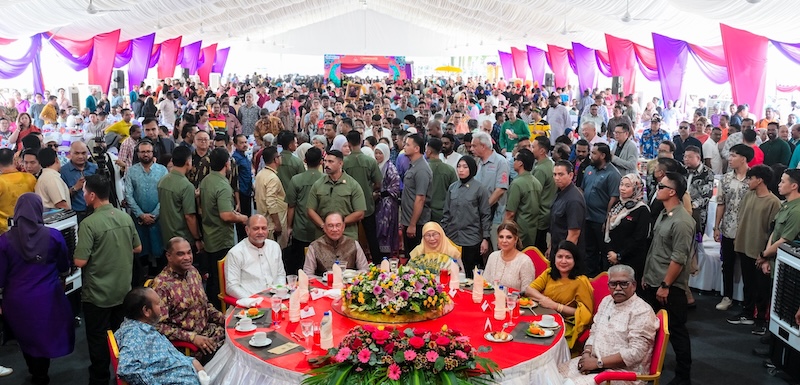
Prime Minister Anwar Ibrahim (seated, 4th from left) and Digital Minister Gobind Singh Deo at the Deepavali Open House in Brickfields, Kuala Lumpur, on October 18, 2025 — Photo: Gobind Singh Deo Facebook
By Dr. B. S. Bains | Opinion |
Across India and Southeast Asia, the festival of Diwali—known in Malaysia as Deepavali—has long symbolised the triumph of light over darkness and good over evil. Yet beyond its glowing lamps lies a deeper story of evolution—of faith, migration, and meaning. How did a festival born of ancient Hindu epics become part of Sikh history and later, a shared cultural celebration in Malaysia?
From Kurukshetra to Kanyakumari — The Historical Thread
The roots of Diwali stretch deep into India’s ancient soil. The Ramayana recounts Lord Rama’s return to Ayodhya after defeating Ravana, ruler of Lanka. The Mahabharata, meanwhile, unfolds in Kurukshetra—once a part of Punjab, now in Haryana—linking the story to the spiritual geography of northern India.
Southern India, including Kanyakumari, carries traces of Ravana’s legacy. These interconnected tales show how the spirit of Diwali slowly spread across regions, from the north to the south, each adapting the story to its own rhythm. Over time, as trade and travel wove India together, Diwali’s flame illuminated diverse traditions.
The Sikh Connection — From Diwali to BandiChhorDivas
For Sikhs, the connection to Diwali is not mythical but historical. The day of Bandi Chhor Divas—the Day of Liberation—marks Guru Hargobind Sahib Ji’s (6th Sikh Guru) release from imprisonment in Bhopal (1,230km from Amritsar) alongside 52 kings of different regions of India. Although this event did not originally fall on the same date as Diwali, the closeness of the occasions led to shared celebration. In the similar note the 52 kings when tgeyreturn to their respective Kingdom would celebrate Diwali commemorating their freedom from imprisonment. But the Spirit of Diwali would remain the same.
Over time, what was once a harmonious and joyous celebration has become clouded by confusion and control. Within the Sikh community, the once-clear distinction between reverence and ritual has been blurred—often by self-appointed guardians of faith and rigid clergy who insist on dictating how Sikhs should feel, celebrate, or even remember. The absence of the word “Diwali” in the Guru Granth Sahib does not mean that the celebration holds no place for Sikhs. Yet, such narrow interpretations have gradually eroded the warmth, unity, and simplicity that once made Diwali a cherished family celebration, reducing it to a hesitant and colourless ritual for many. Today, many Sikhs quietly reflect: in our pursuit of being “pure,” have we forgotten the deeper essence of our Gurus’ teachings—to turn ritual into reverence, and separation into shared devotion?
From Ritual to Reverence
The Gurus spoke not to a sect, but to humanity at large. They called for an evolution from ritualism to reverence, from empty custom to conscious celebration. But to to entirely erase the idea of celebration. Lighting lamps and decorating homes hold meaning only when they reflect the light of truth, humility, and service within us. Let this be the virtues and the essence of celebration.
This wisdom invites Sikhs—and all people—to celebrate with awareness, with joy and indulgence. So make Diwali or BandiChhor Divas (what ever you want to call under the umbrella of Diwali) a celebrated festival of firecrackers and sweets, with renewal of inner clarity and compassion.
A Malaysian Reflection — Celebration as Integration
In Malaysia, Deepavali has transcended religious boundaries to become a unifying celebration to all. It is a day when Hindus, Sikhs, Muslims with Indian Origin and entire Malaysians of all backgrounds exchange greetings, share meals, and rejoice together.
This cultural evolution shows how festivals can serve a greater social purpose—to remind us of our common humanity. When celebration becomes integration, it transforms from mere festivity to fellowship.
Perhaps this is the message the Gurus foresaw for humankind: that light is meant not just to shine within temples or homes, but between people—across faiths, across generations, across differences.
So whether one calls it Diwali, Deepavali, or BandiChhorDivas, may the spirit remain the same: to light the lamp of truth within, to dispel ignorance, and to spread joy through shared understanding.
The writer, Dr. Bains B.S., is a physiotherapist, community leader and President of the Private Physiotherapy Clinic Owners’ Association of Malaysia. He writes on culture, interfaith harmony, and the evolution of tradition in the modern Malaysian context.
ASIA SAMACHAR is an online newspaper for Sikhs / Punjabis in Southeast Asia and beyond. You can leave your comments at our website, Facebook, Twitter, and Instagram. We will delete comments we deem offensive or potentially libelous. You can reach us via WhatsApp +6017-335-1399 or email: asia.samachar@gmail.com.
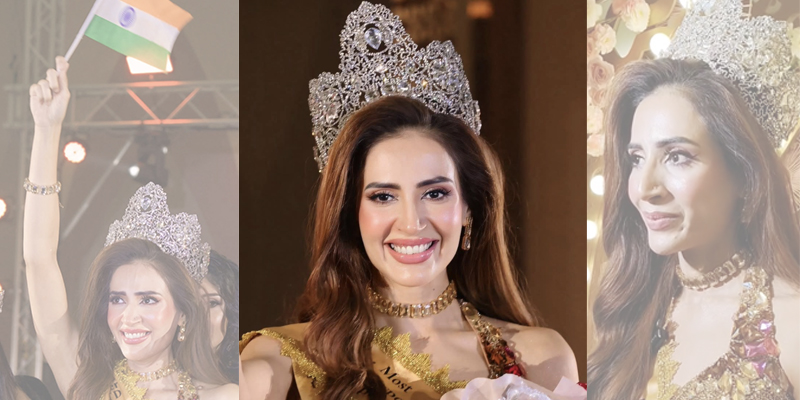
Sherry Sikandar Singh made history as the first Indian woman to bring back the Mrs Universe 2025 crown. The mother-of-one stood against 120 women from across the globe at the 48th edition of the pageant, held at Okada in Manila, Philippines, earlier this month.
ASIA SAMACHAR is an online newspaper for Sikhs / Punjabis in Southeast Asia and beyond. You can leave your comments at our website, Facebook, Twitter, and Instagram. We will delete comments we deem offensive or potentially libelous. You can reach us via WhatsApp +6017-335-1399 or email: asia.samachar@gmail.com. For obituary announcements, click here
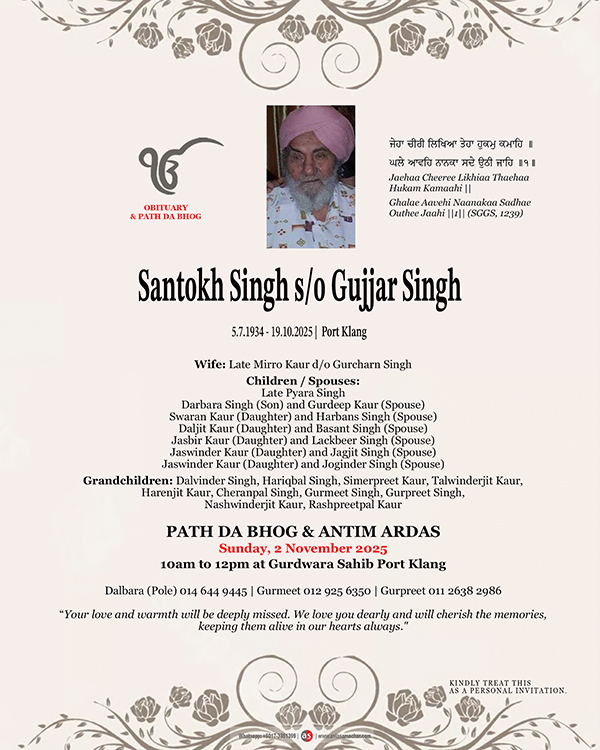
| Entry: 19 Oct 2025; Updated: 29 Oct 2025 | Source: Family
ASIA SAMACHAR is an online newspaper for Sikhs / Punjabis in Southeast Asia and beyond. You can leave your comments at our website, Facebook, Twitter, and Instagram. We will delete comments we deem offensive or potentially libelous. You can reach us via WhatsApp +6017-335-1399 or email: asia.samachar@gmail.com. For obituary announcements, click here