Wife: Mdm Jit Kaur d/o Late Mr Meja Singh& Late Mdm Swaran Kaur (Kajang)
Daughter: Sharanjit Kaur / Son in Law: Kelvinder Singh (Singapore)
Also leaving behind a host of grandchildren, relatives and friends
Saskaar / Cremation: 2.00pm, 1 February 2019 (Friday)
Path da Bhog: 10 February 2019 (Sunday), from 09.00 am to 12.00 noon, at Gurdwara Sahib Butterworth, Seberang Perai, Pulau Pinang
MESSAGE FROM FAMILY:
As the morning blossomed on 30th January 2019, beloved Mr. Ranjit Singh Jessy s/o Late Mr. Hazara Singh Jessy & Late Mdm Jaswant Kaur ( Sango) of Canning Garden, Ipoh, passed on peacefully in his sleep. A great giver of love, he will be missed by all. All welcomed to above residence or crematorium to pay last respects.
The family wishes to thank all in advance for best wishes and prayers.
Contact:
Jit Kaur – 017-4334140
Sarjit Singh –016-3449776
Amarjit – 012-5887154
| Entry: 31 Jan 2019 | Source: Family |
ASIA SAMACHAR is an online newspaper for Sikhs / Punjabis in Southeast Asia and beyond.Facebook | WhatsApp +6017-335-1399 | Email: editor@asiasamachar.com | Twitter | Instagram | Obituary announcements, click here |
Pakistan state lawmaker Mahinder Pal Singh creates history as the first Pakistan Sikh to be made a state parliamentary secretary.
Mahinder is an elected Member of Provincial Asembly (MPA) from on a reserved seat for minorities on a Pakistan Tehreek-e-Insaf ticket from Multan, Punjab.
He is one of the 37 MPAs appointed as parliamentary secretaries by Punjab chief minister Usman Budzar.
They would be entitled to a monthly salary of Rp20,000, a Rp10,000 monthly sumptuary allowance and an official car and residence, as per the Punjab Parliamentary Secretaries (Salaries, Allowances and Privileges) Ordinance 2002. They also get to travel locally on business class equal to a first grade officer.
ASIA SAMACHAR is an online newspaper for Sikhs / Punjabis in Southeast Asia and beyond.Facebook | WhatsApp +6017-335-1399 | Email: editor@asiasamachar.com | Twitter | Instagram | Obituary announcements, click here |
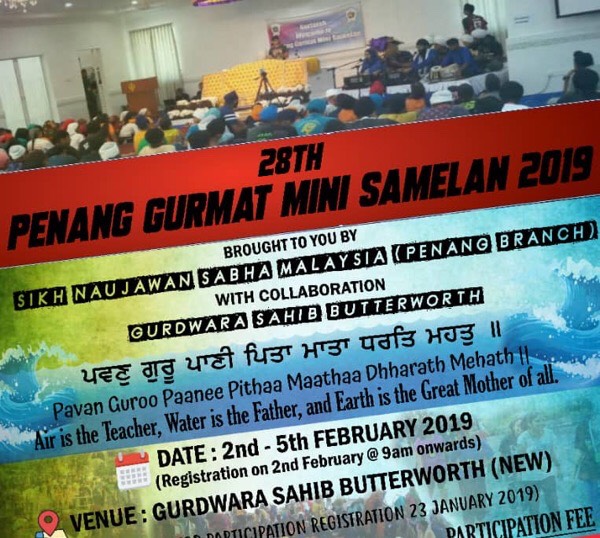
The annual Penang Sikh youth camp held during the Chinese New Year holidays is back.
The four day camp, from Feb 2-5, 2019, will be the first camp to be organised at the new building of Gurdwara Sahib Butterworth (GSB).
“We are expecting a big turnout. The Ipoh bus is already full. There will also be a bus from Petaling Jaya,” camp chairman Harjinder Singh told Asia Samachar.
The 28th Gurmat Mini Samelan Penang is organised by SNSM Penang and GSB, with the support of the other local gurdwaras. The camp usually attracts 200 to 300 participants.
For more information, contact Hardeep Singh (016-4343264) or Gurjeet Kaur (011-36005295).
ASIA SAMACHAR is an online newspaper for Sikhs / Punjabis in Southeast Asia and beyond.Facebook | WhatsApp +6017-335-1399 | Email: editor@asiasamachar.com | Twitter | Instagram | Obituary announcements, click here |
AKHAND PATH: Commences at 8am, 1 Feb 2019 (Friday) at Wadda Gurdwara Sahib Kampung Pandan, with Path Da Bhog at 8.00 am, 3 Feb 2019 (Sunday). JODH MELA: 3 Feb 2019 (Sunday), 9.30 am-11.30am, at Wadda Gurdwara Sahib Kampung Pandan |Malaysia
JASWANT KAUR W/O LATE SDR GURCHARAN SINGH
(Kg Pandan Settlement /Bangsar)
Village: Bundala, Amritsar
Born: 22 Dec 1931
Departed: 28 Jan 2019
Husband: Late Gurcharan Singh (Kg Pandan Settlement / Bangsar)
Children:
Late Sarjit Kaur
Mdm Daljit Kaur
Late Harbhajan Singh
Late Manjit Singh
Mdm Pritam Kaur
Dr Sarmukh Singh
Dr Balbir Singh
Mdm Harjinder Kaur
Akhand Path: Commences at 8am, 1 Feb 2019 (Friday) at Wadda Gurdwara Sahib Kampung Pandan, with Path Da Bhog at 8.00 am, 3 Feb 2019 (Sunday)
Jodh Mela: 3 Feb 2019 (Sunday), 9.30 am-11.30am, at Wadda Gurdwara Sahib Kampung Pandan
Jodh Mela program as follows:
9.15am – 9.30am: Kirtan by Late Mata Jaswant Kaur great grandchildren
As the morning blossomed today the beloved matriach of the Hundal family Mdm Jaswant Kaur (w/o Late Sdr Gurcharan Singh) of Kg Pandan Settlement/ Bangsar passed on peacefully in her sleep. She was 87 and lived a wonderfully full life. A great giver of love, she will be missed by all. We rejoice her passing as she will now go to a better place.
All welcomed to above residence or crematorium to pay last respects, say goodbye and give her the send off she deserves.
The family wishes to thank all in advance for best wishes and prayers for our beloved Bibiji.
| Entry: 28 Jan 2019; Updated: 31 Jan 2019 | Source: Family |
ASIA SAMACHAR is an online newspaper for Sikhs / Punjabis in Southeast Asia and beyond.Facebook | WhatsApp +6017-335-1399 | Email: editor@asiasamachar.com | Twitter | Instagram | Obituary announcements, click here |
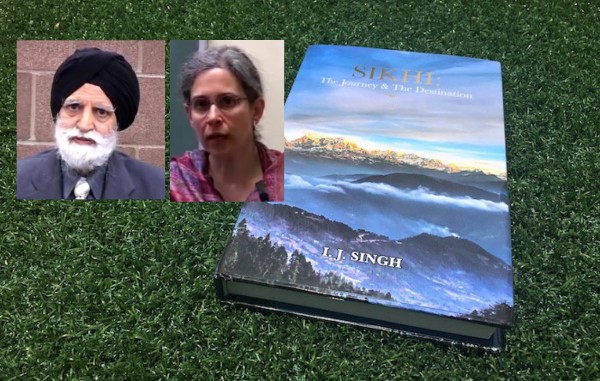
Prof I.J. Singh (left) and Laurie Bolger (Photo: Sikh Coalition library project video grab). Background: The book under review
Review by Laurie Bolger | BOOK REVIEW |
“But to apprehend the point of intersection of the timeless with time, is an occupation for the saint,” T.S. Eliot tells us in his lengthy poetic work Four Quartets.
While one might not necessarily characterize I.J. Singh as a saint, he has indeed made the meticulous parsing of the points of intersection of the timeless tenets of Sikhi with the time-bound aspects of the contemporary Sikh diaspora into his occupation – or, one could say, his life’s true vocation! Throughout the pages of all of his five previous books, the author has taken evident intellectual delight and visceral joy in the challenge of “connecting the dots,” and this sixth compilation of essays is no exception.
Many, if not most, other authors of essay compilations have their own “pet” topics they feel comfortable writing about, and stick exclusively to them. Not I.J. Singh!
As is the case with his five earlier books, Sikhi: The Journey & The Destination lavishes upon the reader a mind-blowingly diverse smorgasbord of themes and ideas relating to Sikh life in the modern diaspora. Similarly, this work, like its antecedents, is in no way a rigid catechism or an uninspiring “How-To” manual of what to believe and how to behave. There is no spoon-feeding, nor mental coddling; no black-and-white, “carved in stone” answers are ever provided. As they make their way through this volume, readers must always think for themselves, and thereby actively engage in the contemplation and inquiry – the Vichaar – that is an intrinsic part of Sikhi.
SIKHI: THE JOURNEY & THE DESTINATION | Author: I.J. Singh | Publisher: Nishaan Nagaara in association with Chardi Kalaa Foundation, 2018 | ISBN 978-93-82811-09-1 |300 pages
The Foreword and Introduction that begin the book are written by two distinguished and prominent India-based Sikhs: Mohinder Singh (Professor-Director, National Institute of Panjab Studies, New Delhi) and Tarlochan Singh (Ex-M.P., and Former Chairman, National Commission for Minorities, India), respectively. Highly laudatory of I.J. Singh and the products of his prolific pen, these brief but enlightening sections are well worth reading. Following the Introduction is a short section of Acknowledgments, written by the author himself.
Subsequently, the reader should definitely not be tempted to skip I.J. Singh’s Preface. Besides being a source of interesting autobiographical information – giving the reader a fine opportunity to understand how the events of his life history catalyzed his deep and abiding interest in exploring Sikhi through his writings – the author provides a wonderful exposition of his personal mindset, particularly highlighting his strong and abiding predilection for frank discussion and vigorous debate. He also discusses the methodology he uses to write his essays, and the reasons he thinks they are meaningful and needed by his intended audience of both Sikhs and non-Sikhs. Here, I.J. Singh not only situates himself firmly in the modern American Sikh diaspora, but also ensconces his sixth book into context among his previous five works. The evolution of his thought processes and the means by which his new ideas build upon the foundations of the preceding ones are much in evidence in this prefatory section. Both those readers who are new to his writings and those who are already familiar with his formidable oeuvre will particularly appreciate the Preface as an “appetizer” to prepare one’s mind for the sumptuous literary banquet to follow.
So much could be said about every essay in this book! Here follows a discussion of seven of them that I found of particular interest.
GURU GOBIND SINGH
His own Sikhs honored Guru Gobind Singh as Mard Agamra, a peerless man, I.J. Singh explains in Essay III, “Guru Gobind Singh: The Man Non-Pareil.” Although this essay describes the many reasons why the Tenth Sikh Master was quite extraordinary, this essay focuses on Guru Gobind Singh not as disconnected from the Sikhi of Guru Nanak (the first Founder-Guru), but as an integral part of the progression of ten human Gurus who worked towards a common goal: mentoring a community under “virtual siege” to form “a human development movement” and forge a borderless Sikh nation with a defining ideology, philosophy, and core of common ethics.
In this essay, I.J. Singh cogently lays out the four transformational events of Guru Gobind Singh’s legacy: the initiation rite of Amrit Sanchar as a defining marker of Sikh identity; the taking up of arms when necessary to defend freedom; the investiture of Sikh spiritual primacy in the Guru Granth Sahib; and the establishment of Sikh temporal authority in the Sikh Panth. The end result was “a revolution via evolution,” the author explains, which has enabled Sikhs to go forward into the changed realities of the future with wisdom and determination.
TRANSLATING GURBANI
In Essay XIII, “Translating Gurbani: Pitfalls & Pleasures,” I.J. Singh posits that, although numerous English translations (and online search engines) of the complete Guru Granth Sahib already exist, there is nevertheless the need for new initiatives to translate the Sikh scripture in user-friendly terms that are relevant to the Sikh “globally connected existence of a nation without walls.”
The norma loquendi of Sikhs in the 21st century diaspora is no longer Punjabi, or any other Indic language, I.J. Singh asserts, and the legends of Indian mythology are now alien to a new generation. How else can Sikhs understand the Guru Granth Sahib and adopt it as a blueprint for daily living, without new undertakings to translate its mystical poetry and capture its lofty message? Even if a translation will always be inadequate in some way, and the original text of the Gurbani must ever be kept on hand, the struggle to make sense of “what the Guru really meant” is an intrinsic part of the lifelong path of a Sikh.
END-OF-LIFE
The Indic religions proclaim that freedom from the recycling of one birth to another is the goal of human life, I.J. Singh explains in Essay XXIV, “Reincarnation / Transmigration: Re-visited & Re-explored.”
Although reincarnation and transmigration retain an enormous presence in Indian culture-at-large, and seem to come across as major themes in the Guru Granth Sahib, should they remain pivotal to contemporary Sikhi? When we persist in focusing on what will happen after our death, we will undervalue our life here on Earth, the author warns. When contemplating the metaphorical poetry of the Sikh scriptures, the cultural context of the Guru period must always be kept in mind. “Death is a veil, like birth, through which we may not see,” he reminds us.
With this pragmatic mindset, reincarnation and transmigration are reinterpreted to mean that after death, every living thing becomes part of the greater biological life cycle. Rather than ruminating on end-of-life questions, the author posits that a better use of our energies would be a concentration on the eternal challenge posed by Guru Amardas, the third Sikh Guru: “What footprints will you leave in the sands of time?”
THE TURBAN
No exploration of Sikh identity can fail to include a discussion of the Sikh turban. In Essay XXIX, “Turban of the Sikhs,” I.J. Singh analyses the debate surrounding whether the turban is an intrinsic, Guru-promulgated part of Sikhi, or whether it was a requirement initiated in the 20th century by the Singh Sabha reform movement, and formalized in the Sikh Rehat Maryada (the code of Sikh conduct and conventions) only at that time.
Some naysayers remain unconvinced by accounts of the events of Vaisakhi 1699, when Guru Gobind Singh created the discipline of the Khalsa – the community of initiated, committed Sikhs – and mandated that the long, unshorn hair of a Sikh (known as Kesh, one of the five Kakkars, or Sikh articles of faith) was to be covered by a turban. Others believe in the historical evidence of Kesh and the turban being consistent external markers of the recognizable Sikh male, starting from the latter part of the Guru period and continuing for over 300 years, right up until present times.
Hewing closely to his signature penchant for “connecting the dots” throughout time and space, the author illuminates and expands the turban debate with an unusual example of binding traditions that became enshrined into law: the events leading up to the adoption, in 1947, of the 22nd Amendment to the Constitution of the United States, which limited the office of the U.S. President to two consecutive terms. By showing how laws evolve from and reflect a history of the shared values of a free people, I.J. Singh buttresses his argument for the Kesh and the turban being at the innermost core of Sikh identity.
UNIVERSAL CONNECTIVITY
In Essay XXXI, “Ged Outta Da Box Awreddy” (the whimsical title playfully pokes fun at a stereotyped “Noo Yawk” accent), I.J. Singh discusses what is truly a major hallmark of his writing style, his proclivity for exploring the Guru Granth Sahib – and Sikhi as a whole – using not only references from Gurbani itself, but also from contemporary diaspora society.
To the author, supporting his own opinions using an impressive panoply of non-Sikh sources (the Bible, William Shakespeare, Oscar Wilde and Albert Einstein would be a typical assortment), is a very natural and desirable offshoot of the universality and timelessness of Sikhi. With a personal worldview shaped over many decades by both Sikh and non-Sikh texts and traditions, he heartily rejects the insular mindset held by many people that any validation of Gurbani concepts must come only from Gurbani itself.
According to the author, Gurbani and modern society-at-large are not “hermetically-sealed cocoons” existing in isolation. Fostering the idea of universal connectivity, and examining one’s own faith through the lens of frank interactions and open dialogues with the outside world perfectly jibes with the ways the Gurus themselves lived and taught, I.J. Singh opines. Why shouldn’t the Gurus’ contemporary followers – today’s Sikhs – continue that tradition of dynamic exploration and receptivity? This in no way demeans or threatens Gurbani, he believes; on the contrary, it strengthens and emphasizes Sikhi’s timeless meaning and universal relevance.
SIKH AMERICANS
After almost 60 years of living in the United States, I.J. Singh is most certainly a Sikh-American. Essay XXXIV, “Sikh Americans: A Lament … … or Delight” is therefore a very appropriate addition to this book.
This essay, which includes many interesting personal details of his early years in the U.S., examines the place of Sikhs and Sikhi within the immense framework of contemporary American society. The varied cultural practices and traditions that immigrants bring to America greatly enrich this nation and should be recognized and nurtured, the author stresses.
While indisputably supporting integration, he questions the idea of the “melting pot,” which might result in homogenized blending beyond recognition of the diverse components that immigrants bring with them. Should America, then, be characterized as a tossed salad or as a mosaic, I.J. Singh wonders. After examining the relevancy of these metaphors, he settles on that of a multi-instrument orchestra, which can make beautiful music when wisely led.
According to the author, Sikhs must continue to actively define their “place at the table” of contemporary U.S. society. By embracing “the core of American values that unites, defines, and enriches us,” one can – and should – become both a good Sikh and a good American.
GENDER & SEX
While Sikh teachings denounced the evils of sexism right from the inception of the faith, Sikh practices have unfortunately not always reflected this Guru-ordained viewpoint. I.J. Singh laments this dichotomy in Essay XXXVI, entitled “What Sikhism says about Gender, Sex & Related Issues,” which is the final piece of the book.
While women’s rights were severely curtailed in traditional Hindu and Islamic societies, in contrast, from its very preamble, the Guru Granth Sahib unambiguously states that God has no gender, and refers to the Creator in its hymns as both Father and Mother. The Sikh scripture acknowledges that all birth is a result of sexual activity, and posits that the relationship between the genders should mirror the sanctity that exists in the human-Divine connection. However, just as America generally reflects Judeo-Christian values, even though separation of church and state is mandated by law, India, while a nominally secular country, largely espouses Hindu values.
In the author’s opinion, within this vast, engulfing sea of Indian/Hindu practices, Sikh teachings are not thoroughly internalized and integrated into the daily life of many Sikhs. “Not that it is unique to us,” I.J. Singh ruefully admits at the close of this essay, “but there is an awful, yawning gulf between all that we preach and what we practice.”
The thirty-sixth essay ends this delectable mind-feast, which is unfortunate for two reasons. Firstly, because the captivated reader would surely not want this marvelous book to be at its close! Secondly, unlike all of his previous five works, Sikhi: The Journey & The Destination has no Glossary. This is its biggest drawback, as some essays, admittedly, do need additional explanation for non-Sikh readers, or even for Sikhs who may not have in-depth knowledge of certain aspects of their faith. To be sure, this shortcoming is mitigated somewhat by the ease with which anyone can look up any topic on the Internet. However, when one has insufficient prior knowledge of a given subject, one runs the risk of not being able to discern when one is being misinformed by what one reads. Too often, in one’s search for background material to elucidate a particular concept, one is easily taken in by something written by a very authoritative-sounding author – who, in actuality, really doesn’t know what he or she is talking about. Of course, the most delightful remedy for this problem would be to find and peruse the Glossaries of I.J. Singh’s other works – and, of course, to read the entirety of those works themselves, too!
VINTAGE I.J. SINGH
This issue aside, Sikhi: The Journey & The Destination is “vintage” I.J. Singh. This book’s panoply of adroitly-dissected ideas will provoke, engage and gratify any reader who is fortunate enough to delve deeply into its pages. With his impressive range of knowledge of non-Sikh religions and cultures, and his highly articulate writing style, for which he is so very justifiably celebrated, I.J. Singh has penned a most worthy successor to his five other books: Sikhs & Sikhism: A View With a Bias (1994, 1998); The Sikh Way: A Pilgrim’s Progress (2001); Being & Becoming a Sikh (2003); The World According to Sikhi (2006); and Sikhs Today: Ideas & Opinions (2012).
After living almost 60 years in America, the author has few peers when it comes to keeping one’s finger firmly on the pulse of today’s Sikh diaspora. His insightful commentary and subtle, trenchant wit consistently excite and delight the reader’s mind. Might there be a seventh book of essays in I.J. Singh’s future? Let’s hope so!
In conclusion, I’d like to undertake a dot-connection of my own. Guru Nanak, the First Sikh Master, traveled far and wide, accompanied by his faithful Muslim companion, Bhai Mardana. During a voyage, the two hungry and tired men sought food and shelter in a village one night, but received only rude and unkind treatment from its inhabitants. The next night, in another village, they enjoyed lovely courtesy and hospitality. About the first group of villagers, Guru Nanak remarked, “May these people stay comfortably here in this village forever.” For those who lived in the second location, the Guru wished, “May the people of this village scatter everywhere.” In explaining his words to a confused Bhai Mardana, the Guru reasoned that the undesirable characteristics of those that lived in the first village should remain limited to one place, while the wonderful qualities of the second village’s inhabitants should spread far and wide, to benefit as many other people as possible.
So, just as with the Guru’s beautiful wish, my hope for Sikhi: The Journey & The Destination is that it be disseminated as globally as possible, not only to Sikhs, but also (and especially) to non-Sikhs, as well. While this splendid book certainly deserves a warm and hearty welcome from the Sikh community, every feasible action must be taken to ensure that it does not remain exclusively within these confines, but that it is enabled to go forth into the world-at-large, to spearhead the desperately-needed efforts of education and outreach aimed at sharing the message of the timeless and universal faith of Sikhi. Now that would be wonderful, indeed!
ASIA SAMACHAR is an online newspaper for Sikhs / Punjabis in Southeast Asia and beyond.Facebook | WhatsApp +6017-335-1399 | Email: editor@asiasamachar.com | Twitter | Instagram | Obituary announcements, click here |
ASIA SAMACHAR is an online newspaper for Sikhs / Punjabis in Southeast Asia and beyond.Facebook | WhatsApp +6017-335-1399 | Email: editor@asiasamachar.com | Twitter | Instagram | Obituary announcements, click here |
AKHAND PATH: Commences at 9am, 7 Feb 2019 (Thursday) at residence No.1, Lorong Dendang 1, Kawasan 16, Taman Rashna, 41300 Klang, Selangor. PATH DA BHOG: 9 February 2019 (Saturday), 10am-12noon, at Gurdwara Sahib Klang|Malaysia
Gurnam Kaur (1932-2019), Klang
GURNAM KAUR A/P HIRA SINGH
Village: Malhi, Talvindi
Date of Birth: 16 Jan 1932
Departed: 26 Jan 2019
Husband: Late Sardar Hari Singh Bhinder (Retired police no. 172)
Children / Spouses:
1. Sharmukh Singh/ Manjit Kaur
2. Gurcharan Singh/ Jit Kaur
3. Charnam Kaur / Bhaskaran
4. Late Baldeva Singh
5. Jagrais Singh / Amarpall Kaur
6. Mahinder Kaur / Bobby Devine
7. Sarjeet Kaur / Sarjit Singh
8. Shinder Kaur / Suhkdev Singh
9. Manjit Kaur / Amarjit Singh
Leaving behind children, grandchildren and great grandchildren.
Akhand Path: Commences at 9am, 7 Feb 2019 (Thursday) at residence No.1, Lorong Dendang 1, Kawasan 16, Taman Rashna, 41300 Klang, Selangor
Followed by Path Da Bhog: 9 February 2019 (Saturday), 10am-12noon, at Gurdwara Sahib Klang
Contact:
Gurcharan Singh 016-6991303
Sukhi 016-2300042
Harvin 012-2555581
| Entry: 26 Jan 2019; Updated: 30 Jan 2019 | Source: Family |
ASIA SAMACHAR is an online newspaper for Sikhs / Punjabis in Southeast Asia and beyond.Facebook | WhatsApp +6017-335-1399 | Email: editor@asiasamachar.com | Twitter | Instagram | Obituary announcements, click here |
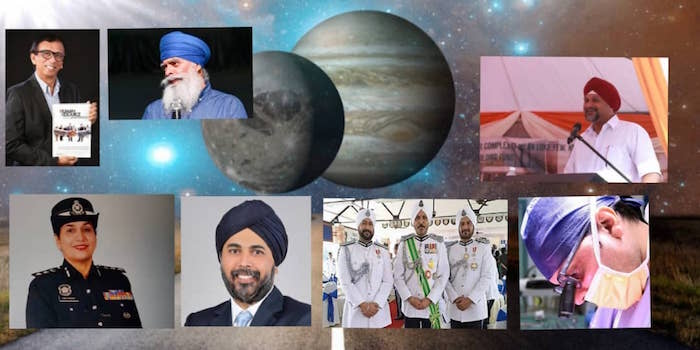
Galaxy of Sikhs: Some Sikhs recently featured in Asia Samachar (Background photo: Pixabay)
By Hb Singh | OPINION |
“What has happened to Sikhs today?” my friend lamented as we sat for Guru Ka Langgar. “In those days, they were so full of valour and love.”
“We had people like Banda Singh Bahadur – warrior, saint, strategist, all in one. Our Sikh mothers endured unimaginable pain. We had Sikhs who were cut limb by limb, yet stayed true to Sikhi.”
For the uninitiated, the ‘cut limb by limb’ is a reflection from the standard version of the Sikhs Ardas or supplication as contained in the Sikh Rehat Maryada (SRM) document.
I could sense where the conversation was headed. It’s unlikely to be jovial, cheerful or upbeat. He is digging into Sikh history. Our history is replete with torture and sacrifices. At some point of our short history, our forefathers had endured what ISIS did in the recent past. But seen from another light, it is also one full of inspiration and hope.
“Where are those Sikhs today?” he said in a sombre voice.
I turned to him, my eyebrows coming close together. Now, that’s a sure sign something is about to come.
I decided to cheer him up a little. But not so fast. As much as he was feeling melancholy, I decided to give him a dose of my reality check.
“So, whoever told you that all Sikhs were fine and dandy in those days?” I began.
“What you shared are examples of fine and beautiful people over a period of time. But in that same period, I bet you we had problematic people.
“I’m sure there was a fair share of Sikhs who were all nutty and messed up. It’s just that we don’t read or think about them today.”
I was driving home a simple point. We tend so amplify the good or the bad, and downplay the other, depending on the case we intend to drive home. In this conversation, he amplified the good, and ignored the bad apples amongst the Sikhs of the past. As a result, Sikhs today look rather bad.
We are prone to nostalgia. We say things like how things were better back then, how people were more honest back then, how stuff was simpler once upon time.
Really? Are we not making the past look better simply by dismissing, by design, the reality? Not everything was better back then!
Enough about the past. What about the present? I went on to argue that Sikhs are alive and kicking all over the world.
“Look at where we are seated,” I began to argue my case for Sikhs today. “We are in a gurdwara just about a mile away from the Malaysian parliament house, the national police headquarters and the country’s central bank. We are in a Muslim-majority nation. And this is a fully-functioning gurdwara.”
In Malaysia, Sikhs are doing decently well. Of course, we have our challenges. Naturally, we have Sikhs who are struggling economically and on other fronts. But that’s the story of about every other community, as well.
Next point, the food before me.
“We are having Langgar here today, some 550 years after the birth of Guru Nanak. The Langgar institution that our Gurus started has endured the test of time,” I pressed forward, tucking in another bite of the sumptuous mixture of rice and curry, with a dash of santan (coconut milk).
Langgar is food cooked and distributed at gurdwaras and Sikh religious functions. Its largely vegetarian, allowing most people can consume it. A practice started by the Sikh Gurus, it is free, open to one and all. Everyone – beggar or billionaire, peasant or prime minister – sit together in what is called the Panggat.
Guru Ka Langgar still exists as an integral Sikh practice.
But it gets better. Guru Ka Langgar has taken on new wings in many places. Just look at numerous occasions where Sikhs have run Guru Ka Langgar to feed victims of humanitarian disasters.
In 2016, a group of American Sikhs teamed up with Latin Americans and the US Vets to serve healthy vegetarian meals through its Free Meal Service.The SevaTruck serves piping hot meals, freshly prepared in the mobile kitchen. And there are numerous such examples in the UK, Australia, Malaysia and India.
“That’s Guru Nanak at work today,” I pressed my point.
Next, my final point for the day. I’ve almost finished the food before me.
“Is the Sikhi spirit lost on Sikhs today? I just read about this Sikh farmer in the Us who has offered to pay the rent for US Federal workers if they are affected by the partial shutdown of the nation’s government,” I said.
Mike Sandhu is a farmer and landowner in Tracy, the second most populated city in San Joaquin County, California.
“I see the spirit of Guru Nanak alive and kicking in him. And this is a Sikh living and breathing today.”
Hb Singh is a Kuala Lumpur-based journalist with some experience in dealing with Sikh organisations, both from within and outside.
* This is the opinion of the writer, organisation or publication and does not necessarily represent the views of Asia Samachar.
ASIA SAMACHAR is an online newspaper for Sikhs / Punjabis in Southeast Asia and beyond.Facebook | WhatsApp +6017-335-1399 | Email: editor@asiasamachar.com | Twitter | Instagram | Obituary announcements, click here |
Dr Jaswinder Singh Samra – Photo: Australian Pancreatic Centre website
Veteran surgeon Dr Jaswinder Singh Samra received Order of Australia Medal (OAM) for 2019 honour for service to medicine as a pancreatic specialist.
The award was in conjunction with Australia Day today.
Dr Jaswinder, a member of the Australian Medical Association (AMA), is the co-founder of the Australian Pancreatic Centre along with Dr Anubhav Mittal.
Born in the UK, Dr Jaswinder is a hepatobiliary and pancreatic surgeon. He has a special interest in pancreatic cancer and cholangiocarcinoma and undertakes a broad range of laparoscopic surgery.
ASIA SAMACHAR is an online newspaper for Sikhs / Punjabis in Southeast Asia and beyond.Facebook | WhatsApp +6017-335-1399 | Email: editor@asiasamachar.com | Twitter | Instagram | Obituary announcements, click here |
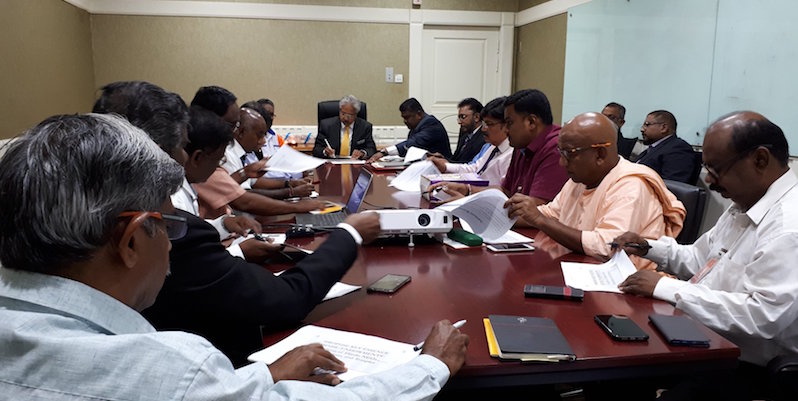
Senator Waytha Moorthy in a discussion with Hindu temple management representatives, Hindu non-governmental organisations and foundations at his Purajaya office on 25 Jan 2019 – Photo: Facebook page of Coalition of Hindu Temples, NGO and Foundations
By Asia Samachar Team | MALAYSIA |
Malaysian Indian Transformation Unit (MITRA), the rebranded agency handling the RM100 million allocation earmarked for the Indian community under Federal Budget 2019, will start receiving grant proposals Tuesday (28 Jan) onwards.
It will be managed via the Grant Management System 2019 (GMS 2019) that will be operational under the unit’s new website.
The online grant application system will enable Malaysian legal entities to propose innovative and creative socio-economic programmes to uplift the Indian community particularly those belonging in the B40 socioeconomic stratum, according to a MITRA statement.
“With the GMS 2019 project, MITRA is looking forward to receiving unique proposals from various stakeholders on what can be done to curb and overcome social and economic challenges that are plaguing the community and to ensure their optimal inclusiveness into Malaysian civil society,” MITRA Director General S. Letchumanan Shanmugam said in the statement.
MITRA, is a unit under the Prime Minister’s Department, was known as the Socio-economic development of the Indian community Unit (SEDIC) under the previous Barisan Nasional-led government.
In May 2018, the Pakatan Harapan coalition, led by former Prime Minister Dr Mahathir Mohamad, stormed into office in a surprise victory at the general polls, marking the first ever change for Malaysia at the federal government level.
The unit comes under the purview of Minister in the Prime Minister’s Department (National Unity and Social Well Being) Senator Waytha Moorthy Ponnusamy.
In Federal Budget 2019, the government had set aside RM100 million to support the Indian community with a focus on eradicating hardcore poverty.
In his speech when presenting Federal Budget 2019, Finance Minister Lim Guan Eng said the government had proposed an ‘allocation of RM100 million to support the Indian community, including TVET to improve the career advancement opportunities of the Indian youths’. This comes under to achieve balanced development throughout the country, especially in the rural areas.
TVET, short for Technical and Vocational Education and Training, is meant to provide knowledge and skills for employment.
In the past, Sikh organisations, including the Malaysian Gurdwaras Council (MGC) and Khalsa Diwan Malaysia (KDM), have received funding for community projects from SEDIC.
Landing page of MITRA’s new website – Photo: Asia Samachar
On the new system, Letchumanan said GMS 2019 is user-friendly, integrated and a transparent system.
The application process is made simple but at the same time it places much importance on credibility, credentials and accountability of applicants, the MITRA statement said.
The system was jointly developed with the Asia Pacific University (APU) as part of its corporate social responsibility (CSR), the statement added.
The application for the GMS 2019 commence on 28 Jan 2019. Prospective applicants may read the application procedures, requirements and terms and conditions of the GMS 2019 from the newly launched website at www.mitra.gov.my .
For more information on the online portal and the GMS 2019, contact MITRA’s office at 03-8886 6262 / 03-8886 6322.
ASIA SAMACHAR is an online newspaper for Sikhs / Punjabis in Southeast Asia and beyond.Facebook | WhatsApp +6017-335-1399 | Email: editor@asiasamachar.com | Twitter | Instagram | Obituary announcements, click here |



























 Hb Singh is a Kuala Lumpur-based journalist with some experience in dealing with Sikh organisations, both from within and outside.