Saskaar/Cremation: 1.00pm, 07 December 2018 (Friday), at Cheras Cremation Centre, Jalan Kuari, Kuala Lumpur
Cortege timing: Cortege leaves residence No 4, Jalan 7, Taman Sri Ukay, 68000 Ampang, Selangor at 12.00pm
Daughters: Tarvinder Kaur, Surinder Kaur and Navinder Kaur
Path da Bhog: 22 December 2018 (Saturday), 10am-12.30pm, at Gurdwara Sahib Ulu Kelang, Selangor
Missed by grandchildren, family and friends.
Contact:
Darshan 010-2200029
Surin 012-6615660
Navin 010-2269971
Tarvin 016-4180713
| Entry: 6 Dec 2018 | Source: Family |
ASIA SAMACHAR is an online newspaper for Sikhs / Punjabis in Southeast Asia and beyond.Facebook | WhatsApp +6017-335-1399 | Email: editor@asiasamachar.com | Twitter | Instagram | Obituary announcements, click here |
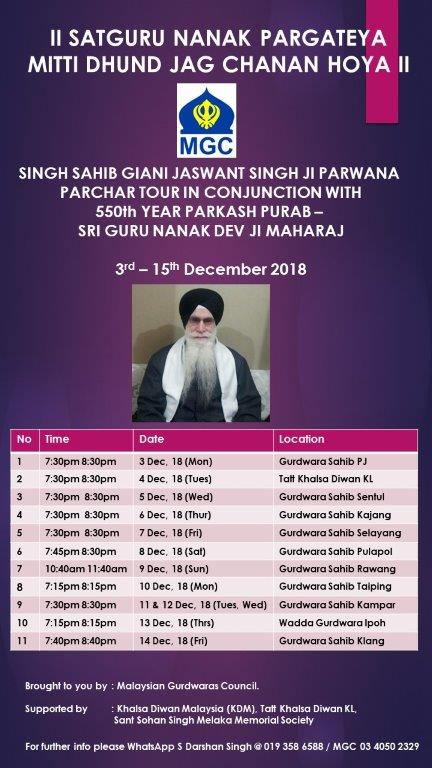
Singh Sahib Giani Jaswant Singh Parwana, a former Darbar Sahib head granthi, is in Malaysia for a Sikh parchaar tour in conjunction with 550 year Guru Nanak Dev Ji Parkash Purab.
The tour is organised by the Malaysian Gurdwaras Council (MGC) and supported by Khalsa Diwan Malaysia (KDM), Tatt Khalsa Diwan Selangor and Sant Sohan Singh Ji Malacca Memorial Society.
Gurdwara Sahib Sentul – 5 December 2018 (Wednesday) , 7:30pm – 8:30pm
Gurdwara Sahib Kajang – 6 December 2018 (Thursday), 7:30pm – 8:30pm
Gurdwara Sahib Selayang – 7 December 2018, (Friday), 7:30pm – 8:30pm
Gurdwara Sahib Pulapol – 8 December 2018, (Saturday), 7:45pm – 8:30pm
Gurdwara Sahib Rawang – 9 December 2018, (Sunday), 10:40am – 11:40am
Gurdwara Sahib Taiping- 10 December 2018, (Monday), 7:15pm – 8:15pm
Gurdwara Sahib Kampar – 11 & 12 December 2018 (Tuesday, Wednesday), 7:30pm – 8:30pm
Wadda Gurdwara Sahib Ipoh – 13 December 2018, (Thursday), 7:15pm – 8:15pm
Gurdwara Sahib Klang – 14 December 2018 (Friday), 7:40pm – 8:40pm
Amar Singh at the Sikh prayer session at Gurdwara Sahib Pulapol, Kuala Lumpur, hours before his official retirement – Photo: PDRM
The highest ranking Sikh police officer in Asia, ex-India, retired today. The retirement of Malaysian police commissioner Amar Singh Ishar Singh also brings to a close a three-generation run spanning over 90 years in the police force.
Though having served a good 35 years in the Malaysian police force, Amar Singh, who retires as the Federal Commercial Crime Investigations Department (CCID) director, says he never worked even for a day.
“I did not work a single day in the police force. You work when you’re paid to do something. I did what I like to do and I got paid for it. (In essence) I never really worked even for a single day.
“This is the Punjabi spirit. We don’t work. We serve. Whatever we do, we do it with passion, drive and love. You don’t call that work. You can pay, that’s by the way,” he told more a gathered crowd of more than 300 Sikh policemen and community members at a farewell at the Gurdwara Sahib Pulapol in Kuala Lumpur today (5 Dec 2018).
You can view parts of the event today captured live at Asia Samachar Facebook page.
“We are blessed that our parents came up the hard way. My family history in the police force spans beyond 90 years. My grandfather was a policeman. His number was PC2023. He served at Federated Malay States Police (FMSP) in the 1920s.
“My mum was born in Raub (in Pahang). She was brought up at Bukit Aman headquarters. My father then joined the police force.
“And later so did I. Not that I wanted to be a policeman. I told my dad: even if this is the last job in the world, I didn’t want to be a policeman. Things have changed. You ask me now, I love being in the police force. My 35 years in the force was beautiful, we did good work together.”
Amar Singh’s maternal grandfather, Bachan Singh, was a constable who joined the force in the early 1900s. He was reported to have served in Kuala Kubu Baru, Kuala Lipis and Raub, and retired in Klang in the 1940s.
His father, Ishar Singh, joined the Federated Malay States Police in 1939, a year after coming to Malaya from Punjab and was a pioneer member of the police jungle squad established during the Emergency, according to a news report. He retired as a corporal in 1971 and died in 1999 at the age of 80.
Amar Singh at the Sikh prayer session at Gurdwara Sahib Pulapol, Kuala Lumpur, hours before his official retirement – Photo: PDRM
FIGHTING SPIRIT, DO IT NOW
In a message to fellow policemen, he said: “We Sikhs are fighters. We Sikhs get what we want.”
He recalled his early days. He spoke about his uncle Basant Singh, whose police number was 3699 and his dad, Koperal 1610, who were good buddies.
“I used to drive them from Ipoh to KL. They would be singing songs, having a good time. Both my Uncle and my dad told me this: Amar, the salutes that we have given in the police force, make sure you collect them back all, with interest. Incidentally, both of them were moneylenders.”
“This was a driving force for me. When I was the commandant Pulapol (Kuala Lumpur) and receive salutes in the thousands, I used to think of both of them. I would say: These salutes are for you.”
Talking to the largely Sikh crowd before him, Amar said: “Sikhs have a fighting spirit in them. Whatever we set our eyes upon, we get it. And my father always says: kal da kaam aajh karo, hunn daa kaam hunn karoo.
“Don’t procrastinate. Do tomorrow’s work today, and do today’s work now.”
In an earlier event, Amar handed over duties as the Bukit Aman CCID chief to Deputy Comm Saiful Azly Kamaruddin, who will be the CCID acting director. The event was witnessed by Inspector General of Police Mohamad Fuzi Harun.
“He is truly a rare gem of a policeman and I wish him a happy retirement,” Fuzi said of Amar.
REMARKABLE CAREER
Amar broke all the barriers that the early two generation members form his family would have faced.
He retired as a Police Commissioner, the highest rank achieved by an Indian in the Malaysian police force.
He was made history for the Sikh community in Malaysia when he was appointed as the Kuala Lumpur police chief chief police officer, with the rank of commissioner, on 19 Feb 2016.
This is the highest rank attained by a Sikh police officer in Malaysia. Santokh Singh was the last Sikh to be appointed as a state police chief when he was made Selangor CPO with the rank of Senior Assistant Commissioner of Police (SAC) 1.
He broke the glass ceiling for the community again when, effective 14 Oct 2017, he was appointed as the commercial crime investigation director at the Malaysian police headquarters.
He was also the first Indian and Sikh cop to become a director at Bukit Aman, as the Malaysian police headquarters is usually referred to.
Amar Singh hands over duties to his deputy DCP Saiful Azly, witnessed by IGP Fuzi – Photo: PDRM
ASIA SAMACHAR is an online newspaper for Sikhs / Punjabis in Southeast Asia and beyond.Facebook | WhatsApp +6017-335-1399 | Email: editor@asiasamachar.com | Twitter | Instagram | Obituary announcements, click here |
Brothers: Late Mangal Singh, Joginder Singh, Late Kajan Singh & Jaswant Singh
Path Da Bhog: 9 December 2018 (Sunday), 9.30am to 11.30am, at Gurdwara Sahib Seremban, followed by Guru Ka Langgar.
Contact: Harpreet Singh 019-6289202
| Entry: 5 Dec 2018 | Source: Family |
ASIA SAMACHAR is an online newspaper for Sikhs / Punjabis in Southeast Asia and beyond.Facebook | WhatsApp +6017-335-1399 | Email: editor@asiasamachar.com | Twitter | Instagram | Obituary announcements, click here |
HISTORIC MOMENT: Pakistan PM Imran Khan and Punjab MLA Navjot Singh Sidhu – Photo: Imran Khan Official
By I.J. Singh | OPINION |
India and Pakistan reminded me of a couple that have lived together for a lifetime and more. But they have also grown weary of each other. When the British left the Indian subcontinent the main body of land (largely the northwest territory of Punjab) was divided into India and Pakistan. This fragmentation 71 years ago of a people with shared ethos — land, language culture, cuisine and music — was cataclysmic. They plundered and killed each other in 1947 as perhaps only Biblical brothers do, and they have waged war on each other thrice along with many a smaller skirmish to sustain their hatred of each other. Keep in mind also that both India and Pakistan are now nuclear powers.
Yet, these neighbors love each other; their ties antedate time and continue to bind them. Occasionally they are nice to each other, but mostly they bicker and vilify the other. The religious reality of Sikhi took birth in what is now Pakistan; that is necessarily where we look for the early history, traditions and markers of Sikhi
I know of what I speak. I was born and attended primary school in what is now Pakistan. I remember the rioting and killings of 1947, spent the next 13 years in India and the rest of my life in America.
Not surprising, therefore, that caravans of Sikh pilgrims from across the world, and more so from neighboring India, are anxious to visit Pakistan and reconnect with their history. This has not always been popular with India’s political bureaucracy. They see these visitors (largely Sikh) as possible enemies of India fraternizing with Pakistan — the enemy du jour. The ethos, cuisine, and language that collectively define all Punjabis, Sikhs, Muslims or Hindus, stoke the politically-driven suspicious mind and spills out onto society. But this year is super-special. It’s 550 years since the birth of Guru Nanak, the founder of the Sikh faith. The yearly pilgrimage of Sikhs is no longer a trickle but a raging flood.
For years, Sikhs in India and across the world have been clamoring for easing the process to let Sikhs visit their historical/religious sites in Pakistan, particularly Kartarpur, a town that Guru Nanak founded, where he started the mission of Sikhi and spent his last years. It lies only a short bus ride across the border into Pakistan. Only the span of the river Ravi separates the two countries at that point.
Sometimes, like a bolt of lightning, good sense strikes and jolts us up to the possibilities. Sparks arose in Punjab, and around the world in the Sikh community that perhaps a Guru Nanak Peace Bridge or Corridor of Peace – a walkway – be demarcated running from the India-Pakistan border in Amritsar (India) to Kartarpur in Pakistan. This tribute to Guru Nanak, the Prince of Peace, could bring a people together — separated just 71 years ago, like long lost siblings.
The movement quickly became a rare but raging fire. For success it required governmental and political vision with will andwisdom in both nations. Such qualities are often in short supply but ultimately will emerge in response to a people’s determined will and vision.
That’s exactly what happened.
At a celebratory meeting/bash (November 2018) movers and shakers along with governmental personnel from both India and Pakistan were in full throated support of the endeavor for this corridor of peace. The most notable voices were two prominent former cricketers who had respectively represented their national teams– Imran Khan of Pakistan and Navjot Singh Sidhu of India. Both are active politicians in their respective countries Imran is the current Prime Minister of Pakistan.
Whether you owe loyalty to India, Pakistan or somewhere else in the world this surely is a matter to celebrate. We welcome it wholeheartedly not for the Sikhs alone who are and will remain a minority no matter where in the world they live, but for the entire globe. I repeat that India and Pakistan, are both nuclear armed nations, and committed enemies who have fought many wars
But political constraints often trump common sense. Much of the Indian Press remains suspicious and dismissive of such peace overtures as a workable goal. Their attitudes and reactions remain disappointing. For instance, the Indian Press castigated Navjot Singh Sidhu when he and Imran Khan embraced at the ceremony. The Press is ignoring the place of Sikhs and Punjab during the Freedom Struggle of India as well. This closed mindedness makes me wonder! Have they never seen boxers shaking hands before a fight? Have they never seen dedicated competitors greet each other most cordially in life and death competitions or losers honestly compliment the winners even after a bitterfight? What a pity that they never encountered or learned such spiritual moral values.
For naysayers I submit some parallels to think about: During the cold war, the Berlin wall, that was erected in 1961 dividing Germany into two nations, was demolished 28 years later in 1989. Was that being disloyal to existing realities or was it a progressive humanitarian act? And now in 2018, a new initiative occupies us: South Korea and North Korea, two independent nations that fought a brutal war from 1950 to 1953 are reaching out to each other peacefully to jointly develop the North Korean Railroad system into a modern facility. Remember Vietnam? North and South Vietnam had been at war since the early 1950’s; that America entered after 1954. This historic conflict divided a people and ended in 1973. Vietnam is now a single unified nation at peace with America and its treasured trading partner. Not that I am recommending or even remotely suggesting it, but sometimes I wonder if some political activists dream of the golden past of a greater Bengal as a collaborative entity?
Some final thoughts: 1. A popular American idea: Keep your friends close and your enemies closer. 2. War and cruelty are human realities but peace and goodwill, too, are supreme human traits and aspirations. Perpetuating a zero-sum game – a losing proposition — ultimately helps no one. The idea here is to evolve in a direction such that enemies become participants and partners in progress.
Building bridges across a political divide is never easy but it is so necessary.
[I.J. Singh is a New York based writer and speaker on Sikhism in the Diaspora, and a Professor of Anatomy. Email: ijsingh99@gmail.com]
* This is the opinion of the writer, organisation or publication and does not necessarily represent the views of Asia Samachar.
ASIA SAMACHAR is an online newspaper for Sikhs / Punjabis in Southeast Asia and beyond.Facebook | WhatsApp +6017-335-1399 | Email: editor@asiasamachar.com | Twitter | Instagram | Obituary announcements, click here |
Sikh girls in Birmingham and the West Midlands were subjected to decades of abuse by grooming gangs despite pleas for help, a shock report claims.
And members of the Sikh community turned vigilante when the police and other authorities failed to act on their concerns, the authors of the study allege.
Entitled “The Religiously Aggravated Sexual Exploitation of Young Sikh Women Across the UK”, the report has echoes of the Rotherham child sexual exploitation scandal.
The West Midlands girls are said to have been targeted by “fashionably-dressed adult Pakistani men” before being isolated from their families and mistreated by one or more abusers.
The authors say the research is not a “witch-hunt against any individual, community, culture or faith” but an attempt to understand the root causes of the issue, which they feel deserves the same national spotlight as the Rotherham scandal.
The study has been produced by the Sikh Mediation and Rehabilitation Team (SMART), an independent organisation, in conjunction with Sikh Youth UK.
Deepa Singh, a co-ordinator for Sikh Youth, said: “This is a victory for silent victims within the Sikh community who have been silenced by Government bodies whose cries for help were ignored.
“The truth is evidenced and it will now be for central government and local authorities to address the growing concern of continued targeted abuse of Sikh girls.”
ASIA SAMACHAR is an online newspaper for Sikhs / Punjabis in Southeast Asia and beyond.Facebook | WhatsApp +6017-335-1399 | Email: editor@asiasamachar.com | Twitter | Instagram | Obituary announcements, click here |
Third gen cop: Amar’s badge CP G/10305. The other two badges are that of his maternal grandfather and father
Malaysia’s top Sikh cop Amar Singh Ishar Singh will be retiring tomorrow (5 Dec 2018) after an illustrious career that saw him coming in the limelight on numerous occasions.
The third generation police retires as a Police Commissioner, the highest rank achieved by an Indian in the Malaysian police force.
He was made history for the Sikh community in Malaysia when he was appointed as the Kuala Lumpur police chief chief police officer, with the rank of commissioner, on 19 Feb 2016.
This is the highest rank attained by a Sikh police officer in Malaysia. Santokh Singh was the last Sikh to be appointed as a state police chief when he was made Selangor CPO with the rank of Senior Assistant Commissioner of Police (SAC) 1.
Amar broke the glass ceiling for the community again when, effective 14 Oct 2017, he was appointed as the commercial crime investigation director at the Malaysian police headquarters.
He becomes the first Indian and Sikh cop to become a director at Bukit Aman, as the Malaysian police headquarters is usually referred to.
Amar Singh’s father and maternal grandfather were both policemen.
His father, Ishar Singh, joined the Federated Malay States Police in 1939 a year after coming to Malaya from Punjab and was a pioneer member of the police jungle squad established during the Emergency, according to a news report. He retired as a corporal in 1971 and died in 1999 at the age of 80.
Amar Singh’s maternal grandfather, Bachan Singh, was a constable who joined the force in the early 1900s. He was reported to have served in Kuala Kubu Baru, Kuala Lipis and Raub, and retired in Klang in the 1940s.
KL Pulapol commandant SAC Samsudin Mat (third from right) and his team listening to Kuala Lumpur CPO Commissioner Amar Singh (right) explaining about the activities at the Gurdwara Sahib Pulapol, a long-standing gurdwara built within the compounds of the police training centre from the times of the British – PHOTO / ASIA SAMACHAR
Itinerary | 5 Dec 2018 (Wednesday) | Gurdwara Sahib Pulapol, Kuala Lumpur
12pm-1pm: Lunch
1pm-2.20pm: Kirtan darbar
2.20pm-2.45: Dasmesh Band performance
2.45pm-4pm: High Tea
4pm-4.15pm: Beating the Retreat Ceremony at Marching Square, Pulapol
ASIA SAMACHAR is an online newspaper for Sikhs / Punjabis in Southeast Asia and beyond.Facebook | WhatsApp +6017-335-1399 | Email: editor@asiasamachar.com | Twitter | Instagram | Obituary announcements, click here |
A body of a 50-year old Sikh patient who died 10 days ago in Ipoh, Perak, remains unclaimed. The hospital authorities are trying to contact his next of kin.
Pradeep Singh a/l Sukhdev Singh died at Hospital Raja Permaisuri Bainun in Ipoh on 23 Nov 2018.
Those with information on the next of kin can contact Raja Mangeet Singh (+6012-5381709), the Perak State Forensic Supervisor based in Hospital Raja Permaisuri Bainun.
UPDATE (4 Dec 2018): The family has been reached and funeral arrangements have been made.
ASIA SAMACHAR is an online newspaper for Sikhs / Punjabis in Southeast Asia and beyond.Facebook | WhatsApp +6017-335-1399 | Email: editor@asiasamachar.com | Twitter | Instagram | Obituary announcements, click here |
Balvinder Singh at gurdwara at Wan Chai – Photo: Nota Tam / SCMP
By David Vetter | SCMP |
Balwinder Singh Brar remembers his early days at the finance company where he worked as an adviser.
Everyone in the office was Chinese, and he stood out not only as the only non-Chinese but also as a Sikh with a beard and long hair under his turban.
“They had no idea where I was from, why I looked like this,” he recalls.
But some of his more outgoing workmates eventually asked about his appearance. “They said they’d never met someone like me before, so they wanted to understand,” he says.
Singh, 24, who was born and raised in Hong Kong and speaks fluent Cantonese, was only too happy to tell others about his South Asian and Sikh background, and most of his colleagues quickly accepted him.
His experience was largely positive, but many non-Chinese – and South Asians in particular – find it difficult to fit into the Hong Kong workplace because of a combination of cultural differences, language barriers and old-fashioned prejudice.
These are issues the city’s official equality body, the Equal Opportunities Commission (EOC), aims to tackle head-on with a new employers’ charter that several major firms will sign on Thursday.
Read full story, entitled How ethnic minority workers are shunned in Hong Kong, and whether a new equality charter for companies will change this, here.
As the Sikhs worldwide honour the memory of Guru Tegh Bahadur ji (Gurpurab date was 24 November), there are a number facts about the life and martyrdom of Guru ji which we need to research further.
Some of these were confirmed from contemporary sources like the Bhat Vahis by my own study as requested by the Sikh Missionary Society UK about two years ago. It became clear that Guru Hargobind ji decided the strategy to be followed by successor Guru Sahiban after him. The Nirmal Panth founded by Guru Nanak Sahib began to emerge as the Khalsa Panth. The expression Khalsa was used by Guru Hargobind in his Hukamnamas (e.g. Purab di Sangat Guru da Khalsa hoay..).
His youngest son (Guru) Tegh Bahadur ji spent the first 23 years of his life in the company with his beloved father and was fully briefed about his mission before he was sent to Bakala with his mother, Mata Nanaki ji, and his wife, Gujri ji. Guru Tegh Bahadur, a great saint-warrior, remained active before and after Guruship. His bravery in the battle of Kartarpur at the age of 14 years earned him the title Tegh Bahadur from his father Guru.
Even after starting his life at Bakala, he remained constantly in touch with the Guru Family at Kiratpur and undertook parchaar tours from 1656 and became the most travelled Guru after Guru Nanak Sahib. In accordance with the grand strategy he was named as the Baba of Bakala by Guru Har Krishan before his demise and, contrary to accounts, the Guruship was passed on to Tegh Bahadur at an open well-attended ceremony on at Bakala on 11 August 1664, before Makhan Shah came to Bakala to serve Guru ji for a prolonged period.
It is little known that Guru ji was arrested or detained three times when, finally, Aurangzeb himself ordered his execution at Delhi. Contrary to traditional stories, Delhi Sikhs played a daring and well-planned part following Guru ji’s execution.
The Guru stood against zealous proselytization and bigotry. It was in that sense that in the history of great martyrdoms for worthy causes, the martyrdom of Guru Tegh Bahadur was described as unique by Guru Gobind Singh ji. Tilak janju Rakha Prabh tanka (Guru Gobind Singh) should be read in the sense that it was a consequence of the egalitarian Sikh ideology. Even the highly biased NCERT [India’s National Council of Educational Research and Training] historian realised this when, otherwise, he wrote a highly distorted account about the reason for the shaheedi of Guru ji. The universal objective of Guru Nanak’s mission was to secure the human rights of all. Religious freedom is one of those rights.
In Guru Tegh Bahadur, the Sikhs have a most remarkable story to tell the world torn apart by religious conflict. It is the missionary duty of every Sikh to read and disseminate this story as widely as possible.
(Note: In April last year, I completed the first study of the life and supreme sacrifice Guru Tegh Bahadur ji: printed by the Panjab Times UK and available from the Sikh Missionary Society UK. ( https://www.sikhmissionarysociety.org/ )
Gurmukh Singh OBE, a retired UK senior civil servant, chairs the Advisory Board of The Sikh Missionary Society UK. Email: sewauk2005@yahoo.co.uk. The article first appeared at The Panjab Times, UK
* This is the opinion of the writer, organisation or publication and does not necessarily represent the views of Asia Samachar.
ASIA SAMACHAR is an online newspaper for Sikhs / Punjabis in Southeast Asia and beyond.Facebook | WhatsApp +6017-335-1399 | Email: editor@asiasamachar.com | Twitter | Instagram | Obituary announcements, click here |























 Singh Sahib Giani Jaswant Singh Parwana, a former Darbar Sahib head granthi, is in Malaysia for a Sikh parchaar tour in conjunction with 550 year Guru Nanak Dev Ji Parkash Purab.


 By Gurmukh Singh OBE | PANJAB TIMES |