[ASIA SAMACHAR is an online newspaper for Sikhs in Southeast Asia and surrounding countries. We have a Facebook page, do give it a LIKE. Follow us on Twitter. Visit our website: www.asiasamachar.com] 16187
[The fastest way to reach Asia Samachar: Facebook message or WhatsApp text to +6017-335-1399. For obituary announcements, click here]
MPA Ramesh Singh Arora introducing the Sikh Marriage Bill 2017 in the Punjab Assembly
Sikhs in Punjab, Pakistan, will soon be able to solemnise and register Anand Karaj marriages under the soon-to-passed Sikh Marriage Act 2017.
Ramesh Singh Arora, the first and only Sikh lawmaker in the Punjab state assembly, introduced the Punjab Anand Karaj Bill 2017 at its recent sitting, a move that did not see any objections.
“It will take about two months for the assembly to pass the Bill,” he told Asia Samachar in a text message.
When asked if Sikhs could see such a legislation at the national level, he replied: “This is the first step…I will then try to pass it in the National Assembly.”
On 19 March 2017, Pakistan President Mamnoon Hussain gave his approval to the Hindu Marriage Bill 2017 on the advice of Prime Minister Nawaz Sharif, turning it into law.
The Sikh marriage proposed legislatio is meant to provide for the solemnisation and registration of Anand Karaj in the province of Punjab.
The bill noted that it was ‘expedient to remove any doubts as to the validity of the marriage ceremony among the Sikhs, commonly known as called Anand Karaj.’
In the bill, “Anand Karaj” means the lawful union of a Sikh male and Sikh female solemnised under the Act and conducted in accordance with the practices of the Sikh religion, as permitted in the Guru Granth Sahib.
The bill also empowers women and children to claim their right in inheritance, according to a Pakistan newspaper.
Ramesh lauded the government and thanked Nawaz Sharif, CM Shahbaz Sharif, Interior Minister Ahsen Iqbal, Provincial Minister Raja Ashfaq Sarwar and Law Minister Rana Sana Ullah Khan for extending cooperation to the Bill responding to the demand of the Sikh community of the country, reports The News.
Ramesh told the newspaper that once again it had been proven that Pakistan was the most secure country for the minorities, adding that nowhere else and even in the country like India where Sikh population was over 20 million, it could register its marriages as a community, and have to merge with Hindus under the law, thus losing their individual identity.
In Pakistan, where the volume of Sikh population is much lesser than those living in India, this right has been granted to them to register their marriage which would enable the women, children to claim their rights in inheritance as per law, he told the newspaper.
He added that he was thankful to the Opposition MPAs who did not oppose it.
Ramesh was elected Member of Provincial Assembly (MPA) of Punjab in 2013 general elections from one of the seats reserved for non-Muslims. He chairs the assembly’s Standing Committee on Commerce & Investment.
MPA Ramesh Singh Arora with the proposed Sikh Marriage Act 2017 before stepping into the Punjab state assembly
[ASIA SAMACHAR is an online newspaper for Sikhs in Southeast Asia and surrounding countries. We have a Facebook page, do give it a LIKE. Follow us on Twitter. Visit our website: www.asiasamachar.com] 16177
[Fastest way to reach Asia Samachar: Facebook message or WhatsApp +6017-335-1399. Our email: editor@asiasamachar.com. For obituary announcements, click here]
The Delhi High Court has issued a notice requiring mosques, mandirs and other religious places in Delhi to restrict the decibel level of loudspeakers as well as restricting the height of the loudspeakers at only eight feet from the ground.
The Delhi High Court today (25 Oct 2017) issued a notice to the Central Government in a plea seeking removal of loudspeakers from religious places on the ground that such practice violates the right to be left alone which is a part of the right to privacy laid down by the Supreme Court.
The petition filed by one Sanjjiiv Kkumar was heard by the Bench of Acting Chief Justice Gita Mittal and Justice C Hari Shankar, reportsLive Law Network.
The Delhi High Court issued the notice to the Union of India on a public interest litigation for removal of loudspeakers from all religious structures on the ground that their use is an encroachment on a person’s “right to be left alone and spatial control” and thus violates the newly recognised fundamental right to privacy.
A bench headed by Acting Chief Justice Gita Mittal issued the notice on the PIL filed by social activist Sanjjiiv Kkumaar.
Sanjjiiv, in his PIL, traced the advent of all religions in India to say, “Hinduism is 4,000 years old, Jainism is 2,600 years old, Buddhism is 2,500 years old, Christianity is 2,000 years old, Islam is 1,400 years old, Sikhism is 500 years old and on another hand, Moving coil current loudspeakers are not even 100 years old. Thus, it’s beyond doubt, and as facts and truth speaks for itself per se, loudspeakers were never a part of any religion”.
“As loudspeakers is not part of/intrinsic to any of the religions as all religions are 4,000 to 500 years old whereas loudspeaker came into existence in 1924, that is less than 100 years and hence, banning them will not violate Article 25 or 26 of the Constitution of India,” he said.
The report added that the petition also quoted from the Supreme Court’s verdict in Forum, Prevention of Envn. and Sound Pollution as: “No religion ever says to force the unwilling to listen to expressions of religious beliefs.”
“This observation of Hon’ble Apex Court is of utmost importance as what Supreme Court says, Loudspeakers do exactly opposite of the same and hence violate fundamental rights of citizens of India,” the PIL said.
During the hearing, the Pradhan of Jai Mata Mandir and the Imam of Gosiya Mosque in the Sunder Nagri area offered an undertaking on their willingness to abide by the court’s directions, reportsIndia Today.
“Our biggest challenge was to handle this sensitive matter in an amicable way. I am glad that the state (police) instead of imposing anything on the respondent mosque and temple invited them to court for a mutual settlement,” the report quoted counsel for the government Anjana Gosain.
Justice Sanghi asked the assistant commissioner of police (traffic) to ensure that the guidelines on decibel limits under the Environment (Protection) Act, 1986, were strictly followed in the area. The court asked for compliance report by March 10. The court was hearing a petition by Madhav Roy of Ekta Vihar, who sought respite from the noise pollution.
Explaining its directions, the court said the loudspeakers should be placed in such a way that the sound waves are focused at the centre of the place of worship. This will ensure that only the devotees interested in listening to the discourses get to hear these and sound doesn’t go outside, the India Today report added.
“I direct that no religious establishment or institution or place of worship in Ekta Vihar or Sunder Nagri shall install loudspeakers at a high point or close to the pinnacle of the religious place of worship,” Justice Sanghi said.
[ASIA SAMACHAR is an online newspaper for Sikhs in Southeast Asia and surrounding countries. We have a Facebook page, do give it a LIKE. Follow us on Twitter. Visit our website: www.asiasamachar.com] 16166
[Fastest way to reach Asia Samachar: Facebook message or WhatsApp +6017-335-1399. Our email: editor@asiasamachar.com. For obituary announcements, click here]
Saskaar / Cremation: 2.30pm on 26 October 2017 (Thursday) at Serendah Crematorium, Selangor
Path da Bhog: 5 November 2017 (Sunday), 5pm-7pm, at Gurdwara Sahib Rawang, Selangor
Contact:
Boghar Singh 016-218 7772
Dalvinder Singh 012-291 9938
Jagdeep Singh 010-979 2156
| Asia Samachar | Entry: 25 Oct 2017; Updated: 31 Oct 2017 | Source: Family |
[ASIA SAMACHAR is an online newspaper for Sikhs in Southeast Asia and surrounding countries. We have a Facebook page, do give it a LIKE. Follow us on Twitter. Visit our website: www.asiasamachar.com] 16168
[The fastest way to reach Asia Samachar: Facebook message or WhatsApp text to +6017-335-1399. For obituary announcements, click here]
Harshdeep Kaur — the voice behind some of the stirring songs like Katiya Karun from Rockstar, Heer from Jab Tak Hai Jaan, Zaalima from Raees — will be in Singapore on Nov 3 as part of the MTV Unplugged musical concert.
The unique thing about this lady singer is the turban that she dons when on stage? What’s the story behind the turban?
“It’s a style statement. It started with the reality show I was doing ‘Junoon Kuchh Kar Dikhaane Ka’. So I started wearing the turban in that show and now it has become a part of my identity. Whenever I perform on stage or sing Sufi songs, I wear a turban,” she tells Connected To India in an interview in the run-up to the Singapore event.
Introduced to music at the age of five, Harshdeep has come a long way after winning the reality show ‘Junoon Kuchh Kar Dikhaane Ka’ in 2008. She has worked with some leading music directors such as AR Rahman, Pritam, Vishal-Shekhar, Shankar Ehsaan Loy and Amit Trivedi, the report said.
This is the first ever MTV Unplugged in Singapore, but Harshdeep is no stranger to the republic, having performed at Esplanade at the Jagjit Singh Tribute concert.
“We were very happy to see the response to how people look for good music and how they come and listen to soulful music,” she said.
[ASIA SAMACHAR is an online newspaper for Sikhs / Punjabis in Southeast Asia and beyond. How to reach us: Facebook message or WhatsApp +6017-335-1399. Our email: editor@asiasamachar.com. Follow us at Facebook, Twitter, Instagram. For obituary announcements, click here]
GROWING: BBC reports on the growing Sikh community in Pakistan – Photo grab from BBC report (Pakistani Hindus who adopted Sikhism – BBC News Punjabi)
By Gurcharan Singh, London
The growth of Sikhism is renewing in Pakistan with great enthusiasm.Greater good deeds by Sikhs at international level , the success of Sikhs in other countries , the growing numbers of Sikh converts in the west is influencing the suppressed Hindu communities in Pakistan.
That aside, the negative activities of detractors and their fake books, and increasing violent dramas in Gurduaras has not yet dampened the would be Sikhs in Pakistan.The Pakistani Sikh converts are influenced more by the positive message of Guru Granth sahib, thus find it regenerates their confidence and image in Pakistan, as a Sikh. They found that being Sikhs it gave them multiple preaxis to dignity, esteem and empowers them as individuals and as Sikhs.
Hinduism is looked upon negatively,in Pakistan because when the fanatical Hindu right wingers – RSS create issues of divide and rule among minorities and take their anger out on Muslims and Dalits,in India,there is a reaction among the Moslem nations towards such atrocities being committed upon the minorities.
It is no different in Pakistan, as the Muslims do react towards the Hindus in Pakistan.The Hindu society does not feel safe within Pakistan, in most circumstances, but especially so,when they are harassed as the result of RSS activities in India.
There are many instances and reports of young Hindu girls being abducted and forcefully indulged into nikkah. There are countless instances that attacks upon hindus have taken place.
But such has not taken place against Sikhs, bar a few cases from the tribal Taliban infested areas, where some Sikh victims have been reported, too, along with thousands of Muslim victims.The tribal areas generally have no Hindu population.
The Muslim brotherhood regards the Sikhs as people of the Book and believers of One God, like themselves.They recognise Sikhi demands goodwill and respect towards all humanity both in words and actions.They also understand that the philosophy of Guru Granth Sahib is very much closer to the Koran. They have much respect for Sikhs and regard them very disciplined and honourable society of people.
EMBRACING SIKHISM
Thus, such conditions, has created a beeline for many Hindus to adopt Sikhism readily. A recent BBC report [See: Pakistani Hindus who adopted Sikhism – BBC News Punjabi, 5 Oct 2017] investigation into the religions of Pakistan 2017 confirmed the rising conversion of Hindus into Sikhism, not only in Sindh, but Khairpur and Balochistan.
In 1947, the entire Sikh population had left Sind. But now, in a Karachi suburb of Oop Ngri lives Srd Krishan Singh who previously was a Hindu, and worshipper of Ram Chander and various gods like Mahakaal and Durga Devi.
Not too long back, about 10 years, he along with his two sons, four brothers and two nephews, were initiated into the Sikh religion.
Krishna admits that since they adopted Sikhism, their relations with the local authorities and the surrounding Muslim society has improved tremendously, and they are very respectfully addressed as ‘Sardar Sahib’, and looked upon with great awe and not with contempt or opposition.
It does not stop there. Socially they have cordial relationship with Muslims and they are invited to intermingle in Muslim marriages, and get togethers, where vegetarian foods are prepared for them, specially.
Krishan says: “When we were Hindus, we were never regarded with much respect, often sent to coventry, in our presence.”
Krishan Singh – Grab from BBC News Punjabi
The population of Krishan’s surburb was initially all Hindu but currently there are 40 Sikh families, who have all adopted Sikhism from Hinduism. Most of the people are from Baghrri sub castes. The building of a large Gurduara is taking place, currently, supported by funding from expatriate Sikhs. The Gurduara will be able to seat 500 people.
Duruu Singh is the jathedar of this Gurduara and locality. Duruu Singh says that whenever Hindus go in jathas to Nankana Sahib and meet the foreign Sikhs who have arrived; they get influenced by the love shown by these foreign Sikhs, that many on return decide to also adopt Sikh faith.
He goes on to say, that often, stones and garbage are thrown at the statues of devis and devtas by the local Muslim population. Often, abuse also takes place of the statues, and individual persons of Hindu community. But such actions are NOT committed against Gurduaras or the visible Sikhs.
This why Hindus and Dalits in Pakistan are increasingly adopting the Sikh faith. During recent gurpurab of Guru Gobind Singh, the police was made available to ensure Sikhs could celebrate the nager kirtan (kirtan procession) without any issue. No issues even rose as the local Muslims joined together with Sikhs in the celebration. Hindu festivals cannot be celebrated openly.
Karachi’s Aram Bagh Gurduara has been now opened after 24 year long legal case and Sikhs have started thronging that Gurduara. Before 1947, there were over seven Gurduaras in Karachi, but have been run down due to lack of care. Duruu says if all these Gurduaras are reopened, Sikh numbers will certainly increase.
Hira Singh – Grab from BBC News Punjabi
A Srd Hira Singh, an advocate in the High Court of Sind, converted to Sikhism long time ago. In the BBC interview, he says that about 1,100 people from the Dalit brotherhood have converted to Sikhism through his own private efforts in the last five years. He teaches them the messages of Guru Granth sahib, care and love for humanity and hard work -thus 1,100 have become Sardars. These were people who even the Hindus rejected and would not offer their glasses to drink water from. Now everybody refers to them as SARDAR JI or Sardar sahib.
There is a substantial Hindu minority in Sind, who believes in Guru Nanak Ji. There is a Guru Granth in many mandirs along with the statues of Mahakal, Durga Devi or Ram Chander.
Now, as the increasing Sikh population is building their separate Gurduaras, there is no such pooja or duality of worshipping mythology or puranic verses. Hira says that he preaches Sikhs do not worship idols or puranic teachings. New converts take that seriously, and concentrate upon the teachings of Guru Granth Sahib.
NOT ORGANISED CONVERSION
The leader of Pakistan Hindu Council Mangla Sharma grudgingly accepts that there is a substantial scale conversion going on among Hindus into Sikhism. He also admits that this is not an organised conversion, but people initiating into Sikhism on their own free will. He says that 20-25 years ago, there was NOT a single VISIBLE Sikh to be seen in SIND, nor there was even a seat for Sikhs in the National Assembly of Sind, all this has changed now.
He goes on to say that since from 2000, many good Sikh deeds hit the news headlines. People started taking notice of the Sikh religion. The people who adopted the Sikh religion soon found it was to their advantage to be Sikhs, both in community and also politically in government, and as said already it offered them multiple opportunities to enrich and enhance their own standing and quality of life in Pakistan.
Mangal goes on to say that the teachings of Sikhism are universal and it can be seen the Sikhs are a very cohesive community and support each other closely both in business and other aspects of life.They are on a positive financial footing and well respected among Muslims and government.
Also, in recent times, the Sikhs took a leading role in a case in Sind high court against alcohol prohibition with great success, and earning respect among Muslims. Secondly, there was census box for Sikhs in the National Census, now they have won that right too, which has boosted the Sikhs.
Mangal says the success of Sikhs in foreign western and other countries has filtered through, which has created an impressive image of being Sikhs, has persuaded many to convert to Sikhism in Pakistan.
[ASIA SAMACHAR is an online newspaper for Sikhs in Southeast Asia and surrounding countries. We have a Facebook page, do give it a LIKE. Follow us on Twitter. Visit our website: www.asiasamachar.com] 16019
[Fastest way to reach Asia Samachar: Facebook message or WhatsApp +6017-335-1399. Our email: editor@asiasamachar.com. For obituary announcements, click here]
M101, a real estate firm headquartered in Malaysia, has opened its doors for Indians to invest and buy property in their project M101 Skywheel. The company said that it is targeting consumers, who want to have a second home in a foreign land, reports The Hindu.
Seth Yap, CEO of M101, who was in Chennai to promote his project, said, “Historically, there have been very close ties between Tamil Nadu and Malaysia. Many big plantations in Malaysia are owned by communities from Tamil Nadu, which have set up huge businesses in both countries. We want such people to see our property.”
“The 800 sq. ft studio apartments are priced at ₹2 crore,” he said, adding that the project was supported by the Malaysian government. Located close to the Petronas Towers, Skywheel is headed for completion by 2020. To market this property, the firm has inked a deal with two Indian real estate firms — REMAX India and Connection Point.
Yasser Rahman, director, Connection Point, said, “A lot of people from Tamil Nadu are buying homes in places like Dubai. With this venture, they will look at Malaysia also. Harinder Singh, director, REMAX India, said Indians are buying property in various regions around the world, including the U.S.A and Australia, the report added.
[ASIA SAMACHAR is an online newspaper for Sikhs in Southeast Asia and surrounding countries. We have a Facebook page, do give it a LIKE. Follow us on Twitter. Visit our website: www.asiasamachar.com] 16148
[Fastest way to reach Asia Samachar: Facebook message or WhatsApp +6017-335-1399. Our email: editor@asiasamachar.com. For obituary announcements, click here]
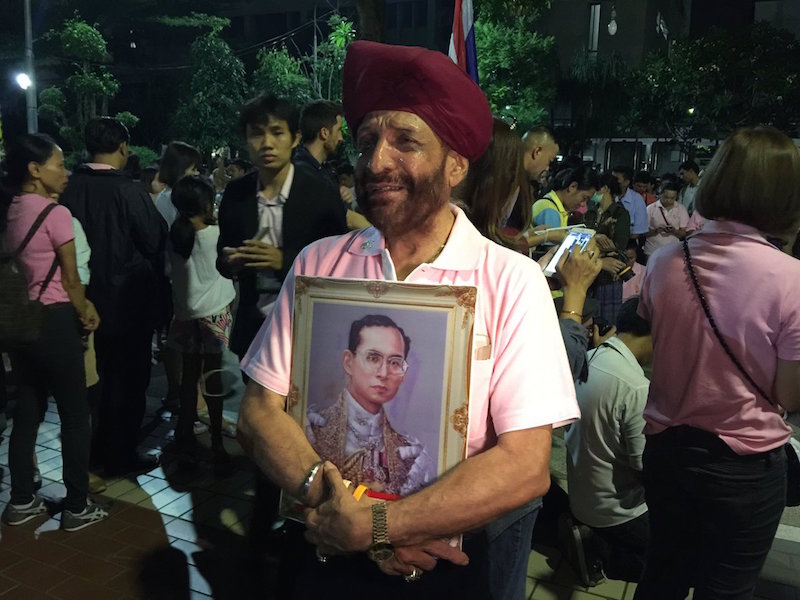
A Thai television channel interviewed Sakda Sachamitr (Darshan Singh Sachdev) on his love and faithfulness for the The Father of the Nation (King Rama IX) and Living the Life according to the footsteps laid down by the Late King Rama IX of Thailand. The interviewed was picked up Thai Sikh News, a Facebook-based news platform.
Darshan was amongst the many Sikhs in Thailand who had joined their fellow countrymen in mourning the death of belovedKing Bhumibol Adulyadej on 13 Oct 2016.
His photo, teary eyed while holding a potrait of the King, became viral on the social media.
A Thai Sikh in tears holding a potrait of the King. The photo was retweeted by the Thai Public Broadcasting Service (Thai PBS) – PHOTO / TWITTER
In a report last year, Asia Samacharreported that Sikhs in Thailand had been holding prayers for the King, including at the Gurdwara Siri Guru Singh Sabha in Bangkok.
“We’ve been holding prayers for the beloved King for some time now. We will be meeting tomorrow to discuss our next programme,”the then gurdwara secretary Surinder Singh told Asia Samachar.
After the passing away of the revered King, his body was moved to the Grand Palace in Bangkok. Over 12 million people have travelled there to pay their respects since. The final rites will take place from Oct 25-29, with the actual cremation taking place on Oct 26.
Among the regional dignitaries at the funeral are former Indonesia president Megawati Soekarnoputri, Singapore President Halimah Yacob and Sultan of Perak Sultan Nazrin Muizzuddin Shah Sultan Azlan Shah from Malaysia.
ASIA SAMACHAR is an online newspaper for Sikhs / Punjabis in Southeast Asia and beyond.Facebook | WhatsApp +6017-335-1399 | Email: editor@asiasamachar.com | Twitter | Instagram | Obituary announcements, click here |
SIKHS IN UNIFORM: Sikhs in the police force in a 1948 photograph taken at Pusing, Perak. Second from the left is Kpl 1610 Ishar Singh, the dad of Commissioner Amar Singh who became the first Malaysian India to become a Federal director. Amar’s maternal grandfather, Bachan Singh, was a constable in the police force. – Photo courtesy of Amar Singh
By Dr Manjit S. Sidhu | Sikhs in Malaysia
Revisiting the Punjab
Only 5 per cent of the Sikh migrants to Malaya had never revisited the Punjab. Amongst the remainder, the time-lag between their emigration to Malaya and the return trip to their native place (Punjab) varied greatly from 2 years to 50 years. Eighteen per cent revisited the Punjab within 5 years.
Another 35 per cent did so between 6 and 10 years while 28 per cent took between 11 to 20 years. Fourteen per cent took 21 years or more before making the sentimental journey to their places of birth. Amongst them were some who revisited the Punjab after 40 years. [Source: Interviews by author in 1978 and 1979 of 100 Malaysian Sikhs born in India and Pakistan].
The 5 per cent who had yet to revisit India, still entertained visions of doing so in the future. Unless they make an early decision their dreams may fail to materialise as they are old men. The proportion of those who never revisited the Punjab might have been higher but for the fact that in many cases (especially for those in the police force) their passage was provided for-once every five years-by the colonial authorities.
[Footnote: Since many Sikh migrants to Malaya were poor, they evolved a system to help fellow Sikhs to revisit the Punjab. Most Sikhs from the same town would contribute some money (usually between M $10 and M $20) to help their fellow Sikh brother to return to the Punjab for a visit.]
Table 11: Length of time taken to revisit the Punjab since emigrating to Malaya
Length of time (Years) / Per cent
0 – 5 18
6 – 10 35
11 – 15 18
16 – 20 10
21 – 30 7
3- 1 40 2
Over 41 5
Never revisited 5
Total 100
Purpose of first revisit
One quarter of the Sikh migrants to Malaya revisited the Punjab with the intention of getting married. Of these, 2 were unsuccessful and returned to Malaya with their marital status remaining the same (i.e. single). Two per cent gave the reason for the revisit as pilgrimage to the Sikh holy places in India. The largest proportion (53 per cent) gave social reasons for their first visit, the most common being to see their parents or other relations. Fifteen per cent stated the following reasons; medical treatment, to buy land, to have the shares of their ancestral property transferred to their names or their children’s names, to study or to return home as they were without work owing to the Economic Depression of the 1930s. And of course there were 5 per cent migrants who had yet to revisit the Punjab. [The source f
Right up to the mid-19508 most of the Sikhs moving between India and Southeast Asia used the sea route. It was only in the 1960s and 1970s that the air-route between Singapore (or Kuala Lumpur) – New Delhi became popular. But old habits die hard and some still use the Port Klang (or Penang) – Madras sea route since it is not only cheaper but also allows them to carry more luggage. Most of those going through Madras, stay at the Sikh temple to break the journey.
Table 12: Reasons for the first return trip to Punjab
Reasons Per cent
Marriage 25
Pilgrimage 2
Social 53
Other 15
Never revisited 5
Total 100
Subsequent visits to the Punjab
Earlier it was noted that 5 per cent of the Sikh migrants to Malaya had never revisited the Punjab. Eleven per cent had been able to do so only once. A quarter however made two trips to the Punjab. Another 23 per cent did make 3 visits.
Fourth and fifth visits were made by 12 and 9 per cent of the migrants respectively. Thereafter, the frequency declined sharply (see table 13). It is worth recording that 2 wealthy Sikhs did make over 10 trips to the Punjab; these visits were necessitated by their substantial economic interests in both India and Malaya.
About one-quarter of them used the sea route in all their journeys to India. Fifteen per cent used the air-route during their subsequent visits; only on their maiden journey to Malaya did they travel by sea. The remainder used both the sea and air routes during the subsequent visits. Since the 19705 the air route has become popular for several reasons. Owing to increasing competition among the airlines operating in this sector, some airlines offer relatively cheap fares (about $1000 Malaysian Ringgit) for return tickets from Kuala Lumpur to Delhi. Besides, it takes only a few hours to reach New Delhi instead of several days by sea. Furthermore, New Delhi is relatively close to the Punjab and one can reach one’s village from New Delhi within a few hours. The time factor is crucial for taking the air route since it is difficult to get more than a month’s leave from one’s place of work.
Sponsoring subsequent migrants
A large proportion of the Sikh migrants had been helped in one way or another in their migration to Malaya by relatives, fellow villagers and others. To discover whether the same sort of attitude prevailed amongst the emigrant Sikhs covered in this study, they were asked: “Did you help other Sikhs from the Punjab to migrate to Malaya? If yes, what sort of help did you provide?”
Only 17 per cent of the migrant Sikhs had helped others from the Punjab to migrate to Malaya. In most cases they helped relatives but there were some who helped fellow-villagers. In some cases they brought the new migrants along, on their return to Malaya, after a holiday in Punjab. Others sponsored new migrants by sending them entry permits to the Peninsula. Once the fresh migrants landed in Malaya they were usually well looked after by their sponsors until they found employment and got sufficiently adjusted to the new environment.
On the whole it would appear that a majority of the Sikhs covered in the survey avoided sponsoring more migrants from the Punjab. But it should be remembered that about 70 per cent of the Sikhs covered in this survey entered Malaya between 1930 and 1953. The 1930s was a particularly difficult period in the Peninsula’s economic history owing to the economic slump, especially in view of the country’s heavy dependence upon two export commodities – tin and rubber. Their low prices affected all sectors of the Peninsular economy and in turn gave rise to considerable unemployment. Just as the economy began to show signs of early recovery in the late 1930s and early 1940s there came the Second World War when free movement between Southeast Asia and British India ceased altogether.
Although migration from Punjab to Malaya revived after the end of the War, India became independent in 1947 while Malaya remained a British Colony for another decade, thus breaking the former link that existed between the two British colonies. Besides, in 1953, new immigration rules were passed that virtually brought all forms of migration into the Peninsula to a halt.
Despite this, many Sikh females-married to Sikhs from Malaya-from the Punjab continued‘to enter the country freely. But since the Indian sex ratio has improved vastly in the post-Second World War‘ period, the . Malaysian government openly started discouraging non-Malays from bringing alien wives to Malaya. This new policy was introduced from 1979 onwards.
Visits to other countries (excluding India)
In this section the neighbouring countries of Singapore, Thailand and Burma are excluded since these have been common stop-overs for Sikhs travelling between Malaya and India by sea or air. One-fifth of those surveyed had travelled to other regions, such as Indonesia, Hong Kong, Vietnam, Pakistan, Nepal, East Africa, the Middle-East, the United Kingdom and Europe.
One person had even been on a world tour. These visits were made for various reasons. For example, the five who had been to the UK had different reasons for doing so. One who had joined the police force as a constable had gone there several years later for a senior police officer’s course. Another had gone there in the mid-19503 to seek employment, but had returned since he found the cultural differences too great to overcome. One had gone to bring back his son (who was studying there) upon receiving intelligence that the son was about to marry an English woman. Of the remaining two, one had visited Britain as a member of the Malaysian Police Band while the other had gone to UK. as a tourist.
The trips to Pakistan by seven persons were mostly undertaken as pilgrimages to Sikh temples that are located in that country. Of course, two Sikh migrants (Aroras) had been born in the Pakistani Punjab prior to the partition of the Indian Sub-continent. Another Sikh had visited East Africa and the Middle East as a soldier in the British Army, during World War 11. One of the Sikhs visiting Indonesia had gone there to get married to a Sikh girl from that country.
Children settled outside Malaysia
Thirty-five per cent of the migrants had children settled outside Malaysia. Nine per cent revealed that their children had remained in India since birth. Six per cent had married their Malaysian-born daughters in India, while a similar proportion had their daughters married in Singapore; ten per cent have children married and settled in the UK, 3 per cent in Australia and New Zealand and 2 per cent in the US Internal mobility amongst migrant Sikhs Having examined their revisits to the Punjab and other countries, it is also pertinent to examine their mobility within the Malay Peninsula. Table 14 summarises their moves within the country. In all cases the moves imply a shift in residence from one town to another. Intra-urban mobility has been ignored.
Table 14: Geographical mobility In Malaya amongst Sikh migrants
Number of moves Per cent
Did not move since arrival 24
l to 2 moves since arrival 20
3 to 5 moves since arrival 28
6 to 10 moves since arrival 16
Over 10 moves since arrival 12
Total 100
Barely a quarter of the migrants have remained in one place since their first arrival. On the other hand, the majority had moved several times. This was not unexpected since the majority were wage earners and had to move frequently as the situation warranted. The maximum number of moves was often made by Sikhs working in the Police Force who were frequently posted from one town to another and occasionally from one state to another.
The other category to move frequently were the watchmen especially those working in small mines and construction sites. As soon as the minerals were exhausted and the mine closed or the construction work was completed, these workers were compelled to move on in search of new jobs. This procedure was repeated every now and then. On the other hand, those who became salesmen and later businessmen tended to remain in the same place since their contacts were confined to that locality.
Sikhs In Malaysia by Dr Manjit S. Sidhu, p185-p191, Published by Sant Sohan Singh Ji Melaka Memorial Society Malaysia, 1991. – PHOTO / ASIA SAMACHAR
[This is part three of the extract from Chapter 1: Sikh Migration to Peninsular Malaysia from Sikhs in Malaysia by Dr Manjit S. Sidhu, Published by Sant Sohan Singh Ji Melaka Memorial Society Malaysia, 1991]
[ASIA SAMACHAR is an online newspaper for Sikhs in Southeast Asia and surrounding countries. We have a Facebook page, do give it a LIKE. Follow us on Twitter. Visit our website: www.asiasamachar.com] 16137
[Fastest way to reach Asia Samachar: Facebook message or WhatsApp +6017-335-1399. Our email: editor@asiasamachar.com. For obituary announcements, click here]
Not long ago, it took approximately 24 hours to reach Amritsar from Kuala Lumpur. A long and tiring journey, indeed. Tedious planning was vital to ensure hassle-free on-the-ground logistics. The lengthy travelling time to Sri Harminder Sahib or Golden Temple was often a battle, what more security concerns for females travelling without a male companion.
Things have changed, thankfully! Emergence of a direct flight from KL to Amritsar is a game-changer. Within 10 hours, one could cherish the magnificent Golden Temple. The ease of travel makes it a possibility to do so even more than once annually.
The looming question on my mind has been, what made Amritsar a feasible route, as it caters for a niche market. While I never got to answer that, I take leisure in the fact that Amritsar is like a stone throw away now. What is more, if lucky, a return business class ticket can be purchased at less than RM1,000! A real bargain.
Surely, it is heartening to note how it is relatively easier now for us, Malaysian Sikhs predominantly, to visit Amritsar, especially families with the elderly and children. Hopefully airliner Malindo would expand its existing network to cover more destinations in North India. I’m hopeful for Chandigarh. Rumour says it though, now how far that’s true – let’s wait.
To-date, Malindo would have certainly transported thousands to and fro Amritsar, from the vibrant city of KL. Needless to say, language is at often times a barrier.
While it is unreasonable to consider in-flight crew who speak Punjabi or Hindi, perhaps it would be an added advantage to have pre-recorded digitised messages in aid of those who are unable speak English. However, this is subject to the carrier’s assessment of its passengers’ need. The intent being to provide insights on food and beverage options, and more importantly, ensuring safety messages are well-understood, including the announcements on regulatory requirements of visiting country.
While it would be interesting to have more carriers offering direct flight services from KL to Amritsar, Kudos to Malindo for being Malaysia’s first and only carrier to have successfully done so. Surely, increased frequency of Malindo’s flights going to and fro Amritsar would be an added advantage! Actually, I am kepeing my fingers crossed for the Chandigarh news to be true.
Come to think of it, Malindo could even lead the way in championing sustainable transportation. As it is, the airliner does offers adequate services, seemingly at par with full-fare carriers. Simply efforts such as safety messages and posters describing importance of upholding safety is a spot on! Similarly, shape the industry’s response to managing the climate change dilemma, involving your passengers and business partners in your efforts.
Well, Malindo, your carrier has proven that it offers a competitive edge! Time to accelerate and grow further. I am certain you can do it. Simple efforts don’t necessarily entail fat investments, all it takes is leadership and a desire to lead.
Last but not least, well done team Malindo!
READERS. WHAT HAS BEEN YOUR EXPERIENCE FYLING TO AMRITSAR, INDIA AND PAKISTAN. DO SHARE.
Taranjit Kaur is a Kuala Lumpur based executive who gets involved in Sikh activities.
* This is the opinion of the writer, organisation or publication and does not necessarily represent the views of Asia Samachar.
[ASIA SAMACHAR is an online newspaper for Sikhs in Southeast Asia and surrounding countries. We have a Facebook page, do give it a LIKE. Follow us on Twitter. Visit our website: www.asiasamachar.com] 16131
[Fastest way to reach Asia Samachar: Facebook message or WhatsApp +6017-335-1399. Our email: editor@asiasamachar.com. For obituary announcements, click here]























 M101, a real estate firm headquartered in Malaysia, has opened its doors for Indians to invest and buy property in their project M101 Skywheel. The company said that it is targeting consumers, who want to have a second home in a foreign land, reports The Hindu.