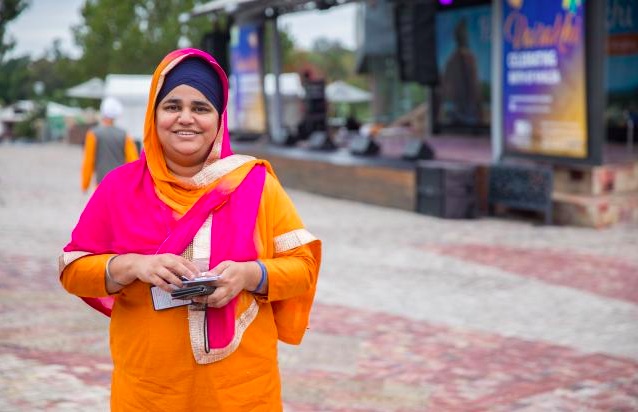
Gurinder Kaur is the new president of the Whittlesea Interfaith Network, a group comprised of people from different faiths coming together to “foster harmony”. She spoke to Michaela Meade about what brought her to the group, and what she wants to accomplish in the role.
What’s your connection to Whittlesea?
When I first landed in Australia, I stayed in Lalor for a few weeks. Then after moving to a couple of suburbs outside the City of Whittlesea, we bought our first home in Epping in February, 2009. I have been living in Epping with my husband now for more than 12 years. Since then, I have been getting more active with local community projects and events. I also enjoy the nature, park and creeks within our municipality. I really feel very much connected to the City of Whittlesea, its places and the people.
What are some of your favourite memories?
The first and foremost memory is my daughter’s birth at the Northern Hospital in Epping. Some of the other favourite memories include organising a Sikh Diwali event at Galada Community Centre and undertaking my radio broadcasting course with 88.6 Plenty Valley FM. Another favourite memory is winning the 2019 Westfield Plenty Valley Local Hero Award for taking interfaith tolerance to the next level.
How did you get involved in the Whittlesea Interfaith Network?
Back in 2016, one of my friends who was previously representing the Sikh community within the Whittlesea Interfaith Network contacted me, and asked if I could replace him and I agreed. At that time, I didn’t know much about Whittlesea Interfaith Network but I found the team very welcoming and liked the important work they do. Since then, I started being actively involved in Whittlesea Interfaith Network projects and being part of the network.
What do you hope to accomplish over your time as president?
I would like to get more youth involved from various faiths in the interfaith and partner with more organisations to deliver interfaith projects and events to promote peace and harmony. I also hope to showcase Whittlesea Interfaith Network’s work by enhancing our online presence, especially in this unprecedented time the world is passing through.
What’s something people would be surprised to know about you?
Being a Sikh baptised woman, I do wear a turban as part of my faith identity. Today I do visit schools, workplaces and many community events sharing awareness about this identity and advocating for others who wear it. But something that surprises others is knowing that I was not actually confident to wear the turban myself when I was in India, and I gained that confidence actually being in Australia. The reason for having that confidence in Australia was the acceptance and appreciation to follow one’s faith without discrimination.
Read the full story, ‘My Place – Gurinder Kaur’, (StarWeekly, 7 Dec 2021), here.
ASIA SAMACHAR is an online newspaper for Sikhs / Punjabis in Southeast Asia and beyond.Facebook | WhatsApp +6017-335-1399 | Email: editor@asiasamachar.com | Twitter | Instagram | Obituary announcements, click here
Wife of Late Sardar Arjan Singh Gill (Ex Court Interpreter, Seremban High Court)
Passed away peacefully on 30 November 2021
Our mother was a very warm, wonderful, loving and caring person who always put her children above herself. She was an amazing, fun loving, strong and capable person who always embraced everyone with her beautiful smile and warm tight hugs.
She was also a loving Grandmother and Great Grandmother who will be deeply missed by all.
Dearly loved, cherished & missed by:
Children /Spouse
Amrit Kaur / Dr Narindar Singh Dhaliwal
Dr Rajinder Singh Gill (deceased) / Dr Lily Jacob
Jaswinder Kaur / Douglas Henderson
Raghbir Singh Gill
Dr. Satwant Singh Gill (deceased)
Hardeep Singh Gill
And a host of grandchildren, great grandchildren, relatives and friends
Path Da Bhog prayers will be held on Saturday 11 December 2021 at Gurdwara Sahib Seremban from 9.30am till 11:30am. Guru ka Langgar will be served thereafter.
Please treat this as a personal invitation.
For more information, kindly contact the following numbers: –
Hardeep Singh Gill (+6016) 311 0837
Nazneen Kaur Gill (+6014) 681 7101
| Entry: 7 Dec 2021 | Source: Family
ASIA SAMACHAR is an online newspaper for Sikhs / Punjabis in Southeast Asia and beyond.Facebook | WhatsApp +6017-335-1399 | Email: editor@asiasamachar.com | Twitter | Instagram | Obituary announcements, click here |
Missionary work, an extension of the process of delivering the spiritual and sacred message of the prophet, guru or divine being over time, is like a fountain that quenches the thirst of the seeker. The process of delivering the message is governed by the principle that the content remains original and is presented skillfully to be acceptable to the new learner. In line with this principle, messages of the Sikh Gurus need to be shared with clarity, honesty and joy, emanating from the heart of the parcharak or missionary, who should have a free mind and hopefully has lived in accordance with the principles being shared.
Over the years the Sikh parcharaks have used and relied on methods that were relevant to a period where unquestionable faith was regarded to be important to practice Sikhi. This faith was built by narrating stories and events relating to the lives of the Gurus using a process to emotionalize the listeners. The language used was generally Punjabi and the mood created through emotional words expressed in tones swayed the sangat. As many of these were expressed in poetry the dadis and kevisars refined the emotional process to great heights and in their desire to fire the sangat made additions that are difficult to find in history of the Gurus.
These stories of the historical events were based on sources and writings, which appeared many years after the Guru period. The writers of these documents also carried a bias due to their own leanings and faith. They added numerous matters that were incorrect, then doctored and distorted the facts. The writers also colored the events in the lives of the Gurus with mythological happenings despite their colorings being contrary to the principles enshrined in Gurbani and the principles practiced by the Gurus. Over a period of time with the constant repetition, such stories became accepted by generations of Sikhs to be true. As it was faith based many feared questioning what was being stated and silently accepted them as truth. As faith was used as the driving force to acceptance of whatever the preacher said and in addition to the belief that the parcharak was more learned with a higher level of knowledge, these historical events became a part of the Sikh parchar system.
The main institution used for missionary work was the Gurdwara where programs had a set process beginning with kirtan, the singing of holy hymns relevant to the occasion, followed with preaching by self-trained parcharaks. This became the modus operandi of parchar or missionary work. Low rates of literacy in Gurumukhi, a lack of factual knowledge and a strong belief that religious matters cannot be questioned due to fear of divine retribution led to blind acceptance of all messages delivered from the stages of Gurdwaras. The parcharaks were themselves persons who had acquired the knowledge from some seminary or dera by mostly hearing it from their teachers or other parcharaks. There was and till date there is no institution that examines and awards certification for qualification as parcharak. In this void, many found being a parcharak was a stable economic endeavor which had the added value of respect shown by the sangat. This lack of proper intellectual missionary institutions with a formal system of training led to unlearned parcharaks occupying posts in all Sikh institutions and Gurdwaras.
The British had destroyed the education system of Maharaja Ranjit Singh, which had made Punjab the state with the lowest literacy rate. The low literacy combined with the loss of strong leadership opened the doors to create a missionary system mentioned above. The corruption began when Nirmalas, who were basically Hindu trained and who were supported by the British Rulers of Punjab, began to occupy and run gurdwaras. These events allowed and added to the process of distorted historical events purportedly from the lifes of the Gurus being driven into the minds of Punjabis and Sikhs. The Sikhs having lost Punjab could only find solace and strengths from the emotionalized miraculous stories rendered by these parcharaks.
As Sikhs have now general risen educationally and economically over the last century the mind set of the sangat seems to be transforming. The educational system in schools itself has changed in this century and is driven by inquiry learning and a willingness to think outside the box and discover creative solutions. Children and students are guided through the process of creative thinking to make them question all aspects of knowledge as this enables them to arrive at knowledge and logical based opinions. This transformation in thinking has been witnessed in many Sikh youths and children in Gurmat camps. Youths and children are more ready to accept logical stories and feel a pride in being followers of intelligent Gurus. The thirst for knowledge-based faith for living is ever increasing and Gurbani and the lives of the Gurus, if presented in accordance with reality, would receive greater acceptance. As the logic and rational facts will be in line with the mind set and daily life, taking the path of searching on ways to quench the thirst could be more easily accepted. Many youths who attend camps and are fed the old dry fodder. They flow along with the religious requirements as required by the parents only waiting to be economically stable to wave goodbye to the myths they had endured silently.
The changed mind set of the Sikh children and youths provide all the budding parcharaks with an opportunity to change the paradigm and present the Gurus as intellectuals, researchers, social activists, reformers, financial wizards, master town planners, human rights fighters, administrators, architects, creators of social and economic support systems and supporters of all humans. As family men they displaced behavior as exemplary fathers, grandfathers, brothers and husbands giving equal rights to their spouses which is relevant and required today. All our Gurus were well educated and had the best teachers in languages of the time, great musicians, physically fit and masters in the art of defense, horse riding just to name a few. Gurus were people centered and used their knowledge and capability to develop people in arts, business and self-reliance while being caring and kind. Gurus established medical centers for all who needed them and did not discriminate. This list is not exhaustive.
The sources of history can remain but the ability to change the narrative to one that is acceptable to the requirements of the times is needed. Guru Nanak Sahib was the most intelligent child, youth and person of his time. His obedience was remarkable as he was willing to abide by the requests of his father. This can be promoted. Guru Ji did not oppose the ceremony of the thread but at the pinnacle of it being performed, he very politely requested of the learned Pandit to provide an explanation of the objective of wearing the thread, this is inquiry. After hearing he further asked about its limitations and stated that as it needed to be changed with time how it would travel with the person after death. It was only after the Pandit had stated fully the traditional view, Guru Ji present that he wanted to wear only a higher value thread that was everlasting and was the support and guide to spiritual enlightened living. A similar inquiry method was used when attending school with the Panda. It was not just one day of schooling, as we are made to believe, Guru Ji had the best teachers for a period of 8 years, being intelligent, Guru Ji mastered languages, sciences and mathematics. These are but a few examples of the process of shifting the paradigm.
It was this acquired knowledge that allowed Guru Nanak sahib to plan his travels and calculate precisely the date of arrival at the center where a huge gathering was celebrating a ritual. Guru Sahib was so brave he was a warrior of true spirituality armed with divine knowledge. Imagine challenging the millions of Hindu pilgrims in Benares who were sending water to their ancestors in another world by throwing water towards the rising sun. A single person against a million, Wah! what bravery and yet without any weapon only intelligence and a loving caring smile. Guru Angad made us body builders, Guru Amar Das showed the light to aging healthily, Guru Ram Das the orphan who succeed against all odds to become a wealthy businessman and the greatest musical mind are a few other ideas.
The development of the internet and the latest media has also given us the tools to reach every youth. It is not only the reach but it allows a phased learning process with the learner being guided and moved at the learner’s pace using the inquiry learning method. “You never change things by fighting the existing reality. To change something, build a new model that makes the existing model obsolete,” said Richard Buckminster Fuller. In this change the challenge is to keep the message short, sweet and interesting, full of graphics and music. It also has to provide guidance to the Sikh learner on how the principles of Sikhi as practiced by the Gurus can be applied to his life as a student, employee or adult. Another challenge is that presently, there exist many versions of each “Sakhi” the paradigm shift is to bring forth the rational values and logical approach which will appeal creating new insights. These will be accepted by intelligent persons who are educated in the processes of logical thinking. After acceptance they may to be applied for successful living as well as being able to advance it in non-Sikh societies with pride.
Start the movement “I stand with my wonderful Guru: Guru Granth Sahib Ji” the divine fountain of spiritual knowledge.
Paguman Singh, a retired senior official of a Malaysian-based social security organisation, has been involved in Sikhi parchaar for more than three decades. He now resides in New Zealand.
* This is the opinion of the writer, organisation or publication and does not necessarily represent the views of Asia Samachar.
ASIA SAMACHAR is an online newspaper for Sikhs / Punjabis in Southeast Asia and beyond.Facebook | WhatsApp +6017-335-1399 | Email: editor@asiasamachar.com | Twitter | Instagram | Obituary announcements, click here |
Hj Mohd Ridzwan Abdullah@ Jaswant / Hjh Naaimah Abdullah (KL)
Jasveer Kaur / Sriraman (Menglembu, Ipoh)
Suaran Singh / Sukhvinder Kaur (Subang Jaya)
Balbir Kaur (Ipoh)
Grandchildren: 7 grandchildren, 3 grand son in laws, 1 grand daughter in law, 10 great grandchildren & 1 great great granddaughter
Saskaar/cremation: Cortege leaves house at 1.00 pm on 7 Dec 2021 (Tuesday). Cremation takes place at 2.30 pm @ Wadda Gurdwara crematorium, Ipoh
House address: 28, Jalan Meteor (Taman Star), Taman Moonlight Park, 31400 Ipoh, Perak
Path Da Bhog: Saturday, 18 December 2021 @ 10am-12pm at Ashby Road Gurdwara (Greentown), Ipoh. Thereafter, langar will be served.
Contact
Suaran: 010 5591712 (Son)
Harveen: 019 2779449 (Granddaughter)
Malathi: 012 5603469 (Granddaughter)
Mom Things we feel most deeply, are the hardest things to say, Dearest Mom we love you In a very special way If we could have one lifetime wish, One dream that could come true, We’d pray to God with all our hearts, For yesterday with you ..Thank you for being wonderful mom to us, loving grandma to all our children.. Missing you always & you will always remain in our hearts…
| Entry: 6 Dec 2021 | Source: Family
ASIA SAMACHAR is an online newspaper for Sikhs / Punjabis in Southeast Asia and beyond.Facebook | WhatsApp +6017-335-1399 | Email: editor@asiasamachar.com | Twitter | Instagram | Obituary announcements, click here |
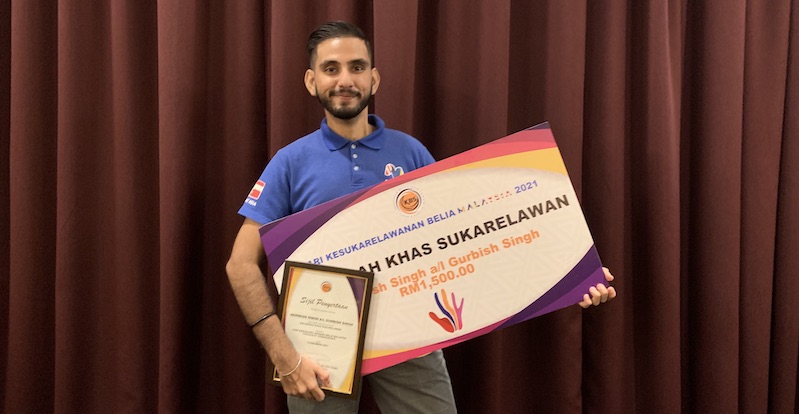
Nermesh Singh bags Malaysian youth volunteer award – Photo: Supplied
By Asia Samachar | Malaysia |
Final year pharmacy student Nermesh Singh has bagged a Malaysian youth volunteer award with a cash prize of RM6,500 to boot.
Nermesh won the Special Youth Volunteer Awards at the National Youth Volunteerism Day 2021 (Hari Kesukarelawanan Belia Malaysia 2021) held in Ipoh, Perak, on Sunday (5 Dec 2021).
The award came with a prize money of RM1,500. Youth and Sports Minister Faizal Azumu, who officiated the event, topped it up with another RM5,000.
The award was intended to appreciate, recognise and inspire the Malaysian youth to continue efforts in the world of volunteerism and to celebrate International Volunteer Day.
Nermesh is an active youth. Go here to read one of his experiences.
ASIA SAMACHAR is an online newspaper for Sikhs / Punjabis in Southeast Asia and beyond.Facebook | WhatsApp +6017-335-1399 | Email: editor@asiasamachar.com | Twitter | Instagram | Obituary announcements, click here
In the 12th and final Hijacking of Sikhi video series, KARMINDER SINGH DHILLON looks at the new generation of Sikh reformers. He examines the challenges they face, including excommunication
By Karminder Singh Dhillon | Opinion |
The Singh Sabha, Panchkandi, Intellectual, Missionary Parcharak groups thus fear that the achievements that were obtained through the Sikh Reht Maryada (SRM) are in serious danger. These groups thus dedicated their parchar towards bringing about an awakening within Sikhs and Sikhi — the awakening that was initiated by the Pioneers in the form of Professor Gurmukh Singh, Giani Ditt Singh, Karam Singh Historian and Bhai Kahn Singh Nabha.
In short, these Sikhs have decided to pick up where the pioneers of the Singh Sabha Reform Movement left off. Many of them face daunting and unnerving challenges such as excommunication; violence and threats of violence; intimidation; and attempts to prevent their messages from reaching the Sikhs in general — either through Gurdwara stages or the social media.
PROF SAHEB SINGH (1892 — 1977)
Saheb Singh (1892-1977), a professor of Sanskrit at Guru Nanak Khalsa College, and later Principal of Shaheed Missionary College and Gurmat College played a major role in ridding Gurbani of Snatan, Vedic and Yogic influence that the Hijackers of Sikhi had injected into the Sikh psyche. In 1932 he authored ae historic book titled Gurbani Vyakaran (Gurbani Grammar), bringing into light a hitherto undiscovered fact that Gurbani was composed in accordance with a grammar and syntax that allowed for its true meanings to be known.
In 1965 he authored a ten volume Punjabi translation of the SGGS that relied on Gurbani Grammar instead of the Snatan, Vedic and Yogic interpretations that the nirmlas had done in their Fareedkoti Teeka. He also authored 50 other books — the combined effect of which was to virtually decimate the view of the nirmlas that the SGGS was the fifth Veyd. He faced tremendous opposition from the nirmlas, dera and taksali sants and babas who attempted to rubbish his basic claim that Gurbani had a grammar and syntax. What was perhaps most difficult for these groups to accept was that a Hindu convert (Prof Sahib Singh was born Nathu Ram, he adopted Sikhi as a young adult) would attempt to provide a separate identity to Gurbani and its messages.
GYANI BHAG SINGH AMBALA
Gyani Bhag Singh Ambala became the first Sikh intellectual, parcharak and writer to expose the reality of the Bachitar Natak granth. In 1976 he wrote and published a well-researched and documented book titled Dasam Granth Darpan in which he argued that none of the contents of that granth were composed by Guru Gobind Singh. He provided the original sources where the contents had been lifted from — mainly old Snatan texts such as Markandey Puran, Vishnu Puran, Sahansar Maal etc.
The narratives of Hemkunt, Deh Shiva, Miter Pyare Nu, Dhust Daman (name of Guru Gobind Singh in his past life) and Chaupai were exposed as fabrications aimed at corrupting, denigrating and debasing both the tenth master and his spirituality.
His biggest exposure was the 600 pages of sordid and explicit sexual narratives under the heading of Triya Chriter contained within the Dasam granth. For the first time, the Sikh world was told that woman degrading sexual content in the form of tales of debauchery described in explicit detail involving sexual acts between kings and their lovers, married women and _ extramarital relations, prostitutes, incest and acts with animals filled 600 pages of the Dasam granth within a section termed Chitro Pakhyaan ~ the details and examples of which are too explicit to be provided on any sane platform.
Gyani Bhag Singh had taken on the number one Sikh preacher at that time – nirmla Sant Singh Maskeen on the issue of Dasam granth. At a function in Delhi, Bhag Singh raised Maskeen’s ire by placing one page of the explicit Chitro Pakhyan in front of Maskeen and daring him to explain it to the sangat. Ambala had also left Maskeen speechless in an open debate. Maskeen’s untenable position at that time was that Guru Gobind Singh authored the Dasam granth. Nirmla Maskeen had thus become Ambala’s main adversary.
Maskeen engineered the excommunication of Gyani Bhag Singh which was handed down on the 5 July 1977 by the jathedars of Akal Takhat. Maskeen then promised Ambala that he would get the excommunication order lifted if the latter would provide a written apology. The apology was
GYANI GURBAKSH SINGH KALA AFGANA
Gyani Gurbaksh Singh Kala Afgana (1922 — 2019) stands amongst the most enlightened, awakened and dedicated Sikhs who devoted his entire life towards. detailing and exposing, in excruciating detail – the Hijackers and Hijacking of Sikhi – that went on for some 200 years. His research and depth of understanding of Gurbani is unmatched. He captured the entire narrative of the distortion and corruption of Sikhi at the hands of the udasis, nirmlas and dera and taksali sants in a massive twelve volume expose’ aptly titled Bipran Ki Reet Ton Sach Da Marg. The final volume is devoted exclusively towards exposing the deception that is the Bachitar Natak (Dasam granth).
When in 1998 the then Akal Takhat jathedar Joginder Singh Vedanti published the previously banned and blasphemous book titled Gurbilas Patshai 6, Gurbaksh Singh took on him in a fervor that was unprecedented. Kala Afghana published, first in 2001, a book titled Gurbilas Patshai 6: Sri Guru Granth Sahib Ji Roop Satguru Nanak Sahib Ji Day Parkh-Darbar Vich. (Gurbilas Patshahi 6 Examined in the Court of Guru Nanak’s Benchmark as Stipulated in the Sri Guru Granth Sahib); and in 2003 a second book titled Gurbani Di Kasvati Tay Gurbilas Patshahi 6 (Gurbilas Patshahi 6 on the Benchmark of Gurbani). He refuted each and every blasphemous and fake narrative about the Sikh Gurus that were contained within the rewritten book of Vedanti. His iron clad arguments were such because they were based on the truths of Gurbani and illustrated amply with Gurbani verses.
The original Gurbilas was written jointly by two Nirmlas Gurmukh Singh and Darbara Singh during the period 1830-1840. They did not put their names to it. Prior to Bhai Kahn Singh Nabha’s expose’ regarding its true authorship, the nirmlas had spread the lie that an individual by the name of Sohan Kavi had authored it. It is clear that the original Gurbilas authors harbored anti-Sikh and anti-Gurmat agendas. The book purported to recount the life of Guru Hargobind, the Sixth Guru with ample narratives of the third through the ninth Gurus. Its anti-gurmat messages and anti-Gurbani messages and in particular its overt brahmanical tones were clearly evident. The Sikh panth, in 1920 decided that Gurbilas should not be preached in Sikh Gurdwaras. It remained banned till 1998, when the Dhram Parchar Committee of SGPC (of all institutions!) republished the book under the authorship of Akal Takhat jathedar Joginder Singh Vedanti (of all persons) and Dr Amarjeet Singh.
In what appeared to be a concerted effort to have the book accepted by the Sikh masses, this republished version carried acknowledgments from the Who’s Who of Sikhs such as the SGPC chief Tohra, the jathedars and granthis of the takhats, preachers such as nirmla parcharak Sant Singh Maskeen, Jaswant Singh Parwana, and writers such as Joginder Singh Talwara.
Kala Afghana diligently and systematically exposed the folly of not just Gurbilas 6, but the agenda behind its republication. Kala Afgana’s books took on each story of Gurbilas and analyzed it on the touch stone (Kasvati) of Gurbani. He managed to establish that virtually every story in Gurbilas 6 was a fabrication. The result was that in October 2000, the SGPC banned the book (its own book, really) a second time. Kala Afgana’s suggestion that the republication of Gurbilas was a conspiracy involving the highest echelons of the Sikh establishment including the Akal Takhat which had been deeply infiltrated by dera thought was proven in the fact that no action was taken against any of the 15 prominent parcharaks, kathakars and leaders of Sikh institutions that wrote glowing commentaries in praise of both the contents of the blasphemous book as well as of the two editors.
Equally ironical was the fact that while one author escaped any form of sanction, the other framed charges against Kala Afgana over books that had been published and distributed decades ago. Vedanti refused to allow Afgana an opportunity to defend himself; and then sat in judgement over those same charges that led to his excommunication.
Jathedar Joginder Singh Vedanti thus made sure that Kala Afgana paid the price for the gumption to expose him. Vedanti laid out the grounds for Afgana’s excommunication but turned down his request for his defense to be conveyed via video conferencing from Canada where Afgana was a resident. Vedanti ruled that teleconferencing was against the maryada. Afgana’s request for more time to appear in person was turned down as well and he was excommunicated in abstentia from the Sikh Panth in June of 2003.
The ex-communication of Kala Afgana speaks volumes of spiritual decay that has crept into our institutions as a result of the infiltration of the hijackers into the inner sanctums of Sikhi. One wonders if his enlightened mind, awakened conscience and dedicated spirit; his voluminous research and writing on Gurbani and Sikhi matters; and the devotion of his passion towards correcting the wrongs within Sikh thought and practices became the reason and cause of his punishment. Indeed, if excommunication is the reward for such selflessness, then what really is the future of the Sikhi of Guru Nanak.
(Extracted from the writer’s book The Hijacking of Sikhi, published in 2020. Other personalities covered in this chapter were Singh Sabha International California secretary-general Hardev Singh Shergill, preacher and author Inder Singh Ghagga and his daughter Navdeep Kaur, Akal Takht former jathedar Prof Darshan Singh Khasa, Rozana Spokeman editor-in-chief Joginder Singh, Nanakshahi calendar creator Pal Singh Pureval, Sikh historian and writer Harjinder Singh Dilgeer, Radio Virsa founder Harnek Singh Neki and Sikh preacher Ranjit Singh Dhadreanwalla]
Sikh thinker, writer and parcharak Karminder Singh Dhillon, PhD (Boston), is a retired Malaysian civil servant. He is the joint-editor of The Sikh Bulletin and author of The Hijacking of Sikhi. He can be contacted at dhillon99@gmail.com.
LINKS TO VIDEOS AND LECTURE NOTES FOR ‘THE HIJACKING OF SIKHI’
Hijacking of Sikhi – Part 1 (The Plot): Video | Notes
Hijacking of Sikhi – Part 2 (Udasis): Video | Notes
Hijacking of Sikhi – Part 3 (Udasis): Video | Notes
Hijacking of Sikhi – Part 4 (Nirmlas): Video | Notes
Hijacking of Sikhi – Part 5 (Nirmlas): Video | Notes
Hijacking of Sikhi – Part 6 (Nirmlas – Sooraj Parkash): Video | Notes
Hijacking of Sikhi – Part 7 (Distorting Gurbani: The Nirmalas): Video | Notes
Hijacking of Sikhi – Part 8 (Dera Sants & Taksali Babas): Video | Notes
Hijacking of Sikhi – Part 9 (The Hijacked Turn into Hijackers / Stockholm Syndrome): Video | Notes
Hijacking of Sikhi – Part 10 (Dasam Granth: The weapon of mass control): Video | Notes
Hijacking of Sikhi – Part 11 (Freeing Sikhi from the Hijackers: The SRM): Video | Notes
Hijacking of Sikhi – Part 12 (The Battle Continues Into 21st Century): Video | Notes
ASIA SAMACHAR is an online newspaper for Sikhs / Punjabis in Southeast Asia and beyond.Facebook | WhatsApp +6017-335-1399 | Email: editor@asiasamachar.com | Twitter | Instagram | Obituary announcements, click here |
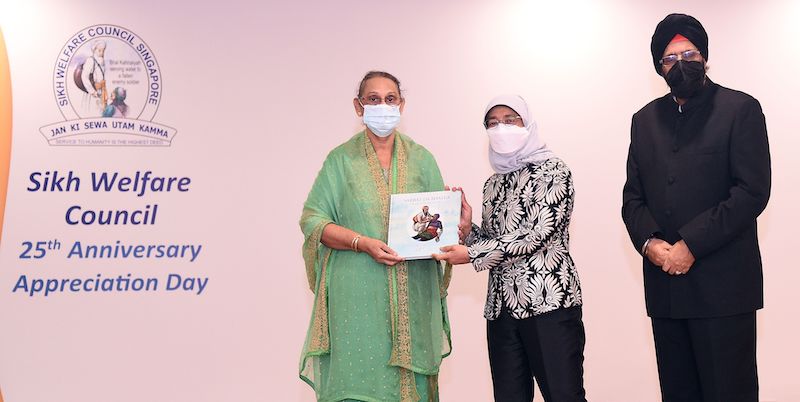
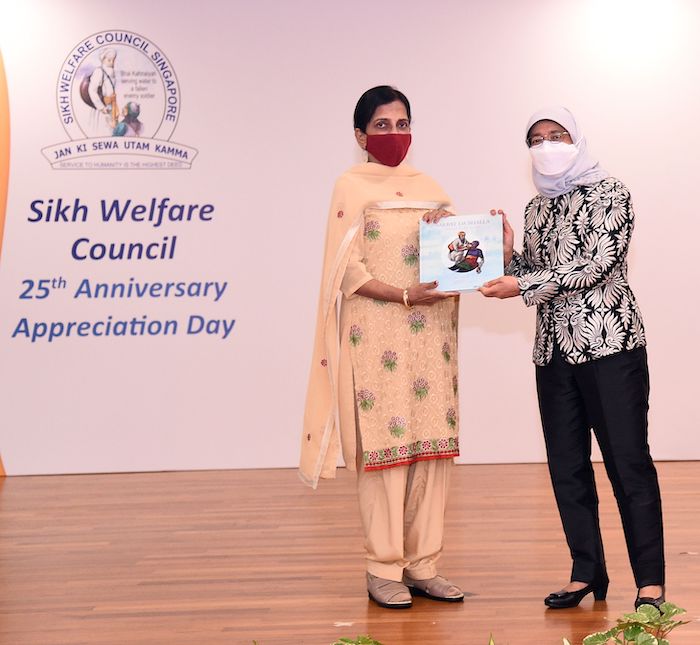
Singapore President Halimah Yacob presenting the SIWEC 25th Anniversary commemorative book to Baljinder Kour, accompanied by SIWEC immediate past chairman and event organising chairman Gurdip Singh Usma - Photo: Supplied
By Asia Samachar | Singapore |
Some years ago, retired school teacher Charanjeet Kaur leaped at the opportunity to engage Singapore Sikh seniors. The efforts led to the formation of Sunehri Sahelian, a novel programme that would enrich the lives of seniors in their golden years.
“In all my years of organising community activities, I had never seen any Sikh seniors participating in any of our activities! So I was very happy and excited!” she said when recalling the initial days of the programme in 2014.
Let us also introduce you to Baljinder Kour, another active member of the Singapore Sikh community. For last decade, she has volunteered with SIWEC’s bereavement and grief support programme. She is among a group of volunteers who spring into action at very short notice to assist a bereaved family when a death occurs.
“I find meaning in being with grieving families to bring them comfort when a loved one passes on. Doing this sewa is emotional work that requires patience,” she says. “I will continue doing this as long as I am able to do so.” Baljinder is the current president of Istri Sat Sang (women’s wing) at Central Sikh Temple (CST).
Charanjeet and Baljinder Kour were among the 85 in-person guests recognised at an event yesterday (4 Dec 2021) to celebrate the 25th Anniversary of the Sikh Welfare Council (SIWEC).
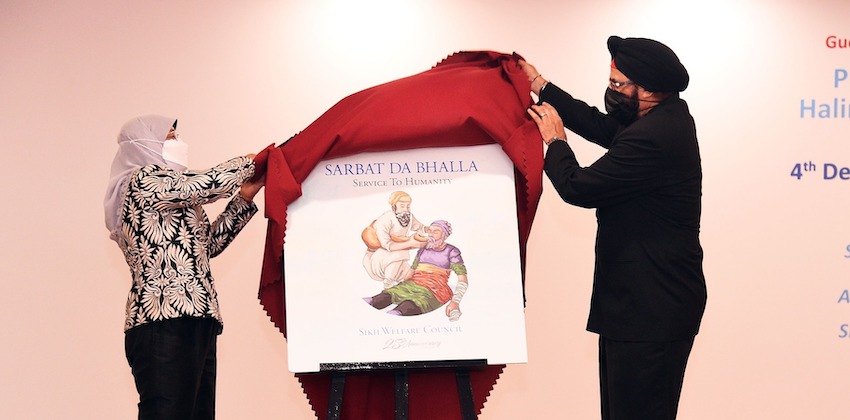
Guest of honour President Halimah Yacob also launched the first comprehensive publication documenting SIWEC’s major milestones and achievements titled Sarbat da Bhalla – Service to Humanity.
The hybrid event was hosted at the Singapore Khalsa Association (SKA) and the Sikh Centre (SC) concurrently.
Seated among the guests were Luvinderpal Singh, part of the cycling volunteer team who have raised funds for the organisation.
“I am really glad and thankful to SIWEC for recognising cyclists. I feel very proud, and I think that the cyclists would have been very glad and proud that we have been recognised for our efforts,” he said.
Looking at the commemorative book, volunteer and former SIWEC staff Jaspreet Kaur said: “The commemorative book and the video shared today brought back a lot of memories of the work we have done as a team in SIWEC.”
SIWEC chairman Harmit Singh said that over time, the organisation has grown from a lean self-help group with only one staff manning a 24/7 hotline in 1995 to becoming an established social service agency (SSA) with Institute of Public Character (IPC) status and full membership of the National Council of Social Service (NCSS).
“25 years later, we are now in a stronger financial position to employ seven full-time staff operating a diverse range of welfare programmes. These include financial assistance to vulnerable families, active ageing programmes for seniors in the community, psycho-social support for seniors and persons with disability in long-term care facilities, community mediation for families facing conflict, education support for children from our client-families, bereavement and grief support for members of the Sikh community, as well as mental health support to those who need it,” he said.
SIWEC was first established as a self-help group in 1995. It is an approved charity with Institution of Public Character (IPC) status since 2009, and a full member of the National Council of Social Service (NCSS) since 2014.
The objectives of SIWEC are to carry out and manage welfare schemes in the form of relief, financial assistance, health, education, housing, or any other help (collectively referred to as “welfare”) for those requiring assistance within the Singapore community.
Charanjeet Kaur, SIWEC programme coordinator for Active Ageing, receiving the commemorative book from President Halimah Yacob
Singapore President Halimah Yacob launching SIWEC’s commemorative book, Sarbat Da Bhalla – Service to Humanity, at the oganisation’s 25th Anniversary celebrations Gurdip Singh Usma, accompanied by organising chairman Gurdip Singh Usma – Photo: Supplied
ASIA SAMACHAR is an online newspaper for Sikhs / Punjabis in Southeast Asia and beyond.Facebook | WhatsApp +6017-335-1399 | Email: editor@asiasamachar.com | Twitter | Instagram | Obituary announcements, click here
Raunak Singh Nirmal, a serial entrepreneur who’s first job out of college was at Amazon, is today dealing with companies that sell on Amazon. His company is making waves. Personally, he has made cut to enter Forbes’ 30 Under 30 listing for 2022.
Not bad for a Sikh who emigrated from India when he was 7 years old.
Acquco is one of the largest and fastest-growing aggregators of companies that sell on Amazon. The 29-year old co-founder and CEO has raised $160 million to acquire businesses that will generate some $250 million in revenue this year, reports Forbes. “I’ve been living and breathing Amazon,” he tells the magazine.
He founded Acquco along with Wiley Zhang after launching and successfully exiting several multi-million dollar Amazon brands, he says in an article under his byline.
In essence, they are building the largest e-commerce platform in the world, with a focus on building Amazon businesses, and operating across a number of platforms including Walmart, eBay, and Shopify.
Raunak got his start in Computer Science and Operations Research Engineering at Cornell. After graduating, he landed a job with Amazon as a business analyst, all while selling on Amazon to get a better lay of the land.
“Just six months after joining the Amazon team, I was promoted to Product Manager, overseeing a team of engineers to implement a product idea I had pitched, which was estimated to net $1B in annual revenue for Amazon. After implementation, I decided to leave Amazon to pursue my third party selling business full-time, which sold over $7MM in its first year of operation.
“Since building that first business, I’ve built and sold multiple brands on the platform, researched and developed several methods to uniquely execute SEO on Amazon, served as a consultant to some of the largest Amazon US sellers, created a third party service that helps sellers recover money that Amazon owes them from over 27 unique reimbursement scenarios, all while creating a seller outsourcing firm in the Philippines to help sellers save money on account operations. I know my way around building Amazon businesses from the ground up as well as driving significant optimizations to existing businesses,” he wrote.
ASIA SAMACHAR is an online newspaper for Sikhs / Punjabis in Southeast Asia and beyond.Facebook | WhatsApp +6017-335-1399 | Email: editor@asiasamachar.com | Twitter | Instagram | Obituary announcements, click here
Ranjit Singh is familiar face when someone is dealing with Sikh Welfare Council (SIWEC). He has served as its manager for the last nine years.
As the Singapore organisation celebrates its 25th anniversary, Asia Samachar talks to Ranjit on his experience.
“The past 9 years that I have been with SIWEC have been very fruitful and as SIWEC grew to reach out to the community in a myriad of ways, I too was able to reach out to many more people in the community through our various projects,” he says.
SIWEC was set up as a community-wide response to assist vulnerable Sikh families and individuals in Singapore to better cope with a fast-changing socio-economic context which presented financial, educational, employment and social challenges. Today, it is has evolved and does much more.
On Saturday (4 December), the organistion will celebrate its 25th anniversary, with Singapore president Halimah Yacob as the guest of honour.
This is the second interview in the run-up to the 25th anniversary event. Yesterday, Asia Samachar ran an interview with SIWEC advisor and immediate past president Gurdip Singh Usma. Tomorrow, we will talk to Balbir Kaur, the first and longest serving volunteer Sikh woman prison counsellor, one of the projects undertaken by SIWEC.
Excerpts from the interview.
Q: Can you share with us your journey in SIWEC since 2012, when you first took on the role as manager?
The past 9 years that I have been with SIWEC have been very fruitful and as SIWEC grew to reach out to the community in a myriad of ways, I too was able to reach out to many more people in the community through our various projects. Over the years, we have cultivated many relationships with agencies beyond the Sikh community and I have worked closely with the various establishments and stakeholders in order to cater to the needs of the community. Working hand in hand with the various agencies has allowed for us at SIWEC to constantly improve in terms of our approach to serving the community as I firmly believe that there is always room for improvement. One of our services that has remained over the years is our 24/7 hotline that responds swiftly to help Sikh families. We started with helping by providing bereavement services and hospitalisation transport and today we even respond to delicate cases that require mediation due to family violence or abuse. Through all of this, my motivation has been to be able to support our clients in the best way possible across the various initiatives we have, in line with our mission of Sarbat Da Bhalla.
Q: Tell us about one of the volunteer project that you and your team have actively participated in?
I have been a part of SIWEC’s key initiatives and services which include education support services, spending time and meeting with clients such as the elderly who are living alone, and bereavement to name a few. I have personally been involved in some of the more novel and even unique SIWEC initiatives like coordinating and participating in our special fund-raising events such as the annual Ride-2-Serve charity cycle rides where volunteers cycle from Malacca, Malaysia to Singapore. Ride-2-Serve is an important initiative for SIWEC as there has been a sustained outreach in the community to encourage voluntarism and seek donations. I get immense satisfaction from being part of a committed group of volunteers like our friends from Ride-2-Serve (R2S).
Q: What do you envision for SIWEC in the next 25 years?
Going forward, I feel more can be done for the community especially the youths as we have an ageing population as such, I feel that more is needed to be done for the community. We look forward to more volunteers and more generous donors to work with, in the community.I also wish that going forward, SIWEC will continue to be people oriented and continue striving to reach out to the needs of those in the community so that we can continue to live up to the mission of Sarbat Da Bhalla.
Event Live Stream: 4 Dec 2021 (Saturday, from 2pm-4pm, Singapore time). Join SIWEC as they celebrate Silver Jubilee to recognise the contributions of their volunteers. Guest of Honour is Singapore President Halimah Yacob. Links: Facebook and YouTube
ASIA SAMACHAR is an online newspaper for Sikhs / Punjabis in Southeast Asia and beyond.Facebook | WhatsApp +6017-335-1399 | Email: editor@asiasamachar.com | Twitter | Instagram | Obituary announcements, click here
Manveer Singh and family at the Humans of Armadale exhibition
By Asia Samachar | Australia |
Manveer Singh Ajmir, a specialist in remote communications who moved to Australia from Malaysia a decade ago, is an active member of his local community in Perth suburb. Armadale is very much home for this young Sikh family.
In fact, when the city came together to launch the Humans of Armadale exhibition, Manveer was one of the 20 ‘remarkable and inspiring individuals’ featured.
And as Christmas is approaching, something interesting is in store for the residents of the city located on the south-eastern edge of the Perth metropolitan region. The Humans of Armadale Christmas Wreaths are up at Jull Street Armadale. They have QR stickers on the ground to direct people to the stories on its website. One of them will take them to Manveer’s story. How cool is that!
Manveer’s love affair with Piara Waters began almost 10 years ago when he chose the suburb to build his house. At that time, he was concerned if he had made the right choice—it seemed like a deserted area with no schools, shopping centres, limited transports services, and roads far from ready.
“Fast forward 10 years, Piara Waters is more than just a family home; I have fully embraced what is now the fastest-growing suburbs in Perth. More importantly, I am in love with the great sense of community spirit,” he said in an entry for Humans of Armadale.
“Being born and brought up in Malaysia with North Indian heritage, having obtained my tertiary education from the UK, and married to an Indonesian, I have been exposed to different cultures and backgrounds. Hence, it was a bonus for me to have found out that the suburb I had selected represented such diversity. The sense of community spirit provides comfort for a migrant like me, and at the same time, allows me to mentor newcomers who are struggling to integrate. In this regard, it is only natural for me to get involved in building my community.”
Manveer moved to Australia about a decade ago in pursuit of certain opportunities that came his way.
“When I first moved to Australia, my main concerns were adjusting to the new environment and building trust with new friends,” he told Asia Samachar.
His parents are Ajmir Singh, who worked for shoemaker company Bata, with a stint of 10 years in Vietnam; and Gurnam Kor from Klang. He is married to Jagjeevan Kaur who hails from Jakarta, Indonesia.
He is also active on the Sikh volunteer circle. At the moment, he is part of the Perth Chapter of the Sikh Youth Australia Inc (SYA).
ASIA SAMACHAR is an online newspaper for Sikhs / Punjabis in Southeast Asia and beyond.Facebook | WhatsApp +6017-335-1399 | Email: editor@asiasamachar.com | Twitter | Instagram | Obituary announcements, click here