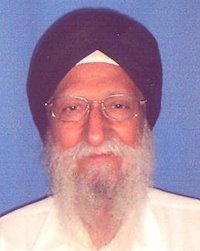
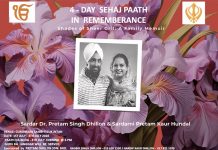
PATH DA BHOG & ANTIM ARDAS:24th April 2021 (Saturday), 10am to 12noon, at Gurdwara Sahib Pokok Assam, Taiping, Perak. Guru Ka Langgar will be served| Malaysia
Path Da Bhog & Antim Ardas: 24th April 2021 (Saturday), 10am to 12noon, at Gurdwara Sahib Pokok Assam, Taiping, Perak. Guru Ka Langgar will be served.
Contact: Anand 019 – 472 9972
Bapa, Nanaji & Dadaji, “Main Jaha Rahoon, Main Kahin Bhi Hoon, Teri Yaad Saath Hai”
Though it looks like the whole world moves with us,
But hidden in our heart grows loneliness,
Only the memory is with us,
Your memory is with us,
Wherever we live, Wherever we are,
Your memory is with us.
Rest in Peace dear Bapa.
The family expresses their heartfelt thanks to all relatives and friends for their support during the recent bereavement.
| Entry: 20 April 2021 | Source: Family
ASIA SAMACHAR is an online newspaper for Sikhs / Punjabis in Southeast Asia and beyond.Facebook | WhatsApp +6017-335-1399 | Email: editor@asiasamachar.com | Twitter | Instagram | Obituary announcements, click here |
Former Indian Prime Minister Manmohan Singh has tested positive for coronavirus, just a day after dispatching a letter to current premier on the need to ramp up measures to contain its spread.
The 88-year-old veteran Congress leader
was admitted to All India Institute of Medical Sciences in Delhi on Monday.
In his letter to Prime Minister Narendra Modi on Sunday, he listed suggestions to fight the second wave of coronavirus pandemic effectively.
The former PM advised his successor to ramp up the pace of vaccination programme in the country.
He also advised that one must not look at absolute numbers but the total percentage of population vaccinated.
Noting that India currently has vaccinated only a small fraction of its population, Manmohan said he is certain that with the right policy design, “we can do much better and very quickly”.
He added that he is forwarding his suggestions for consideration in a spirit of constructive cooperation in which he has always believed and acted upon.
ASIA SAMACHAR is an online newspaper for Sikhs / Punjabis in Southeast Asia and beyond.Facebook | WhatsApp +6017-335-1399 | Email: editor@asiasamachar.com | Twitter | Instagram | Obituary announcements, click here |
Path Da Bhog: 1 May 2021 (Saturday), 4pm-6pm, at Gurdwara Sahib Petaling Jaya. Guru Ka Langgar will be served.
Contact:
Gurwinder Singh – 0163116030
Satwant Singh – 0192745502
Navjeet Kaur – 0122251466
| Entry: 19 April 2021 | Source: Family
ASIA SAMACHAR is an online newspaper for Sikhs / Punjabis in Southeast Asia and beyond.Facebook | WhatsApp +6017-335-1399 | Email: editor@asiasamachar.com | Twitter | Instagram | Obituary announcements, click here |
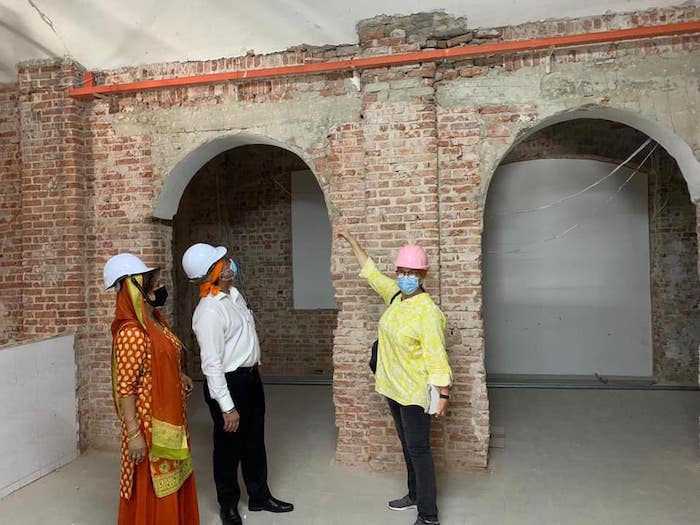
Dr Gwynn Jenkins pointing to some restoration work, with Jagdeep (middle) and Gurmit watching – Photo: Jagdeep Singh Deo Facebook page
By Asia Samachar Team | MALAYSIA |
Already home to one of the oldest gurdwaras in Southeast Asia, Penang may add to its historic appeal if plans come to fruition to build a dedicated Sikh Museum.
Penang state lawmaker Jagdeep Singh Deo has suggested that Penang should “spearhead a Sikh Museum to recognise the contributions of Sikhs throughout the country and region.”
Jagdeep, who is the Penang state local government, housing, town and country planning committee chairman, made the remarks in Vaisakhi greetings shared on his Facebook page on Wednesday (14 April).
“I’ll pursue further this new agenda to have a Sikh museum,” he was quoted in a report in The Star before giving an update on the restoration work of Wadda Gurdwara Sahib Penang (WGSP) in Jalan Gurdwara, George Town. The road was formerly known as Brick Kiln Road.
A gurdwara, literally meaning the door to the Guru, is a central Sikh institution that serves more than just as a place of worship.
WGSP, the oldest gurdwara structure in Penang, is currently undergoing a major restoration work which has taken longer than expected.
“We hope to restore the 118-year-old gurdwara to its original glory…As the gurdwara is classified as a Category One heritage building, we have to follow certain guidelines, ” Jagdeep said.
He was accompanied by heritage architecture and cultural anthropology consultant Dr Gwynn Jenkins who had been engaged to assist in applying for the gurdwara to be gazetted as a National Heritage Site. Also present was WGSP patron Gurmit Kaur, who is also Jagdeep’s mother.
Founded in 1901, WGSP was first named Diamond Jubilee Sikh Temple to commemorate the Diamond Jubilee of Queen Victoria of Britain. Upon completion, it was the biggest gurdwara in Malaya as well as South East Asia.
Located at No.87, Jalan Gurdwara, formerly known as Brick Kiln Road, Penang, the gurdwara structure is a beautiful striking mixture of Moorish and modern architectural design.
It was on 3rd June 1901 that Colonel Walker of the Malay States Guides laid the foundation of the Gurdwara, Penang. The Straits Settlement Government of Penang, in commemoration of the Diamond Jubilee of Queen Victoria of Britain, granted the land on which it is built. The foundation stone can be seen in the corner of the building near the “Nishan Sahib” (flagpole).
Not many people know that this historic Gurdwara is one of the three sites in Penang, which commemorate the diamond jubilee of Queen Victoria. The other two being the clock tower near Fort Cornwallis and the Victoria Green Field of the Chinese Recreation Club in Burma Road. In the corner of the field is a statue of Queen Victoria.
The Sikh Gurdwara, Penang, was also known as the Malaya Tapuan Da Gurdwara (Malayan Territories Gurdwara) and was for many decades a central meeting place for all northern Indians in Siam, Sumatra, Borneo, Hong Kong and Shanghai. Penang was the major transit port for people traveling to and from India and regions of South East Asia. As the travelers faced difficulties in finding a place to stay, the need for a Gurdwara was urgently felt.
The three other gurdwaras on the Penang island are Gurdwara Sahib Bayan Baru, Gurdwara Sahib Khalsa Dharam Jatha and Gurdwara Sahib Police. Gurdwara Sahib Butterworth is the other Penang gudwara, located on the mainland of Peninsular Malaysia.
ASIA SAMACHAR is an online newspaper for Sikhs / Punjabis in Southeast Asia and beyond.Facebook | WhatsApp +6017-335-1399 | Email: editor@asiasamachar.com | Twitter | Instagram | Obituary announcements, click here |
Amarjeet Kaur Johal, 64, died in the Indianapolis FedEx facility mass shooting
By Simran Jeet Singh | CNN |
The shooting came just days after Sikhs, who comprise the world’s fifth-largest religious community, celebrated Vaisakhi, the most significant holiday of our calendar, and also as the state of Indiana was honoring its Sikh residents with an awareness and appreciation month — one of several states to do so.
The FBI has not determined the killer’s motives — and may never do so given that he turned the gun on himself and is now deceased.
Sikh Americans once again feel targeted. As we come upon 20 years since the terrorist attacks of 9/11, and the racist backlash that ensued, we cannot ignore the long history of hate violence against Sikhs in this country. FBI hate crime data shows Sikhs to be one of the most commonly targeted religious groups — behind Jews and Muslims — in modern America.
We also know that much of the violence that Sikhs face has to do with the cultural and religious illiteracy of others. Despite being one of the world’s largest religions, most Americans do not know who Sikhs are. A 2013 study led by the Stanford Innovation Lab and the Sikh American Legal Defense and Education Fund found that 70% of Americans misidentified Sikhs when shown a Sikh man in a picture, with many believing they were Muslim.
The distinctive Sikh appearance — which often includes brown skin, facial hair and turbans wrapped upon our heads — has made Sikhs regular targets of racist violence. Balbir Singh Sodhi, a turbaned Sikh immigrant from Punjab, India, was the first casualty of a hate crime after 9/11. His murderer, Frank Roque, on a shooting rampage that included attacks on an Afghan couple and a man of Lebanese descent, wrongly associated Sodhi’s Sikh identity with terrorism and killed him at point-blank range outside Sodhi’s gas station in Mesa, Arizona, on Sept. 15.
We can point to various factors that contribute to such unnecessary tragedies: unchecked access to deadly firearms, xenophobic rhetoric that sanctions bigotry, a history and climate of racism that makes those who look different frighteningly vulnerable.
And while we may not know the Indianapolis killer’s motive, we do know the immense cost of our cultural ignorance. If nothing else, this tragedy might spur more people to learn about their Sikh neighbors.
The Sikh religion (Sikhi, in Punjabi) is one of the world’s youngest, originating about 500 years ago in the Punjab region of South Asia, which is currently split between Pakistan and northwest India.
The faith’s founder, Guru Nanak, was born in 1469 and was disenchanted with the suffering, divisions and social inequities he saw around him. He sought to establish a new community with a new vision rooted in oneness, love and justice. He taught that all people are equal and interconnected, and that human beings have no legitimate basis for creating hierarchies or discriminating against one another. Rather, each of us is inherently divine and we ought to treat one another accordingly. To serve humanity is to serve God (Vahiguru).
Guru Nanak put his vision into practice, establishing institutions that would live beyond him. For example, he started the tradition of langar, a free communal meal open to all with only one condition — everyone must sit on the ground together as equals. This tradition remains alive and well today.
Guru Nanak traveled around South and Central Asia spreading his message and building a following. These people referred to themselves as Sikhs, a term that derives from Sanskrit and means “students.” The mindset was that we are lifelong students, always seeking to learn and grow.
Guru Nanak’s community also grew, and before he died, he appointed a successor, Guru Angad. There were 10 total gurus (enlighteners) in the lineage of Guru Nanak, the last of whom, Guru Gobind Singh, passed away in 1708. From that time onwards, Sikh authority would rest in two entities — the Guru Granth Sahib, scriptural canon that was compiled and primarily composed by the Sikh gurus themselves, and the Guru Khalsa Panth, the community of initiated Sikhs. To this day, Sikhs view these two entities as their eternal guru.
As part of their practice, Sikhs maintain long, uncut hair, which they often wrap in turbans on top of their heads. Many see their appearance as a public promise to live by their faith. Sikhs cherish their identities as gifts from their gurus and shared aspects that bind them to their co-religionists, present and past.
Sikhs continued to grow in numbers and disperse around the world over the decades. After British colonizers took control in Punjab in 1849, more and more Sikhs moved to regions controlled by the British Empire, including the United Kingdom, Southeast Asia and East Africa.
Read the full story, ‘Why Sikh Americans again feel targeted after the Indianapolis shooting’ (CNN, 17 April 2021), here.
Simran Jeet Singh (@simran) is a scholar and historian of South Asia, a senior fellow for the Sikh Coalition, the author of a guide for reporters covering Sikhism and a 2020 Equality Fellow for the Open Society Foundations.
* This is the opinion of the writer, organisation or publication and does not necessarily represent the views of Asia Samachar.
ASIA SAMACHAR is an online newspaper for Sikhs / Punjabis in Southeast Asia and beyond.Facebook | WhatsApp +6017-335-1399 | Email: editor@asiasamachar.com | Twitter | Instagram | Obituary announcements, click here |
Some writers like Dr. Karminder Singh of Malaysia are trying try to create doubts about Gurbani. He does this by quoting Gurbani but giving meanings which have no bearing on the original. His main push is that the concept of the “hereafter” represented by ਪਲਤ and ਓਥੈ both meaning ‘there’ and ਅਗੈ meaning ahead, in Gurbani do not mean the ‘hereafter’
His view is that everything happens in life and there is no hereafter. He does not seem to do understand the Formless Supreme Being, the soul and the subtle nature of divine justice system. The Gurbani concept is that the creature acts here in life with the physical body directed by the soul, which is accountable for the deeds in the hereafter. Kabir Ji says.
The human body is like a village and the soul is (mahtau) the master of the land, i.e. the soul commands the body organs; five farmhands live in it.
They are eyes, nose, ears, (raspat-i = master of taste) tongue and skin; these organs do not obey orders of the Almighty which are present in the conscience. 1.
When Dharam Rai the metaphoric Divine court presenter asks for account of deeds – at the end of life – then heavy debtor balance shows, i.e. the soul is adjudged to have lot of shortcomings.
The five farmhands run away, i.e. are not there after death, and the soul is bound by the Divine court. 2.
Despite these clear statements, he denies the concept of ਧਰਮ ਰਾਇ Dharam Rai, ਚਿਤ੍ਰ ਗੁਪਤ Chitr Gupt and ਜਮ Jamm. These are metaphorical entities and represent the Divine justice system. Roughly, Dharam Rai is like the prosecutors, Chitr Gupt like the investigators and Jamm like the policemen in the worldly justice system, as described below.
Gurbani teaches to conform to Divine directions or natural laws for comfort here and in the hereafter. The fifth Guru says.
ਹਲਤਿਸੁਖੁਪਲਤਿਸੁਖੁਨਿਤਸੁਖੁਸਿਮਰਨੋਨਾਮੁਗੋਬਿੰਦਕਾਸਦਾਲੀਜੈ॥M; 5, p 683
One remains in peace (halat) here and (palat) in the hereafter, by ever remembering and obeying Naam/directions of the Almighty.
Guru Nanak says everyone here has to die, but whether a soul is to remain in cycles of births and deaths, is decided in the hereafter where no one is present to help.
Decision on births and deaths is taken (jaaey kai) after reaching there; everyone here is consumed by death.
That is the place (jithai) where the soul is made to understand this and no one accompanies to (tithai) to that place – the hereafter.
Aasa Di Vaar Paurri 3 says the same thing.
ਅਗੈਕਰਣੀਕੀਰਤਿਵਾਚੀਐਬਹਿਲੇਖਾਕਰਿਸਮਝਾਇਆ॥ਥਾਉਨਹੋਵੀਪਉਦੀਈਹੁਣਿਸੁਣੀਐਕਿਆਰੂਆਇਆ॥ M: 1, p 464
One’s deeds and praising the Almighty is narrated (agai = ahead) in the hereafter and one is explained the account of deeds. The soul does not know here to go when it is hit, i.e. has to face consequences of deeds.
Here is the complete picture.
The Creator, the Supreme Spirit, sends souls to take births in bodies of creatures with Hukam or directions on their roles in life.
The Omnipotent Creator who created the whole universe is the One Who created the soul, body and introduces IT’s own substance/Naam/commands in it.
The soul is to get back to the Supreme Spirit but can reunite subject to it complying with the directions, which it can do only in human birth. Otherwise, it remains in cycles of births and deaths until it obtains human birth and complies with Divine directions.
There are eighty four lakh life forms, among whom the human form is supreme, because human form in which the soul can understand and obey divine directions – it is the opportunity to unite with the Creator. One who misses this opportunity bears the distress of coming and going, i.e. remains in cycles of births and deaths.
Japji Paurri 34 explains that the decision on destiny of the creatures is based on their deeds.
Dharam Rai has directions to consider deeds of creatures based on the eternal Dharam/duties given by the Creator. Your jurisdiction is on the soul caught in duality – ignoring Divine directions.
Dharam Rai before the Creator narrates good and bad deeds of creatures before God. Some come near/unite and some are kept away/cannot unite, based on each one’s deeds.
This is what happens to those who do not conform to Hukam or Divine directions on role in life
ਆਪੀਨ੍ਹ੍ਹੈਭੋਗਭੋਗਿਕੈਹੋਇਭਸਮੜਿਭਉਰੁਸਿਧਾਇਆ॥ਵਡਾਹੋਆਦੁਨੀਦਾਰੁਗਲਿਸੰਗਲੁਘਤਿਚਲਾਇਆ॥ M: 1, p 464.
When one completes the given life span, the soul departs and the body is reduced to dust/dies.
One who behaves big in the word, i.e. does not obey Divine commands, that soul is figuratively chained round the neck and taken away – like convicts in worldly justice system.
In humility, Guru Nanak applies this to himself and says.
I am thankless; I have not acknowledged what You did for me, o Almighty. I am evil, I am a criminal like a thief; what face will I show to You?
The third Guru elaborates.
ਮਾਇਆਮੋਹੁਪਰੇਤੁਹੈਕਾਮੁਕ੍ਰੋਧੁਅਹੰਕਾਰਾ॥ਏਹਜਮਕੀਸਿਰਕਾਰਹੈਏਨ੍ਹ੍ਹਾਉਪਰਿਜਮਕਾਡੰਡੁਕਰਾਰਾ॥੩੫੧੩ M: 5, p 513
(Moh) lures of the world play make one a ghost, i.e. one acts directionless under influence of lust, anger and vanity. Such a person is in (sarkaar) jurisdiction/authority of Jamm and gets hard punishment from the Divine justice system.
Those who obey the Divine get respect from Jamm, the Divine justice system.
ਜਿਨਿਜਮੁਕੀਤਾਸੋਸੇਵੀਐਗੁਰਮੁਖਿਦੁਖੁਨਹੋਇ॥ਨਾਨਕਗੁਰਮੁਖਿਜਮੁਸੇਵਾਕਰੇਜਿਨਮਨਿਸਚਾਹੋਇ॥੧॥ M: 3, p 588
Those who follow the guru, obey the Almighty who created the Jamm, and face no distress. Jamm the Divine justice system serves/shows respect to those who keep directions of the Eternal in mind – like the law abiding citizens.
Karminder Singh has now posted another article on “Applying the canvas“. This shows his perception that some people whom he calls the ‘Sikh clergy’, promote the Hindu concepts of Narak/hell, Surag/heaven and Teerath/holy places for pilgrimage and quotes Gurbani rejecting them. No one with understanding of Gurbani believes the way Karminder Singh thinks they do. Gurbani rejects these concepts outright. He could have put it like this, but no. He wants to show he is saying something new.
There is need to beware of those trying to mislead the Sikhs by misrepresenting Gurbani.
Rawel Singh, who lives in the United States, is a Gurbani enthusiast has translated the entire Sri Guru Granth Sahib into modern English and sends out daily interpretation of the Hukamnama from Darbar Sahib Amritsar. You can find more of his writing here.
* This is the opinion of the writer, organisation or publication and does not necessarily represent the views of Asia Samachar.
ASIA SAMACHAR is an online newspaper for Sikhs / Punjabis in Southeast Asia and beyond.Facebook | WhatsApp +6017-335-1399 | Email: editor@asiasamachar.com | Twitter | Instagram | Obituary announcements, click here |
Pritam Singh at the early days of Khalsa Land, the SNSM camp site in Kuala Kubu Bharu, Selangor – Photo: Harnarinder Singh
By Darshan Kaur | MALAYSIA |
Master Pritam Singh Ji, fondly known as Masterji, was everyone’s friend.
Speaking to my sister, Windy after Masterji’s passing, she recalled how Masterji would often call us – Sabha’s Children (Sikh Naujawan Sabha Malaysia – SNSM) – his friends. There were so many of us at Gurmat Samelans or SNSM events and he would address some of us by saying, “Hello my friend…”. And, if you made the effort to greet Masterji at social functions, he would even thank you for coming to meet him.
Masterji, in his capacity as SNSM Jathedar or advisor, was someone you wanted to meet because you knew he would surely make you smile. In fact, he would most likely make you giggle or laugh out loud with his wise cracks and jokes. Even if he was the most senior person in the room, rest assured, he was the most playful.
Masterji was not only jovial, humble but very nurturing.
I had the privilege to be on in the team, along with Masterji, for the Punjabi Bhasa Mela. This is an annual event designed for young children meant to encourage the learning of the mother tongue. Held annually, he played a key role in the event. There were many chaa-meetings in the Sabha House, as the SNSM’s headquarters is known, then located in Bangsar, Kuala Lumpur.
Scenes from SNSM’s Gurmat Samelan in 1977 at Petaling Jaya gurdewara. Master Pritam Singh is addressing the participants (bottom, right) – Photo: Courtesy of SNSMMaster Pritam Singh at one of the SNSM Hola Mahalla event – Photo: Harnarinder SinghMaster Pritam Singh at a SNSM Punjabi Bhasa Mela event – Photo: Harnarinder Singh
What started off with planning and preparing for the event, with Masterji’s encouragement and insistence, I ended up being one of the initial judges for the competition. This was despite my embarrassing revelation that I had failed my Punjabi paper in lower secondary. Masterji’s retort: “So what? I will be there to guide you. This is your opportunity to learn. There is nothing for you to worry about, Beta. Besides, I need someone who knows how to write `khabrah’.” News-writing was one of the categories of the competition. I knew Masterji was more than capable of doing in English, Punjabi and Malay, eloquently. This is an example of Masterji’s endearing way of inspiring us and making us step out of our comfort zones.
His fatherly advice, personality and warm hugs will surely be missed. Masterji was a committed sewadar, full of enthusiasm and very disciplined. The latter, he credited to his teaching background and subsequently as headmaster of the school.
An amazing orator, he knew how to engage the youth and lure them onto the right path. This “magic” was Masterji’s trademark. He was funny yet frank, down-to-earth and very aware of problems plaguing the youth.
Volunteering was in his veins. I recall Masterji’s words, “…as sewadars, Sabha’s vision and mission should be close to our hearts…we should focus on serving the community.” A testament of his dedication to SNSM and to always show up, when called upon.
Masterji, YOU will always remain in our hearts for being such a loving and a gentle Soul. We will miss you very much, Masterji. Goodbye my friend…
(Darshan Kaur, now dabbling in the media in Canada, had spent many years as an active volunteer with SNSM and other Sikh outfits in Malaysia)
ASIA SAMACHAR is an online newspaper for Sikhs / Punjabis in Southeast Asia and beyond.Facebook | WhatsApp +6017-335-1399 | Email: editor@asiasamachar.com | Twitter | Instagram | Obituary announcements, click here |
Indianapolis Fedex mass shooting – Photo grab from USA Today video
By Asia Samachar Team | United States |
At least four Sikhs, including a 64-year old grandmother, were among those killed in a Thursday night shooting at a FedEx facility in Indianapolis that claimed the lives of eight workers, according to initial reports.
“Out of eight, four are Sikh community members,” businessman Gurinder Singh Khalsa, who identified himself as a leader of the local Sikh community, told Reuters. He said he had spoken with the families of those killed.
Deputy Chief Craig McCartt on Friday afternoon identified the gunman as 19-year-old Brandon Hole, who was last employed by FedEx in 2020, reported CNN. Hole was found dead of a gunshot wound that appeared to be self-inflicted, McCartt said.
In a statement, US-based Sikh Coalition said it was ‘deeply saddened’ to confirm that at least four Sikh community members are among those killed in the mass shooting.
“Sadly, we acknowledge that this number is subject to change for the worse as more information becomes publicly available and those who were injured are treated at area hospitals,” according to the US-based Sikh Coalition in a statement.
“I am heartbroken to confirm that my naniji (maternal grandmother), Amarjeet Kaur Johal, is among those killed in the senseless shooting at the FedEx facility in Indianapolis,” the Sikh Coalition statement quoted community member Komal Chohan. “We are still working to identify others who were injured and killed on Thursday night. I have several family members who work at the particular facility and are traumatized. My nani, my family, and our families should not feel unsafe at work, at their place of worship, or anywhere. Enough is enough–our community has been through enough trauma.”
“I have sat with families from our community and so many others at the Holiday Inn Express as they wait to hear the fates of their loved ones,” said community member Maninder Singh Walia. “These kinds of violent attacks are a threat to all of us. Our community has a long road of healing–physically, mentally, and spiritually–to recover from this tragedy.”
Sikh Coalition Executive Director Satjeet Kaur said: “While we don’t yet know the motive of the shooter, he targeted a facility known to be heavily populated by Sikh employees, and the attack is traumatic for our community as we continue to face senseless violence. Further traumatizing is the reality that many of these community members, like Sikhs we have worked with in the past, will eventually have to return to the place where their lives were almost taken from them.”
For more than 125 years, Sikhs have been an integral part of the American fabric. Although Sikhs began settling in Indiana more than 50 years ago, the first gurdwara (Sikh house of worship) was established in 1999. In the last two decades, the Sikh population around Indianapolis has experienced significant growth; today, there are 10 gurdwaras across the state and an estimated 8,000 to 10,000 Sikh Americans who have made Indiana their home, the statement added.
ASIA SAMACHAR is an online newspaper for Sikhs / Punjabis in Southeast Asia and beyond.Facebook | WhatsApp +6017-335-1399 | Email: editor@asiasamachar.com | Twitter | Instagram | Obituary announcements, click here |
By Karminder Singh | Sikhi Concepts | Part 12 of 12 |
Gurbani clearly and definitively uses all of the pre-existing concepts of the Old Canvas within its composition. They are used in two basic ways, in which they provide two meanings, two basic understandings, and two primary contexts.
One is when the concept is mentioned as The Original Pre-1469 Concept. As an example, we will find mukt which means salvation mentioned in the Sri Guru Granth Sahib (SGGS) as a pre-1469 concept, with pre-1469 meanings.
The other usage is when the SAME concept is mentioned as The REDEFINED Gurbani Concept. REDEFINED Sikhi and Gurmat concept.
The language and terminology of the concept is the same. There is no change in the term itself. A qualifier or an adjective is sometimes added to the term. For instance, the adding of jivan to make it jivan mukt. But Mukt is retained.
To simplify things, we can take the example of the concept of happiness. So I may compose a sentence that reads: Happiness to most people is having lots of friends, plenty of money, big houses and fancy cars. Then I compose a second sentence that reads: But happiness to me is having peace of mind. Because happiness that is dependent on material is superficial.
In both the above instances – the concept is the same: Happiness. The language and terminology for the concept is the same. But its usage is in two different contexts. In the first instance, it’s used in the original sense – as to how it means to most people. Namely in terms of material wealth.
In the second instance – it is being REDEFINED in accordance to my understanding. It is being REDEFINED to state what Happiness means to me. In a way then, I am offering a critique in the first instance. I am critiquing happiness that is sought in material things. That is NOT the kind of happiness that I want to seek. That is a CRITIQUE of the concept of Happiness that is defined in the material sense.
In the second instance – I am ADVOCATING. I am saying this is the kind of happiness I WANT.
Why is the same terminology, the same word – happiness – being used in both these CONTRADICTORY situations? Because the concept ALREADY exists in the minds of everyone. Everyone IDENTIFIES with it easily and readily. We must speak in the language that people understand – even when we want to convey new knowledge or new ideas.
So people in the world of religion in 1469 – the era of Guru Nanak’s birth – understood the concepts such as DEATH, AFTER LIFE, 8.4 million, Reincarnation, Heaven and Hell, Salvation or Mukti, Dhrm Raj, Dargah, Chitargupt, Ancestors, etc. The understanding of the people was as prescribed within the 4,000-year-old canvas. Their understanding was provided by the clergy who obtained it from the variety of texts that expounded on the old canvas.
What our Gurus and Bhagats are saying is that the existing or pre-existing understanding of the religious world is NOT our understanding and NOT our experience. For instance, the Gurbani composers point out that the religious world is obsessed with DEATH – its fear, its uncertainty, what will happen after death, judgement in the afterlife, how to get to heaven and that. It’s all about physical death. The entire focus is on physical death and what happens after.
Our Gurus and Bhagats are saying that’s not the DEATH that concerns us. That kind of death – physical death – is for everyone – and we have accepted that. There isn’t much to say about it in the real and meaningful sense, other than saying it’s part of life and living.
Our Gurus and Bhagats are saying – the death that IS of concern to us, that we seek to avoid, that we want to keep at bay, that we want to prevent – is spiritual death. So this is DEATH Redefined in Gurbani.
The language and the terminology the SAME. The word is still DEATH – or marn, maut, etc in Punjabi. Why because that’s the term, that’s the concept that ALREADY exists in the minds of everyone. Everyone IDENTIFIES with it easily and readily. Our Gurus and Bhagats are speaking in the language that people understand – even when their PRIMARY OBJECTIVE is to convey NEW knowledge, NEW ideas, NEW understanding.
This is what I mean by REDEFINING.
The same rule applies to EACH and EVERY other pre-existing concept and belief. The terms are the SAME. But the meanings are to be understood within two starkly contrasting contexts. TWO very different meanings.
One is when the Gurus and Bhagats wish to critique the existing understanding. In this case the Gurbani writers MENTION the concept or belief as it existed then and they CRITIQUE it.
The other is when the composers of Gurbani want to present a REDEFINED meaning and understanding of the same concept. The pre-1469 concept is mentioned, but with a REDEFINED meaning.
So in SUMMARY then, one context is when the writers of Gurbani want to REJECT the concept as it existed then. The other is when the composers of Gurbani want to ADVOCATE the REDEFINED concept.
The question is HOW will we know in WHICH of the TWO contexts it is being used. Because the WORD, the TERM, the name of the concept is STILL the SAME.
For example, the word NARUK SURAG – heaven and hell. How do we know when Naruk Surag is being used in the pre-1469 context, and when it’s being used in the REDEFINED Gurbani context?
This is where we will need to UNDERSTAND the message of the VERSE it’s being used it.
IF the message of the Verse is a CRITIQUE, a CONDEMNATION, a REJECTION of Naruk Surag – like Naruk Surag Tay May Raheyo. Meaning: I DISCARD Naruk Surag. Or Santan Dou Raday – Meaning: Realized beings reject both Naruk and Surag – then we know that the Naruk Surag in these two verses is the pre-existing concept of heaven and hell in the afterlife. Why? Because it is being rejected.
ਕਬੀਰ ਸੁਰਗ ਨਰਕ ਤੇ ਮੈ ਰਹਿਓ ਸਤਿਗੁਰ ਕੇ ਪਰਸਾਦਿ ॥
Naruk Surag Tay May Raheyo (SGGS, 1370)
ਕਵਨੁ ਨਰਕੁ ਕਿਆ ਸੁਰਗੁ ਬਿਚਾਰਾ ਸੰਤਨ ਦੋਊ ਰਾਦੇ ॥
Kavan Naruk Kia Surag Bichara Santan Dou Raday (SGGS, 696)
Take another case. JUM DOOT – the soldiers of Death. When Guru Amardas ji says ਪੰਚ ਦੂਤ ਤੁਧੁ ਵਸਿ ਕੀਤੇ ਕਾਲੁ ਕੰਟਕੁ ਮਾਰਿਆ ॥ What we have here is an ADVOCACY to do something to the DOOT – do something to the soldiers of death – to CONTROL them, to RESTRAIN THEM – ਵਸਿ ਕੀਤੇ ॥ VAS KEETAY. As a result of which DEATH is ELIMINATED – ਕਾਲੁ ਕੰਟਕੁ ਮਾਰਿਆ.
It would be the height of ignorance to say Guru Amardas ji is saying there are FIVE JUM DOOTS of the afterlife type – ਪੰਚ ਦੂਤ. And then say that Guru Amardas ji is saying we can and should CONTROL or RESTRAIN the so called five soldiers of death in the afterlife so that we can avoid physical death.
So to say JUM DOOT here is applied in the context of the pre-1469 meanings – soldiers of death in the afterlife – would be both ridiculous and wrong interpretation.
Why? In this verse, Guru Amardas ji is NOT critiquing the DOOT, but ADVOCATING something in relation to the DOOT. Hence, we know that the meanings of DOOT that apply here are the REDEFINED Gurbani meanings. The DOOT refer to our VICES. And KAAL refers not to physical death but SPIRITUAL DEATH.
ਪੰਚ ਦੂਤ ਤੁਧੁ ਵਸਿ ਕੀਤੇ ਕਾਲੁ ਕੰਟਕੁ ਮਾਰਿਆ ॥
Panch Doot Tudh Vas Keetay Kaal Kantuk Mariya. (SGGS, 917)
Meaning: O Mind, RESTRAIN, PUT A LEASH, CONTROL the soldiers of spiritual death – the FIVE VICES; and you will avoid spiritual death.
The argument that Gurbani accepts any, every and ALL of the pre-1469 concepts SIMPLY because they are MENTIONED in Gurbani does not hold water. To hold such a position is to display our ignorance about Gurbani.
We will always need to discover the context of the usage of that concept. That is our task – as Sikhs of Gurbani. As students of the SGGS.
As an example, let’s take a look at the pre-1469 concept of TEERATH. A teerath is a place of pilgrimage. There are 68 such places within the pre-1469 belief system. These 68 places are considered “purified geographic locations” because holy people have purified them though their spiritual acts over long periods of time.
And the belief is that making a pilgrimage to these places, and undertaking baths and other rituals therein brings about INNER CLEANSING that in turn allows the devotee to go to heaven in the afterlife and meet God.
A teerath is thus a place to go to for inner cleansing, for inner purification.
Now, this is NOT a GURMAT Belief. But the word TEERATH appears numerous times in Gurbani. It can be found is a whole multitude of verses within the SGGS.
As mentioned above, it appears – just like every other pre 1469 concept – in two primary contexts.
The first is to NEGATE the notion of teeraths in Sikhi. When someone wants to critique, negate or reject an idea or a philosophy it needs to be mentioned.
But the mere act of mentioning cannot be taken to mean acceptance or even advocacy as a Gurbani principle.
Take this verse of Kabir on page 474 of the SGGS.
ਅੰਤਰਿ ਮੈਲੁ ਜੇ ਤੀਰਥ ਨਾਵੈ ਤਿਸੁ ਬੈਕੁੰਠ ਨ ਜਾਨਾਂ ॥
Antur Mael Jay Teerath Nahvey Tis Baikunth Na Jana. (SGGS, 474)
Meaning: The bathing at places of pilgrimage does not remove inner impurities and does not take one to heaven.
This is a critique of teeraths. Note that the word TEERATH NAVEIY is being used by Kabir, but the context is to CRITIQUE, not advocate.
Take this verse on page 39 of the SGGS.
ਮਲੁ ਹਉਮੈ ਧੋਤੀ ਕਿਵੈ ਨ ਉਤਰੈ ਜੇ ਸਉ ਤੀਰਥ ਨਾਇ ॥
Mul Haumai Dhotee Kivey na Utrey Jay Sau Teerath Nayeh. (SGGS, 39)
Meaning the impurities of human ego cannot be eliminated even if one washes oneself in one hundred places of pilgrimage.
Again this is a critique of the belief pertaining to teeraths.
Here is yet another verse on page 61 of the SGGS.
ਤੀਰਥ ਨਾਤਾ ਕਿਆ ਕਰੇ ਮਨ ਮਹਿ ਮੈਲੁ ਗੁਮਾਨੁ ॥
Teerath Nahta Kya Krey Mun Keh Mael Guman. (SGGS, 61)
Meaning: Of what use is bathing at teeraths if the mind is filled with the impurities of ego.
Even though the word TEERATH is used in all three verse – it is not in any way an affirmation that the concept of teerath is accepted within Gurbani. But the Canvas of Guru Nanak has REDEFINED the concept of TEERATH. Gurbani has REDEFINED the concept of TEERATH.
This verse of Guru Nanak on page 4 of the SGGS introduces the REDEFINED meaning of TEERATH in Gurbani, Gurmat and Sikhi.
Suneya Maniya Mun Keeta Bhao. Anturgat Teerath Mul Naho. (SGGS, 4)
Meaning: The, the ACCEPTANCE and the INCULCATION and the BECOMING within one’s mind of Divine Love is the inner teerath.
This is the inner teerath of Gurbani.
How do we know that the REDEFINED meaning applies in this verse? From the context. And the context is that Guru Nanak is advocating the going and bathing at the Teerath ਤੀਰਥਿ ਮਲਿ ਨਾਉ. But the concept is REDEFINED as ਅੰਤਰਗਤਿ ਤੀਰਥਿ Anturgat Teerath meaning an INNER TEERATH, meaning an INNER Cleansing, meaning an INNER PURIFICATION.
Take this verse of Guru Nānak on page 687 of the SGGS.
Meaning: O Mind, Go Cleanse Yourself (of Vices) in the Teerath that is Divine Virtues. This Teerath is One of Discourse of the Shabd That Brings About Inner Enlightenment.
Again, the context tells us that the meaning of the word TEERATH here is the REDEFINED meaning. Why? Because Guru Nanak is NOT critiquing, but ADVOCATING.
Guru Nanak is saying- Go cleanse yourself in this teerath ਤੀਰਥਿ ਨਾਵਣ ਜਾਉ Teerath Nahvan Jao – the teerath of Divine Virtues ਤੀਰਥੁ ਨਾਮੁ ਹੈ Teerath Naam Hai. Obviously the cleansing that Guru Nanak is talking about is the inner cleansing of our vices.
Here is another verse of Guru Nanak on the subject of teeraths on page 990 of the SGGS.
Maru Mehla 1. Patit Pimeet Asankh Hohe Har Charni Mun Laag. Athsath Teerath Naam Prabh Nanak Jis Mastuk Bhag. (SGGS, 990)
Meaning: My 68 teerath concept is DIVINE VIRTUES through which I obtain the blessings of the Divine.
The word Athsath means 68. The number 68 refers to the 68 places of pilgrimage ਅਠਸਠਿ ਤੀਰਥ. It is A clear reference to the pre-1469 concept of 68 places of pilgrimage. But Guru Nanak is Redefining it.
Here is yet another verse of Guru Nanak on the issue of REDEFINING the concept of teerath.
Nanak Gur Smaan Teerath Nahi Koye Sachey Gur Gopala. (SGGS, 467)
Meaning: Nanak, there is no teerath other than my Guru, (Because) It is my Guru who connects me to my Creator within.
Our task, as Sikhs wishing to understanding the messages that are intended by our Gurus and Bhagats – is to know the context of the usage of the particular concept.
Context is critical. We need to understand that Gurbani is poetic so CONTEXT is CRITICAL. When pre-existing concepts are used in Gurbani- the context comes from the FOUNDATIONAL principles of Gurbani and Gurmat.
If this context is ignored – then four things will happen. One, Gurbani will appear contradictory all over the place; Two, we will never get to the intended messages. Three, we will revert to the 4,000 old canvas, and, Four we can then ask: “What is the purpose of Gurbani then? Why couldn’t our Gurus tell us to just go read the existing texts?”
Too many of us Sikhs have, for too long, been taken for a ride by our clergy – our granthis, ragis, kirtanias, parcharaks – who are invested in keeping us mired in the literal meanings of Gurbani and to keep us away from the truths of Gurbani.
For the clergy class to survive, we Sikhs need to remain stuck in literal assertions such as “Sikhi believes in Reincarnation, Gurbani accepts 8.4 million, Dhrm Raj exists in Sikhi, Jum Doot is accepted in Gurbani, etc. The clergy need us to believe in all these things and be engulfed in fear so that we keep going to them to ensure we escape all these ugly things in the so called afterlife. Even if the clergy themselves have no clue of their own state, their own status and their own fate.
The truth is that our clergy today is threatened by enlightenment as the clergy during Guru Nanak was. For our clergy to keep on prospering, the Sikẖ masses must be kept in darkness of the light of Gurbani.
Our Gurus declared:
ਗੁਰਬਾਣੀ ਇਸੁ ਜਗ ਮਹਿ ਚਾਨਣੁ ਕਰਮਿ ਵਸੈ ਮਨਿ ਆਏ ॥
Gurbani Esjug Meh Chanan Karm Vseiy Man Aiye (SGGS, 67)
Meaning: Gurbani is spiritual enlightenment which is Realized Within Through Deeds
Gurbani is enlightenment indeed. But no amount of bright light is of help for those who prefer to live with their eyes closed shut. The onus of letting in the light of Gurbani is ours. The deed or act of opening our eyes to this light is ours to perform. Karm means deed or action. It is something that we have to do – to let the enlightenment of Gurbani in. Just like we have to open a window to let the light in.
In essence then, what Gurbani has done is to Liberate us from the entire pre-1469 Canvas. This old canvas is the life line of our clergy. This 4,000 year old canvas is their ticket to CONTROL, their ticket to MANIPULATION and to their making a living.
To free ourselves from this 4,000 year old Canvas is to liberate ourselves from the debilitating and crippling entanglement, fear and anxiety of the clergy concocted concepts of the 4,000 year old canvas.
Rejecting the clergy was amongst the first things the Bhagats that sit within the SGGS did.
Bhagat Kabir has these two verses in the SGGS. The first is:
Meaning the conflict within me has ended. I have discarded the clergy (from my spiritual journey).
The term Pandit Mullah is a collective phrase of the clergy that existed then. The Sikhs of today have to contend with our own clergy who are of the mindsets of Pandit and Mullahs – but dressed in Sikhi garb. In many ways our clergy are so much worse than the Pandit Mullah of Guru Nanak’s days. Our clergy are worse because they want to remain joined at the hip of the Old Canvas – even after Guru Nanak had shown them the light.
Kabir’s next verse is:
ਪੰਡਿਤ ਮੁਲਾਂ ਜੋ ਲਿਖਿ ਦੀਆ ॥ ਛਾਡਿ ਚਲੇ ਹਮ ਕਛੂ ਨ ਲੀਆ ॥
Pandit Mulla Jo Likh Deeya. Chaad Chaley Hum Kachoo Na Leeya. (SGGS, 1159)
Meaning: All that the clergy has put forth in the name of spirituality, I have discarded it all. I accept none of it while walking my journey of spirituality.
SIKHI CONCEPTS VIDEO SERIES BY KARMINDER SINGH DHILLON
Sikh thinker, writer and parcharak Karminder Singh Dhillon, PhD (Boston), is a retired Malaysian civil servant. He is the joint-editor of The Sikh Bulletin and author of The Hijacking of Sikhi. He can be contacted at dhillon99@gmail.com.
* This is the opinion of the writer, organisation or publication and does not necessarily represent the views of Asia Samachar.
ASIA SAMACHAR is an online newspaper for Sikhs / Punjabis in Southeast Asia and beyond.Facebook | WhatsApp +6017-335-1399 | Email: editor@asiasamachar.com | Twitter | Instagram | Obituary announcements, click here |
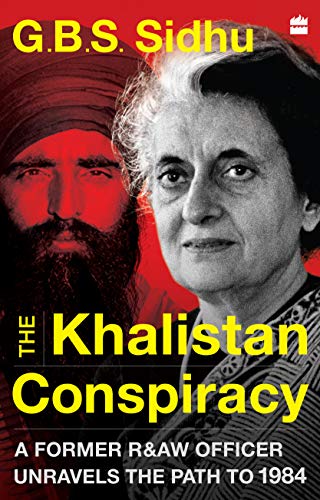
Title of Book: The Khalistan Conspiracy: A Former RAW Officer Unravels the Path to 1984 Authored by: G.B. S. Sidhu, New Delhi Published by: Harper Collins Publishers, India, 2020 (Paperback First Edition, Pages: 268; Price: Rs. 499, US:$20)
Before moving to Vancouver on 21st February, I learned about publication of this wonderful account by Mr. GBS Sidhu from a review written by Jaspal Singh Sidhu of Institute of Sikh Studies, Chandigarh. How this book reached me, is also interesting? Safir Rammah of Academy of the Punjab in North America (APNA) sends me all new titles for free download online and Sidhu’s book was a gift from Janab Rammah. Its dedication reveals that the author is son-in-law of Swaran Singh, the Minister with longest track record during the Congress rule in India.
The book has 14 Chapters followed by exhaustive Notes, two Annexures and Photos relevant to the text. In the Preface, author introduces himself in a brilliant way as the key-figure in the merger of Sikkim with India with reference to his book: “Sikkim: Dawn of Democracy, The Truth Behind the Merger with India (Penguin Random House, India, 2018)”. This success story brought the author in the good books of PM, Indira Gandhi and External Affairs Ministry. He was posted as first secretary in the Indian High Commission in Ottawa, Canada for 3 years (1976-79). He reports candidly about the situation in Canada: “Other than the normal jostling for the management of gurudwaras in the two major cities of Vancouver and Toronto, for an average Sikh the concept of Khalistan was a non-issue – if not a bit of a joke – not worthy of attention”.
The author’s analysis of Khalistan agenda puts the blame squarely on the role of Giani Zail Singh and the coterie in the PM’s house, identified as #1, Akbar road group, working to destabilize Punjab: “The genesis of the falsehoods can be traced to 1978 , when former Chief Minister of Punjab Giani Zail Singh advised Indira Gandhi’s younger son, Sanjay Gandhi, that the Akali Dal-Janata Party coalition government in Punjab could be destabilized if the moderate policies followed by the senior Akali Dal leadership, comprising Harchand Singh Longowal, Shiromani Gurudwara Parbandhak Committee (SGPC) chairman, G.S. Tohra, and Chief Minister Parkash Singh Badal, could come under constant attack by a suitable Sikh Sant”.
The author succinctly narrates his story under Op-1 (1978-80) and Op-2 (1980-84). The actors of Op-1 are identified as Giani Zail Singh and Sanjay Gandhi, and those of Op-2 were Kamal Nath, ML Fotedar, Arun Nehru and Arun Singh, scion of Kapurthala family. Under Op-1, Giani Jee helped to discover the Sant from Punjab, who could dance to their tunes. The author leaves no doubt that both these operations had the sanction of PM, Indira Gandhi: “With Indira Gandhi’s approval sought and Sanjay’s ally Kamal Nath on board, Sant Jarnail Singh Bhindranwale of Gurudwara Darshan Prakash at Chowk Mehta was chosen as the Sant who would do their bidding in Punjab”.
Chapter 1, Introduction, starts with an assessment of Indira Gandhi in the eyes of future historians: “Indira Gandhi will be remembered for two of her most controversial decisions – promulgation of National Emergency (26 June 1975 to 21 January 1977) and Operation Blue Star (4 to 8 June 1984)”. The author narrates the events leading to dismissal of Indira Gandhi’s election as Member of Parliament by Allahabad High Court and her game plan to recover her lost position by hook or by crook. This book reads like an insider’s story who had full information to the planning and shenanigans of both these operations: “The purpose of this book is to unravel the truth behind the developments leading to Operation Blue Star and its aftermath”.
In Chapter 2, author tries to identify two pro-Khalistanis in Toronto area; Professor Uday Singh and Kuldip Singh Sodhi. But the most important Khalistan leader, Jagjit Singh Chauhan’s history is given in full detail by the author: “Jagjit Singh Chauhan, a medical doctor by profession,…..he served as finance minister in Lachman Singh Gill’s cabinet. In 1971 he shifted to the United Kingdom. On 13 October 1971, he placed a full-page advertisement in the New York Times proclaiming the creation of an independent Sikh state named Khalistan. ….. In reaction to Operation Blue Star, Chauhan announced a government of Khalistan in exile in London on 13 June 1984. Remarkably, the Rajiv Gandhi government allowed Chauhan to enter India in 1989, hoist the Khalistan flag at Anandpur Sahib, and return to the UK….In 2001, he was allowed to return to India and he died in 2007″. Uday Singh was a Prof. of Mathematics and a deeply religious Sikh who came out openly in support of Khalistan after Operation Blue Star and the 1984 pogrom and wrote a book, “The Waning and Waxing of Khalistan“. Till 1979, Khalistan was not an issue among the Sikh diaspora in Canada.
Chapter 3 is devoted to a recount of Sikh-Nirankari clash of 1978 in Amritsar, Giani Zail Singh’s role in creation of Dal Khalsa and his collaboration with Sanjay Gandhi in Op-1, emergence of Bhindranwale on Punjab political scene, and his becoming a pawn in the hands of Congress-led government in Delhi. The author laments: “Unfortunately, Punjab was not to remain a ‘haven of prosperity and peace’ for long. Political opportunism and short-term electoral gains overtook considerations of national interest and the need to maintain religious harmony, peace, prosperity and stability”.
Chapter 4 gives a vivid description of rise of Bhindranwale as a religious-cum-political leader and beginning of Op-2 under the planned strategy of #1, Akbar road group. The author reveals the game plan of this group:”It was decided that the Congress would deploy him (Bhindranwale) and the issue of Khalistan – which had by then stuck to him because of his refusal or inability to rebut it – in order to win the eighth Lok Sabha elections that were due before January 1985. It was necessary to keep the pot boiling in Punjab and to allow Bhindranwale to operate unhindered till the situation was ripe for final action”.
This Chapter is significant on other counts also. The murders of Nirankari Chief, Gurbachan Singh and Lala Jagat Narain in broad day light, Bhindranwale’s surrender at Chowk Mehta, statement of Giani Zail Singh in Parliament exonerating Bhindranwale, and his release are part of this Chapter. The dubious role of Giani Zail Singh in Op-1 has been a topic of debate but a reference by the author may connect the link between the two main actors: “Zail Singh and Rajiv Gandhi attended Santokh Singh’s memorial service. A photograph from the event shows Zail Singh with Bhindranwale”. Compared with 1979, the scenario had changed in Canada in 1981 as reported by author after his visit. His friends were curious to know why Bhindranwale is being patronized by senior Congress leaders and they had no sympathy for him: “The activities of Bhindranwale, who appeared to be enjoying political patronage, needed to be curbed and controlled”.
Chapter 5 dilates upon the negotiations of moderate Akali leaders with Congress leaders, including PM Indira Gandhi. The Akali Dal was represented by Harchand Singh Longowal, Parkash Singh Badal, Gurcharan Singh Tohra, Surjit Singh Barnala and Balwant Singh. Indira Gandhi was assisted by Cabinet Secretary, C.R. Krishnaswamy Rao Sahib, her Principal Secretary, P.C. Alexander and Home Secretary, T.N. Chaturvedi. Indira Gandhi played a very cunning role but blamed Akalis for failure of the talks. But in reality the prolonged exercise was a charade; a total of twenty-six rounds of negotiations ended without producing any results. The Akalis reduced their demands from 45 in 1981 to just 15 and wanted to wriggle out of this ‘Dharam Yudh Morcha’ by some face saving device. According to author: “It was a Catch-22 situation for the moderate Akali leadership. On the one hand, the # 1 Akbar Road group was gradually eroding the hold of the moderate Akali Dal leaders over their peaceful agitation by encouraging and overlooking Bhindranwale’s extremism and violence. On the other hand, they were telling the Akali moderates to regain their hold over the agitation before their demands were accepted.”
The author refers to the role of Cabinet Minister, Swaran Singh, who was approached by the Akalis to act as an intermediary. Swaran Singh took Indira Gandhi into confidence who gave her consent to go ahead. Singh was finally able to bring down Bhindranwale to one small demand, which was the unconditional release of Amrik Singh and Thara Singh. Bhindranwale also agreed to move back to his Mehta Chowk gurudwara once a final settlement was reached and his men were released. After bringing Akalis, Bhindranwale and Congress leaders to some common minimum programme, Swaran Singh was very hopeful of success of his mission when it was sabotaged by #1 Akbar road group. Author is of the view that Giani Zail Singh played a dubious role in this whole episode and Indira Gandhi changed her mind, forcing the Akalis to withdraw from negotiations.
In Chapter 7, author gives a detailed description of Bhindranwale’s killer squad and unabated violence carried out by his men in Punjab, rasta-roko agitation of moderate Akali Dal to reassert itself, and remote control of Bhindranwale by the central agencies. The author clearly states that Akbar road group was stage managing the activities of Bhindranwale by planting ‘moles’ in his camp and Harminder Singh Sandhu, General Secretary of All India Sikh Students Federation (AISSF), was suspected to be one such person. He escaped alive during Operation Blue Star but was murdered later due to his suspicious role in this episode. Author gives vivid details of murder of AS Atwal, DIG of Jallandhar range, on 25 April 1983 after his exit from Golden Temple, Bhindranwale’s ‘hit list’, communal discord in Punjab and killing of Hindus in a bus, entry of Babbar Khalsa in Golden Temple Complex, and daily sermons of Bhindranwale from the roof of langar hall, which were mostly anti-Hindu in content.
In the next two Chapters, author refers to changing scenario in Canada and USA where the diaspora Sikhs were disappointed and turning to be sympathisers with the Bhindranwale. The author gives details of “Operation Sundown” which was planned in April 1984 as a heliborne operation to abduct Bhindranwale from the Golden Temple complex. At the last moment, it was dropped on the intervention of PM, Indira Gandhi, to avoid civil casualties which were thousand times more during Operation Blue Star carried out in June 1984.
PC Alexander, Principal Secretary to PM, played a crucial role in the ongoing negotiations between the two sides. In his book, “Through the Corridors of Power: An Inside Story“, he writes: “Indira Gandhi ‘sincerely believed till the last moment that a solution could be found through talks’. In fact, there was no need to stretch the negotiations till ‘the last moment’ in the first place as she could have settled the matter back in 1982 by sticking with her initial acceptance of the Swaran Singh formula”.
Chapter 11 is focussed on Operation Blue Star and it opens with author’s critical remarks: “OPERATION BHINDRANWALE-Khalistan-2 (Op-2) had a predetermined goal, a fixed time frame and an operational plan”. “Senior Akali Dal leaders, troubled by the PM’s dilatory tactics, were feeling helpless and suffocated within the Golden Temple complex because of Bhindranwale’s presence and his extremist activities. Clandestine smuggling of arms and ammunition and fortification of the Akal Takht by Maj. Gen. Shahbeg Singh had started by March 1984, and were being conveniently overlooked by the security apparatus concerned”. According to author: “The justification for such an action was provided by Harchand Singh Longowal on 23 May 1984, when he announced that starting 3 June, no food grains would be allowed to move out of Punjab, and that Sikhs would not pay taxes and dues. With the Punjab police and paramilitary forces incapable of clearing the by-now heavily armed Akal Takht complex, army’s involvement became inevitable”.
Chapter 12 deals with Indira Gandhi’s assassination and the anti-Sikh pogrom. Author himself was an eye witness to happenings of loot, arson and mayhem in Delhi. He had to hide his family in a Hindu friend’s home before he could seek protection from his department. He had access to the police network over his radio and was horrified to learn about the connivance of Delhi police in the Sikh pogrom. He compares the scenario in Delhi with the Sikh persecution during the regime of Zakaria Khan, governor of Lahore (1726–45). This pogrom leading to Sikh genocide has become part of the Sikh memory. Author is highly critical of Justice Ranganath Misra and other commissions set up to probe Sikh genocide just as an eyewash: “Unfortunately, other than a number of commissions and committees that followed, nothing happened to the known goons and murderers, who continued to roam freely without any fear of law or justice”.
Chapter 13 describes the events leading to ‘aftermath‘ of Indira Gandhi’s assassination. The author squarely puts the blame of creating the “Ghost of Khalistan” on leaders of Op-2: “The outcome of Op-2 launched by the #1 Akbar Road group in the early 1980s ended in the events of 1984. It also gave birth to a hitherto non-existent issue – Khalistan – thereby providing an opportunity to certain countries, particularly Pakistan, to use that as a handle to further their respective agendas vis-a-vis India”. This Chapter also gives details of fake encounters carried out by the police in Punjab and UP, the infamous Pilibhit encounter.
Chapter 14 sums up the purpose of Operation Blue Star in one sentence: “It was conceived in 1978 by Sanjay Gandhi with the blessings of Indira Gandhi, with the sole purpose of winning elections due by January 1985 for the Congress”. The author ridicules its bad planning and execution: “The religious divide of gigantic proportions created over a period finally led to an ill-conceived, badly planned and horribly executed Operation Blue Star, and to a carefully planned and surgically executed pogrom against Sikhs that followed the assassination of Indira Gandhi in Delhi and some other cities of India”.
The author has added two Annexures to the book, and in number II, a brief description of Commissions, Committees and SITs set up Government of India to probe 1984 pogrom of Sikhs is given. It shows the inadequacy and unwillingness of these commissions to mete out justice to the Sikhs.
In my estimation, this book “Khalistan Conspiracy” by GBS Sidhu is a monumental work based on factual data and ‘inside the ring’ view as author himself, as a member of RAW, was involved as an active player to record the events leading to Operation Blue Star and its aftermath. I have no doubt about the integrity and modus operandi of the author. I appreciate his calling a spade a spade. In crystal clear terms, I find indictment of all key players, namely, Indira Gandhi as Prime Minister, Giani Zail Singh as Home Minister and then President of India, Bhindranwale as persona non grata in Golden Temple complex, and the moderate Akali Dal leaders for allowing the use of complex premises for un-sanctimonious purposes by Bhindranwale and his killing squad.
There are a few howlers in the text, for example, hijacking is written as highjacking repeatedly. Swaran Singh served as a Lecturer in Khalsa College, Layallpur in 1946 but author writes Layallpur Khalsa College, Jallandhar which started only after partition in 1947. I recommend this book as a ‘must read‘ for general public for removing cobwebs from their minds, and future historians of Sikhs for an impeccable and unbiased account of the Blue Star Operation and its aftermath.
Scholar and scientist Hardev Singh Virk retired from Amritsar-based Guru Nanak Dev University in 2002 after serving as Founder Head Physics Department and Dean Academics. Ex-Professor of Eminence, Punjabi University, Patiala. He is the present Visiting Professor at SGGS World University, Fatehgarh Sahib (Punjab), India.
ASIA SAMACHAR is an online newspaper for Sikhs / Punjabis in Southeast Asia and beyond.Facebook | WhatsApp +6017-335-1399 | Email: editor@asiasamachar.com | Twitter | Instagram | Obituary announcements, click here |





















 JEHA CHIRI LIKHYA TEHA HUKAM KAMAEH, GHALE AAVE NAANKA SADE UTHEE JAAYE (SGGS, 1239)