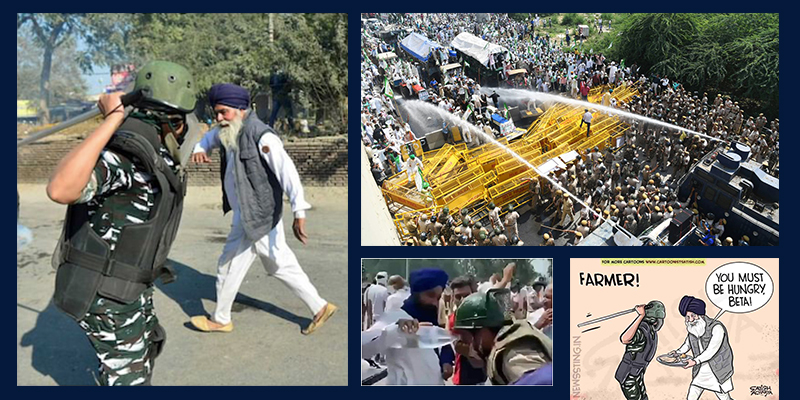
Farmers’ protest in Delhi. Photo source, clockwise from left: Ravi Choudhary (PTI), AFP
By Asia Samachar Team | INDIA |
A conversation to dig deeper into the #DelhiChallo. What are some of the underlying issues in the massive farmers’ protest in India?
The major entry points to Delhi have been blocked by protesting farmers who have come from Panjab, Haryana, Uttar Pradesh and a number of other states.
Their representatives are now in tense talks with the Indian government. The talks, which went on for some seven hours yesterday (3 Dec), did not come to any conclusion.
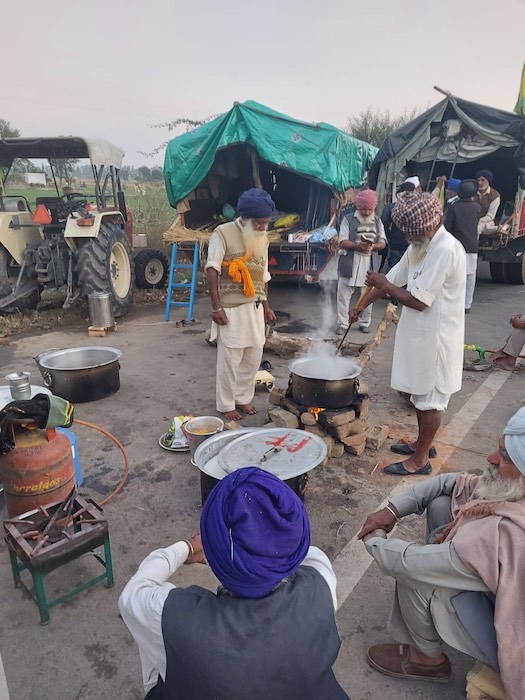
At the lunch and tea breaks, the farmers’ leaders declined the lunch and tea provided by the government at Vigyan Bhavan, instead opting for food brought for them from a gurdwara. It was a powerful symbolic move to underscore their resolve.
It as reported that the central ministers had offered to consider a number of amendments to the contentious farm reform laws. They had also provided assurance that minimum support prices (MSP) for farm produce would continue.
The dialogue is scheduled to resume on December 5.
“The government made a fatal miscalculation in underestimating the resolve of the farmers,” award winning senior journalist P Sainath tells Indian journalist Faye D’Souza in an interview.
Sainath, founding editor of the People’s Archive of Rural India (PARI), is also the author of the book Everybody Loves a Good Drought (Penguin India, 1996). D’Souza is the executive editor of Mirror Now.
Some snippets from the interview.
LANGGAR
The Langgars of the gurdwara in Karnal feed these policemen who had used water cannons against people in their 60s and 70s in what had been Delhi’s coldest day in winter in 70 years – 9 degrees Celcius. And yet the farmers had the grace.
For me, the visual of the month was the farmers feeding the hands that best them, and the policemen biting the hand that feed them. It really tells you something about he marginalised section and the state. And the state of those relations are today.
ACCESS TO COURTS
You are making the executive (as) the judiciary. That is outrageous. The executive takes on the powers of the judiciary. Well, in a way, that’s how the Modi government behaves.
[In the discussion between the government and the farmers] Agriculture Minister Narendra Singh Tomar has offered the farmers a ‘death by committee.’
A far greater committee exists. It had given an incredible report – a blueprint for Indian agriculture. The Swaminathan Commission has laid in Parliament for 15 years without even an hour’s discussion on the report.
The government made a fatal miscalculation in underestimating the resolve of the farmers.
The farmers have made their choice and they’re at the gates of Delhi to tell that to the government.
The government, the corporate media and the elite are not getting it – the sense of grievance and the sense of betrayal that is there now in the farmers.
So here you are looking at the what the government is doing. It is one more milestone on a way to agrarian hell where you handover Indian agriculture to the corporations. That has been the process for two decades now. It’s intensifying.
It’s time for non-farmers to join [the protest] as well. The agrarian crisis has become a societal crisis, perhaps even a civilisation crisis, with the largest body of small farmers, small holders on earth fighting for their survival.
It’s not just about the loss of productivity but the loss of humanity. Look at death by suicides of 330,000 farmers but where is our outrage.
ASIA SAMACHAR is an online newspaper for Sikhs / Punjabis in Southeast Asia and beyond.Facebook | WhatsApp +6017-335-1399 | Email: editor@asiasamachar.com | Twitter | Instagram | Obituary announcements, click here |
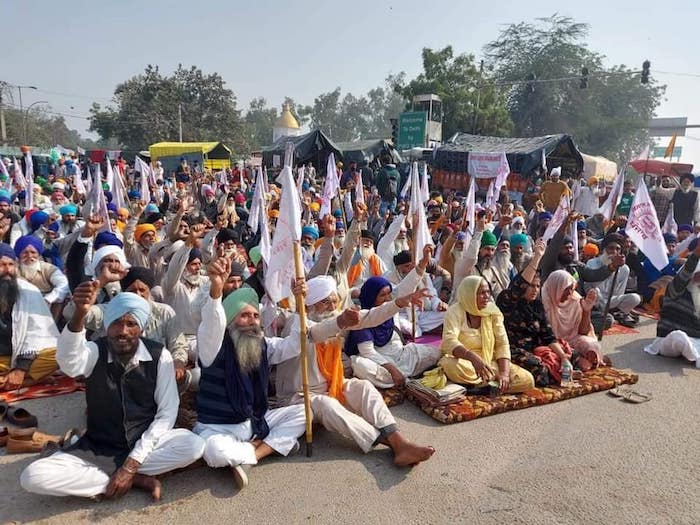
Panjab farmers huddled at the Singhu border, Delhi – Photo: Harpreet Singh / Asia Samachar
By Jaskaran Singh Sandhu | OPINION |
A question that is frequently emerging these days in online debates and commentary is – why do Punjabis and Sikhs in the diaspora care so much about the ‘Delhi Chalo’ farmers’ march? These commentators also like to suggest to us folks sitting in Canada, US, the UK, or Australia – that we should just mind our own business and quit speaking up on the issue.
This is actually a common critique from Indians. After all, what do these Canadians know, living a privileged life in the West, disconnected from the ground realities in India? However, this critique lacks a very basic understanding of Punjabi culture and the Sikhi that moves us.
THE ‘SIKHI’ THAT INSPIRES US – NO MATTER WHERE WE ARE IN THE WORLD
We care because that is our people fighting on the long road to Delhi. Those are our grandparents, our brothers and sisters – literally and figuratively. It is our people pushing over barricades, braving water cannons, and walking through tear gas.
It is also the same Sikhi that inspires all of us, regardless of where we may be around the globe.
The revolutionary drive to change the world, the resolve to fight injustice wherever it may present itself, and the chardi kala spirit that brings the grit needed for it all.
Watch almost every Punjabi cellphone video or interview from the protest and you see that Sikhi manifest itself repeatedly. From little children to elders all describing a resolve based on a proud history of sacrificing one’s life for the greater good, a proud history of marching on Delhi like Baghel Singh, a proud history of fighting against all odds.
It is our family and friends out there, people we care for deeply at a personal level. We worry for them and will advocate for them in whatever way we can.
SIKH DIASPORA-DRIVEN ADVOCACY & ITS IMPACT
Our advocacy can range from battling misinformation on social media to encouraging politicians to speak out. Punjabis and Sikhs in Canada, for example, are respected, connected, and powerful.
Our ability to mobilise at a grassroots level through advocacy organisations and community institutions means we have a voice that we can project into the world.
We have seen this happen again with the ‘Delhi Chalo’ movement. Canadian MPs, MPPs, and City Councillors from across the political spectrum have all spoken out, lending their support to the cause. They have called on the Indian government to stop the violence, bringing international media attention to what is happening.
During a Guru Nanak Dev ji Gurpurab event, the Prime Minister of Canada, Justin Trudeau, shared with Sikh Canadians that his government has reached out to Indian authorities, through various channels, to share concerns regarding police brutality and asking that the right to peaceful protests be respected.
This came after the leaders of Canada’s largest opposition parties made public statements in support of farmers as well – the NDP’s Jagmeet Singh and the Conservatives’ Erin O’Toole. That is incredibly powerful, and if it even helps a little in supporting farmers on the ground, including those from outside Punjab like Rajasthan, UP and Haryana, then our diaspora-driven advocacy was worth it.
It is also not lost to us in the West that many in India do not complain about the HSS, Overseas Friends of BJP, or Congress politicians trying to raise money abroad, with the same vigour that they complain about organic advocacy from Sikhs in Canada or elsewhere.
We are witnessing a major moment of agitation and protest. Like those we could only read about in the past. And we are witnessing it as it happens. You are going to be very disappointed if you were expecting us in the diaspora to stay quiet.
Jaskaran Sandhu is a senior consultant with Crestview Strategy. He previously served as executive director for the World Sikh Organization of Canada and as senior adviser to Brampton’s Office of the Mayor. He tweets @JaskaranSandhu_. The article first appeared at The Quint (2 Dec 2020).
ASIA SAMACHAR is an online newspaper for Sikhs / Punjabis in Southeast Asia and beyond.Facebook | WhatsApp +6017-335-1399 | Email: editor@asiasamachar.com | Twitter | Instagram | Obituary announcements, click here |
SAHEJ PATH DA BHOG & ANTIM ARDAS:19 Dec 2020 (Saturday) at Wadda Gurdwara Sahib Kampung Pandan (Luar), Kuala Lumpur. Programme – 10.00am – 11.30am: Kirtan and Katha, 11.30am: Start of Sehaj Paath Da Phog and Ardaas. Guru Ka Langgar will be served| Malaysia
With a very heavy heart, we wish to inform that Sardar Naginder Singh Dhanoa (Nick) s/o Late Sardar Babu Singh Dhanoa & Late Sardarni Bachan Kaur, husband of Mdm. Amarjit Kaur (Amri) from Pandan Indah, Kuala Lumpur has passed away peacefully on 2nd December 2020. (1953-2020)
Path Da Bhog & Antim Ardas: 19 Dec 2020 (Saturday) at Wadda Gurdwara Sahib Kampung Pandan (Luar), Kuala Lumpur. Programme – 10.00am – 11.30am: Kirtan and Katha, 11.30am: Start of Sehaj Paath Da Phog and Ardaas. Guru Ka Langgar will be served.
As Kuala Lumpur is still under the CMCO, please adhere to the SOPs. Message from Wadda Gurdwara Sahib Kampung Pandan
Contact:
Jayvinder 019-666 6066
Rishi 016-269 0907
Ishweer (son) 012-339 0057
Please strictly adhere to the CMCO SOP, as stated below
| Entry: 3 Dec 2020; Updated: 8 Dec 2020 | Source: Family
ASIA SAMACHAR is an online newspaper for Sikhs / Punjabis in Southeast Asia and beyond.Facebook | WhatsApp +6017-335-1399 | Email: editor@asiasamachar.com | Twitter | Instagram | Obituary announcements, click here |
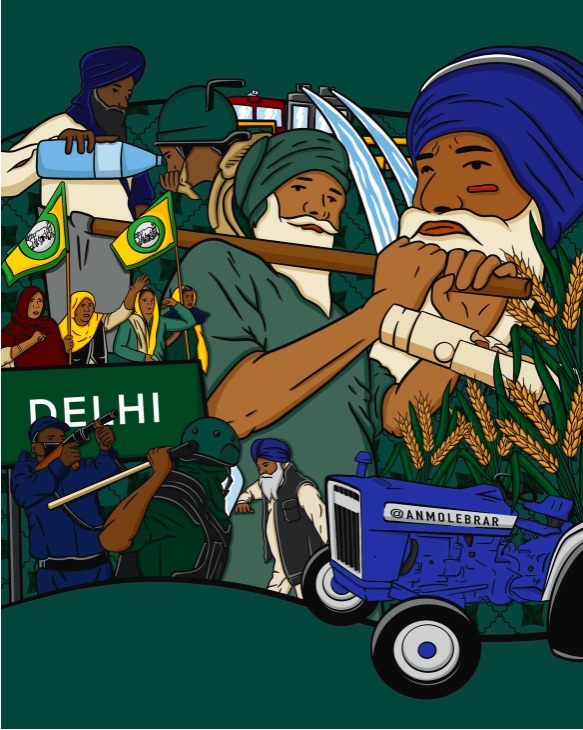
Illustration by Anmole Brar / The Lipstick Politico
By Ashveer Pal Singh | OPINION |
A few days ago, armed with a daffli and the rhythms of Punjabi dhadis two young women sang into microphones amongst a group of farmers camped out on the Haryana-Delhi Border:
Pimps are trying to sell our land, we will pin them to our knees.
We’ve sharpened the edges of our blunt swords,
the youth is eager to rip out the roots of oppressive rulers.’
These are not the refrains that regularly accompany a trip on the Grand Trunk Road, though perhaps the Punjabi faces might look familiar. Farmers, young women, children, all manner of people moving in one direction, with one purpose. Less makki di roti; more maan ki baat.
The protests have recently emerged across a number of media channels, and while a great deal of commentary and playtime has been spent listening to pundits wax poetic about whether or not one ought to agree or disagree with the vehicle, few have stopped to question the direction itself. How exactly did we get to this point, and what led us down this road in the first place?: So let’s take a moment for a quick explainer: Why are people protesting towards Delhi, who are they, and what is at stake?
Tell me about it. No really, please tell me about it.
This September, the BJP-lead government rammed three acts through the parliament under the guise of achieving that elusive dream of ‘global agricultural capital’. Aside from demonstrating how quickly the government of India is capable of moving (when it is politically motivated to do so), these three acts also succeeded in entirely deregulating agriculture in the country, putting farmers in peril. Crops can be sold outside of government-regulated mandis, contract farming has become formalized, and companies can hoard essential commodities. While these changes may seem abstract and easy to detach oneself from, what is critical to note here is that these changes remove key protections for those who till the land – putting their livelihoods, families, and associated local economies at risk. Keep in mind as well, that these destabilizing changes come on the heels of the farming community in India has made international headlines for widespread suicides under the weight of immense debt among agriculturist households across the country. This is the single most important development in Indian agriculture since the Green Revolution of the 1960s, by which this community labored to make the country food secure and independent of first world nation food aid. The irony is that today, the agrarian community is one which has little margin-left with which to absorb the economic shocks that these acts will bring.
After smaller protests around the country by a multitude of farmers organizations, and failed talks with the central government to resolve the impasse, Punjab’s farmers declared Dilli Challo and marched towards Raisina Hill in cars, buses, and tractors. But they are not alone. Over 500 farmers unions across the country are supporting the march officially.
But take a look on Instagram, and you’ll find young women shouting and singing slogans alongside their turbaned uncles, and children on the road too. International support has been voiced across the diaspora, as well as from elected representatives in the UK and Canada. Every part of the Grand Trunk ecosystem seems to be stepping up to play its part. Local mechanics have volunteered their labor to maintain tractors. The famous Amrik Sukhdev Dhaba fed protestors as they passed. Free medical booths appeared on the roadside as if out of thin air. Local hotels offered their facilities for protestors to wash up. It’s notable that this protest marks one of the first instances that the farmer’s movement has gained such widespread support.
What is at stake?
Reforms like these impact so many lives at so many levels. The trickle-down effects run everywhere from the bhavans of Delhi to the ribbons that tie the braids of a little girl sitting in her second class. Don’t believe us? The next time you eat, take a good look at your plate and consider how many different individual people were somehow involved in the simple production of your lunch.
About the Author: Ashveer Pal Singh is a PhD candidate in the Department of anthropology at Stanford University and a User Experience Researcher at Facebook. His thesis research examines bureaucracy, e-governance, and political culture in Punjab.
Read the full story, ‘A Snake in the Sarson: How Punjabi Farmers Found themselves at the Gates of Parliament’ (The Lipstick Politico, 1 Dec 2020), here.
ASIA SAMACHAR is an online newspaper for Sikhs / Punjabis in Southeast Asia and beyond.Facebook | WhatsApp +6017-335-1399 | Email: editor@asiasamachar.com | Twitter | Instagram | Obituary announcements, click here |
Guru Nanak gurpurab at Kota Kinabalu gurdwara – Photo: Supplied
By Asia Samachar Team | MALAYSIA |
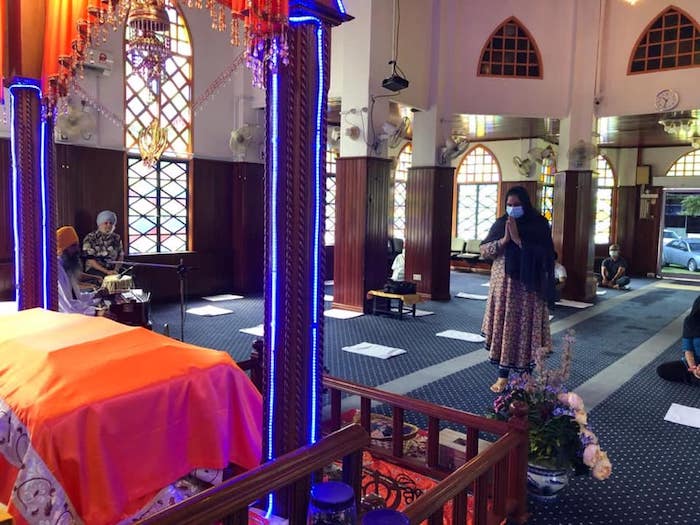
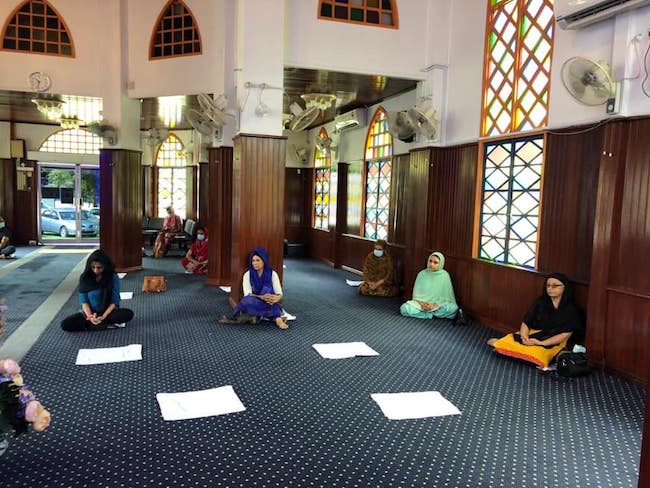
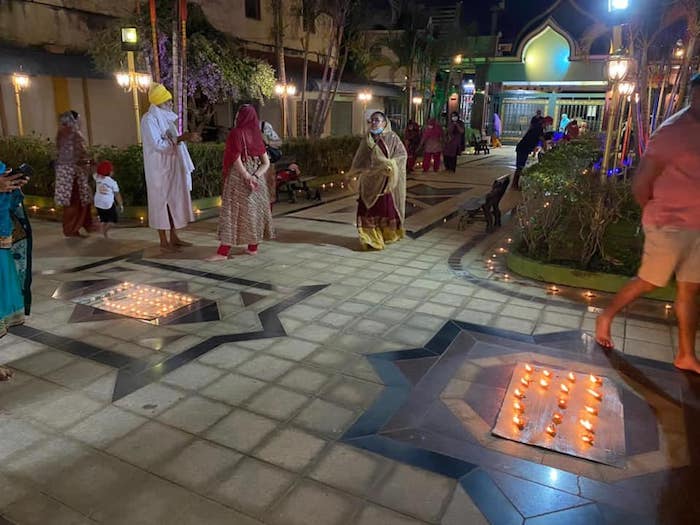
#GuruNanak551 | MALAYSIA: Gurdwaras nationwide commemorated the 551st birthday of Guru Nanak on a smaller scale due to the Covid-19 pandemic restrictions.
It was the same in Kota Kinabalu, the Sabah state capital which is still under the Red Zone for Covid-19 pandemic. But it did not stop the Sikhs in the Sabah stage capital to commemorate the 551st birthday of Guru Nanak. “The authorities have limited the presence to 20 people at any one time,” Kinabalu Singh Sabha Association secretary told Asia Samachar.
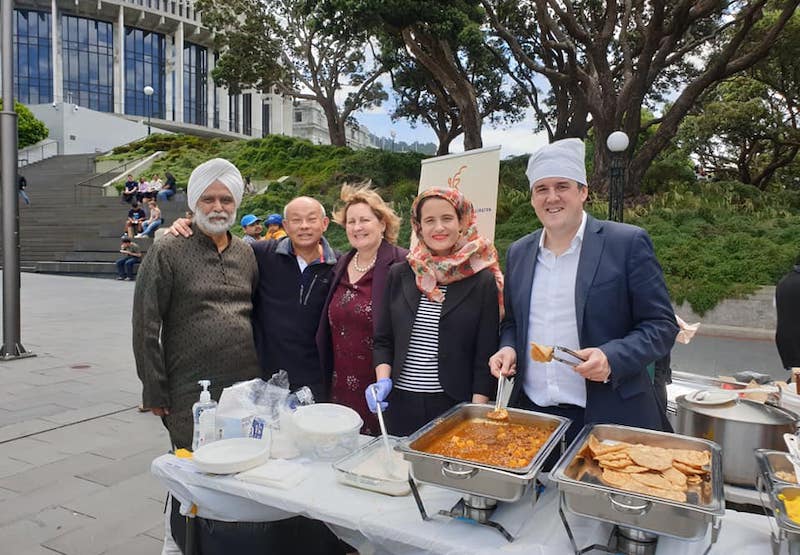
In Wellington, New Zealand, two local lawmakers joined Ekta Inc for a gurpurab event at the Wellington Cenotaph on Nov 27. The Members of Parliament were Nicola Willis (Wellington) and Chris Bishop (Hutt Valley).
(Asia Samachar welcomes you to share photos of how your local Sanggat observed the celebration. Whatsapp: +6017-3351399 Email: editor@asiasamachar.com)
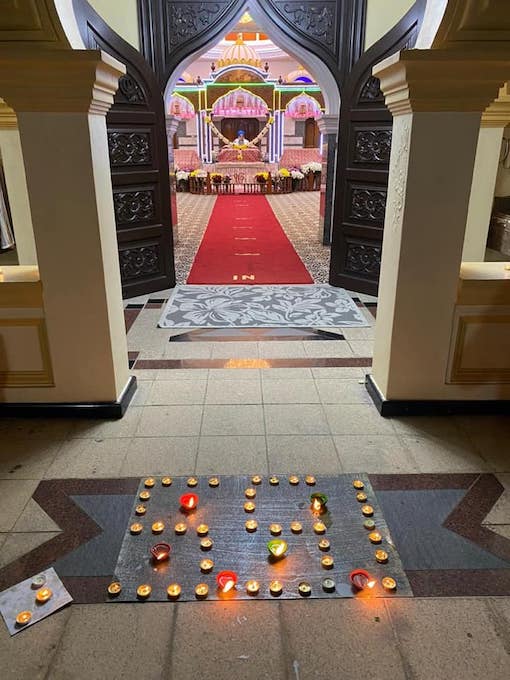
Guru Nanak gurpurab at Kota Kinabalu gurdwara – Photo: SuppliedMPs Nicola Willis 2nd from right) and Chris Bishop (right) with EKTA Inc member Manjit Singh Grewal (left) at the Guru Nanak gurpurab event – Photo: SuppliedLighting candles for Guru Nanak gurpurab at Malacca gurdwara – Photo: SuppliedLighting candles for Guru Nanak gurpurab at Malacca gurdwara – Photo: Supplied
ASIA SAMACHAR is an online newspaper for Sikhs / Punjabis in Southeast Asia and beyond.Facebook | WhatsApp +6017-335-1399 | Email: editor@asiasamachar.com | Twitter | Instagram | Obituary announcements, click here |
EVENT | SINGAPORE: Fancy taking part in online footsy? Here’s your chance. SKA FIFA20 Tournament is now open for registration. Organised by the Singapore Khalsa Association (SKA), the online tourney will start off with 64 players. Semi-finals onwards will be held at SKA.
All participants will receive a $5 e-voucher from Arcade Sports (https://www.arcadesports.sg).
Games will be played on PS4. Players can choose the team of their choice.
Log on to https://sg.footsy.app/esports-ska to register now.
ASIA SAMACHAR is an online newspaper for Sikhs / Punjabis in Southeast Asia and beyond.Facebook | WhatsApp +6017-335-1399 | Email: editor@asiasamachar.com | Twitter | Instagram | Obituary announcements, click here |
The propagandists ranging from Vivek Agnihotri [Indian film director and activist] to Malviya [BJP leader Amit Malviya] himself uttered no word in last 55 days. The farmers have been protesting peacefully and all of a sudden they decide to beat a dead cause to incite emotions. Here is how this propaganda works.
Make Hindus insecure about Sikhs by making it all about JSB [Jarnail Singh Bhindranwale].
And please don’t be fooled, they make Hindus uncomfortable for just votes. Malviya has no other job but to keep BJP vote bank intact by keeping fear intact in gullible people.
This fear can be anything, “Pakistan is at war with us”, “Muslims are going to annihilate us all”, “Sikhs plan to kill us all” and anything that makes their vote bank insecure to seek refuge back in party.
I am more than happy to host anyone who wants to come here to see things.
The unfortunate and sad part is that this propaganda is not even for Hindus, it is for Hindu votes. The fact is that farmers are not Sikhs alone. There are Hindus standing shoulder to shoulder not knowing what’s talked online about them.
Fact 2 – No there are not just protestors from Punjab and Haryana. 500 Farm unions from across the nation are participating in this. Please check the borders leading to Delhi. The crowd from UP [Uttar Pardesh] and Rajasthan is at borders.
No, there is no separatists here. The cherry picked videos and posters mean nothing. Please think with a calm head, if I am a separatist, why would I want to believe in abolition of law and not just violate it in Punjab? That’s separatism right? We are doing things democratically
AAP, Congress, and other communist parties have been denied stage. These people have habits of earning brownie points by going to protest sites and creating their own propaganda. The video of man making stupid remarks is absolutely condemnable, and we don’t subscribe to it.
Please understand that you can beat the dead horse to reclaim your journalism or be rewarded by party in power but this will only prolong the struggle. Because this is unlike any struggle. We are here to stay and propaganda can’t do anything.
Talk – Ensure – Resolve.
Adapted from tweet entry by @amaanbali on farmers’ protest against the controversial farm laws passed earlier by Indian parliament. Check his Twitter account for more photos and updates
ASIA SAMACHAR is an online newspaper for Sikhs / Punjabis in Southeast Asia and beyond.Facebook | WhatsApp +6017-335-1399 | Email: editor@asiasamachar.com | Twitter | Instagram | Obituary announcements, click here |
Walking on the delightful avenues of Paris, one is almost immediately overwhelmed by just how astonishingly beautiful the city of Paris truly is. Its splendid classical buildings and plazas, its resplendent churches and cathedrals, its verdant parks and gardens, and its world famous landmarks have undeniably rendered the French metropolis a true masterpiece of artistry and elegance in the field of urban design in the eyes of the world.
One of its most famous landmarks, the ever so popular, The Louvre Museum, or simply called The Louvre where the Mona Lisa is displayed, is an example of classical French architecture at its finest. Its classical appearance has mesmerized many an eye, and the aesthetic of its renaissance design projects a timeless quality, to be appreciated by all of humanity, and not just the citizens of France.
Louvre by night, Paris, France – Photo: Piotr Gaborek
However, what makes the Louvre even more visually stunning, other than its gorgeous classical veneer, it’s the incorporation of a rather modern steel and glass pyramid, that sits right in the middle of the vast plaza in front of the Louvre building itself, that acts as an entry point into the Louvre Museum Complex located below.
Initially called ‘a scar on the cheek of Paris’ by the Parisians themselves, due to its controversial and contrasting look next to a classically inspired complex that the citizens didn’t like in the beginning, the glass and steel pyramid has become an icon onto itself that creates a modern identity for the entire museum, tying the Louvre Museum from its roots in the past to the present day era.
The placing of architectural structures next to each other is an interesting exercise in contemporary architecture, particularly so in designing a modern structure next to an older one. Indeed, to find a way to visually and structurally connect an older building with a newer one, is one of the more interesting challenges architects face in the modern era, and its planning and design can be an exciting commission to explore and execute.
Typically, a good number of Gurdwaras in Malaysia that were built in the past, say within a span of a 50 to 100 years or so, will follow a rather straightforward formulaic appearance. These Gurdwaras are usually a single storey or a double storey structure, that usually has a dome on top, decorative arches and other flowery designs built into the building, and these were done to create an appearance that would visually ‘tie’ these Gurdwaras with the older Gurdwaras that were built in the past in India. Now, there is nothing wrong in attempting to celebrate one’s architectural heritage in the design of our houses of worship by incorporating these elements, and in that sense all these Gurdwaras have done a wonderful job in bringing the Sanggat together under one roof to worship the Supreme and to perform sewa for the community by incorporating such an aesthetic.
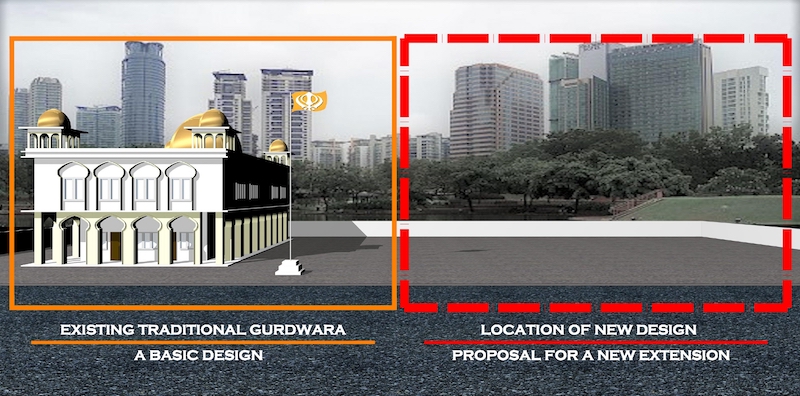
Exploring on this premise of designing the new next to the old, let’s make an assumption that a committee for a Gurdwara built with the traditional look has decided to do some renovation work that will require a new extension to be built next to the existing traditional Gurdwara. Let’s assume, purely on a hypothetical basis, the older Gurdwara is double storey structure with a Darbar Sahib on the first floor and a Langgar Hall, an office and a couple of rooms on the ground floor – relatively common for such buildings – and that the committee has acquired the land next to the traditional Gurdwara for the renovation project. The Gurdwara could look something like the following picture, but next to an empty plot of land where the new extension will be built.
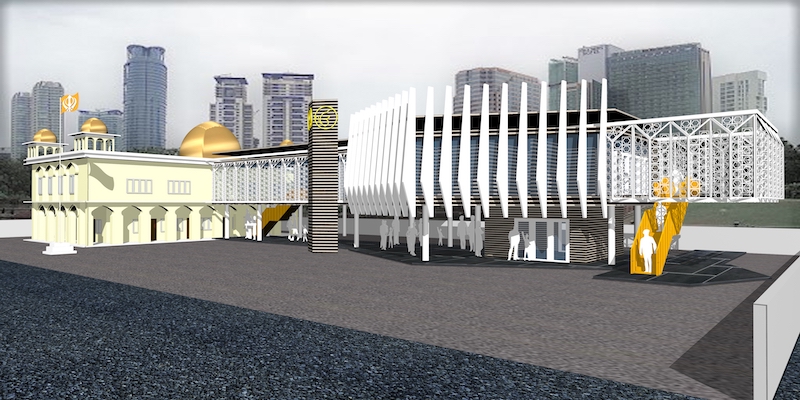
As a requirement for the new extension, let’s assume, again, purely hypothetically, that the new conceptual building needs to house two multi-purpose rooms, rooms for staff (granthis, etc) and guests, and finally some offices too for administrative work and the committee has decided to adopt a modern design for the new extension. The Darbar Sahib and the Langgar Hall would remain as they are in the existing traditional Gurdwara but perhaps could be enhanced with an updated look to accommodate the rest of the modern aesthetic that’s being proposed for the extension. The other important requirement will be to allocate enough space for carparking as well to ensure that enough parking bays will be provided for the Sanggat. Based on all these requirements, the proposed conceptual extension could be designed as shown in the following visual.
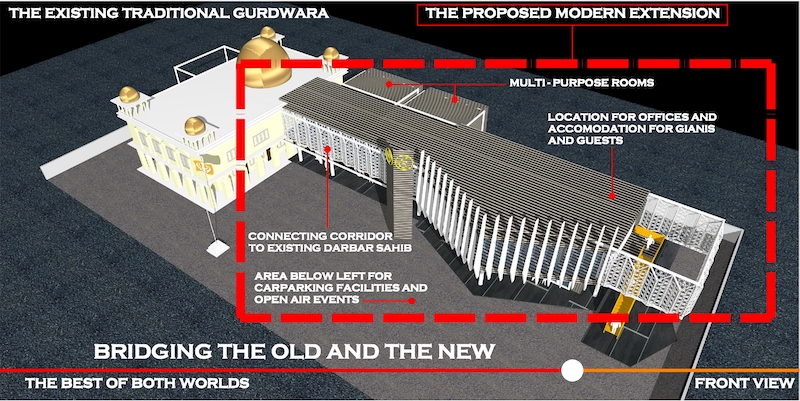
As mentioned previously, this is purely a conceptual idea and this extension is simply a proposal that is rooted in imagination and the occasional bouts of day dreaming on the part of the author. Based on the requirements given by the committee, the proposed extension could be an elevated structure that would house all the needed areas above the carparking area, so as to not sacrifice too much space below meant for the Sanggat to park their cars. A new corridor could be built that would directly connect to the Darbar Sahib on the first floor with the rest of the new areas, making accessibility convenient and practical for the daily running of the Gurdwara complex.
The new extension shown on the right above, connects to the traditional Gurdwara on the left through an elevated full height glass corridor, covered with a screen of geometric designs and connected with a staircase built of metal and shown in yellow, to create a visual, colour based connection with the yellow ( or various shades of yellow or sometimes orange ) seen in the domes of such traditional Gurdwaras. The ground floor has an enclosure that can be used for any purpose, but in this case, it is used as guardhouse and as a security centre of sorts for the rest of the complex. The rest of the open areas are meant for parking and can be converted into an open area for open – air activities, such as gatherings for Vasakhi or Diwali.
The proposed extension would have accommodation for Gianis and guests located on the far right of the structure, that can easily be accessed by the staircase also located at the end of the proposed extension. This would allow easy connectivity to both the Giani and the guest to come and go as they please and would make it easy for their belongings and their luggage to be carried from the ground to the top from a drop off point on the ground floor. Offices too are located within this area, that are protected by a series of tall ‘fins’ – that are also sometimes referred to as ‘blades’ because of their sharp, streamlined look – that act as sunshading devices to prevent too much light and heat to enter the rooms above.
The extension would have two multi – purpose rooms at the back and that can be used for various purposes such as classrooms, seminar halls, office spaces and such, depending on what the future requirement of the Gurdwara could be. These areas are easily accessible from one end of the extension to another, where the Darbar Sahib is located and are therefore in a strategic location within the new complex. An additional staircase is located below to further facilitate an easy flow of pedestrian traffic from the ground to the first floor.
In many instances in the professional world, a proposal for an extension to an existing building is a relatively common request that architects receive globally, and as written previously, can be an exciting prospect to plan and carry out. This design exercise, where two structures are placed next to each other with contrasting appearances that would make them stand out even more, is sometimes referred to as ‘Juxtapositioning’ in architectural circles, and provides an intriguing possibility of proposing a design that implores the design team to find a way to skillfully combine the old and the new to create a cohesively new structure while respecting the need for each structure to remain faithful to their original designs.
This conceptual extension is an expression of that request, where very often, clients will need a design that helps them to supplicate the needs of an existing building with a new design. Simply tearing down an old building to build a new one might not be feasible due to budget constraints and due to the fact that the old building may have both significant cultural and historical value that must be preserved. A solution to create and combine a new extension with the existing one usually is the most practical course to pursue when requiring a new set of needs to be met, and the design of a new extension can celebrate contemporary ideas and concepts into an older context, and create something entirely new and exciting, while preserving the old and the cherished.
Waheguru Bless.
The next proposal will imagine designing a Gurdwara that is ultra-futuristic in its appearance as a means to celebrate the incredible accomplishments of modern technology in the 21st century.
Vishal J. Singh, an aspiring architect, holds a Bachelor of Architecture Degree from Infrastructure University Kuala Lumpur and enjoys engaging in architecture and its theories as his first love.
* This is the opinion of the writer, organisation or publication and does not necessarily represent the views of Asia Samachar.
ASIA SAMACHAR is an online newspaper for Sikhs / Punjabis in Southeast Asia and beyond.Facebook | WhatsApp +6017-335-1399 | Email: editor@asiasamachar.com | Twitter | Instagram | Obituary announcements, click here |
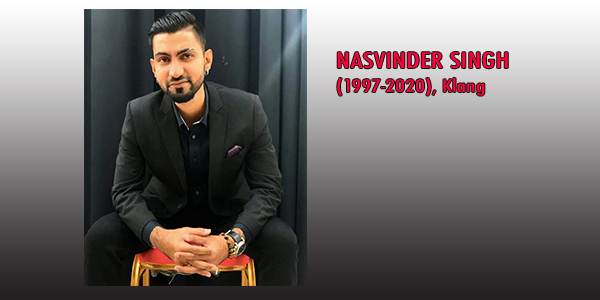
SASKAAR / CREMATION:Cortege leaves from residence No 154, Jalan Sungai Nibong 3, Rantau Panjang, 42100, Klang at 3 pm, 2 December 2020 (Wednesday) for cremation at Hindu Crematorium Simpang Lima, Klang, at 4pm | Malaysia
A life so beautifully lived deserves to be beautifully remembered.
Parents: Pall Singh and Paramjit Kaur
Siblings: Jagwin Singh,Jagrash Singh and Menisha Kaur
Paternal Grandparents: Jaswant Kaur (Taiping) & Late Piara Singh
Maternal Grandparents: Late Celindar Kaur & Late Mengar Singh
Cortege leaves from residence No 154, Jalan Sungai Nibong 3, Rantau Panjang, 42100, Klang at 3 pm, 2 December 2020 (Wednesday) for cremation at Hindu Crematorium Simpang Lima, Klang, at 4pm
Path da Bhog to be announced later.
Contact:
Pall Singh – 0122312393 (Father)
Jagwin Singh – 0102175041 (Brother)
| Entry: 1 Dec 2020 | Source: Family
ASIA SAMACHAR is an online newspaper for Sikhs / Punjabis in Southeast Asia and beyond.Facebook | WhatsApp +6017-335-1399 | Email: editor@asiasamachar.com | Twitter | Instagram | Obituary announcements, click here |
#ChaloDelhi | It’s evening and you can hear sounds of the Sikh evening prayer Raheras playing in the background as Sikh farmers continue their protest against controversial farm laws.
Farmers from Panjab, Haryana, Rajasthan and a number of other states have blocked two key entry points to Delhi.
Singhu and Tikri borders have been closed as it is completely blocked by the protesting farmers, an act to register their case with the national leaders.
The farmers have declined offers to converge at designated ground at the Nirankari Samagam Ground in North Delhi’s Burari area.
Panjab-based television stations SinghNaad is on the ground. Here, Sukhwinder Singh Shabra from the Kissan Sangarsh Committee Punjab speaks.
ASIA SAMACHAR is an online newspaper for Sikhs / Punjabis in Southeast Asia and beyond.Facebook | WhatsApp +6017-335-1399 | Email: editor@asiasamachar.com | Twitter | Instagram | Obituary announcements, click here |