















UA-56202873-1
Page 442

Root Cause of The Sikh Problem: The Partition of India (1947) – Part I  

1
Another map of Panjab – Source: To be identified
By Hardev Singh Virk | OPINION |
Introduction

India Wins Freedom: An Autobiographical Narrative[1] by Abul Kalaam Azad outlines how Congress betrayed Muslim nationalists; Partition could have been avoided if it were not for some poor policy decisions from Congress high command. Sir Evan Jenkins, the governor of the Punjab from April 1946 – 15 August 1947, complained that the dogmatism of the Congress and Muslim League high commands prevented any settlement of the political impasse in the region. The British-Congress-Muslim League triangle in Delhi was intent on a swift transfer of power[2], which was not conducive to arriving at a settlement that took account of the particular conditions in the Punjab. On 15 August 1947 the Indian people gained their independence; but the price was Partition, death and displacement of population in the Punjab.

After more than 70 years of Indian independence, Sikhs are not yet reconciled to their fate. India was divided on the basis of  two nation theory into India and Pakistan. Sikhs were considered as part of the Hindus along with Jains and Buddhists. During political parleys with the British, the Sikhs were  invited as equal partners with Muslim League and Indian National Congress but Sikh leaders failed to put up their case with the acumen and political wisdom desired at such meetings. Till the day of Partition, they displayed a dithering attitude to their demands. They were not sure which way to go? The demand for a separate nation status remained dormant and buried in their bosom. They were left with the only option to join India.

Master Tara Singh was the indisputable leader of the Sikhs before and after partition  of India. Master Tara Singh and Akali Dal strongly opposed the partition of India. I believe Master Tara Singh had to share the blame for failure of Sikh leadership during the parleys for Partition of India. It is obvious that Sikh leaders were not sure of their moves at the negotiation table. They had not done their homework sincerely. Sometimes, they were asking for Azad Punjab with dominant Muslim population, other times they were opposed to partition of India, which shows that in both these cases the Sikhs were fighting a losing battle. Ultimately, they were caught in a trap well laid out by the leaders of Indian National Congress and opted to join India without asking any written guarantees for their liberty and status as an independent nation.

There are several studies on failure of Sikh leadership to obtain an independent  Sikh state at the time of Partition of India but I shall summarize the results of only three for the sake of brevity.


1.  Sikh Failure on the Partition of Punjab in 1947

Akhtar Hussain Sandhu [3] in his paper published in International Journal of Punjab Studies  (September, 2012) has presented an incisive survey of the Sikh failure. The main points of this study are summed up as follows:

  1. Sikh leaders lacked political vision, therefore the Akalis were simultaneously anti-government, anti-Muslim League, anti-Congress, anti-Unionist, anti-British, anti-Khalsa National Party and anti-Communist and other Sikhs who were not their allies.
  2. Sincerity of purpose was badly missing in the political creed of the Akalis. While dealing with the Congress, the Sikh leadership many times demonstrated compromising behaviour on political issues.
  3. Sikhism attracted the main bulk of the followers from Hinduism. The impact of this link remained intact and affected the political idealism of the Sikhs. The Akalis brainwashed the Sikh masses through speeches and statements that the Muslims were their enemies and the Hindus were their friends.
  4. At every crucial moment, the Congress ignored the Sikhs but the Akali leadership did not dare to adopt an independent direction in their politics. The acceptance of the Congress’ influence proved pernicious for the Sikh future.
  5. The Akali policy to sideline and humiliate the Sikh aristocracy, Communists, Mazhabi Sikhs, Congress-supporting Sikhs, and other groups proved detrimental in the long run.
  6. The dual membership of many Sikhs was another problem as many were enjoying affiliation with more than one party. A Sikh was a Congressite and the Akali member at the same time or a Communist and Congressite .
  7. Master Tara Singh remained unchallenged as the sole leader of the Sikhs during the period 1923 to 1947. The Sikh masses rendered their wholehearted support to him but at the most sensitive time he went into the background and left the Sikh panth at the mercy of Sardar Baldev Singh and Sardar Swaran Singh. One of the main causes of Master Tara Singh’s aloofness was the severe opposition from within the Akali circles which convinced him to remain in the background for the time being as a deliberate tactic.
  8. He (Master Tara Singh) was headmaster of a high school who lacked the vision of a national or provincial political leadership.
  9. The Sikh demographic pattern was such a critical disadvantage which could not be adequately addressed by the Sikh leaders. They did not form a majority of the population in any district of the Punjab.
  10. Creation of a Sikh state or joining Pakistan or India were the main options available to the Sikhs but as freedom was coming closer the Sikhs started restricting their options. Their leaders were not talking to the Muslim leaders and were least interested in taking advantage of their bargaining position. They were pleasing the Hindu leadership by posing themselves as the champions of united India and protectors of the Hindus. They relied on the Congress which had betrayed them on every important political turn in their history. The Congress and the Hindu press gave a cold shoulder to the Sikhs but still they did not take the independent course in politics.
  11. The Sikh leadership also became victim of their traditional weakness in political parleys. Moreover, they had to deal with the competent leadership like M. A. Jinnah, M. K. Gandhi and Jawaharlal Nehru which put them in a defensive position.
  12. Sikh leadership, in the run up to partition, could not gauge the depth of the political issues confronting their community. They joined hands with the Congress and favoured united India in which they were only one per cent of the population. The main reasons behind this decision was their religious and cultural affinity to Hinduism, weak leadership, disunity, Mughal atrocities during the early centuries of the rise of Sikh tradition, and the Muslim onslaught in the late 1940s.
  1. The Role of Sikhs during the Partition of India

Avinash Hingorani [4] has reported this study on academia.edu in 2014. He reports that after creation of Khalsa by Guru Gobind Singh, the Sikhs aspired for their political identity and fought for independent political status in Punjab: From the time of Guru Nanak (1469-1539) to the last Guru, Guru Gobind Singh (1666-1708), Sikh followers began to acquire their own political identity which was independent from that of the Hindus and Muslims.  Due to religious persecutions, the Sikhs wanted to create their own empire that was independent from Mughal rule, and this led to a war between the Sikhs and the Mughal Empire. Guru Gobind Singh inaugurated a group of Sikh authoritative leaders known as the Khalsa. Guru Gobind Singh then sent Banda Singh Bahadur, a Sikh general, to go fight the Mughal rulers”.

The main points of this study are summed as follows:

  1. When partition occurred in 1947, the Sikhs wanted their own state in the Punjab region. Unfortunately the British Raj categorized the Sikhs as merely being a subdivision of the Hindus and never considered giving them their own separate nation.
  2. While the Sikhs shared many similarities to the Hindus it would be unfair to consider them as merely being a subdivision or a caste of Hinduism.
  3. The British did not acknowledge the Sikhs grievances, and in 1943 it became clear that the Muslims would be given their independent state of Pakistan. In response to this Giani Kartar Singh called for a separate state called Azad Punjab, which was to be comprised of Ambala, Jullundar, Lahore, Multan, and Lyallpur divisions. Many Sikh leaders supported this independent state of Azad Punjab. Lahore was once the capital of the Sikh empire and the Sikhs wanted Lahore most of all. Giani Kartar Singh asked “if Pakistan was to come out of compulsion because Mr. Jinnah’s demand could not be resisted, why not give an independent state to the Sikhs also?”.
  4. In 1944, Sikh leader and activist Master Tara Singh led the Sikhs in declaring their own independent state. Tara Singh believed that the creation of Azad Punjab would be necessary to protect Sikhs and Hindus from Muslim rule. Tara Singh believed that Azad Punjab could “take out the overwhelming majority of the Hindus and Sikhs from Muslim domination and get rid of the present Pakistan”.
  5. Master Tara Singh feared that if Pakistan were created the Sikh community would be “lost forever”. After making these comments Tara Singh was invited to a round table conference at Simla at the end of the Second World War by Governor-General Lord Archibald Wavell to represent the Sikhs of India and to quell the political relations between the different religious groups of India. Tara Singh argued that the “creation of Pakistan would be more injurious to his community than to any other community”. He strongly encouraged against the demand of Pakistan by the Muslims and coincidentally made several Muslim enemies.
  6. Muhammad Ali Jinnah, who outwardly maintained an attitude of sullen and studious disregard towards the Sikhs, tried to cajole them privately. He knew in his heart of hearts that Sikh opposition to Pakistan was one real obstacle in his way and made several secret overtures to the leaders of the community. He chided them for being too subservient to Congress influence and held out all kinds of allurements, including the formation of an autonomous Sikh area within Pakistan. Some British officers also conveyed similar offers to Sikh leaders.
  7. It can be argued that the Muslims were able to achieve their own separate state from India because they were more assertive than the Sikhs. The Sikhs did not use violence against the other ethnic groups of India like the Muslims chose to do.
  8. The Sikhs were ultimately the odd man out in India’s partition and now had to make a difficult choice between India and Pakistan. For most Sikhs India seemed like the better option even if it meant leaving behind “their homes, their livelihoods, and their ancestral villages”.
  9. They also argued that an independent Punjabi Sikh majority state “was promised to the Sikh leader Master Tara Singh by Nehru in return for Sikh political support during the negotiations for Indian Independence”.
  10. This promise would finally be fulfilled on November 1st, 1966 and Punjab would finally become a Sikh majority state. Before 1966 Sikhs “constituted just over 33 percent of Punjab, after 1966, they made up a majority at 66 percent”. The Sikhs finally had power again in the land of their ancestral history and even though Lahore was still a part of Pakistan, the Sikhs were at least once again the majority group in Punjab.
3.  The Sikhs and the Partition of Punjab

Amabel Crowe [5] has reported this study as a part of MA history dissertation in the University of Edinburg in 2014. This study reveals many new facets of Sikh failure to share the exploits of Partition of Punjab along with the Muslim League. Sikhs constituted less than 15% of Punjab population but they contributed more than 40 % revenue to the state exchequer and were the richest community in Punjab. During Partition of India, Sikhs were the worst sufferers of all. They not only lost their religious and cultural heritage but also the richest economy based on agriculture in Pakistan.

The main conclusions of this study can be summed up as follows:

Sikhs were caught unawares as they were not prepared for the Partition of Punjab. First they wanted Azad Punjab with 40 % Muslim, 40 % Hindu and 20% Sikh population. When this proved to be a utopia, then they passed a resolution in favour of an independent Sikh State. Master Tara Singh and Giani Kartar Singh were their front rank leaders but they passed the baton to Baldev Singh and Swaran Singh. I consider this as a big blunder. Swaran Singh was a staunch Congressman and Baldev Singh was prevailed upon by Pandit Nehru to go with the Congress plan. He was the weakest link to present the Sikh case at London round table conference as his personal interests lay in joining India to save his business. Sikh masses were kept in the dark and Sikh elites were holding the reins of Sikh Panth. The elites (Baldev Singh, Surjit Singh Majithia, Ujjal Singh etc.) were in favour of joining India.

The Akali leadership was not united and had no clear cut policy to protect the interests of Sikhs. Master Tara Singh failed to provide leadership at this crucial juncture of history. He wanted to remain in the background and his nominees (Baldev Singh et al.) had personal political ambitions to join India. Sikh leaders’ antagonism against Muslim League proved to be another hurdle in their decision making. Ultimately, Master Tara Singh, Baldev Singh and Giani Kartar Singh crumbled under the Congress pressure and together on 18 April 1947 met Lord Mountbatten to demand the Partition of Punjab into Muslim and non-Muslim areas.

Sirdar Kapur Singh [6] squarely blames Master Tara Singh for failure of the Sikhs to get an independent Sikh State in Sachi Sakhi. I feel his account is based on some half-truths. For example, there is no written document found in the archives of Partition where British offered some special status for the Sikhs. However, Kirpal Singh historian cites one oral evidence based on the statement of Lord Mountbatten [7]: “It must point out that the people who asked for the partition were the Sikhs. The Congress took up their request and framed the resolution in the form they wanted. They wanted the Punjab to be divided in two predominantly Muslim and non-Muslim areas. I have done exactly what the Sikhs requested me to do through the Congress. The request came to me as a tremendous shock as I like the Sikhs, I am fond of them and I wish them well“.

References

[1] Abul Kalam Azad, India Wins Freedom: An Autobiographical Narrative, (Hyderabad: Orient Longman, 1988).

[2] Lucy P. Chester, Borders and conflict in South Asia: the Radcliffe Boundary Commission and the partition of Punjab, (Manchester: Manchester University Press, 2009), 13.

[3] punjab.global.ucsb.edu › journals › volume19 › Sandh

[4] www.academia.edu › The_Role_of_Sikhs_during_the_Pa…

[5] www.academia.edu › The_Sikhs_and_the_Partition_of_th…

[6] www.panjabdigilib.org › searches › displayPage

[7] Justice Din Mohammad, 5 August 1947. in: Kirpal Singh, Select Documents on the Partition of the Punjab. p. 377.


Scholar and scientist Hardev Singh Virk retired from Amritsar-based Guru Nanak Dev University in 2002 after serving as Founder Head Physics Department and Dean Academics. Ex-Professor of Eminence, Punjabi University, Patiala. He is the present Visiting Professor at SGGS World University, Fatehgarh Sahib (Punjab), India. 


RELATED STORY:

Failure of Sikhs to gain an Independent State during Partition of India (Asia Samachar, 10 Sept 2020)

Betrayal of the Sikh Community (Asia Samachar, 11 May 2019)


ASIA SAMACHAR is an online newspaper for Sikhs / Punjabis in Southeast Asia and beyond. Facebook | WhatsApp +6017-335-1399 | Email: editor@asiasamachar.com | Twitter | Instagram | Obituary announcements, click here |

Vertical upward integration in farming sector

0
A tractor parked at Piyau Manri, near Kundli. Farmers from Panjab and other Indian states are protesting three farm laws passed in September in what is turning out to be the largest such protest in India. – Photo: @amaanbali
By Bhupinder ‘Bo’ Singh OPINION |

First and foremost I would like to tell my farmers brothers/sisters that I understand and feel their concern regarding the agricultural reform bills that have been passed by the Indian Government. We can feel your anguish and understand what is fueling the protests. We hope that the outcome of ongoing discussions with the Government is fruitful and satisfactorily addresses your concerns.

The government says the reforms, which opens the farming sector to private players, will not hurt farmers but have not satisfactorily addressed farmers’ concerns. So, if the Government agrees and makes concessions to the farmers this time, the issue will prop up again in future. Long term the policies may not be fully in farmers’ interest as other vested stake holders will attempt to engineer something of this sort again.

We need to think outside the box to come to a solution to this vexing issue. I think this can happen, when farmers take control of their produce and give value added end products to consumers directly. Let us take an example of wheat. At present farmers sell the wheat at say minimum support price (MSP) to the government or private sector agencies. Instead, if the farmers set up a co-operative, that buys their product at MSP, stores the grains in silos, convert them to end products consumed and then sells them through co-operative operated outlets. The co-operative could sell following wheat products:

Atta (flour), Sooji, Maida, Chapatti/Phulkas, Paronthas (Aloo, Methi, Saada), sliced bread, halwa etc.

Additionally the co-operatives can enter into deals with major consumers — such as Shiromani Gurdwara Parbandhak Committee (SGPC), Delhi Sikh Gurdwara Management Committee (DSGMC) — securing long term deals to supply to them, thereby creating a win-win situation for both parties.

As the co-operatives generate money, the surplus cash could be reinvested in new products besides rewarding the shareholders. While proposing this idea, I have the success of Amul Dairy in my mind. Amul started out with milk then added butter, ghee, cheese, ice cream etc. and today there are a plethora of products marketed under that brand. Recently we have seen how Baba Ramdev has spawned a growth in Ayurvedic products using similar model. I have just touched the tip of the iceberg but when a detailed study is carried out many more ideas using the model of farmer-to-consumer direct can become a reality.

Such a venture will not only make farmers less dependent on the government or even private sector but also make them masters of their produce and destiny. Through these efforts they can provide employment to many thousands and bring economic prosperity to themselves and the community. This venture could grow and become a conglomerate down the road as Con-Agra, Archer Daniels Midland, General Mills.

Wishing our farmers best of luck, financial security, and economic success. Let this new model become the second Green Revolution bringing prosperity to the farmers.

Bhupinder ‘Bo’ Singh, Houston. Born in Bhamo, Myanmar, he now lives in Houston, US, where he runs a manufacturing company formed with his son. A mechanical engineer by training, he has authored a number of books, including Connecting with the Master – A collection of essays on topics related to Sikhism (2006) and In Bully’s Eyes – An Illustrated Children’s book on Bullying (2019).


RELATED STORY:

Grace under duress (Asia Samachar, 4 Dec 2020)


ASIA SAMACHAR is an online newspaper for Sikhs / Punjabis in Southeast Asia and beyond. Facebook | WhatsApp +6017-335-1399 | Email: editor@asiasamachar.com | Twitter | Instagram | Obituary announcements, click here |

Breakfast at Singhu border

0
Source: Tweet by @AmaanBali

#DelhiChalo | Breakfast Scenes at Singhu Border. Mornings are colder with every passing day. Respect for everyone sitting under the sky. Some breakthroughs have been achieved yesterday, Let’s pray for resolution on 9th. #FarmersProtest – Photo/text tweeted by @AmaanBali


RELATED STORY:

Grace under duress (Asia Samachar, 4 Dec 2020)


ASIA SAMACHAR is an online newspaper for Sikhs / Punjabis in Southeast Asia and beyond. Facebook | WhatsApp +6017-335-1399 | Email: editor@asiasamachar.com | Twitter | Instagram | Obituary announcements, click here |

Calm before the storm?

0
Photograbs from ScoopWhoop video covering India farmer protest in Delhi
By Asia Samachar Team | INDIA |

ScoopWhoop reporter walk-about captures early days of India #FarmerProtest in Delhi. Click here for the video.

At 17:00, hear a Sikh running Langgar, preparing chapati and food in carefree abundance. “This is Baba Nanak’s Langgar,” he says. “We will continue cooking as long as necessary. We’ve not been keeping count.”

At 26:50, he takes a peep into one of the many well-stocked trucks. This one carries 500kg of atta (flour), coriander leaves, green cardamom, ghee and a host of other necessities to run a full kitchen. #DelhiChalo

RELATED STORY:

Deadlock after 5 rounds of talks, farmers and government to meet again on Wednesday (Asia Samachar, 6 Dec 2020)


ASIA SAMACHAR is an online newspaper for Sikhs / Punjabis in Southeast Asia and beyond. Facebook | WhatsApp +6017-335-1399 | Email: editor@asiasamachar.com | Twitter | Instagram | Obituary announcements, click here |

SEWA Healthcare to assist chronic and terminal illnesses patients

0
SKA, Sewa Healthcare MOU: L-R: Satyaprakash Tiwari, MP Wan Rizal and Hernaikh – Photo: Supplied
By Asia Samachar Team | SINGAPORE |

A group of healthcare professionals in the allied health, medical and nursing fields from the Sikh and the Indian diaspora have come together to lend a helping hand to community members.

They intend to pay special attention chronic and terminal illnesses.

SEWA Healthcare volunteers provide education, counselling and support to people with chronic and terminal illnesses, as well as their families and the community in order to empower them to lead quality, healthy and productive lives.

SEWA Healthcare, the community initiative, was officially launched today (Dec 6)  by Dr Wan Rizal Wan Zakariah, Member of Parliament for Jalan Besar GRC.

He also witnessed the signing of a memorandum of understanding between SEWA Healthcare and the Singapore Khalsa Association (SKA).

SEWA Healthcare has a team of 50 dedicated volunteers and it expects the number to grow exponentially in the near future, according to a statement released by SKA.

Among others, SKA and SEWA Healthcare will jointly organise programmes and events to promote active and healthy lifestyles and lifestyle management as well as hold regular health-related sessions for the public. They will also promote and disseminate key messages on the importance of a healthy lifestyle and provide opportunities for member of the society at large to contribute to their programmes and initiatives.

In addition, the two groups will promote corporate social responsibility activities such as training and enrichment programmes. They will also reach out to and collaborate with government agencies and like-minded organisations on health-related for the society at large.

Dr Wan Rizal noted the concerns of Singapore’s ageing population which have been made more apparent by the COVID-19 pandemic and it is, thus, important to re-examine the approaches to addressing the healthcare issues facing the elderly.

Hernaikh Singh said SKA plans to organise regular medical screenings and health-related sessions for SKA’s members and the Sikh community.

“Whilst the SEWA Healthcare team will cater to the SKA membership and the Sikh community in particular, it will also reach out the larger society … We at SKA have been making significant contributions to the development of the Singapore society at large. The establishment of SEWA Healthcare will be an extension of that responsibility,” he said in the same statement.

SEWA Healthcare president Satyaprakash Tiwari  said the initiative will serve to provide the necessary integration within the community in addressing its needs.

“We will work closely with the various stakeholders and constantly revitalise to work to meet the needs of the community,” he said.


RELATED STORY:

Dr Sangeeta powers formation of mental health foundation (Asia Samachar, 20 Aug 2020)


ASIA SAMACHAR is an online newspaper for Sikhs / Punjabis in Southeast Asia and beyond. Facebook | WhatsApp +6017-335-1399 | Email: editor@asiasamachar.com | Twitter | Instagram | Obituary announcements, click here |

Thai Sikhs step up for Phuket’s hungry – Report

0
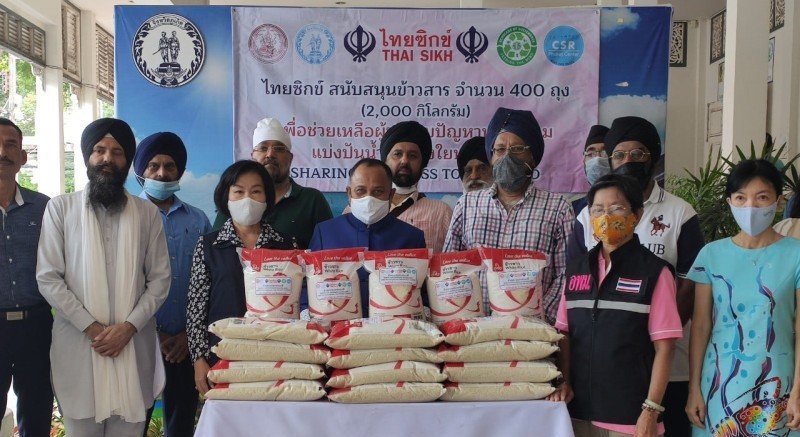
Rice and other daily necessities for families in need – Photo: CSR Phuket Center / The Phuket News
By Asia Samachar Team | THAILAND |

PHUKET: A delegation representing the Sikh community in Thailand on Friday (Dec 4) donated two tons of rice to be distributed to families in Phuket suffering severe financial hardship during the ongoing economic crisis.

In total, 400 bags of rice were handed over at a small official event at Phuket Provincial Hall yesterday (Dec 4) led by Lertchai Srikureja, joined by other Thai Sikhs from Bangkok, reports The Phuket News.

Present to receive the rice were Phuket governor Narong Woonciew along with his wife Wandee Woonciew, who serves as president of the Thai Red Cross chapter in Phuket.

Also present were Sophon Thongsai, Chief of the Phuket Provincial Office of the Department of Disaster Prevention and Mitigation (DDPM), Tida Boonrat, Chief of the Phuket Provincial Office of the Comptroller-General, officials from the Phuket office of the Ministry of Social Development and Human Security Office and volunteers from the SOS Foundation Phuket chapter.


ASIA SAMACHAR is an online newspaper for Sikhs / Punjabis in Southeast Asia and beyond. Facebook | WhatsApp +6017-335-1399 | Email: editor@asiasamachar.com | Twitter | Instagram | Obituary announcements, click here |
Deadlock after 5 rounds of talks, farmers and government to meet again on Wednesday

0
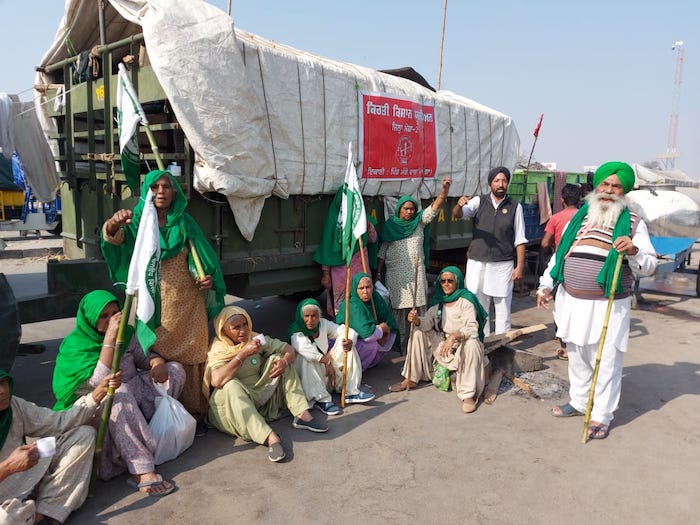
Women are equally represented in the farmers’ protest. Here a scene at Singhu border, Delhi – Photo: Harpreet Singh
By Asia Samachar Team | INDAI |

India’s government failed on Saturday (Dec 6) to break a deadlock with farmers protesting over agricultural reforms and will meet again on Wednesday, the agriculture minister and union leaders said.

Thousands of Indian farmers have demonstrated against the laws, which they say threaten their livelihoods, by camping on the outskirts of the capital New Delhi and blocking highways, reports Reuters.

Prime Minister Narendra Modi’s government says the new laws are meant to overhaul antiquated procurement procedures and give growers more options to sell their produce.

“Farmers made it clear to the ministers that they want the government to repeal the laws,” the news agency quoted Jagjit Singh Dhalewal, a senior farmers’ leader, after five hours of talks on Saturday.

Agriculture and farmers’ welfare minister Narendra Singh Tomar told reporters that talks will resume on Wednesday, adding the government is committed to farmers’ welfare and is keen to examine and consider the issues raised.

The government asked for some more time to present a concrete proposal, says Kavitha Kuruganti of Mahila Kisan Adhikar Manch, one of the 40 unions invited for the talks with Union minister Narendra Singh Tomar, Piyush Goyal and Som Prakash on the contentious farm Acts.

“Ministers said they need further consultations within the government for that and proposed December 9 as the date for next meeting to which union leaders agreed,” he as quoted in a Tribune News Service report.

Earlier, seeking to break the deadlock over protests against the new farm laws, the government on Saturday told representatives of agitating farmers that their concerns are being looked into but the union leaders stuck to their demand for repeal of the legislations and threatened to walk out of the talks, according to the report.

In an earlier report, PTI quoted Bharatiya Kisan Union general secretary Harinder Singh Lakhwal as saying: “In our meeting today [Friday], we have decided to give a ‘Bharat Bandh’ call on December 8 during which we will also occupy all toll plazas.”

Panjab farmers are prepared for a long-drawn protest. protest. A scene at Singhu border, Delhi – Photo: Harpreet Singh
Indian farmer representatives in meeting with government ministers on 5 Dec 2020 – Photo: Twitter of Narendra Singh Tomar, Minister of Agriculture and Farmer Welfare
RELATED STORY:

Grace under duress (Asia Samachar, 4 Dec 2020)


ASIA SAMACHAR is an online newspaper for Sikhs / Punjabis in Southeast Asia and beyond. Facebook | WhatsApp +6017-335-1399 | Email: editor@asiasamachar.com | Twitter | Instagram | Obituary announcements, click here |
Revisiting death

0

THE prevailing thinking of death and what happens after death is a muddled idea that needs clarification.

In this second of a 12 video series on ‘Sikhi Concepts’, Dr Karminder Singh attempts to revisit the topic. (See introductory video here).

“The focus and obsession of the old canvas was death and after-death,” he argues.

By redefining death, Guru Nanak did two things. First, he shook the very foundation of the d canvas. He pulled the rug from under the feet of that canvass, so to speak. He demolished the two pillars that held up that canvas: death and the fear of what happens after death.

In redefining death Guru Nanak established the foundation of his own Sikhi: life and living in the her and now.

Gurbani provides a proper, balanced and realistic understanding of the notion of death. It can be summarised into four principles:

  • Physical death is for everyone
  • Physical death is certain
  • We are all in cue
  • Physical death is the return of elements back to their source.

These alignment is liberating because it frees us from the concocted tale, it frees us from the anxiety of a fabricated journey, and it liberates us from the worry of a faked journey. The alignment is meaningful because it tells us to make the very best of our lives. It tells us to live our lives in the here and the now. It tells us to live our lives positively in bliss and joy while contributing to humanity. It tells us to the fullest, right up to the moment of certainty of physical death.

“This is gift of liberation to mankind by Guru Nanak. It’s a blessing of freedom from fear that Gurbani provides us,” he says.

Dr Karminder, author of five newly released books on Sikhi, then goes on to discuss the ‘two revolutionary’ meanings of death in Gurbani. What are they?

SIKHI CONCEPTS VIDEO SERIES BY KARMINDER SINGH DHILLON

Part 1: Guru Nanak’s Canvas

Part 2: Death

Part 3: After Life

Part 4: 8.4 million (Chaurasi Lakh)

Part 5: Reincarnation

Part 6: Heaven and Hell

Part 7: Salvation in Afterlife (Mukti)

Part 8: Court of Judgement (Dargah)

Part 9: Dhrm Raj


RELATED STORY:

Karminder talks about what shaped his thinking, and his latest books on Sikhi (Asia Samachar, 20 Nov 2020)


ASIA SAMACHAR is an online newspaper for Sikhs / Punjabis in Southeast Asia and beyond. Facebook | WhatsApp +6017-335-1399 | Email: editor@asiasamachar.com | Twitter | Instagram | Obituary announcements, click here |
Lights-out for Father of Fibre Optics

1
Narinder Singh Kapany (1926-2020): Father of Fiber Optics
By Asia Samachar Team | UNITED STATES |

Dr Narinder Singh Kapany is certainly a giant amongst present day Sikhs. Badged as the Father of Fiber Optics, Kapany passed away today (4 Dec 2020). He was 94.

The man who bent light, the American physicist is renown for his work in fibre optics.

The pioneering fiber-optics researcher and entrepreneur coined the term ‘fibre optics’ in an article in Scientific American in 1960. He later went on to write the first book about the new field. His passion and zeal for fibre optics was clearly evident when he became the the new field’s most prominent researcher, writer, and spokesperson.

Kapany’s research and inventions have encompassed fibre-optics communications, lasers, biomedical instrumentation, solar energy and pollution monitoring. He has over one hundred patents, and was a member of the National Inventors Council

He completed his education at Agra University and Imperial College London, focusing on physics.

Kapany, the founding chairman of the Sikh Foundation and a trustee of the UC Santa Cruz Foundation, was also a Regents Professor at UC Santa Cruz from 1977 to 1983. In 1999, he endowed the Narinder Singh Kapany Chair in Optoelectronics at the Baskin School of Engineering.

He started his first company in Palo Alto, Silicon Valley, in 1960.


RELATED STORY:

Vivian has grand plans for Singapore firm Strontium Technology (Asia Samachar, 10 July 2016)


ASIA SAMACHAR is an online newspaper for Sikhs / Punjabis in Southeast Asia and beyond. Facebook | WhatsApp +6017-335-1399 | Email: editor@asiasamachar.com | Twitter | Instagram | Obituary announcements, click here |
Grace under duress

0
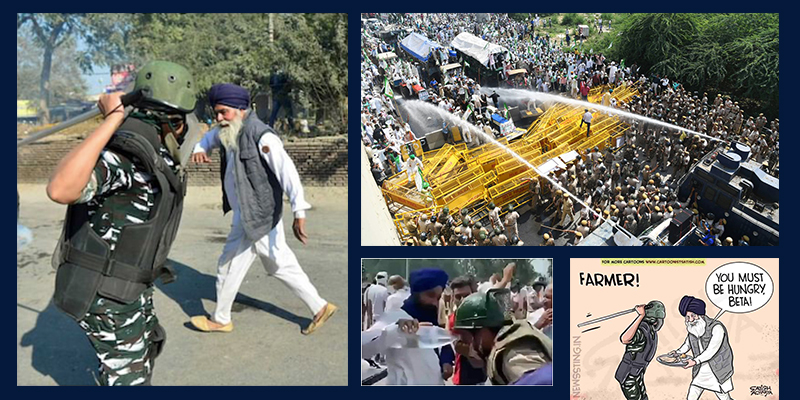
Farmers’ protest in Delhi. Photo source, clockwise from left: Ravi Choudhary (PTI), AFP
By Asia Samachar Team | INDIA |

A conversation to dig deeper into the #DelhiChallo. What are some of the underlying issues in the massive farmers’ protest in India?

The major entry points to Delhi have been blocked by protesting farmers who have come from Panjab, Haryana, Uttar Pradesh and a number of other states.

Their representatives are now in tense talks with the Indian government. The talks, which went on for some seven hours yesterday (3 Dec), did not come to any conclusion.

At the lunch and tea breaks, the farmers’ leaders declined the lunch and tea provided by the government at Vigyan Bhavan, instead opting for food brought for them from a gurdwara. It was a powerful symbolic move to underscore their resolve.

It as reported that the central ministers had offered to consider a number of amendments to the contentious farm reform laws. They had also provided assurance that minimum support prices (MSP) for farm produce would continue.

The dialogue is scheduled to resume on December 5.

“The government made a fatal miscalculation in underestimating the resolve of the farmers,” award winning senior journalist P Sainath tells Indian journalist Faye D’Souza in an interview.

Sainath, founding editor of the People’s Archive of Rural India (PARI), is also the author of the book Everybody Loves a Good Drought (Penguin India, 1996). D’Souza is the executive editor of Mirror Now.

Some snippets from the interview.

LANGGAR

The Langgars of the gurdwara in Karnal feed these policemen who had used water cannons against people in their 60s and 70s in what had been Delhi’s coldest day in winter in 70 years – 9 degrees Celcius. And yet the farmers had the grace.

For me, the visual of the month was the farmers feeding the hands that best them, and the policemen biting the hand that feed them. It really tells you something about he marginalised section and the state. And the state of those relations are today.

ACCESS TO COURTS

You are making the executive (as) the judiciary. That is outrageous. The executive takes on the powers of the judiciary. Well, in a way, that’s how the Modi government behaves.

[In the discussion between the government and the farmers] Agriculture Minister Narendra Singh Tomar has offered the farmers a ‘death by committee.’

A far greater committee exists. It had given an incredible report – a blueprint for Indian agriculture. The Swaminathan Commission has laid in Parliament for 15 years without even an hour’s discussion on the report.

The government made a fatal miscalculation in underestimating the resolve of the farmers.

The farmers have made their choice and they’re at the gates of Delhi to tell that to the government.

The government, the corporate media and the elite are not getting it – the sense of grievance and the sense of betrayal that is there now in the farmers.

So here you are looking at the what the government is doing. It is one more milestone on a way to agrarian hell where you handover Indian agriculture to the corporations. That has been the process for two decades now. It’s intensifying.

It’s time for non-farmers to join [the protest] as well. The agrarian crisis has become a societal crisis, perhaps even a civilisation crisis, with the largest body of small farmers, small holders on earth fighting for their survival.

It’s not just about the loss of productivity but the loss of humanity. Look at death by suicides of 330,000 farmers but where is our outrage.


RELATED STORY:

Dear Indians, Here’s Why Farmers’ March Matters To Sikh Diaspora (Asia Samachar, 4 Dec 2020)


ASIA SAMACHAR is an online newspaper for Sikhs / Punjabis in Southeast Asia and beyond. Facebook | WhatsApp +6017-335-1399 | Email: editor@asiasamachar.com | Twitter | Instagram | Obituary announcements, click here |