UA-56202873-1
Page 608

Garnal Singh Gurcharan Singh (Jelu) (1966-2018), Ipoh

SASKAAR / CREMATION: 1pm, 18 December 2018 (Tuesday) at Wadda Gurdwara Sahib Ipoh Crematorium, Ipoh. Cortege leaves residence No. 151, Taman Pertama 4, Taman Pertama, 30100 Ipoh, Perak at 12.30pm | MALAYSIA
Garnal Singh (1966-2018), Ipoh

GARNAL SINGH (JELU) S/O GURCHARAN SINGH

Village: Saidpur, Punjab

Born: 25 January 1966

Departed: 17 December 2018

Wife: Dalip Kaur d/o Jagdish Singh

Children/Spouses:

Sangeet Kaur / Harinder Singh

Baljinder Singh (Sunny)

Rangeet Kaur (Twinkle)

Grandchildren: Rhanveer Singh, Raajveer Singh, Rhaiveer Singh & Eishveer Singh.

Saskaar/ Cremation: 1pm, 18 December 2018 (Tuesday) at Wadda Gurdwara Sahib Ipoh Crematorium, Ipoh.

Cortege timing: Cortege leaves residence No. 151, Taman Pertama 4, Taman Pertama, 30100 Ipoh, Perak at 12.30pm, 18 December 2018 (Tuesday)

Sehaj Path Da Bhog: 30 December 2018 (Sunday), 9.00 am – 1.00 pm, at Wadda Gurdwara Sahib Ipoh.

Contact:

Puran Singh +60175735524

Shendey +601115155569

Gomeh +60195222022

Sunny +60143041897


| Entry: 17 Dec 2018  | Source: Family |

ASIA SAMACHAR is an online newspaper for Sikhs / Punjabis in Southeast Asia and beyond. Facebook | WhatsApp +6017-335-1399 | Email: editor@asiasamachar.com | Twitter | Instagram | Obituary announcements, click here |

Congress leader Sajjan Kumar sentenced to life imprisonment in 1984 Sikh genocide

2
Sajjan Kumar (right) – Montage courtesy of Daily Post India

Senior Congress leader Sajjan Kumar has been sentenced to life imprisonment in 1984 Sikh massacre case, the first major conviction for a case that has remained a deep scar in the psyche of the Sikh community in India and worldwide.

The High Court of Delhi found Sajjan, who was an MP at the time, guilty of inciting crowds to kill Sikhs.

In a scathing verdict, the Delhi high court judges said the accused evaded justice due to “political patronage”, reports BBC.

With his conviction, the attention will certainly turned towards another Congress leader, Kamal Nath, who was also involved in the 1984 dark episode.  Nath has emerged as the front-runner for the post of Madhya Pradesh chief minister, according to media reports.

“Monday is big day not only for victims, but for the whole Nation-will see if Law finally catches up with killer of thousands,” Aam Aadmi Party leader and Supreme Court lawyer H S Phoolka said in a Tweeter posting two days earlier.

Phoolka had resigned as the Punjab state assembly opposition leader to work on the case of ‘of murder of 5 Sikhs during #1984SikhGenocide at Raj Nagar, Delhi Cant PS.’

“There’s ample amount of evidence against Kamal Nath and the wheel of justice is yet to turn against him. Now, it is up to (Congress President) Rahul Gandhi to decide whether he wants a man who was involved in the 1984 anti-Sikh riots as the chief minister of Madhya Pradesh,” Phoolka told PTI.

There are other cases pending in the courts, including one against former Congress minister Jagdish Tytler, who denies any hand in anti-Sikh violence.

The killing of Mrs Gandhi, who belonged to the Congress – now India’s main opposition party- saw mobs attack and murder members of the Sikh community across the country. The worst violence took place in the capital, Delhi, where more than 2,700 Sikhs are believed to have died, the report added.

In Sajjan’s case, the court had cancelled an earlier court order acquitting him of charges in what the judges called “genocide”.

The 73-year old politician was convicted in the killing of five members of a family in Raj Nagar and the torching of a gurdwara in Delhi on November 1, 1984. He has been told to surrender by December 31.

“It is important to assure the victims that despite the challenges truth will prevail,” the High Court said, giving a shout-out to victims like Jagdish Kaur and Nirpreet Kaur, who fought for justice for 34 years and suffered intimidation and harassment. “The aftershock of those atrocities is still being felt,” said the court, reports NDTV.com.


[ASIA SAMACHAR is an online newspaper for Sikhs / Punjabis in Asia. How to reach us: Facebook message or WhatsApp +6017-335-1399. Our email: editor@asiasamachar.com. For obituary announcements, click here]

Ottawa university breaks new grounds with Sikhism, Punjabi courses. Another first in Canada!

0
Prabhroop Chawla

University of Ottawa breaks new grounds with the introduction of Sikhism and Punjabi courses starting January 2019. The Sikhism courses are probably among the first across Canada.

The introduction of the two courses has an interesting backstory. Sometime last year, social science undergraduate student Prabhroop Chawla took the initiative to propose the introduction of the courses, partly because she wanted to take them, as well.

After some months, the university’s Faculty of Arts introduced two new interdisciplinary electives for the winter 2019 trimester.

“When I initially moved (to Ottawa), I noticed that the (Sikh) community was definitely smaller … than it is in Vancouver or in places like Toronto, but I immediately got involved and got to know people in my first year,” she told The Fulcrum, an independent English-language student newspaper at the university.

“I’ve always been really passionate about learning about my heritage and my religion, my language, culture … and I thought well, why not share that with others?”

The Introduction to Punjabi and Sikhism Studies (AHL2100) is an introduction to Punjabi with a focus on oral, written, and reading comprehension, with added lessons offering cultural context to the language through poetry, and literature.

The second programme, the Sikh Diaspora InCanada (AHL3100), will look at the history of the Sikh faith and Punjabi culture, as well as the historical and contemporary contributions and leadership of the Sikh community in Canada.

Both courses, available to students as of January 2019, are also open to community members and students from other institutions.

In August 2018, US-based Harvard University introduced the ‘Sikhism Through Its Scriptures’. The free, four-week course examines the Sikh scripture from a doctrinal and historical perspective by providing an overview of Sikh teachings as well as the historical context within which the scripture evolved and became canonised.

The Harvard course was handled by Harpreet Singh, a scholar of Sikhism and South Asian Religions Traditions at Harvard, and teaching assistants Damanpreet Singh and Ravinder Singh.


[ASIA SAMACHAR is an online newspaper for Sikhs / Punjabis in Asia. How to reach us: Facebook message or WhatsApp +6017-335-1399. Our email: editor@asiasamachar.com. For obituary announcements, click here]

Is Sikhi a universal faith?

1

 By I.J. SINGH | OPINION |

First things first.  Most of us connect with one religion or another; naturally, we treasure some deeply held practices.  You need to know that I am a Sikh so that my biases won’t surprise you.  Today I take on a question that is larger than life.  I attack this Gordian knot less to resolve but more to explore it.

Like many Sikhs I, too, have proudly and forcefully asserted that Sikh faith is universal and its scripture, Guru Granth sahib, is the unparalleled source document on interfaith dialogue.  Some faiths seem not always to be so inclined; my inference rests in the many inter-religious wars that dot human history.

But when religion asserts that their message is unmatched and superior to that of other existing faiths, doesn’t this set up a never-ending war between the faiths of mankind?  Allow me first a brief detour; hopefully, to be better equipped to parse the issue further.

It is self-evident that at birth humans are fragile. They depend on collectives, small or large — families, clans, communities, even nations — to thrive.  Collectives need a code of common behavior that is not easily or casually challenged. In time, collectives, become lifestyles, deeply intertwined with a people’s religious underpinnings of belief, language, music, culture, cuisine and practices. Much as good fences make good neighbors, fences of lifestyles define communities and the borders that separate them.  The defining characteristics of communities are more important than any one individual’s behavior.

These fences aside, we also need to communicate with our neighbors.  Rare people – visionaries and prophets — recognize that humans need an expansive message for humanity.  And that gives us the many religions, each originally connected to a particular ethno-geographical community.  Fences are useful when they do not become hermetically sealed bubbles that isolate neighbors and create “Tribalism?”

A tribal reality is never universal. If tribalism makes us narrowly self-centered, universalism perhaps makes us irresponsible by undervaluing connections and relationship and escaping responsibility. The human default position lies somewhere in the middle.

If I have learned anything from a lifetime in academia it is that no matter the topic, all teaching must be framed in the cultural and linguistic context of the student. Similarly, a prophet must cast his message in the cultural and linguistic context of the people – the norma loquendi — or the lesson is lost. This rule brooks no exceptions.

Ergo, two primary realities end up in conflict.  The visionary prophet constructs an inclusive and universal system – of appeal to any and every listener — even strangers are welcome to the cause.  But the message is organically connected to a specific culture whose people have unique customs, music, language and cuisine.  That’s where a message takes life. Strangers coming in often encounter significant cultural limitations and habits

We can cite chapter and verse from Sikh history, tradition and the Guru Granth to nail the idea that Sikhi is a universal model of life.  History assures us that the Founder, Guru Nanak did not stay entirely within or close to the perimeter of Punjab, but traveled widely across and beyond the Indian Subcontinent – south to Sri Lanka, northwest to the Middle East, including Mecca, Iraq and nearby territories, eastward to Assam and north to Kashmir and Tibet – just about much of the known world of his time.

He spoke of Ik Oankaar, an alphanumeric that he designed where “Ik” is the first numeral “One” and “Oankar,” from Sanskrit meaning “Doer or Creator.” Ergo, a single unitary Creator common to all — Jews, Christians, Muslims, Hindus, Buddhists, Sikhs, Parsees… or Brand X. A partisan God would be a lesser god, not worthy of worship.  In Ik Oankaar there is no room left for differences in caste, creed, color, gender, race, national origin, religious label or similar limiting ideas.

The repository of Sikh heritage – Guru Granth – comprises the writings of six of the ten Founder-Gurus of Sikhism.  It was collated by the Gurus themselves, with minimal risk of unauthorized compositions sneaking into the 1430-page tome.  Also included were selected compositions of Hindu and Muslim saints of the era whose writings found resonance with the Sikh message.  Some of them came from low castes.  Remember that in the India of that time (about 550 years ago) high and low caste Hindus would not ever break bread together or be caught on the adjoining pages of the same holy book, but Sikhi erased such barriers.

Had Jewish or Christian writings been widely available at that time, I am certain, more would have found inclusion and commentary. The Guru Granth does not brand any people as evil or sinful even though it offers critical/analytic comments about widespread practices and interpretations in Hinduism and Islam, the two major faiths in India at that time.

A unique practice that Guru Nanak started was Langar, the serving of a simple vegetarian meal at every Sikh service.  It is prepared and served gratis by men and women volunteers to everyone, poor or rich, high or low of caste or worldly rank.  This mighty dagger aimed at caste-driven cultures exists today all across the globe. Langar is a symbolic and historical reality wherever there is a Sikh community, no matter how small.

This, not so brief take, makes a clear case for Sikhi as a universal religion.  But the devil, as they say, is in the details.  Contradictions emerge not from the teachings but human imperatives, insecurities and tendency to circle the wagons, batten the hatches and erect impermeable barriers in the face of threats, real or imagined.

This is true in all faith disciplines in this wide world, and Sikhs are no exception. An interminable gulf separates principle from practice.  If our contradictions appear less glaring it’s because we are a comparatively young discipline as opposed to many others.  For example, in matters of caste and the place of women the message is direct and clear; our practices are not.

I offer a few examples of such trivia that gnaw and chew at the periphery of our traditions.

The spiritual writings of the Sikhs have always been freely available to anyone, whether Sikh or not.  Many have also been reproduced in scripts other than Gurmukhi.  But a growing Sikh movement rejects such initiatives – as if Gurmukhi is holy script while others are not.  To me holy is the message, not the script that carries it. Languages deserve respect because they carry the human narrative through defeat and triumph – the narrative is our story.

Some divisive ideas seem to focus on if or how to maintain the Guru Granth in a home, who is entitled to keep one, and how to transport it.  I point out their similarity to Christian practices when the Council of Tarragona in 1234 banned the possession of the Old and New Testaments in the Romance Languages and ordered that anyone who has them must turn them over to the local Bishop within eight days.  This regressive decree lasted a couple of centuries.  Some diktats that come from the Akal Takht speak in similar vein.  The concept of respect, or not, for the Guru Granth becomes central, whereas I think respect comes from reading and engagement with the Book. Certainly, we Sikhs should never travel the unfortunate path of 13th century Christianity. That would surely diminish the idea of universality.

I have seen life-threatening disagreements on letting a non-Sikh, or a lay Sikh, and any women, Sikh or not — perform some of the so-called ‘priestly’ functions within a Sikh place of worship.  I leave such inanity without further comment.

The place of the English language within a gurduara often inflames critics.  This, despite the fact that more than six languages and many, many local dialects are found in the Guru Granth itself.  We have started referring to Gurmukhi-Punjabi as holy because the Guru Granth is traditionally penned in Gurmukhi script and Punjabi is the language of Punjab – the homeland of the Sikhs.  Again, I ask Sikhs to marvel at the worldview of the Gurus and their writings before such paranoia.

Sikh teaching does not condemn any religion even though it raises pointed questions at some visible practices of many.  Nowhere Sikhi ever declaims:  Come join our way for this is the only true path.  Unfortunately, many faiths seem to promote that route.  Remember that we cannot easily judge if such ideas were originally uttered by the prophet, nor do we easily see the historical realities then, or if they entered after the Founder-prophet’s life.  Nor can I conclude that such thoughts are a misreading of the mind of the prophet or a mistranslation etc.  Many are the times in the streets that someone has challenged me to join his faith – the only true faith, as he/she put it.  Briefly the teaching of the Sikhs  asks non-Sikhs to thoughtfully discover the virtues in their own faith disciplines.

I feel that none of the founders of any faith would make a claim of exclusivity in his lifetime.  Why?  Because exclusivity creates tribalism, not a universal paradigm.   I think exclusivity might have entered the narrative when the clergy faced opposition or were unprepared for a dialog on tolerance and common sense. Without these attributes in a community, self-governance disappears and the system becomes akin to a kakistocracy – rule by corrupt, unscrupulous minority. Why?

I have pointed to some gaps between Sikh teaching and its practice. Such traits are universally found in every religion. Let me explain via a detour.

This has no bearing on my political label, whatever it is.  Not so long ago I caught Paul Ryan, the current Republican Speaker of the House being interviewed on the tube. He noted that the election period highlighted the many shades of opinions that exist among Republicans.  Given these fissures among hard-core Republicans, the dream of a unifying idea seems like fiction and fantasy.  Then, he offered what I thought was a surprisingly mature thought – that the core requirement for unity is “principles not practice.”

Keep in mind that religious communities and centers exist for imperfect people who are on the path with varying degrees of success, sincerity, faith or understanding. We need to nurture the path, not diminish the follower. This is what transforms sinners into saints. Teach the principles and watch the practices flower and catch up; that’s the idea.

I have often argued that Sikhism is unique, timeless and universal. Universality speaks not only of geographic commonality but also sharing of culture, language, cuisine, music, indeed a way of life with our diverse neighbors. So say the foundational principles of Sikhi. The practices are ours, hence our onus to correct.

I believe that Sikhs should never mount an aggressive agenda to make others convert to our faith, though we should clearly welcome them to the cause.

Aggressive proselytization is not the answer; it only diminishes others without enhancing us.


[I.J. Singh is a New York based writer and speaker on Sikhism in the Diaspora, and a Professor of Anatomy. Email: ijsingh99@gmail.com]

* This is the opinion of the writer, organisation or publication and does not necessarily represent the views of Asia Samachar.

RELATED STORIES:

If this be love….. (Asia Samachar, 23 Nov 2018)

SIKHI: The Journey & The Destination (Asia Samachar, 13 Nov 2018)

Fading Memories, Merging Events – 1984 The Saga (Asia Samachar, 29 Oct 2018)


ASIA SAMACHAR is an online newspaper for Sikhs / Punjabis in Southeast Asia and beyond. Facebook | WhatsApp +6017-335-1399 | Email: editor@asiasamachar.com | Twitter | Instagram | Obituary announcements, click here |

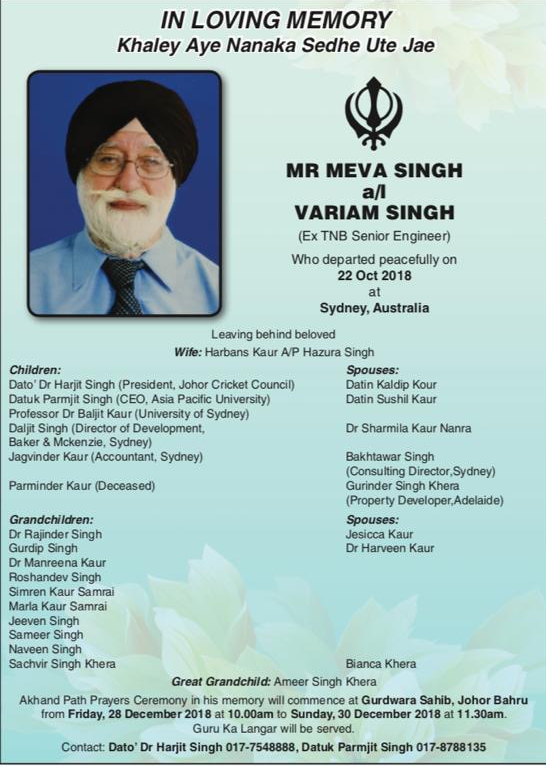
Meva Singh (1927-2018), Johor Bahru / NEB (LLN)

AKHAND PATH: 10am, 28 Dec 2018 (Fri) to 11.30am, 30 Dec 2018 (Sun) at Gurdwara Sahib Johor Bahru. Kirtan programme 10am onwards on Sunday | Malaysia

Meva Singh (1927-2018), Johor Bahru  NEB (LLN)

In Loving Memory

Khaley Aye Nanaka Sedhe Uthe Jae

MEVA SINGH A/L VARIAM SINGH

(Ex TNB Senior Engineer)

Who departed peacefully on 22 Oct 2018 at Sydney, Australia

Leaving behind beloved

Wife: Harbans Kaur a/p Hazura Singh

Children / Spouses:

Dato’ Dr Harjit Singh (President, Johor Cricket Council) / Datin Kaldip Kour

Dato’ Parmjit Singh (CEO, Asia Pacific University) / Datin Shushil Kaur

Professor Dr Baljit Kaur (University of Sydney)

Daljit Singh (Director of Development, Baker & Mckenzie, Sydney) / Dr Sharmila Kaur Nanra

Jagvinder Kaur (Accountant, Sydney) / Bakhtawar Singh

Parminder Kaur (Deceased) / Gurinder Singh Khaira (Property Developer, Adelaide)

Grandchildren (Spouse):

Dr Rajinder Singh (Jesicca Kaur), Gurdip Singh (Dr Harveen Kaur), Dr Manreena Kaur, Roshan Dev Singh, Simren Kaur Samrai, Marla Kaur Samrai, Jeeven Singh, Sameer Singh, Naveen Singh, Sachvir Singh Khaira (Biancha Khera)

Great Grandchild: Ameer Singh Khaira

Akhand Path Prayers Ceremony in his memory will commence at Gurdwara Sahib Johor Bahru from Friday, 28 December 2018 at 10.00am to Sunday, 30 December 2018 at 11.30am.

Guru Ka Langgar will be served.

Contact:

Dato’ Dr Harjit Singh 017-7548888

Dato’ Dr Parmjit Singh 017-8788135

BRIEF PROFILE: Meva Singh was President of Gurdwara Sahib Johor Bahru on numerous occasions on condition of being unanimously elected. He retired Senior Engineer in the National Electricity Board. A self made man. Started of as an Apprentice Wireman and did two jobs to buy books to finally become a qualified engineer. Served the NEB (LLN) from 1947 to 1985 including a three year extension. He then served as Consultant Visiting Engineer till age of 79 years. He was awarded the Gold and Diamond Medal Awards by the Minister of Power.

His wealth was his children’s and grandchildren’s education to the highest levels.

He was an accomplished cricketer, hockey, badminton and table tennis player where he along with the late Attar Singh were Kilat Club’s national doubles table tennis champions. He played Cricket for Kilat Club and Selangor in the early 1950s.

| Entry: 16 Dec 2018  | Source: Family |

ASIA SAMACHAR is an online newspaper for Sikhs / Punjabis in Southeast Asia and beyond. Facebook | WhatsApp +6017-335-1399 | Email: editor@asiasamachar.com | Twitter | Instagram | Obituary announcements, click here |

Wellington MPs screen movie as tribute to WW1 Indian soldiers

0

 The New Zealand (NZ) Parliament ran a historic premier showing of a movie depicting the role of the Indian soldiers of the World War 1 (WW1).

Two NZ Members of Parliament (MPs) hosted the showing of “Farewell My Indian Soldier” on Wednesday (12 Dec 2018).

Parliamentarians Brett Hudson and Chris Bishop hosted the event to commemorate the centenary of the end of the Great War.

The documentary pays a tribute to the Indian soldiers of WW1 and in the memory of the two Indian ANZACs of New Zealand, Ratan Chand Mehra who was killed in Europe in 1915 and Jagt Singh who was injured in Gallipoli.

Also joining in hosting the event were MPs Kanwaljit Singh and Dr Parmjeet Parmar.

“This is the first time ever that the role of the Indian soldiers of WW1 has ever been brought to the NZ Parliament or for that any Parliament. It is a historic occasion,” said Manjit Singh Grewal from NZ Ekta Inc, the co-host of the event, told Asia Samachar.

He added: “This is quite an event and we hope other countries including Malaysia and Singapore will screen it. Thus far the film maker says over a million have viewed it.”

The documentary made by Parisian film maker, Vijay Singh traces India’s involvement in the Great War through a French girl’s desire to get information of Indian great grandfather who was stationed in France during the war.

It is the first time such a tribute has been screened in New Zealand Parliament for the Indian Soldiers.

Former NZ Governor-General Sir Anand Satyanand was the main guest.

Speaking at the event, French Ambassador Sylvaine Carta-Levert said that France could not forget the very important and significant role the Indian soldiers played in the War and in particular with regards to France.


RELATED STORIES:

Unique exhibition capturing role of Indian and Chinese New Zealanders in WW1 (Asia Samachar, 30 Nov 2017)


[ASIA SAMACHAR is an online newspaper for Sikhs / Punjabis in Asia. How to reach us: Facebook message or WhatsApp +6017-335-1399. Our email: editor@asiasamachar.com. For obituary announcements, click here]

Gurmukh Singh (1932-2018), Seremban

SASKAAR / CREMATION: 2pm, 16 Dec 2018 (Sunday), at No 15, Jalan Bijih Timah 4, Taman Templer, 70200 Seremban, Negeri Sembilan. Hearse leave residence at 1pm | MALAYSIA
Gurmukh Singh (1932-2018), Seremban

GURMUKH SINGH S/O LETCMAN SINGH

Dearest family, relatives & friends. Gurmukh Singh s/o Letcman Singh has departed peacefully to be with the Almighty Akaal Purakh.

Born: 14 July 1932

Departed: 14 Dec 2018

Wife: Late Charan Kaur

Last respect: 15 Dec 2018 (Saturday), 12pm onward at residence 6076, Jalan SJ 5/8,Taman Seremban Jaya, 70450 Seremban, Negeri Sembilan

Saskaar/cremation: 2pm, 16 Dec 2018 (Sunday), at No 15, Jalan Bijih Timah 4, Taman Templer, 70200 Seremban, Negeri Sembilan. Hearse leave residence at 1pm

Please join us for the Antim Ardass.

Prayer/Sehaj Path Da Bhog: 22 Dec 2018 (Saturday), 9.30am-11.30am, at Gurdwara Sahib Seremban

Contact:

Jaswant Singh 019-6520266

Avvtar Singh 012-3149181

Surjit Singh 013-2131016

Satwant Singh 012-9115541


ASIA SAMACHAR is an online newspaper for Sikhs / Punjabis in Southeast Asia and beyond. Facebook | WhatsApp +6017-335-1399 | Email: editor@asiasamachar.com | Twitter | Instagram | Obituary announcements, click here |

First military Sikh and Muslim chaplains for British Royal Air Force

1
GRADUATES: (L-R) Reverend Flight Lieutenants J Mbayo BA, C J Harrison BSc, Mandeep Kaur MEng BEng, A D Omar BA Shariah MA PGCE, and P A Johnson MA BA FIBMS graduated as RAF Chaplains this week following basic training at the RAF College Cranwell – Photo: RAF

In a first for the Royal Air Force and the British military, a Sikh Chaplain and Muslim Padre graduated as RAF Chaplains this week following basic training at the RAF College Cranwell in Lincolnshire.

Sikh Chaplain Reverend (Flight Lieutenant) Mandeep Kaur and Muslim Padre Chaplain (Flight Lieutenant) Ali Omar were two out of a total five chaplains to graduate alongside one hundred and forty other Officer Cadets commissioning into a variety of branches following Regular and Reserve Officer training, reports RAF News.

“My role in the RAF as a flagbearer of the Muslim Chaplaincy will see me work with the RAF Chaplaincy branch to negotiate and establish the place of World Faith Chaplaincy within the RAF. An overdue and exciting venture that will see me work side by side as a commissioned Muslim chaplain along colleagues from different faith. I am not sure of my posting at this stage,” said Ali.

In the report, The RAF Chaplain-In-Chief Venerable (Air-Vice Marshal) John Ellis said: “It has been a wonderful joy to welcome five new Chaplains today, representing the diversity of British society into the Royal Air Force Chaplains’ Branch and to celebrate with them and their families. It has been an absolute privilege to welcome our first Sikh and Muslim commissioned Chaplains into the Royal Air Force and I look forward immensely to working with them into the future.”

The Chaplains were marched onto the parade square in front of VIP guests, including the Chaplain-In-Chief, the Venerable (Air-Vice Marshal) John Ellis, as well as their families and friends. They stood on parade alongside their fellow Officer Cadets to be inspected by the two-star rank Reviewing Officer, Air-Vice Marshal Bruce Hedley.

Following the graduation from RAF College Cranwell, the report added that they will assume the pastoral role and duties of an RAF Chaplain and a commissioned Officer.

This will lead them onto providing spiritual, pastoral and ethical support to RAF personnel wherever they go, including deployed Operations.

See original report, entitled ‘First Military Sikh Chaplain and Muslim Padre Graduate from Officer Training’, here.

ASIA SAMACHAR is an online newspaper for Sikhs / Punjabis in Southeast Asia and beyond. Facebook | WhatsApp +6017-335-1399 | Email: editor@asiasamachar.com | Twitter | Instagram | Obituary announcements, click here |

MPLMA tasked to formulate moneylenders’ code of practice for PDPA compliance

0
THE LETTER: (L-R) Amrinderjit, Gobikrishna and Palwinder – Photo: Asia Samachar
By Asia Samachar Team | MALAYSIA |

Malaysian Punjabi Licensed Moneylenders Association (MPLMA) is working with the authorities to assist the money lending community’s preparation to deal with personal data protection.

The Personal Data Protection Commission has tasked the 66-year old organisation, powered by Punjabi moneylenders but open to all other communities, to lead a forum for sector to work out details to comply with the requirements of the Personal Data Protection Act 2010 (PDPA).

Among others, the commission has tasked MPLMA to develop a code of practice for the 3,000-odd money lenders operating in the country. As such, MPLMA has set up a PDPA committee led by Gobikrishna.

“This is an important building block in assisting moneylenders to comply with the PDPA,” Gobikrishna told Asia Samachar in a recent interview.

The appointment of MPLMA was a feather in the organisation’s cap.

“The appointment is certainly a recognition of sorts for us, and also trust upon our organisation. We are the most active association representing moneylenders. We have been working to inject professionalism into the community,” said MPLMA president Palwinder Singh.

The other members of the MPLMA PDPA committee are Amrinderjit Singh, Jeremy Khor Yee Teng, Kaveldeep Singh, Nesibjeet Singh, Ravinder Singh, Satnam Singh and Palwinder Singh.

The invitation came via a letter dated 16 October 2018 signed by deputy commissioner Rosmayuddin Baharuddin.

On its part, the Department of Personal Data Protection (PDP) has begun enforcing the PDPA since 2017 and has been doubling up checks and visits to companies to ensure they comply with the law.

In December 2015, the commission published the Personal Data Protection Standard 2015 after consulting members of the public. The standard sets out the minimum standards to process personal data and it is applicable to anyone who processes or has control or authorises the processing of any personal data relating to commercial transactions. Broadly, it sets out the security standards (electronic and non-electronic processing), retention standards and integrity standards.

On its part, MPLMA has started work on producing the code of practice that will assist moneylenders to comply with the PDPA requirements.

“We handle client data. We need it properly handle it in accordance with act,” said Gobikrishna.

Effective 16 Dec 2016, all registered money lenders are required to register themselves under the Act which regulates the processing of personal data in commercial transactions.

MPLMA has its work cut for it. Last year, it brought together some 600 licensed money lenders representatives for a briefing on the impact of PDPA on the sector. The half-day session also included officials from the Ministry of Urban Wellbeing, Housing and Local Government and Ministry of Communications and Multimedia.

MPLMA, or Persatuan Pemberi Pinjam Wang Berlesen Punjabi Malaysia, was formerly known as Punjabi Sahukara Association. It was established in 1952.


[ASIA SAMACHAR is an online newspaper for Sikhs / Punjabis in Asia. How to reach us: Facebook message or WhatsApp +6017-335-1399. Our email: editor@asiasamachar.com. For obituary announcements, click here]

Jasvir Singh made Bentong councillor for second term

0
Jasvir Singh shaking hands with Pahang MB Pahang Wan Rosdy Wan Ismail – Photo: Supplied
By Asia Samachar Team | MALAYSIA |

Businessman Jasvir Singh Ram Singh has been reappointed as Bentong councillor for a second term.

Jasvir, who is also Gurdwara Sahib Bentong committee president, will serve as a council member of the Bentong Municipal Council from 1 November 2018 till 31 October 2020.

The swearing in ceremony on Wednesday (12 Dec 2018) was witnessed by Pahang menteri besar Wan Rosdy Wan Ismail.


RELATED STORY:

Bentong makes gurdwara president a council member (Asia Samachar, 30 March 2018)


[ASIA SAMACHAR is an online newspaper for Sikhs / Punjabis in Asia. How to reach us: Facebook message or WhatsApp +6017-335-1399. Our email: editor@asiasamachar.com. For obituary announcements, click here]