UA-56202873-1
Page 609

Seattle family honors Sikh traditions while celebrating the winter holidays

0
Tripat Singh and Jasmine Marwaha make music with their 4-month-old daughter, Sahiba Kaur, and son Kabir Singh, 4. – PHOTO: JOSHUA HUSTON / SEATTLES CHILD
By Sydney Parker | SEATTLE  |

When Tripat Singh and Jasmine Marwaha were growing up together in North Seattle in the early 1980s, there were only about 20 other Sikh families in the area and a single gurdwara (place of worship).

They fell in love while Jasmine was studying law at Harvard and married soon after. The Central District couple are now raising their 4-year-old son, Kabir Singh, and 4-month-old daughter, Sahiba Kaur, in a large, dynamic Sikh community.

Sikhism was born in the Punjab region of northern India during an era of extreme class inequality. “The turban used to be worn only by kings and royalty,” says Singh, a clinical practitioner of Eastern medicine. “Sikhs started wearing it as a way of giving the finger to the government. The circumstances you are born into aren’t what you have to be relegated to for the rest of your life.”

Over winter break, Singh and his family play board games, go sledding and get cozy. Kabir is most looking forward to eating sweet and spicy nuts and spending time with his baby sister. “He’s super sweet to her,” says Singh. “He used to sleep over with his grandparents, but now he won’t leave her.”

The family will also commemorate the Siege of Anandpur. To get into the spirit, Singh and his family will share potluck meals with friends and sing call-and-response songs known as Shabad Kirtan: The music of infinite wisdom. Singh describes the singing as “a tradition which allows us as humans to have a divine experience of interconnectedness and general bliss.”

According to Sikh history, Guru Gobind Singh, one of the first Sikh leaders, built a city called Anandpur founded on equitable policies of ruling. The people of Anandpur were empowered to revolt against the reigning empire, but an army was sent in to quash the movement. As the siege persisted, the leader and his family fled, but his two youngest sons were discovered and killed, along with their grandmother.

“It reminds us to cherish our loved ones and appreciate our time together,“ says Singh. “After all, who knows what the next year will bring?”

For Kabir’s sake, hopefully more sweet and spicy nuts.

The original story appeared here.


[ASIA SAMACHAR is an online newspaper for Sikhs / Punjabis in Asia. How to reach us: Facebook message or WhatsApp +6017-335-1399. Our email: editor@asiasamachar.com. For obituary announcements, click here]

Naam Japna & Sikh Social Activism

0


By Gurmukh Singh OBE | PANJAB TIMES |

As we continue to celebrate 550th anniversary of the arrival of Guru Nanak Jyot, I propose to touch on various aspects of the revolutionary Nirmal Panth of the Guru from time to time. In the meantime, saffronization (bhagwan-waad) of Sikhi continues unabated. There seems to be a rush to assimilate Sikhi into the Hindutva fold by next year to coincide with the completion of 550th Guru Nanak Parkaash celebrations.

The topic this week is prompted by a discussion about Naam Japna in Sikhi. In a book review, I wrote:- Naam is the main theme of Japji and it is important to fully grasp what Naam means in Sikh thought. Is Naam japna just inactive parrot-fashion repetition of some holy Word or is it suggestive of a life of Sikhi activism.The author clarifies that living by Naam means emulating Divine virtues/attributes and living by divine command’s Hukam.

Let me digress slightly. Ravinder Singh, popular as Ravi of Khalsa Aid, has a favourite expression which I often recall. When he comes across a dedicated Sikh sevadar, he would say: Oh bahut chardhi kalaa waala Singh hai! For Ravi, Chardhi kalaa waalay Singh are dedicated to Sikhi social activism. They recite the True Naam taught by Guru Nanak and do Sikhi seva in the wider community. Such seva leads them to spiritual satisfaction. They utter Waheguru as they serve Langar to the needy in disaster areas in the Name of the Sustainer of the Universe. That, in practice, is remembering and emulating the Qualities of Akal Purakh (Harjan ayisa chaahiay jaisa Har hi hoay).So, while Naam Japna should lead to seva in the wider community conversely, Sikhi seva leads to Naam Japna in the true Sikhi sense.

Waheguru recitation should bring to mind the Qualities of the Creator described in the Mool Mantar. Naam Japna at home or in Sangat is meditation on the Qualities or Virtues (Goon) of Waheguru and not just repetition of a mantar/word. It is by such, Ik Akal Purakh da dhian karda hoyaa, that a Sikh should recite Waheguru (Sikh Reht Maryada).

Otherwise, Naam Japna becomes mindless mantra repetition Bipran style. It is in that context that Sardar Rawel Singh wrote in his book, Understanding Japji Sahib, Simran is not just chanting the word Vahiguru. In other words, it is vadiyaee vichaar i.e. conscious meditation on the Qualities of Akal Purakh and the Hukam Razaaee.

Sikhi seva organisations formed by Chardhi kalaa waalay Singh serve community needs in different fields: Sikhi education, welfare of the needy and care of vulnerable (e.g. the work of Sikh Awareness Society), charity work, and Panthic advancement. Thus, SEWA (Sikh Education Welfare & Advancement) is also the acronym for own mission in retirement: to serve with diverse organisations as required.

Sikhi has been defined as: Sikhi sikhia Gur vichaar – khoj or research/contemplation of the Guru Word. The precondition of Sikhi for successful living is: Wich dunya seva kamaiyay ta(n) dargeh baisan payiay. Seva in this world takes priority. Bipran style practices lead us back to the Vedic fog (dhund) from which Guru Nanak Jyot delivered us.


Gurmukh Singh OBE, a retired UK senior civil servant, chairs the Advisory Board of The Sikh Missionary Society UK. Email: sewauk2005@yahoo.co.uk. The article first appeared at The Panjab Times, UK

* This is the opinion of the writer, organisation or publication and does not necessarily represent the views of Asia Samachar.


ASIA SAMACHAR is an online newspaper for Sikhs / Punjabis in Southeast Asia and beyond. Facebook | WhatsApp +6017-335-1399 | Email: editor@asiasamachar.com | Twitter | Instagram | Obituary announcements, click here |


London East gurdwara recognised for years of service helping rough sleepers

1
he Lions Club of Fairlop presents members of the Gurdwara Singh Sabha London East, in High Road, Seven Kings, with a shield to recognise their work to help rough sleepers. Photo: Charanjit Bhattia
By Aaron Walawalkar | ILFORD RECORDER |

A Seven Kings Sikh temple has been presented with an award by a charity in recognition of its tireless work to feed the borough’s rough sleepers.

Volunteers at the Gurdwara Singh Sabha London East, in High Road, have been preparing and delivering cooked food to clients of The Welcome Centre, in St Mary’s Road, every fortnight for six years.

The group also donates toiletries, soaps, shower gels and razors to the centre.

These donations are funded by the Lions Club of Fairlop, based in Eton Road, a branch of an international network of volunteers who raise money to tackle challenges within their communities.

The club awarded the Gurdwara a trophy in honour of their years of commitment earlier this month.

It also maintains a reserve fund for rough sleepers recovering from surgery or cancer treatment to stay in bed and breakfast

“The assistance we provide does not take a homeless person off the streets, but it does make life a bit more bearable for them,” said the club’s Charanjit Bhatia.

See original story, entitled ‘Seven Kings Sikh temple awarded trophy for years of service helping rough sleepers’, here.


[ASIA SAMACHAR is an online newspaper for Sikhs / Punjabis in Asia. How to reach us: Facebook message or WhatsApp +6017-335-1399. Our email: editor@asiasamachar.com. For obituary announcements, click here]

Hong Kong entrepreneur throws largest Indian wedding in Thailand

The wedding of Kunal Samtani to Divya Vaswani was the largest wedding ever held in Thailand with five days of festivities in Phuket – Photo: Best Photo and Cinema

Hong Kong entrepreneurs Kishore Samtani and Kumar Vaswani hosted a reception banquet and five-day destination wedding celebration for more than 1,300 guests at their children’s wedding at a resort in Phuket last week.

The wedding of Kunal Samtani to Divya Vaswani was billed the largest wedding ever held in Thailand with five days of festivities at the resort from Nov 28, reports Phuket News.

Kishore and wife Mala Samtani had jointly organised the event together with Divya’s parents, businessman Kumar and Priya Vaswani.

“It took almost a year to plan,” Sally Mangharam from Bangkok-based Mantra Events, which collaborated with Indonesia-based Innaz Communique, told Asia Samachar.

A 3,200-square-metre air-conditioned marquee, Thailand’s largest, was built for the wedding celebrations.

The wedding entourage occupied the entire resort of 615 rooms, villas, all function space and F&B outlets. Guests at the wedding reception were entertained by a number of world-class performances by international artistes, Akon, Jason Derulo, Akshay Kumar and Salman Khan, according to the Phuket News report.

The resort served guests more than 25,000 meals, 12,000 coconuts, over 1,500 bottles of premium liquor and champagne throughout the five-day celebrations, the report said.

In April 2017, Kishore was the promoter for Da-Bangg, a HK$15 million song and dance extravaganza with Bollywood megastar Salman Khan as one of the main draw.

More than 36,000 Indians live in Hong Kong, the fourth largest ethnic group, according to official statistics.


[ASIA SAMACHAR is an online newspaper for Sikhs / Punjabis in Asia. How to reach us: Facebook message or WhatsApp +6017-335-1399. Our email: editor@asiasamachar.com. For obituary announcements, click here]

6,000 runners charge up Super Sikh Run

0
Super Sikh Run 2018 – Photo: Map Studios
By Asia Samachar Team | INDIA |

Some 6,000 runners took part in the Super Sikh Run, a half-marathon that starts and finishes at the historic Gurdwara Rakabganj Sahib in Delhi, on Sunday (9 Dec 2018).

The annual charity run now into its third year also attracted 45 runners in the One Race (Sahas) category designed specially for the differently-abled athletes.

“The event is looked forward to by thousands of runners from all communities. Participation has doubled every year,” event organiser Gurpreet Kaur Wasi told Asia Samachar.

Organised by the Delhi based ‘SuperSikh Foundation’ with the support of corporate partners and the Delhi Sikh Gurdwara Management Committee (DSGMC), the event raises funds for various charities, with humanitarian relief agency Khalsa Aid as its primary charity partner.

The third edition of the run received positive feedback from many of the runners. Participant Dalip Singh Sabharwal, for example, said that the run that he had been waiting for was beautifully executed.

“Starting from the promo runs to 2 days of BiB Expo ‘Festival of Humanity’ and then the Final Race Day – it was just like a big family get-together because all those who have been associated with SSR have got such a bond,” he shared on his Facebook page.

Super Sikh Run, centered around the philosophy ‘One Race Human Race’, is a marathon organised for all participants beyond the feeble barriers of caste, creed, religion, sex, race and the challenges thrown by life.

“We are proud of the fact that Super Sikh Run is today the most prestigious cause led half marathon race in New Delhi. This has been achieved due to the support and guidance that the event receives from the administration, patrons and participants alike,” said Gurpreet.

Super Sikh Run 2018 category for differently-abled – Photo: Map Studios

RELATED STORY:

Ultrarunner Paviter Singh eyes London marathon (Asia Samachar, 1 July 2017)


ASIA SAMACHAR is an online newspaper for Sikhs / Punjabis in Southeast Asia and beyond. Facebook | WhatsApp +6017-335-1399 | Email: editor@asiasamachar.com | Twitter | Instagram | Obituary announcements, click here |

In search of my ‘ethnicity’

1

By Dya Singh | OPINION

There is an uncomfortable widening rift between Sikhs who are born and live in India alongside those who are born in India and have only recently moved overseas, AND those born outside India and have lived all their lives outside India, with minimal ties to India. NRI for some means ‘Non-Residential Indians’, but for me it means ‘Not Really Indian’.

The rift is over ‘ethnic’ and also national identity. For example I was born in Malaysia and have lived outside India all my life.There is very little ‘Indian’ about me. Maybe a little ‘Punjabi’ but very little ‘Indian’! Though I do have very close ‘Indian’ friends.

Even food-wise I could not eat curries, chappati, rice, or even idli-dhosa every day. I get exhausted watching the odd ‘Indian’ movie because they are soooo long. I do not celebrate the ‘Indian’ festivals like Diwali, Dussehra, Holi, Puranmasi etc. I do celebrate Vesakhi as Khalsa Day and other ‘Sikh’ celebrations mainly associated with our Guru Jis. I listen to Indian classical music and ghazals alongside western music. Yes, I do kirtan – but that is Sikhi. I do dabble in some bhajans occasionally alongside chants from various religions like Gregorian, Hindu, Sufi, Islamic, Budhist and even Jewish, Bahai and Zoroastrian.
I go to India, and even Punjab as a tourist, a foreigner, and at best a pilgrim. I am certainly not going ‘home’. I know of fellow Sikhs who get off the flight at Delhi or Amritsar and immediately go down on their knees and kiss the ground in emotional reverence. I envy them, because I do not have that kind of attachment to ‘Mother India’ or in the case of Sikhs, ‘Stepmother India’! I am tensed, ready to defend myself from the hoards of taxi drivers, beggars and other shifty characters I am confronted with from the moment I step outside the airport! ‘They’ know as soon as they see me that I am a ‘foreigner’ and easy picking!

I see hoards of ‘Indians’ living, working and/or studying,  and earning their livelihood, in Australia, yet donning Indian team colours to cheer on the Indian team against Australia. I go to such games dressed in Aussie colours because I am Australian as my passport says, cheering on ‘my’ team Australia. Their emotional attachment, quite rightly, is India!

Unfortunately when the gentle ribbing and slanging between ‘us’ and ‘them’ starts it normally ends with insults as the game heads one way or the other, like – ‘Traitors! You will never be accepted as Australians!’ – from them and – ‘What are you doing here, earning your living here and staying here. Go home!’ – from us.

Proportionally, if there are say, 30 million Sikhs, my guesstimate would be that there are perhaps about 5 million of ‘my’ kind or even less, and the rest ‘Indian’. So I am in a minority, but my kind will grow in numbers into the future as global migration slowly but surely becomes more restricted and more of us are born outside India. And we, outside India do, desperately, want to establish our global ‘Sikh’ identity.

In UK currently there is a huge internal tussle going on between those who want to be able to declare that their ‘ethnicity’ is Sikh rather than the vague ‘Indian’ tick box, at least for ethnic monitoring purposes.

Lobbying has been ongoing since the last British census. The other side maintain that Sikhism is strictly a religion and should not be confused with ethnicity. The effluent amongst the ‘Indian’ Sikhs who have strong business and other vested interests with India even have ‘Friends of India’ organisations to thwart the Sikh ethnicity lobbyists.

So, what is my ‘ethnicity’? The simplest Internet Dictionary definition of ethnicity is …. a social group that shares a common and distinctive culture, religion, language … . There is even a legal precedent of Sikhs being considered an ‘ethnic minority’ in what is referred to as the Mandla case.

My physical image and my deep spiritual attachment is to Sikhism. Even my ‘culture’ is Sikh. I also have strong ties with those from other backgrounds who have converted to Sikhi. My loyalty lies with the country that provides me with my livelihood and stay, and assures the continued stay of my future generations and their livelihood. Those who have migrated here from India and earn their livelihood here might well consider themselves ‘Indian’ but their future generations certainly will not. One generation might, reluctantly, maybe even two, but not any further.

I believe that the sooner ‘they’ accept that they are not Indians any more but certainly ‘Sikh’ and set about strengthening their ‘Sikh’ ties, the better it would be for their future generations. That is the harsh truth!

Let us all aim and push for our global identity of being Sikhs and for ethnic monitoring purposes to be accepted as SIKHS. This is our present and future global identity which takes in background, race, ethnicity, culture, religion and way of life. Whether we were born in India or not, it does not matter. We are first and foremost Sikh, before looking at ourselves as Indian, British, Malaysian, Kenyan, Canadian, American, Australian and so on.

You can barrack for India if you like and I will cheer on Australia, but first and foremost, we are SIKH.


Malaysian-born Dya Singh, who now resides in Australia, is an accomplished musician and a roving Sikh preacher. The Dya Singh World Music Group performs full scale concerts on ‘music for the soul’ based on North Indian classical and semi-classical styles of music with hymns from mainly the Sikh, Hindu and Sufi ‘faiths’. He is also the author of SIKH-ING: Success and Happiness. He can be contacted at dyasingh@khalsa.com

* This is the opinion of the writer and does not necessarily represent the views of Asia Samachar.


RELATED STORY:

Is Guru Nanak’s Parkash Day Different from Guru Nanak’s Birth Day? Yes, It Is. (Asia Samachar, 22 Nov 2018)

40 Malaysian gurdwaras kick-start year-long Nanak 550 celebration (Asia Samachar, 23 Nov 2018)


[ASIA SAMACHAR is an online newspaper for Sikhs / Punjabis in Asia. How to reach us: Facebook message or WhatsApp +6017-335-1399. Our email: editor@asiasamachar.com. For obituary announcements, click here]

It’s my way or the highway

0
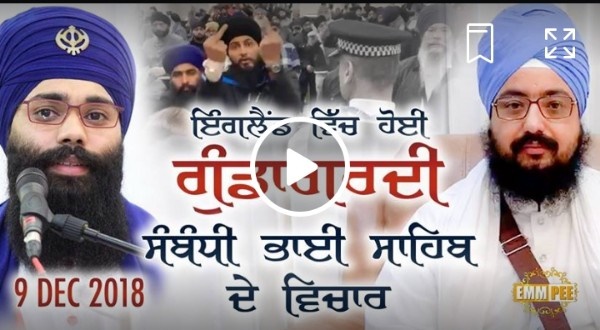
Ranjit Singh Dhadrianwale immediate respond to Hounslow gurdwara incident
By Asia Samachar Team | UK, PUNJAB |

There is a group of Sikhs hell bent on imposing their version of Sikhi upon the masses, even to extent of denying Sikh preachers with different interpretations access to gurdwara platforms, says a popular Sikh preacher.

“Within us now is a group of Sikhs trying to impose their beliefs and understanding upon the masses,” said Punjab-based preacher Ranjit Singh Dhadrianwale in an immediate response to the scuttling of a London gurdwara programme on Saturday (8 Dec 2018).

He said that the group insist that if Sikh parchaar (Sikh preaching) is to be done, it must be done according to their understanding of Gurmat.

“We have this group of people who think they are different and that they are an authority upon themselves. If any parchaar is to happen, it should be done as per their dictates. It should be done as to how they do it, and you need their permission to do so,” he said in a video comment.

He was commenting on the scheduled programme of Nirvair Khalsa Jatha UK (NKJ) at the Sri Guru Singh Sabha Gurdwara in Hounslow which could not start after a group started making loud noises and began behaving aggressively in the darbar sahib. Not too long later, police made their way into the darbar sahib to maintain peace.

FOR FACEBOOK LINK, GO HERE

Ranjit said the opposing group also believes that they have a right to deny speaking platforms to other groups which preach messages not seemingly aligned to their thinking.

“They seem hell bent on denying others the right to think and speak for themselves… In England you have the right to chose which pizza you want to eat. But this people do not want to give you the freedom to chose which preacher you want to listen to,” he said.

In the Hounslow incident, videos circulating via the social media show that a good number of the people present in the darbar sahib had responded positively when asked if they wanted to hear the NKJ group led by young Sikh preacher Harinder Singh.

However, the jostling that happened just as the NKJ members were about to take stage ensured that they were unable to proceed.

Ranjit, who’s group had also experienced rough treatment from people opposing his brand of parchaar, said all this while such groups have used force and gangster-like tactics to beat into submission gurdwara committees and Sikh parcharaks.

“That’s what they’ve been doing all along. They insist that parchaar be aligned to whatever their earlier leaders had preached. They want to drag our thinking back 50 years, 100 years,” he said. “They want to rob us our God-given right to think.”

He points out that parcharaks like him and Harinder Singh do not go out to disrupt programmes by other groups, regardless of their Sikhi views.

“To those who have been saying they want to remain neutral, that this is a so-called quarrel among parcharaks, they should ask themselves this question: Who is instigating all these incidences?

“This is not about two sides slugging it out. It’s about one side trying to put across their thoughts, while the other side hell bent on stopping them because they feel they have the authority to do so,” he said.

Ranjit points out that the Hounslow-type incident was no quarrel among parcharaks, but the work of a group of a ‘small band of brainwashed youth’.

He also urges Sikhs to stand up and be counted in efforts to allow parcharaks like him and Harinder to carry on their preaching.

By standing aside in the name of being neutral, he said they are only empowering the other side which he claims are already deploying underhanded tactics.

“They want to impose their (version of the) maryada on us,” he said.


RELATED STORY:

Opposing group scuttles Nirvair Khalsa programme at London gurdwara (Asia Samachar, 9 Dec  2018)

Group disrupts Inder Singh Ghagaa programe in Ipoh (Asia Samachar, 1 March 2017)


[ASIA SAMACHAR is an online newspaper for Sikhs / Punjabis in Asia. How to reach us: Facebook message or WhatsApp +6017-335-1399. Our email: editor@asiasamachar.com. For obituary announcements, click here]
Dr Param Jeeth Singh made health director for Kuala Lumpur and Putrajaya

0
Dr Param Jeeth Singh (right) shaking hands with Health director general Dr Noor Hisham Abdullah – Photo: Dr Noor Hisham Facebook pagegovernment

Dr Param Jeeth Singh Pakar Singh has been appointed as the director of health for Kuala Lumpur and Putrajaya, effrective 4 December 2018. Prior to this, Dr Param was a unit head at the Selangor health department.

Dr Param Jeeth obtained an MBBS from Mangalore University in India in 1989 and a Master of Public Health from University Kebangsaan Malaysia (UKM) in 1997, according to his profile at the Nastional Specialist Register website.


RELATED STORY:

Dr Baljit inducted into prestigious Canadian Academy of Health Sciences (Asia Samachar, 25 Sept 2018)


[ASIA SAMACHAR is an online newspaper for Sikhs / Punjabis in Asia. How to reach us: Facebook message or WhatsApp +6017-335-1399. Our email: editor@asiasamachar.com. For obituary announcements, click here]

The Opening of the Kartarpur Corridor

1
By Iqbal Singh Sevea | OPINION |


On 28 November 2018, Imran Khan, the Prime Minister of Pakistan, inaugurated the construction of the Kartarpur Corridor. The Kartarpur Corridor is a border crossing that will connect two important Sikh historical Gurdwaras – Dera Baba Nanak Sahib in India and Kartarpur Sahib in Pakistan – and provide access for Sikh pilgrims from Indian Punjab to Pakistani Punjab. The Vice President of India, M. Venkaiah Naidu, had earlier laid the foundation stone for the Indian portion of the corridor on 26 November 2018.

The construction of the corridor has been widely hailed in both India and Pakistan for opening a new chapter in the relations between the two countries. Many believe that the goodwill generated by the corridor and the increased people to people contact it will generate could lead to better diplomatic relations between India and Pakistan. Navjot Singh Sidhu, a Minister in the Indian state of Punjab, welcomed the development as one that will “build bridges, burn animosity and will act like a soothing balm for two neighboring countries.” Imran Khan even suggested that the corridor could mark the first step toward greater economic ties between the two countries.

With the Partition of India in 1947, people living in the new states of India and Pakistan found themselves cut off from religious institutions that they revered. The Sikhs in Indian Punjab, in particular, were separated from key religious institutions. A number of their religious sites now fell in Pakistani Punjab. Amongst these is the Kartarpur Sahib gurdwara, which is built on the site where Guru Nanak, the founder of Sikhism, lived for 18 years. Such is the reverence for the site that Sikhs in India who visit Dera Baba Nanak, another site associated with Guru Nanak, which is about 2 km within the Indian side of the border, use binoculars to get a glimpse of and offer their respects to Kartarpur Sahib.

The idea of the Kartarpur Corridor has been in circulation for a number of decades. In 1999, the former Indian Prime Minister, Atal Bihari Vajpayee, called on his Pakistani counterpart to work together to develop a border crossing at Kartarpur. The idea came into the limelight again when Navjot Sidhu visited Pakistan to attend the inauguration of Imran Khan as the Prime Minister in August 2018. Upon returning to India, Sidhu declared that he had been assured by Khan and the chief of the Pakistani military, General Qamar Bajwa, that Pakistan would open the Kartarpur border in time for the 550th birth anniversary of Nanak in 2019.

The month of November has witnessed a flurry of activity on both sides of the border to inaugurate the corridor. India and Pakistan are not only claiming credit for taking the idea forward but also rushed to lay the foundation stone in their respective domains. Within India, the Congress Party, Bharatiya Janata Party (BJP) and the Akali Dal are each jostling to claim credit for the construction of the corridor. All three parties have their eyes firmly set on the 2019 national elections. They each hope that an association with this initiative will bring them a windfall of Sikh votes. Although the Congress Party is in power in Punjab, the BJP which is in power at the center, and its ally the Akali Dal, have ensured that they are front and center of any event associated with the corridor. For instance, a leading figure from the Akali Dal, Harsimrat Kaur Badal, was sent to Pakistan to represent the Indian government at the groundbreaking ceremony.

For the new Imran Khan government in Pakistan, the opening of the corridor provides a good opportunity to illustrate that it has the political will to back up its rhetoric about developing better ties with India. The government is clearly interested in using religious diplomacy and religious tourism to normalize relations with India.

While both India and Pakistan are trying to claim credit for the initiative, the crucial modalities and technicalities that will govern (and restrict) travel across the corridor have yet to be worked out. These have the potential to limit any lasting impact that the corridor may have on improving relations between the two states. The devil, as they say, is in the details.

Both sides have spoken in terms of visa-free travel but have not spelt out what sort of permits would be required by those seeking to travel across the corridor. Security agencies on both sides of the border will no doubt demand that a strict regime of permits, regulation and monitoring be put in place. Sections within India are already highlighting the potential threat of terrorist infiltration.

An issue that is likely to pose a major stumbling block is whether India will be allowed to have consular access to the pilgrims. India has been clear that it expects its consular staff to be granted unrestricted access. This issue is linked to concerns over support from the Pakistani establishment for Sikh separatists demanding for an independent state of Khalistan. Pakistan’s leading intelligence agency, the Inter-Services Intelligence (ISI), has been accused of supporting the Khalistani militants. There is a concern in India that Pakistan continues to support attempts by segments of the Sikh diaspora to revive the demand for Khalistan.

The decision to open the Kartarpur Corridor marks a step in the right direction by India and Pakistan. There have, however, been a number of similar attempts before. The Samjautha Express, a train service linking Delhi and Lahore, and Sada-e-Sarhad, a bus service connecting Delhi and Lahore, were past initiatives that were launched with similar hopes and fanfare as the Kartarpur Corridor. The future of the corridor and its potential impact on India-Pakistan relations is contingent upon whether the two states will be able to develop sustained channels through which to discuss, firstly, the modalities of religious travel, and, secondly, the expansion of such linkages to other sectors such as trade and commerce.

Even at this nascent stage, the Kartarpur Corridor is already being looked to as a model for the facilitation of further religious travel between India and Pakistan. In the wake of the groundbreaking ceremonies, Hindus in Jammu and Kashmir have called on the governments of India and Pakistan to develop a similar corridor to allow Hindu pilgrims to visit Sharda Peeth. Sharda Peeth is a Hindu temple dedicated to the goddess Sharda Devi, which now falls in the Pakistani side of the Line of Control in Kashmir.

Dr Iqbal Singh Sevea is the Associate Professor University of North Carolina-Chapel Hill and Visiting Associate Professor at the Institute of South Asian Studies, National University of Singapore (NUS)


RELATED STORY:

Pakistan PM Khan lays foundation stone for long-awaited Kartarpur corridor (Asia Samachar, 28 Nov 2018)

On Builiding Bridges (Asia Samachar, 5 Dec 2018)

International peace bridge connecting Kartarpur in Pakistan and Dera Baba Nanak in India (Asia Samachar, 21 Sept 2018)


[ASIA SAMACHAR is an online newspaper for Sikhs / Punjabis in Asia. How to reach us: Facebook message or WhatsApp +6017-335-1399. Our email: editor@asiasamachar.com. For obituary announcements, click here]

Opposing group scuttles Nirvair Khalsa programme at London gurdwara

3
By Asia Samachar Team | UK |

Popular Sikh group Nirvair Khalsa Jatha UK (NKJ) saw their programme at a London gurdwara on Saturday (8 Dec) scuttled when confronted by an opposing group.

Police had entered the Sri Guru Singh Sabha Gurdwara in Hounslow to manage the situation.

The officers moved into the darbar sahib to control the situation that became rowdy just as the jatha was about to start their programme.

It is believed that the commotion boils down to the on-going running battles between groups supporting different interpretations of Gurbani, as witnessed at a number of earlier such incidences in a number of other countries.

The disruption is reminiscent of attempts to disrupt programmes by the hugely popular Punjab-based Sikh preacher Ranjit Singh Dhadrianwale.

In Malaysia, one such incident had occurred in Ipoh in March 2017 when a section of the congregation had disrupted a scheduled sermon by repeating loudly the ‘Waheguru’ chant. See here.

In one video of the Hounslow incident on Saturday, circulating on the social media, a section of the congregation could also be heard repeating the Waheguru chant while a speaker was speaking, ignoring his appeal for them to desist.

When the Harinder Singh-led NKJ group were about to take the stage, the situation became more disrupted, eventually leading to the police entering the darbar sahib.

NKJ UK had recently suspended their programme in the UK after an incident in Leeds.

However, the jatha which was well received in Malaysia in the past, had decided to continue their programmes.

On 5 Dec, the jatha had released the following statement:

“Nirvair Khalsa Jatha UK will resume its Gurmat Parchar mission as of the coming weekend. The decision comes further to consultation with a number of Gurdwara management committees and the significant number of Sikhs in the UK who strongly support the work of the organisation.

“It can be noted that Nirvair Khalsa Jatha UK had issued a statement on 17th November 2018, communicating a decision to postpone all UK Diwaans until further notice. That decision had come in light of disruptions caused at scheduled Diwaans in Leicester last month. Evidently, the disruptions were part of a larger arrangement that is unfortunately working to ban Nirvair Khalsa Jatha UK from stages across the country.

“Nirvair Khalsa Jatha UK would like to thank the numerous Sikhs who have been sending messages and uploading videos of support on social media, and those Gurdwara management committees who have not wavered in their support for Gurmat Parchar, but instead encouraged the organisation to continue its work.”

In that statement, it also stated that the Hounslow programme on Saturday would proceed.


RELATED STORY:

Group disrupts Inder Singh Ghagaa programe in Ipoh (Asia Samachar, 1 March 2017)


[ASIA SAMACHAR is an online newspaper for Sikhs / Punjabis in Asia. How to reach us: Facebook message or WhatsApp +6017-335-1399. Our email: editor@asiasamachar.com. For obituary announcements, click here]