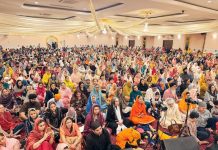
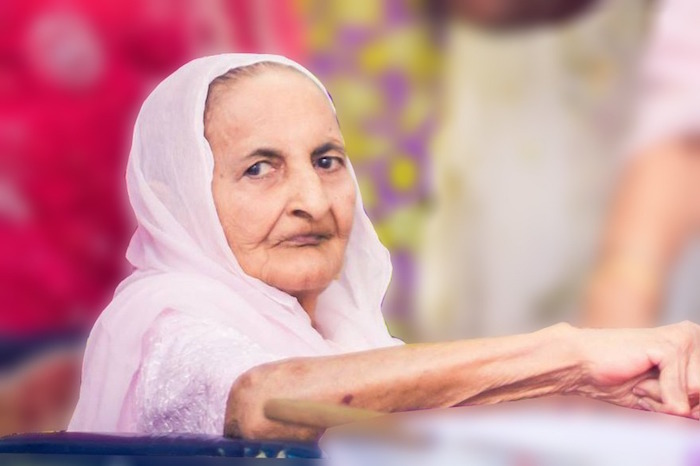
A mother with her daughter and daughters-in-law at the Teeyan – Photo: Supplied
By Balvinder Kaur | MALAYSIA
The Teeyan festival by Pind Di Kuriya was recently held at Wisma Tatt Khalsa in Kuala Lumpur. Its an annual women’s festival of happiness that started last year.
Punjabi ladies came dressed up in colorful attire, sang boliyan and performed giddha performance.
Teeyan is about happiness, prosperity and well-being. It is festival for Indian women where newly married and young unmarried women gather together to celebrate the beginning of rainy season.
A very special thanks to Gurdwara Sahib Tath Khalsa committee for sponsoring the hall and food, Hasheel Sidhu for the sound system, Moghul Mahal and Havely for the gift vouchers.
Teeyan in full swing in Kuala Lumpur – Photo: Supplied
[ASIA SAMACHAR is an online newspaper for Sikhs / Punjabis in Asia. How to reach us: Facebook message or WhatsApp +6017-335-1399. Our email: editor@asiasamachar.com. For obituary announcements, click here]
Seven six years old Gurmit Singh KS, the environmentalist said to be famous for his take-it-to-the-streets activism, has received yet another recognition for his contribution to the environment.
Gurmit is one of the seven recipients of the 2018 Merdeka Award. He was recognised for his contribution in the field of environment.
Historian and academician Prof Emeritus Dr Khoo Kay Kim and University Malaya economist Prof Dr Rajah Rasiah received the award for outstanding scholastic achievement.
The others were ‘Father of Malaysia’s Animation’ Hassan Abd Muthalib (education and community category); Universiti Putra Malaysia Dean of Veterinary Medicine Faculty, Professor Dr Mohd Hair Bejo, and pharmacologist Datuk Dr Gan Ee Kiang (health, science and technology category); and British cave explorer Andrew James Eavis (outstanding contribution to the people of Malaysia category).
Established by the oil and gas giants in Malaysia, Petronas, ExxonMobil and Shell in 2007, the Merdeka Award recognises and rewards Malaysians and non-Malaysians who have made outstanding and lasting contributions to the country and its people.
To date, 49 individuals, including this year’s recipients, as well as two organisations, have been conferred the prestigious award.
In 2017, Prof Dr Balbir Singh was one of the award recipients. Dr Balbir from Universiti Malaysia Sarawak (Unimas) and Dr Timothy William were jointly awarded the award under the Health, Science and Technology category for their incredible contribution to the discovery and pioneering work on a new course of human malaria, plasmodium knowlesi.
Born in 1942 to Punjabi parents in Japanese-occupied Malaya, Gurmit founded two pioneering NGOs — Environmental Protection Society, Malaysia (EPSM) and Centre for Environment, Technology and Development, Malaysia (CETDEM).
Despite his tumultuous relationship with the authorities, he was conferred the Langkawi Environmental Award in 1993, according to the publishier’s note of his book, Memoirs of a Malaysian Eco-Activist, released in 2017.
[ASIA SAMACHAR is an online newspaper for Sikhs / Punjabis in Asia. How to reach us: Facebook message or WhatsApp +6017-335-1399. Our email: editor@asiasamachar.com. For obituary announcements, click here]
Sikh Ardaas (supplication) starts by meditating on the Ten Gurus and then refers to the teaching of Sri Guru Granth Sahib in which is enshrined the spirit of the Ten Gurus. Sikhs understand that there is only One Guru Jote which now resides in Sri Guru Granth Sahib.
Similarly, Sikhs remember the Five Takhts, the Thrones: Akal Takht, Anandpur Sahib, Patna Sahib, Hazur Sahib and Damdama Sahib.
There is much discussion about Sri Akal Takht Sahib and the decision-making processes in the Panth. The Sikh Reht Maryada (SRM) confirms that the most important decisions (Gurmatas) affecting the Panth can only be taken collectively by the Guru Panth. That any Gurdwara disputes should be taken up with Sri Akal Takht Sahib. (SRM Article XXVI b & c).
However, the role of the other Takhts in this decision-making process is less clear. In fact, it is hardly discussed.
We know that the religious practices and traditions of the Takhts are not the same.
Sometimes they even convey conflicting messages about the Sikh way of life through their practices. If the Guru is One then no matter where the Guru sits, his Takht is also One.
That Takht of the Guru is Sri Akal Takht Sahib, albeit, physically, this Takht has 5 locations at Amritsar (the prime location), Anandpur Sahib, Patna Sahib, Hajoor Sahib and Damdama Sahib. This True Takht &ndash Sacha Takht – of the Guru resides in the psyche of every Sikh.
So, in the context of the ongoing discussions which address the sovereignty of Sri Akal Takht Sahib as the One and only Guru Granth-Panth Miri-Piri Institution, the unity of the Five Takhts needs continual stress. All Takhts should be seen to be acting as one voice of the Khalsa Panth.
Outside involvement in Sikh religious affairs started with Gurdwaras Act of 1925 which set up the SGPC. The result is that, through the SGPC as a legal entity – there are allegations of outside interference in the appointments made and the decisions taken at Sri Akal Takht Sahib.
With loss of trust in the Takht office holders, the tendency is to depend increasingly on the courts to settle religious disputes and interpretation of Sikh ideology and tradition. That means that non-Sikhs are now deciding issues to do with Sikh ideology, institutions and identity e.g. with reference to the Kakaars.
The global Sikh community should continue to re-assert independent Panthic control of appointments, practices and procedures at all Takhts. This can only be done by keeping direct link with the Takhts and continually referring issues to Sri Akal Takht Sahib, the supreme miri-piri court of the Khalsa Panth.
Sikhs should not distance themselves from Sri Akal Takht Sahib (including the Takhts) individually or organisationally while seeking full accountability to the Panth from the office holders. That is one way to keep up the pressure for change and to assert Panthic ownership of our great institutions.
A major re-alignment of the decision-making and direction giving processes at the 5 Takhts represented by Sri Akal Takht Sahib is long overdue.
Gurmukh Singh OBE, a retired UK senior civil servant, chairs the Advisory Board of The Sikh Missionary Society UK. Email: sewauk2005@yahoo.co.uk. The article first appeared at The Panjab Times, UK
* This is the opinion of the writer, organisation or publication and does not necessarily represent the views of Asia Samachar.
[ASIA SAMACHAR is an online newspaper for Sikhs / Punjabis in Asia. How to reach us: Facebook message or WhatsApp +6017-335-1399. Our email: editor@asiasamachar.com. For obituary announcements, click here]
By Surinder Kaur Sohan Singh |SIKHI STUDY | OPINION
ਮਿਠਤੁ ਨੀਵੀ ਨਾਨਕਾ ਗੁਣ ਚੰਗਿਆਈਆ ਤਤੁ ॥
Mithath Neevi Nanaka Gun Changiaaeeaa Thatt
Sweetness and Humility O Nanak are the essence of virtues and goodness. (Pg 470, SGGS)
Gurbani tells us that amongst all the divinely virtues the greatest virtue is HUMILITY and amongst the many vices, the greatest vice is ARROGANCE (ahengkaar/ ego).
To remain humble no matter how high on the ladder of success one may be is the challenge for all of us. If because of our knowledge, power, money or status we start treating others as lesser human beings then we have to get ready for a hard fall.
Each one of us is a world unto ourselves. Every person extends a specific vibration of energy. These vibrations are created through our thoughts, words and actions.
What come out of our mouths is even more important than what goes in. It is not how much we pray that matters but rather how we behave with others because each and every action is like a prayer.
What we say and do creates the energy we pass on to those around us and also to the rest of the world.
Guruji reminds us in the line above that sweetness and humility in our words is the essence of virtues. Harsh words and anger hurled at others hurt us more than the person at whom it is directed. There is no doubt that we hurt others but it is good to remember that in that process we end up causing more damage to ourselves also.
To avoid these outburst of anger we are advised by the Guru to do the following:
ਬੰਦੇ ਖੋਜੁ ਦਿਲ ਹਰ ਰੋਜ ਨਾ ਫਿਰੁ ਪਰੇਸਾਨੀ ਮਾਹਿ ॥
Bandae khoj dil har roj na fir paraesaanee maahi
O human being, search your heart everyday and get rid of your anxieties and tensions so that you can function from a place of Love and Compassion rather Anger. (Pg 727, SGGS)
The role of religion is to train us to listen to our inner voice and do introspection and reflection on our actions every day. Try to identify the intention behind our every action.
If our intentions are pure, it should be reflected in the language used to convey this message. If the language used is harsh and hurtful then the intentions cannot be pure.
Being God’S children we have to learn how to speak like Him. Guruji tells us how God speaks in the lines below:
ਮਿਠ ਬੋਲੜਾ ਜੀ ਹਰਿ ਸਜਣੁ ਸੁਆਮੀ ਮੋਰਾ ॥
Mith bolarra jee Har Sajan Suaamee morra
My Lord and Master, my friend always speak so sweetly to me.
ਹਉ ਸੰਮਲਿ ਥਕੀ ਜੀ ਓਹੁ ਕਦੇ ਨ ਬੋਲੈ ਕਉਰਾ ॥
Ho sanmal thhakee jee ouhu kadhae n bolai koura.
I have tested HIM many times but HE has never spoken harshly to me.
ਕਉੜਾ ਬੋਲਿ ਨ ਜਾਨੈ ਪੂਰਨ ਭਗਵਾਨੈ ਅਉਗਣੁ ਕੋ ਨ ਚਿਤਾਰੇ ॥
Koura bol na jaanae pooran Bhagvannai aougun ko na chithaarae.
HE doesn’t even know any bitter words. Although I am full of vices and faults but HE still never uses harsh words and remind me of my faults. (Pg 784, SGGS)
If we do not keep this in mind then all the knowledge that we have accumulated is just a burden we are carrying on our heads and walking around. At the end it will be a cause of our suffering instead of liberating us.
Surinder Kaur Sohan Singh is a Malaysia-based Gurbani enthusiast. This is an edited version of her regular articles shared within a circle of fellow Sikhi seekers. The articles appear on Mondays and Thursdays.
* This is the opinion of the writer, organisation or publication and does not necessarily represent the views of Asia Samachar.
[ASIA SAMACHAR is an online newspaper for Sikhs / Punjabis in Asia. How to reach us: Facebook message or WhatsApp +6017-335-1399. Our email: editor@asiasamachar.com. For obituary announcements, click here]
Baldev Singh Uppal: Movie producer and director behind Sri Saheb Production House and White Merpati Entertainment - Photo: Supplied
Baldev Singh Uppal
By Dr. Balwant Singh Bains | THURSDAY TEA WITH BAINS | PERSONALITIES
Malaysian movie producer and director Baldev Singh Uppal has an uplifting and inspiring story to tell. This is the man behind Sri Saheb Production House and White Merpati Entertainment.
Baldev was born in Kuala Lumpur, Malaysia in 1962. At eight, his life underwent a sea of change. He was compelled to travel to Punjab, India, in 1970 by sea and there he went through his toughest times as a child. He came back to Malaysia in 1975 with a heartfelt tale difficult to narrate in his biography.
In the rural Punjab then, he went to the village school, where he mastered his Punjabi language. Over the later two years, he was forced into home chores demanded in a peasant’s living.
Just before he returned, in Amritsar (In the City of Golden Temple), he got an opportunity to watch his first movie, then the Hindi blockbuster Sholay staring Amitab Bachan and Dharmendra. He was extremely inspired with that movie. When he returned to Malaysia, he had already injured his legs with a fracture. In that condition, he then joined the Malaysian School in Form 2 in Kuala Lumpur.
He grew up in the home of his paternal aunty (Phua Ji). It is there in 1980 that he saw the first gadget that could project movies onto a television via a VCR. It was the cartridge. He tossed and turned it in curiosity and asked from the relative what it could do?
This was the first time he ever saw such an amazing product that could record movies and play over a TV. With this amazing gadget and inspired by the Hindi movie Sholay, since then, he walked a road filled with torns but charged with big ambitions. From the rugs he raised himself through extreme hardship.
On one hand, he was sensitive to SCREEN & PROJECTION, but on the other he knew next to nothing about movies production. This curiosity motivated him to take up a course to learn about electronics. He emphasises that:”Skill is the greatest gift of mother nature and hands-on is the answer to progress and success.”
One must pursue and master it in one’s lifetime.
CAPTURING MARRIAGES
His life into filming began from then onwards. He began with videoing marriages. At one point of time, he landed a project to make a company profile video. Impressed with his work, a Sungai Petani-based company, Pharm Malaysia, gave him another project. By then he had acquired enough experience to make him walk into filming and production.
One day he developed a quest to portray Punjabi culture to the people of Malaysia comprising of various ethnicity. He drove on his scooter to Angkasapuri, the Malaysian broadcasting house in Kuala Lumpur. His guts turned him back when he saw uniformed guards in front of large gates as he knew nobody then.
Later he made a second attempt. While at the gates, he met a Sikh gentleman Chanan Singh to whom Baldev had introduced the quest of running a program for Vasakhi, a Sikh Celebration and Punjabi Culture.
The offer was heard with enthusiasm and was granted a slot by the then officer at the Radio Television Malaysia (RTM), but without any monetary returns. In other words, he has a secured a slot, but his team is not going to be paid for the programme.
Baldev took that opportunity and started working on the project. With little in his coffers, and in 24 hours, he made the first Punjabi entertainment skit to air on Malaysian domestic television on Vasakhi. This marks him as the first Malaysian Sikh to introduce a local Punjabi program on the Malaysian television channels. And he did it for free in 1984.
“I had bet my last coin on it until I found it difficult to feed my two children. I went on struggling over months, but slowly and surely I came out of it,” he said.
“I still continue to supply Vasakhi programs to date to RTM and ASTRO. I am proud to have taken this bold step in my life for the sake of this small but growing Sikh community of Malaysia and this legacy is to stay for generations to come.”
BOLLYWOOD BREAK
With all this in his platter, and with the support of his lovely wife Jaswant Kaur, and having gathered enough experience to make him walk into filming and production world of entertainment, he became the first Malaysian production house to fuse Malaysia cinema production with Bollywood star.
He made a movie in 2004 titled Father starring Kabir Bedi. After many more quality movies, in 2017, his company White Merpati Entertainment released I’m not a Terrorist, a Malay-Hindi fusion with staring Gulshan Grover of Bollywood with Farida Jalal and Malaysian actors like Afiq Muiz and Betty Banafe. It has been dubbed in various languages now.
BUSINESS EXPANSION
Today, his sons Harvinder Singh and Arjil Singh have joined him in filming. Over the years, Baldev has produced more than 1,000 episodes of entertainment program for the local television. There are many more movies in the pipeline.
Baldev has also trained many Sikh youth in Punjabi speaking and have presented them on the TV screens via his programs.
With all that under his belt, Baldev remains a low profile, humble and soft spoken gentleman. He is fluent Punjabi, English and Bahasa Malaysia.
Now, there is no turning back in the world of entertainment. He has many projects in hand and one of it is to produce a film fully for Bollywood.
Another area close to Baldev’s heart is working with the Malaysian Gurdwara Council (MGC), a Malaysian-based non-government organisation that works with the 120-odd gurdwaras in Malaysia. At one point, the early proponents of the council. He had been one of the strong pillor of support during the formative times of MGC, working hand in hand with Paguwan Singh (better known as Hari Singh who now resides in New Zealand). Baldev had offered his office for the working of the council before it shifted to Sentul. His role was to work hand in hand with the council to create awareness about Vasakhi.
On the personal level, his slogan that he repeats several times in Punjabi translates as: “From the MUD of the VILLAGE POND.. through the HOT MOULD in the FURNACE… Baked into a BRICK to be among those on the walls of PALACES”
“Thus was the journey of my life,” he said.
[The interview was conducted on 19 July 2017]
Dr Balwant Singh Bains is a Malaysia-based kirtan enthusiast and a practicing physiotherapist with chain of physiotherapy clinics. Thursday Tea With Bains is a column where he interviews personalities who have contributed to the society and achieved their objectives in life to inspire people at large. Dr Bains has taken up this program to interview personalities around Malaysia as well as around the world in his travels.
ASIA SAMACHAR is an online newspaper for Sikhs / Punjabis in Southeast Asia and beyond.Facebook | WhatsApp +6017-335-1399 | Email: editor@asiasamachar.com | Twitter | Instagram | Obituary announcements, click here |
Devinder Singh Randhawa – Photo courtesy of Suresh Nair
By Suresh Nair | SPORTS247.MY
Tragedy and triumph came almost back to back for former Singapore hockey striker Devinder Singh Randhawa and, to his credit, he has held his head high in a special year.
He lost his iconic elder brother, Bhupinder Singh Randhawa, nicely nicknamed ‘The Gentle Giant’ in April to heart failure. And four months later, he was swept off his feet when his wife Chitra and daughter Sonia, threw a surprise 70th birthday bash on Friday at the Singapore Cricket Club.
Bhupinder, who migrated to Australia in 1983 after serving the SAF as a distinguished Captain and Singapore as an outstanding centre-half at hockey, played in the SEAP (South-East Asia Peninsular) Games in 1969, 1971 and 1973 gold-medal winning team. He also captained the SAFSA hockey team.
In a tear-jerking birthday speech, Dev, also like the late Bhupinder, a former SAF officer and Singapore hockey legend, poignantly remarked that “yesterday is history, today is a gift and tomorrow is a mystery”.
Completely enthralled at his surprise birthday party with the closest of family, friends and folks, he said: “At this juncture of my life what I have say here will pretty well summarise and relate to my extraordinary journey till this day. You know time has a way of moving quickly and catching you unaware of the passing years.
“It seems like only yesterday that I was younger although I’m still young! How the years have gone by and here I’m at the pinnacle of my life and it catches me by total surprise. How did I get here so fast?”
TRIBUTE TO ELDER BROTHER
Eloquently paying tribute to the late Bhupinder, Dev says: “I have never even attended a family funeral until very late in my life, so I didn’t even know what a dying business is all about. I remember seeing older people through the years and always thought they were years and years away from me, so far off that I could not fathom or even imagine fully what it would be like.
“But here it is. The reality has got to sink in. And so now I enter into this new season and for all intense and purposes, I will call it a ‘winter’, unprepared for the aches and pains and loss of strength and the ability to do things that I wish I had done but never did!”
Hugging his wife Chitra, a similar Virgo in zodiac traits, and daughter Sonia Sardana, who flew in from Australia the same day, Dev added: “Yes, I have had regrets. There are things that I wish I hadn’t done, things I should have done, but yet again there are many that I’m happy to have done. It’s all in a lifetime.
“So let me remind you that if you have not reached this ‘winter’ yet, it will be here faster than you think. So whatever you would like to accomplish in your life, please do it timely. Don’t put things off for too long as life is a gift for you. The way you live your life is your gift to those who come after. Make it a fantastic one.”
Off-the-record, Dev reminded me that Virgos are “special-of-special personalities” who can deflect and adapt, plus they want to make life easier and better for everyone, and those aren’t bad qualities to have in a marriage partner.
“Hey Suresh, it’s quality over quantity for Virgo, which makes them very good prospects for long-term committed relationships like marriage.”
Praising the divine Gurus for a strong mental and physical frame after 840 months, Dev philosophically said: “Remember, it is the health that is the real wealth, not pieces of gold and silver. And consider the following: Today is the oldest you have ever been yet the youngest you will ever be. So enjoy this day while it last. In summary, let me say, yesterday is history, today is a gift and tomorrow is a mystery.”
PASSIONATE UNIFORMED TRIBE
Dev, in the foot-steps of the late Bhupinder, continued a Randhawa tradition of a very passionate uniformed tribe, perhaps like the Sikh-version of the Hollywood Oscar-nominated screenplay for ‘An Officer and a Gentleman’ by Douglas Day Stewart.
Of the nine-member Randhawa family, the second, Mandhir Randhawa, was an Air Traffic Controller who had an unusual streak of three commissions, RMAF (Malaysia) RSAF (Singapore) and RAAF (Australia) and retired as a Squadron Leader in Sydney. The third, Savinder Randhawa, was a Singapore Police Force (SPF) Assistant Superintendent of Police (ASP), who once headed the Police Prosecution Branch. The late Bhupinder was No 4, followed by Devinder.
The “surprise of surprises” birthday bash was the discreet brain-child of Virgo-branded wife Chitra, who wanted to salute her husband, “who simply deserves the best”, She explained: “He is my strength, a great husband, good father to Sonia and a wonderful grandfather to our beautiful grandsons, Aryan, Aveer and Aare. He’s my best friend for life.”
In the weeks to discreet preparations, Chitra literally entered stealth mode to put together a spoiler-free surprise event. I know she approached the closest Dev’s buddies in the SAF, hockey-world and SCC-arena. She even appealed to me, as a journalist, for long-lost media reports and photographs when Dev ruled the hockey pitch from the late 1960s onwards in order to put together a prolific 70th-birthday photogenic album.
I must put on record that I enjoyed the eulogies given by his mates from Dev’s bachelor-hood era, from Ricky Soh, his RSAF (Republic of Singapore Air Force) room-mate at Changi Officers Mess (COM), who almost pulled back the velvet curtains to their single-lifestyles. But he hinted that one of Dev’s favourite nicknames was “Randy” without going to the behind-the-scenes bawdy details!
SEAP Games 1973 vice-captain Arul Subramaniam, also a senior SAF officer, remembers the superlative sporting hallmarks of Dev, who he described as a “dazzling forward who with his elegant footwork and stick mastery could confuse the best of defences and make them go the wrong way”,
Arul, who shared a four-decade friendship with Dev, added: “Dev never loses his temper on and off the field, something I’ve always admired.”
TITLE-WINNING HOCKEY CONVENOR
The Yul Brynner-personalised Dev, an alumni of Beatty Secondary School, recalled how he got to military uniform after finishing School Certificate (SC) to complete his Officer Cadet Course (OCC). He spearheaded the SAFSA (Singapore Armed Forces Sports Association) hockey team, finishing Singapore Hockey Federation (SHF) champions from 1968. And in 1970, tongue-in-cheek, he recounted how he got a big knock from his SAF bosses when only nine players (usually it should be 11 players) turned up for the title-winning match on the Padang against SRC (Singapore Recreation Club).
The sports headlines of The Straits Times the next day read: Nine-men SAFSA beat SRC. Dev recalled: “I got an immediate dressing down from the SAF Chief of General Staff (Brig General Kirpa Ram Vij) over the telephone, He didn’t care what the title-winning score was and sternly asked me: Where were the other two players?”
Dev first represented Singapore at the 1969 SEAP Games in Kuala Lumpur. The following year, Singapore qualified for the 1970 Asian Games in Bangkok and under famed West German coach Horst Wein, Singapore finished in fifth place.
His saddest sporting moment was In March 1973, when SAFSA played a friendly against Cypres British Army on the SCC Padang. He says: “That was absolutely my doomsday as I seriously broke both my radius and ulna when trying to beat a lanky Cypres player. Unfortunately, I did not break my fall. A doctor on the ground later used my hockey-stick as a stint and I was carried to the hospital. That was to be the end of my hockey career and one of the reasons I missed out of the 1973 SEAP Games, where Singapore won the iconic hockey gold-medal.”
In my mind, as I spoke in my mini-birthday speech, Dev prolifically stood out as an “officer, sportsman and gentleman” and let me genuinely reiterate now, for a Sikh hockey role-model, he was more than just “big, strong and friendly…and bald!”.
Perhaps the most poignant moment of the three-hour birthday bash was when Dev froze for a good 60 seconds and almost went down on his knees when he came face-to-face with his only daughter Sonia Sardana, who flew in from Adelaide, Australia, just hours before the surprise bash.
It was pure emotional stuff from Bollywood: Dev covered his face, stood speechless, simply overawed by the young mother of three, who found quick time to surprise him on his auspicious 70th bash. He later confessed: “This is the best birthday present ever, Sonia showing up, despite her tight family commitments, absolutely without any notice from Down Under.”
Yes, the biggest salutes to the “70-birthday boy” Dev: Truly befitting for someone who, over four months, held his head high when tragedy and triumph came knocking on his door this year.
As Dev perfectly mentioned in his tear-jerking birthday speech, “yesterday is history, today is a gift and tomorrow is a mystery”.
Many, many, many happy returns of the day, Devinder Singh Randhawa, your principled leadership, personal courage and professional insistence on treating even foes with respect will remain unmatchable.
Suresh Nair is a Singapore-based journalist who has known the Randhawa family for over three decades. He feels privileged to have played a behind-the-scenes role for Dev’s awesome 70th birthday bash.
[ASIA SAMACHAR is an online newspaper for Sikhs / Punjabis in Asia. How to reach us: Facebook message or WhatsApp +6017-335-1399. Our email: editor@asiasamachar.com. For obituary announcements, click here]
As many will know we have strenuously opposed the Sikh Federation UK’s (SFUK) ill-conceived campaign to classify ‘Sikh’ as an ethnicity for many years.
In recent months this increasingly divisive debate has become the subject of significant mainstream media coverage, including an article in the Times last month. The article ‘Sikhs may get ethnicity status’ instigated another flurry of debate and conversation for and against.
Meanwhile during this period, some exchanges on social media turned rather unpleasant, troubling and on occasion personal.
Our Director responded to the Times article with a letter (below).
To help provide a summary of arguments against we refer to the following Q&A and a short summary below. We have spoken to many Sikhs who are undecided whether the SFUK campaign is a good idea or not, and this is largely based on not understanding the issues at hand. Some elements are admittedly complex. We hope the explanation below which has been shared with key stakeholders and decision makers, provides absolute clarity for those grappling with this important issue. In short Sikhism is a great world faith open to all, it is not an ethnic group.
ARCHIVE: Article from 1983 following the Mandla v Dowell Lee ruling
SIKHS AND ETHNICITY
By Lord Singh of Wimbledon CBE, D Lit., DL
EXPLANATION OF ETHNICITY
An ethnic group relates to people emanating from a particular part of the world who have common physical and cultural characteristics. It became important to Sikhs in the early 80s because a School Head deliberately discriminated against a Sikh schoolboy in refusing to allow him to wear a turban at school. The Head was legally entitled to do this because the 1976 Race Relations Act, while giving protection against discrimination on grounds of nationality or ethnic origin, gave no protection against religious discrimination.
At a meeting held in my house with representatives of the then Commission for Racial Equality (CRE) and their solicitors Bindmans, I suggested that we should try claiming protection under ethnicity, as at that time, most Sikhs in the UK were born in India, spoke Punjabi as their first language and had other distinctive ways of life, including religion. Our case eventually went to the House of Lords giving Sikhs protection against religious discrimination under the 1976 Race Relations Act on the grounds of common ethnicity characteristics.
With most Sikhs in the UK now born in this country and speaking English as their first language, some of the arguments used in 1983, no longer apply. Nor are they relevant as the Equalities Act 2010, gives protection against discrimination to all religions and beliefs [the 1976 Act giving Sikhs limited protection under ethnicity, has been repealed].
FURTHER STRETCHING THE MEANING OF ETHNICITY FOR MATERIAL GAIN
Some Sikhs for two different reasons want to call themselves both a religion and an ethnic group, despite Sikh teachings to the contrary. The first reason is a somewhat naïve belief that the distinction might help Sikhs claim a separate identity and possible statehood in India. The second is, that being in both categories will assist in getting additional UK state funding over and above that given to other religions.
Leaving aside the morality of such an argument, common sense reminds us that we must compare like with like. A group which is both an ethnic group and religion must be monitored against others who are also both ethnic groups and religions. Such a category does not exist. Equally it would be absurd to try to monitor state provision for Sikhs as an ethnic category, with the existing ethnic category Indian, when the category Indian, also contains Sikhs.
The argument is also totally against Sikh teachings in which the Gurus condemned man made divisions of our one human family. To suggest a hybrid ‘(Punjabi) ethnic Sikh’ category in the census, in order to chase possible material gain denied to other faiths, is also totally contrary to the egalitarian thrust of a religion open to anyone anywhere in the world. It also defies common sense to suggest that those who embrace Sikhism and call themselves Sikhs in different parts of the world all have the same ethnicity.
MEETING LEGITIMATE SIKH CONCERNS OVER CURRENT ONS ETHNIC CATEGORIES.
One of the main benefits of ethnic monitoring is the fact that people from different parts of the world have discernible differences in propensity and resistance to certain ailments arising from genetic factors related to heredity, diet, climate and culture.
India is a vast subcontinent with many different ethnicities. Pakistani and Bangladeshi are already recognised as separate ethnicities. Recording Punjabi in the census as a separate ethnicity (the state being a similar size to Pakistan) has many attractions. For example, it will help monitor and provide services for a higher than average Punjabi propensity to kidney and liver disease, and diabetes.
Importantly, it will also obviate the need to tick Indian under ethnicity. Many Sikhs are reluctant to record their ethnicity as Indian as memories of the Indian Government perpetrated ethnic cleansing of against Sikhs in 1984 are still fresh in many Sikh minds.
It would be both more accurate, sensible and acceptable to request ONS for a Punjabi ethnic category as an option in the census, rather than trying to re-define a religion open to anyone, anywhere in the world as a contentious hybrid of religion and ethnicity.
Produced for the Network of Sikh Organisations UK (NSOUK), a registered body with a membership of more than 130 gurdwaras and other Sikh organisations.
GAUGING SUPPORT FOR DESCRIBING ‘SIKH’ AS AN ETHNIC GROUP IN THE 2021 UK CENSUS
Difficulties
Supposed support by MPs and the APPG for British Sikhs
Speaking to a number of MPs, including some of those who have given support to the Sikh ethnic tick box, confirms that few have any understanding of Sikh teachings against artificial and divisive groupings of our one human race; nor were they clear of the supposed benefits of describing Sikhs as an ethnic group. Those who signed did so because they were told that this is what their Sikh constituents wanted.
Supposed support in the Sikh Community
Gurdwaras are generally unaware of the pros and cons of ethnic monitoring. Some, that have voiced support for a Sikh ethnic tick box, say they did so because they are stridently opposed to the alternative of describing themselves as ‘Indian’, because of still lingering anger over the state-sponsored genocide against Sikhs in 1984. Many others are of the view that calling ourselves an ethnic group as opposed to Indian is a step towards creating distinct ‘quam’ (national) identity and the creation of a separate Sikh State in India.
While the emotive appeal is very real, it has nothing to do with the 2021 census. It also ignores basic Sikh teachings on the absurdity of creating artificial divisions in our one human family – particularly in the pursuit of supposed material gain. It should also be remembered that some of the organisations lobbying for support for a Sikh ethnic tick box, like the Sikh Federation UK, and the Sikh Network, etc, are all run by the same small group of people, who also have a dominant voice in the Sikh Council.
Reality of support in the Sikh community
The overwhelming attitude of most gurdwaras to a Sikh ethnic tick box in the census is a lack of understanding and relevance. If told that that a Sikh ethnic tick box will benefit the ‘quam’ (Sikh nation), they will probably quickly sign support and get back, to what they regard as, the more important business of providing a service to their sangat (congregation). If however, the real pros and cons are explained and discussed, interest is more sustained, and attitudes are often quite different.
At the suggestion of ONS officers, a meeting was arranged in Guru Singh Sabha Gurdwara Hounslow, with a representative of the ONS present. Presentations were made by the NSO and the Sikh Federation UK and, after discussion for more than an hour, the proposal for a Sikh ethnic tick box in the next census was totally rejected by members of the Gurdwara Committee.
The Sikh ethnic tick box proposal has also been totally rejected in other gurdwaras, where both the pros and cons have been explained and discussed by Committee members, most recently at the gurdwara in Edinburgh.
Suggestion
The only real way to assess whether Sikhs in the UK are prepared to over-ride essential Sikh teachings for unquantified material gain, is by open public debate monitored, and perhaps presided over, by the ONS. Unfortunately, this repeated suggestion by the NSO has been met with personal abuse from the Sikh Federation UK in its different guises.
My repeated request to be allowed to address the APPG for British Sikhs (from which I and other Sikhs in Parliament have been excluded) has also been consistently ignored, as has my request for open debate on any London Sikh TV Channel, Why? My hope is that we show that we are mature enough to discuss such issues rationally and respectfully, always bearing Sikh teachings in mind.
Dr Indarjit Singh, who carries the UK title The Lord Singh of Wimbledon CBE, is a Crossbench Life peer sitting in the House of Lords since 12 October 2011.
This is the personal opinion of the writer or publication and does not necessarily represent the views of the Asia Samachar.
ASIA SAMACHAR is an online newspaper for Sikhs / Punjabis in Southeast Asia and beyond.Facebook | WhatsApp +6017-335-1399 | Email: editor@asiasamachar.com | Twitter | Instagram | Obituary announcements, click here |
Hash runners prayer session at Sentul gurdwara on Merdeka Day – Photo: Supplied
Hash runners from the three Sikh clubs in Klang Valley — United Sikh Hash, Kelab Aman Hash and Chakdey Hash — came together for a prayer session at Gurdwara Sahib Sentul yesterday (31 Aug 2018).
Many of them donned the turban to join the #MerdekaDayShiningTurban campaign. A regular runner, KR Bala, joined his Sikh friends by wearing the turban, as well.
Merdeka Day Shining Turban is campaign launched by Asian Sikh media portal Asia Samachar to get Sikhs to don the turban as Malaysia celebrate the independence day on 31 Aug.
United Sikh Hash grandmaster Palwinder Singh (left) and regular runner KR Bala don the turba for the #MerdekaDayShiningTurban campaign during the hash runners’ annual prayer at Sentul – Photo: Supplied
[ASIA SAMACHAR is an online newspaper for Sikhs / Punjabis in Asia. How to reach us: Facebook message or WhatsApp +6017-335-1399. Our email: editor@asiasamachar.com. For obituary announcements, click here]
Merdeka Day 2018 parade in Penang – Photo: Supplied
Wadda Gurdwara Sahib Penang (WGSP), one of the first few gurdwaras to throw its support for the #MerdekaDayShiningTurban campaign, added colour to the Penang state parade.
The Penang Regitrar of Societies (ROS) invited Persatuaan Wadda Gurdwara Sahib Penang to join them in this year’s parade, a first for the gurdwara.
And, as part of the Merdeka Day Shining Turban campaign, they got all their members to wear the turban.
#MerdekaDayShiningTurban is campaign launched by Asian Sikh media portal Asia Samachar to get Sikhs to don the turban as Malaysia celebrate the independence day on 31 Aug.
Merdeka Day 2018 parade in Penang – Photo: Supplied
[ASIA SAMACHAR is an online newspaper for Sikhs / Punjabis in Asia. How to reach us: Facebook message or WhatsApp +6017-335-1399. Our email: editor@asiasamachar.com. For obituary announcements, click here]
Dear respected saad sangat jio, please be informed that there will be a special darshan sewa of puratan SGGS saroops at PULAPOL Gurdwara from 1 to 2.30 pm and 4pm to 6 pm Saturday 1st September 2018. SGGS saroops of different sizes and languages such as Hindi , Sindhi and Urdu will be displayed for the sangat to do darshan. Please come and be part of this once in a lifetime event ji . Looking forward to seeing you.
[The above message was received from the organising team]
[ASIA SAMACHAR is an online newspaper for Sikhs / Punjabis in Asia. How to reach us: Facebook message or WhatsApp +6017-335-1399. Our email: editor@asiasamachar.com. For obituary announcements, click here]