






















By Prabhjot Singh | Panjab |
Life is a big struggle for them. They never get time to be at peace with themselves.
Moving back and forth from their dilapidated homes to shelters has become a routine for them.
The last six months have been both trying and hard for them. At times, their nationality was called into question. Since nature wiped out all man-made boundaries, they cut across the natural, geographical and man-made barriers to share whatever was left of them to bail each other out of their worst natural calamity aggravated by the apathy of those in authority.
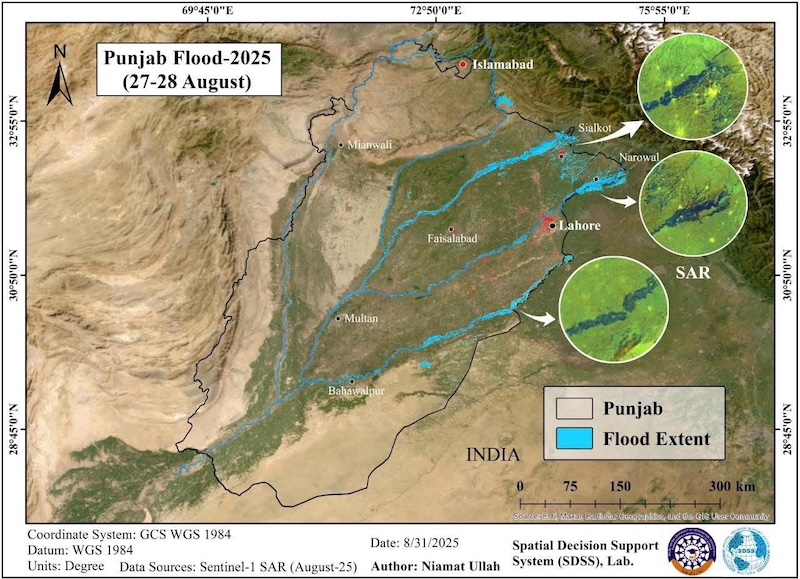
To such an extent that the historic Gurdwara Sri Kartarpur Sahib was inundated for a couple of days. Sikhs had fought for decades to gain access to one of their holiest shrines, just a few km away from the international border.
It is the story of two Panjabs tormented by war and water. Ever since the British, before leaving India, divided them into Indian and Pakistani nationalities, they have lost the meaning of peaceful coexistence. In the meantime, they have managed to learn to move quickly when danger – natural or man-made – comes alive.
For the last six months, life has become extremely difficult and painful for them. Though they have been uprooted several times since the two nations – Pakistan and India – got what they called “independence from the British”, the past six months have wreaked havoc with their lives more than any time before since 1947.
It all started when India and Pakistan went into war, though briefly, and now again when the Monsoon let loose its fury.
Living on the border has never been easy. Denied basic civic amenities, every now and then, they face eviction or evacuation. With limited resources and means of sustenance, they always remain suspect in the eyes of the security forces of either side. Those sitting in the administration far off, making decisions – both political and administrative, without ever bothering about their plight and their survival.
Stop the natural flow of water in rivers, they think, has come to their domain, and they can decide which way rivers flow or how the poor farmers survive with their small land holdings across the fenced borders.
While farmers on the Indian Panjab side are lucky that they have insurance policies – maybe in papers only – both for their crops and their cattle, those in other Panjab have no such support to fight both natural and man-induced disasters.
When division took place, the British divided the territories but were clueless on how to divide the natural bounties, including the rivers. Panjab draws its name from the number of rivers that crisscross its territory. Of the five rivers, Ravi and Sutlej have been sustaining hundreds of thousands of small and marginal farmers across the borders.
Hundreds of Indian – Panjab farmers haplessly watched their milch cattle being swept across the manmade borders by the devastating Ravi and Sutlej waters.
Thousands of acres of agricultural land have been deprived of their nutrients in the floods. From fertile fields, they have become barren pieces of land.
The rivers’ shifting courses and riverine terrain have complicated border demarcations for decades.
This year’s rigorous southwest monsoon has not only left hundreds of people dead in two Panjabs but also caused the deaths of a large number of head of cattle. While in Indian Panjab, farmers rely on mechanised farming, they are also largely dependent upon milch cattle for supplementing the family income. In Pakistan’s Panjab, agriculture is still done by traditional means, where cattle are still largely used in cultivating fields.
Allegations flew free as Pakistan officials accused their Indian counterparts of releasing surplus waters into the Ravi and Sutlej rivers. Though Indian officials denied the allegation, maintaining that Pakistani authorities were informed well in time before the release of overflowing waters into the Pakistani portion of the rivers. Whatever the position, the sufferers are none other than poor people, irrespective of their nationalities.
RELATED STORY:
The Deluge of Despair: When “Natural Disaster” Becomes a Human Tragedy in Panjab (Asia Samachar, 2 Sept 2025)
ASIA SAMACHAR is an online newspaper for Sikhs / Punjabis in Southeast Asia and beyond. You can leave your comments at our website, Facebook, Twitter, and Instagram. We will delete comments we deem offensive or potentially libelous. You can reach us via WhatsApp +6017-335-1399 or email: asia.samachar@gmail.com. For obituary announcements, click here