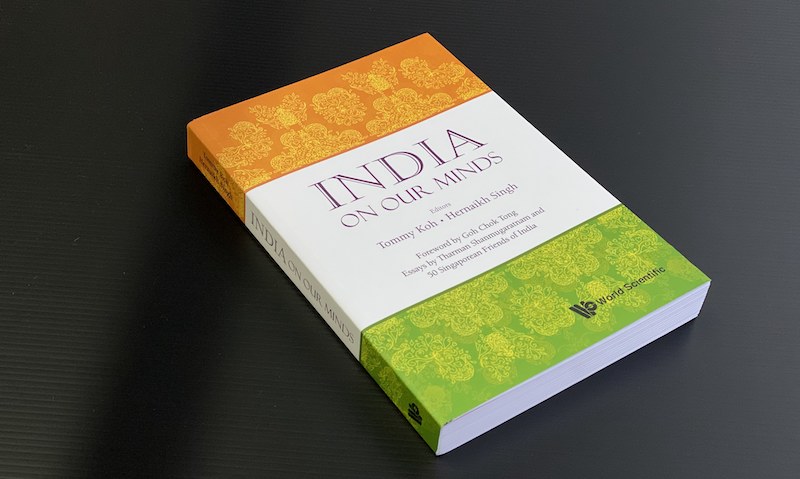
India On Our Minds (Editors: Tommy Koh and Hernaikh Singh) – Photo: Asia Samachar
By Asia Samachar Team | SINGAPORE |
As a trading nation, what happens at large economies like the US, China and India will impact Singapore. So, it is no surprise that Singapore keeps a close watch on what happens in those markets. Hence, newly launched book, ‘India On Our Minds’, is an attestation to that mindset.
“Singapore was an early believer in India’s immense potential,” Prime Minister Lee Hsien Loong said in a speech at the launch of the 362-page book on 7 Dec 2020.
The book, containing 50 articles written by 52 Singaporeans, attempts to capture the past and the present, and a peek into the future.
If you’ve been to India before, you would enjoy Erliana Abdul Rahman’s short musing entitled ‘Red ambassador, Parathas and Other Joys’.
“India changed me. This was where the Gini coefficient was no longer some abstract theory,” she writes. How true. For those who been to India, they can understand clearly when she says that the vast nation of 1.35 billion people is not limited to ‘charity or poverty pornography’, but so much more.
“When I get on a video conference call with my friends during this current lockdown, I am struck bu their resilience and derring-do. Indians have a term for their creative problem-solving skills: jugaad in Hindi, which loosely translates to having a ‘flexible and innovative approach to solving a problem with using limited resources.’ I have not seen a calmer, more creative lot when the situation warrants it.”
The former Singapore political counsellor writes beautifully. She should have captured more of her experience, both as a diplomat from 2011 to 2014, and then a year when she worked with Nobel laurete Kailas Satyarhi.
The book also carries some valuable nuggets in the ‘Joys and sorrows of investing in India’ penned by Sat Pal Khattar. He captured some of the broad issues one may face when taking a plunge to do business in India. After resigning from Singapore inland revenue service in 1974, Khattar floated a law firm which subsequently grew into the republic’s largest law firm in the form of KhattarWong. He was also captain of his private investment firm called Khattar Holdings.
Khattar talks about his involvement in the Radisson Hotel, intellectual property challenge when taking Tiger Balm products to the Indian shore, his ‘most successful’ Indian investment in HDFC Bank and his involvement in Gateway Distriparks Ltd which eventually became the ‘largest and most successful container facility in the private sector in India’.
“We have some success, plenty of frustrations, a fair amount of angst and lots of experience to match. These are an integral part of the joys and sorrows of investing in India.” cautions Khattar who received the Padma Shri award in 2011, making him the first Singaporean to receive the fourth highest Indian civilian award. If one were to have an open and frank sit down with him, you can imagine the wealth of information that one can acquire. For now, the article has captured some bits of them.
Zulkifli Baharuddin, the executive chairman of Indo-Trans Logistics Corporation, makes some comparison between India and China, basing it on his own experience in both the major economies.
“In India, one can only be bowled over by the its promises and presentations which are all too familiar by now. The immediate reality of stretched timelines and cavalier attitudes to the promises and commitments and the myriad of regulatory hurdles soon become a daily pre-occupation of new entrants into the country,” he writes.
Singapore journalist Vikram Khanna also touches on the major global economies in his article ‘Why India’s economies has fallen so far behind China’s’.
‘How Singaporeans perceive Indians’, written by Institute of South Asian Studies (ISAS) in National University of Singapore (NUS) chairman Gopinath Pillai, also jumps out. That would definitely be a question on the mind of many.
The book is edited by Tommy Koh, a Professor of Law at NUS and an ambassador-at-large at Singapore’s foreign ministry, and Hernaikh Singh, a senior associate director at ISAS. Hernaikh is the current president of the Singapore Khalsa Association (SKA).
ASIA SAMACHAR is an online newspaper for Sikhs / Punjabis in Southeast Asia and beyond.Facebook | WhatsApp +6017-335-1399 | Email: editor@asiasamachar.com | Twitter | Instagram | Obituary announcements, click here |
Protesters, including 20-year-old Sumandeep Kaur, are fighting for the repeal of three farming laws in India – Photo: Bhat Burhan / Business Insider Weekly
By Business Insider | INDIA |
Indian farmers are protesting three laws that they fear will threaten their livelihoods and cost lives.
The laws deregulate the buying and selling of agricultural goods, leading farmers to fear they will be exploited by corporations.
India has some of the highest farmer suicide rates in the world, and experts fear the crisis could worsen if the laws are not repealed.
India’s government is in talks with farmers who continue to block road and rail routes across the country.
Across India, farmers are demanding an end to new laws they say are not just threatening their livelihoods, but costing lives.
Protests that erupted in the state of Punjab have spread throughout the country as farmers demand a complete rollback of the three laws that were passed in September. Collectively, the laws deregulate the buying and selling of agricultural goods, leaving farmers exposed to the uncertainties of an open market and potential exploitation by corporations.
Meanwhile, record numbers of farmers in India are committing suicide, and experts fear the farming laws could drive even more people to the brink.
“The new laws that they have passed, we call them death warrants of farmers and laborers,” farmer Kewal Singh of Punjab said.
Agriculture sustains over 40% of the population in India. And as COVID-19 ravaged the country this year, it’s farmers who have kept India’s rural economy afloat.
But the majority of farms are small, family-run operations, often at the mercy of loan sharks.
“This is the kind of farming community which is incredibly vulnerable to all kinds of uncertainties,” said Vikram Patel, a professor at Harvard University’s TH Chan School of Public Health. “Many of these farmers don’t have any surety the banks demand in order to give them loans, so they borrow money from loan sharks, who are of course pretty ruthless. And if you pump your money back, well, they can be pretty dangerous to you or your family.”
Read the full story, India has a farmer suicide epidemic — and farmers are protesting new laws they fear will make things worse (The Business Insider, 8 Jan 2020), here.
ASIA SAMACHAR is an online newspaper for Sikhs / Punjabis in Southeast Asia and beyond.Facebook | WhatsApp +6017-335-1399 | Email: editor@asiasamachar.com | Twitter | Instagram | Obituary announcements, click here |
The farmers protesting against three union laws deemed unfair and unjust to the farming community today (7 Jan) revved up their tractor engines, underlining their determination to get the laws repealed.
The tractor rally on the Kundli-Manesar-Palwal (KMP) expressway was also a show force on the part of the farmers’ unions who have dug their feet at Delhi border entry points, determined not to leave until the repeal of the laws and enshrining into law minimum support price (MSP) mechanism.
Bharatiya Kisan Union leader Rakesh Tikait said the government can try as much as it can, but the farmers will not go back home till the three acts are repealed.
“The government has time till tomorrow. It can make a law on MSP and take back the three laws…Today’s tractor march was a trailer, the entire movie will be shown on January 26,” he was quoted in a report today in The Tribune.
Republic Day, a national holiday on Jan 26, honours the date on which the Constitution of India came into effect.
Swaraj India founder Yogendra Yadav, one of the active union leaders involved in the on-going protest which entered into 42nd day, said: “Centre is trying to divert media attention from #TractorMarchDelhi by playing silly games. Our demands are repeal and we are against any efforts to divide states by projecting the problem as problem of one state.”
Punjab Kisan Union president Ruldu Singh Mansa said nothing less than the repeal of three laws will be accepted by unions, adding that the central government led by Prime Minister Narendra Modi wanting to give states power to decide on state’s subject was in itself a mockery of constitutional framework.
ASIA SAMACHAR is an online newspaper for Sikhs / Punjabis in Southeast Asia and beyond.Facebook | WhatsApp +6017-335-1399 | Email: editor@asiasamachar.com | Twitter | Instagram | Obituary announcements, click here |
Path da Bhog & Antim Ardaas: 10am-12noon, 10 January 2021 (Sunday), at Gurdwara Sahib Bidor, Perak and thereafter followed by Guru Ka Langar.
The family would like to thank everyone for their prayers and loving support rendered during the bereavement.
Contact:
011-29532323 (Sokuan)
016-9018926 (Geswant)
| Entry: 7 Jan 2021 | Source: Family
ASIA SAMACHAR is an online newspaper for Sikhs / Punjabis in Southeast Asia and beyond.Facebook | WhatsApp +6017-335-1399 | Email: editor@asiasamachar.com | Twitter | Instagram | Obituary announcements, click here |
Franchise owners of a burger and beans coffee have set up stalls at the Tikri border, one of the Delhi entry points where thousands of farmers have gathered to protest against three controversial farm laws.
Franchise owners of Burger Singh have set up vegetable burger langar while coffee chain Sardar-Ji-Bakhsh has set up imported beans coffee stall for the protesting farmers who are now also battling the rain and cold weather.
The protests entered the 42nd day on the Delhi borders and 106th day elsewhere in Panjab.
Singh Burger is one of the fastest growing quick service restaurants (QSR) brands of Indian origin with a presence in New Delhi, Gurgaon, Maharashtra, Dehradun and Noida. Sardar-Ji-Bakhsh which started from a single cart in 2016 today has more than two dozen outlets in Delhi.
ASIA SAMACHAR is an online newspaper for Sikhs / Punjabis in Southeast Asia and beyond.Facebook | WhatsApp +6017-335-1399 | Email: editor@asiasamachar.com | Twitter | Instagram | Obituary announcements, click here |
An Indian agency handling meat export had dropped the mention of ‘halal’ in a manual possibly due to pressure from predominantly right-wing Hindu groups and some lesser known Sikh organisations.
The Agricultural and Processed Food Products Export Development Authority (APEDA) is reported to have removed the word from its ‘Red Meat Manual’ amidst a social media campaign by Hindu right-wing groups and Sikh organisations, according to Indian media reports.
In a twitter response on 20 Dec 2020, APEDA said: “There is no condition by Govt. of India that only Halal Meat to be exported. It is requirement of majority of importing countries/Importers. Halal Certification agencies are accredited directly by respective importing countries. No Govt agency has any role in this.”
The twitter entry had also linked readers to the third edition of ‘Indian Meat Industry Red Meat manual’.
The APEDA manual had earlier stated that “animals are slaughtered strictly according to halal method to meet the requirement of Islamic countries”, but now says “the animals are slaughtered according to the requirement of importing country/importer”, reports Indian Express.
It said the manual has also deleted these lines: “The animals are slaughtered by halal system under strict vigilance of (a) recognised and registered Islamic body as per the tenets of Islamic Shariyat. The certificate for halal is issued by the representative of registered Islamic body under whose supervision the slaughter is conducted in order to meet the requirement of (the) importing country.”
The newspaper report quoted unnamed sources as saying that the change was made as the use of word halal in the old manual gave the impression that this was mandatory for all meat exports.
The halal requirement is, for example, mentioned in a letter entitled ‘Advisory for exports of food items to Dubai’ dated 18 Jan 2019 and signed by APEDA GM UK Vats, sighted by Asia Samacar at the agency’s website. The letter noted that for meat, poultry and its products, UAE requires, among others, a halal certification issued by an approved halal organisation.
The latest edition of the red meat manual said India is successfully exporting buffalo meat to more than 70 countries, with major markets being Vietnam, Malaysia, Egypt, Iraq, Saudi Arabia, Philippines, Indonesia, UAE, Algeria, and Russia.
During 2018-19, India exported 1.24 million MT of buffalo meat products worth of US$3.61 billion. Malaysia imported buffalo meat products worth about US$370 annually for 2017-18 and 2018-19 period.
ASIA SAMACHAR is an online newspaper for Sikhs / Punjabis in Southeast Asia and beyond.Facebook | WhatsApp +6017-335-1399 | Email: editor@asiasamachar.com | Twitter | Instagram | Obituary announcements, click here |
In 1926, following an alleged attempt on his life, Italian fascist leader Benito Mussolini decided to erase even the semblance of democracy in Italy by banning all opposition parties and launching a campaign of arrests throughout the country.
Among those arrested was a 33-year-old leftist MP and thinker, Antonio Gramsci. At his trial, a famous demand was made by the official prosecutor to the judge that “We must stop this brain working for twenty years!” Though his subsequent imprisonment took its toll on his physical body, his jailers did not succeed in stopping his brain from working and Gramsci was able to smuggle out many notes to the people, which were later published in his famous book Prison Notebooks.
What Gramsci reminded us of was the power of critical thinking and the threat that this poses to fascists who trade in fear and lies. If we fast forward 100 years, Ram Guha draws revealing parallels between Italy of the 1920s and India of the 2020s. He suggests, Mussolini, like Modi, are mythical figures, crafted by writers and propagandists.
The created myth is “of the Duce, the chief who is always right, the leader who dares where others vacillate”. Like the vast crowds in the 1920’s that greeted Mussolini’s every reference to glory and patriotism with chants of ‘Du-ce! Du-ce! Du-ce!’”, today we see in Modi’s rule, especially after he won a second term in 2019, his every utterance greeted with “Mo-di! Mo-di! Mo-di!”.
The good news is that Modi and the Rashtriya Swayamsevak Sangh (RSS) may just have met their match in the form of the India Farmers movement, inspired by great Punjabi revolutionaries and thinkers, too numerous to mention here. Though Modi’s propaganda machine has sought to undermine the movement by arguing that the farmers are ill-educated sheep being led by the enemies of the state, the truth is that our brains have never been more productive.
It is the critical thinking and acting of the farmers that is raising the consciousness of vast numbers of Indian’s who had become entrapped by Modi’s nationalist rhetoric of making India great. They now realise they are unlikely to benefit from Modi’s cocktail of Hindutva nationalism, fascism, and neoliberalism, and the only beneficiaries will be a small elite, just like in the times of British Colonialism.
And following Gramsci, who used scraps of paper to write his notes, which were smuggled out of prison, today, we can all follow his example by utilising social media to express our opposition to Modi’s fascism and the politics of hate and greed. We can all become citizen journalists and public intellectuals to educate each other about the evils of this present reigime. But in doing so we must avoid being a mirror image of Modi’s hate campaign. And therefore, if as Gramsci argued, ‘to tell the truth is revolutionary’, our role should be to focus on facts, fairness, freedom, and fraternalism.
Perhaps one of Gramsci’s most profound observations was to proclaim ALL human beings as philosophers, that they have a brain, and that the capacity to think and question is not restricted to those with titles, status or academic qualifications. And when ordinary people raise their voice against injustice, they begin to claim their natural intelligence, and revolutionary possibilities of a new type of society begin to be realised.
[Gurnam Singh is an academic activist dedicated to human rights, liberty, equality, social and environmental justice. He is an Associate Professor of Sociology at University of Warwick, UK. He can be contacted at Gurnam.singh.1@warwick.ac.uk]
* This is the opinion of the writer and does not necessarily represent the views of Asia Samachar.
ASIA SAMACHAR is an online newspaper for Sikhs / Punjabis in Southeast Asia and beyond.Facebook | WhatsApp +6017-335-1399 | Email: editor@asiasamachar.com | Twitter | Instagram | Obituary announcements, click here |
In my earlier article I touched on unseen food waste/loss and the resources that are consumed and wasted when such food waste/loss occurs. I can safely say that all the produce and/or products that we consume come from a farm, or at least some component of it comes from a farm. Even a bottle of carbonated drink has sugar in it and this sugar was at some stage sugarcane in a plantation.
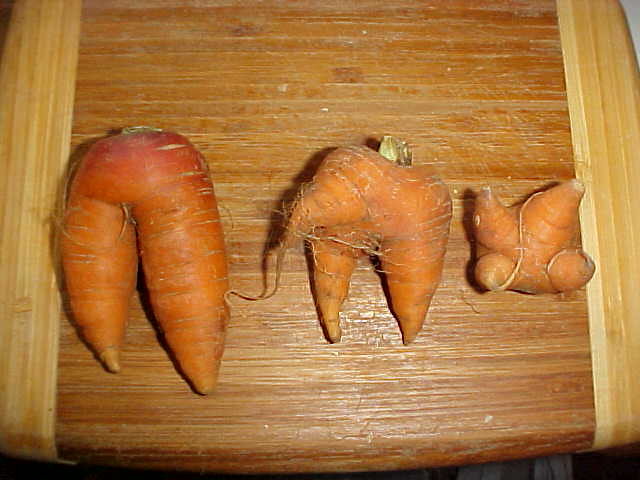
Does food loss occur at farms? For those of us that have experience growing our own fruits and vegetables we would have surely experienced “funny” or misshaped fruits and vegetables. Slightly blemished or bruised fruits and vegetables are also common. Yes, there are carrots that grow to have two or three “legs”, odd-shaped potatoes, double apples and many more misshaped vegetables and fruits. Lightly-bruised fruits and vegetables with some leaves torn or some black spots or too many “eyes” are part and parcel of what is produced at a farm. As home growers, we usually do not worry much about these vegetables and fruits as long as they are consumable.
At the onset, bruised and blemished fruits and vegetables are discarded or used as livestock feed at farms for fear that they may become rotten, or their quality may deteriorate during the transportation period thus causing other fruits and vegetables to turn bad. On the other hand, do we see misshaped fruits and vegetables at our markets, hypermarkets and supermarkets? The obvious answer is, NO! Have we wondered, why?
The answer is, these vegetables and fruits do not pass the stringent aesthetic tests that all retailers impose based on the look, size, colour and other criteria. What happens to these fruits and vegetables? Most of them are discarded at the farm itself and some end up as livestock feed. Imagine the amount of produce wasted. What about wasted resources? One can calculate the amount of resources that it took to grow these. Water, land, labour, fertilizers, pesticides, transportation, fuel and other intangible resources. All these resources are wasted all in the name of “eating with our eyes”. Is this sustainable farming? Is this responsible consumption and production?
One third of all the food that is produced yearly for human consumption, which is approximately 1.3 billion tonnes, ends up as food loss before it even reaches the consumer’s dining table.
What is the impact of this food loss? Is it just financial? What is its effect on our earth? Such non- sustainable farming has a devastating effect on the environment. Water, already a scarce resource in some parts of the world, is wasted; wasteful use of chemicals such as fertilizers and pesticides; fuel used for transportation is wasted and it creates more rotting food in our landfills which in turn creates more methane – one of the most harmful greenhouse gases that contributes to climate change.
Movements such as Wonky Vegetables in UK and France’s third largest supermarket chain Intermarche “Inglorious Fruits and Vegetables” campaign is leading the way to address this food loss. Most other supermarket and hypermarket chains in Europe and in the US have already incorporated the sale of misshaped fruits and vegetables.
Let’s look at Asia, specifically Malaysia. Do we see misshaped fruits and vegetables at our markets, hypermarkets and supermarkets? At least I have not seen any.
Would it not be a good initiative for the farmers to sell these off cheaper to the wholesalers or to some of the hypermarket/supermarket chains that purchase directly from the farmers and hence these can be sold at a certain percentage cheaper to the consumer? What would the effect be on the farmers? Some farmers might think that this will then also push down the price of the so called “normal” fruits and vegetables. How is this so? I have spoken to some farmers in Rawang, Kuang and Kundang, and they said that the wholesalers will say that the cost to produce both “normal” and misshaped vegetables and fruits is the same and if the latter can be sold at a cheaper price then so can the former, and thus, their fear is a drop in their income due to unscrupulous middlemen. Hence, some of them said that the odd-shaped fruits end up as livestock feed, some are thrown away only to end up at the landfills, and some are ploughed back into the land.
Alternatively, a large scale farmer that targets to produce thirty tonnes of tomatoes per week would surely need to grow extra to compensate for the odd shaped ones that will be rejected. What is the percentage of these unwanted misshaped, damaged and blemished ones? What would happen to this misshaped ones? Livestock feed? Landfills? Ploughed back into the soil? What amounts of resources such as water, land, fertilizer, pesticides, fuel, energy both from diesel and human labour are wasted for this? Can these be
recovered? No!
Would it not benefit farmers all over the world if these misfits are both, purchased and sold, at a cheaper price? Would it not reduce the total amount of waste in the entire production chain? Would it not allow the farmer to plan the crop production and resource management more accurately without having to compensate for the odd-shaped ones?
I have seen studies by Malaysian Agricultural Research and Development Institute (MARDI), Federal Agricultural Marketing Authority (FAMA) and research papers on the amount of output of produce be it fruits, vegetables, livestock, crops, paddy, coffee, oil palm fruit and the list goes on. I have searched high and low for studies and /or research papers that specifically look into the amount of slightly blemished, slightly bruised and or odd-shaped fruits and vegetables that are discarded per year in Malaysia based on a sizable sample size of farms and the effects of this on economy and the environment, but could not find any. Maybe, I could be looking up the wrong tree. A good topic to do a doctorate research paper on, I wonder especially why not look at the sustainability and food security aspect?
On the other hand, for the purpose of making sauces, jams, juices, pickle, ketchup, and canning, I see no reason why these odd-shaped fruits and vegetables cannot be used. Are the food manufacturers, who produce the above, purchasing these misshaped fruits and vegetables and using them in their product?
Some basic research, which I have done, indicates that most food manufacturers who produce the above items, get their feedstock in semi-processed forms such as pulps, cut fruit or vegetable slices packed in huge containers to be further processed, raw juices for further processing, hence, they do not know if the odd-shaped fruits and vegetables are processed or discarded. Some manufacturers stated that they have stringent controls within their juicing and sauce plants. Feedstock that meets these stringent standards will be processed while those that do not will be discarded. Do these standards include odd-shaped and slightly bruised fruits and vegetables – was a question posed but no clear answer received.
We, the human race, discard approximately 1.3 billion tonnes of food produce a year. An alarming figure, indeed, and how many hungry stomachs can this produce feed? The answers are all on the internet. Imagine the associated resources that are loss. What we, endless consumers of this earth, need is a mechanism or a solution to channel some of this produce to those who really need it instead of it going to waste. We do see some efforts taken in Europe but what we need is a push from ground up, especially, in Malaysia where we have abundance of resources and the culture of wasting food is alarming.
Last week, I received two huge sacks at our composting collection site. Upon opening them, both were filled with fruit pulp and upon emptying the second sack onto the compost heap, I saw about ten to fifteen guava fruits, which were slightly brown on the top. However, upon closer examination of two to three fruits, only the skin had oxidised and the fruit was still firm and suitable for consumption. Sadly, these fruits were already on the compost pile and exposed to the microbes and fungi, hence, nothing could be done. This is an example of how we waste.
How do we inculcate the habit of consumers, especially in Malaysia, to not be bias towards purchasing odd-shaped and slightly blemished or bruised fruits and vegetables? Is it only when the above awareness is widespread will the retailers respond accordingly? Or is it when there is a supply of such produce on the shelves at cheaper prices or with additional points attached to their purchase or some sort of “carrot” factor will the Malaysian consumer change their preference?
I do not have the answers, but, I would like readers to share your thoughts as to how we can influence the food chain, be it the farmers, wholesalers, wet markets, hypermarkets, supermarkets – to incorporate these “misfits” into the food chain to reduce waste to ensure sustainable and responsible consumption and production.
Jespal Singh Sidhu, a real estate negotiator and an avid gardener, produces compost on a commercial scale for farms, fruit orchards and home gardening enthusiasts. He is also a certified HRDF trainer and conducts trainings and seminars on sustainability, waste management, separation at source organic waste management and environmental related topics. He is available to guide Gurdwaras to reduce carbon footprint in line with the SDG agenda. He can be contacted at compost.sprout@gmail.com
ASIA SAMACHAR is an online newspaper for Sikhs / Punjabis in Southeast Asia and beyond.Facebook | WhatsApp +6017-335-1399 | Email: editor@asiasamachar.com | Twitter | Instagram | Obituary announcements, click here |
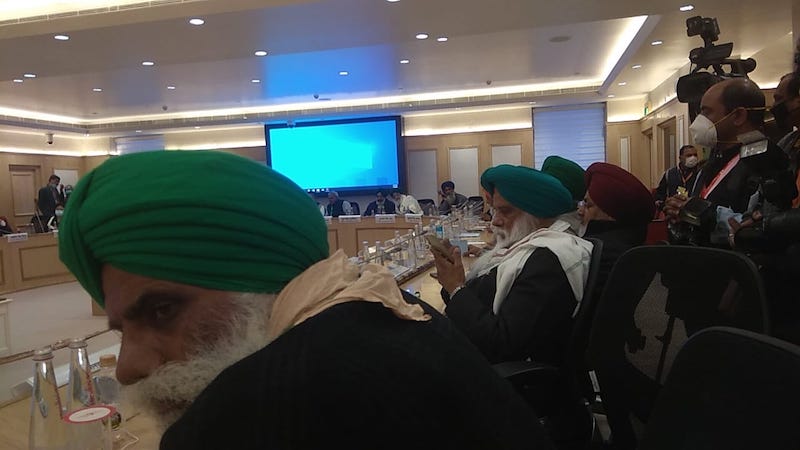
Farmers-ministers meeting on 4 Jan 2021 – Source: Farmers’ leaders
By Asia Samachar Team | INDIA |
The latest round of meeting between farmers’ unions and Indian federal government minister ended inconclusively today (4 Jan 2020) as the latter refused to withdraw the three controversial farm bills.
The next meeting has been scheduled for Friday (8 Jan), but the farmers’ union will possibly huddle tomorrow to decide if they will attend.
The unions made it clear that the government has to come up with modalities to repeal the three laws rammed through Parliament in September 2020 to allow for any meaningful negotiation.
In today’s meeting, the government side wanted to discuss a law for minimum support price (MSP), one of the demands of the farmers, but the farmer representatives declined as they wanted to discuss first repealing the three laws.
“Farmers spoke only about repeal. Government said they will consult further and get back. The next meeting on January 8,” said union leaders in the meeting, reported The Tribune.
In one report, BKU leader Rakesh Tikait was reported to have said: “Union ministers are saying the same thing again and again. We will hold a meeting tomorrow to decide our course . We will not go home, till the time the laws are repealed.”
The farmers’ protest at a number of entry points to Delhi will now enter into the 40th day. Hundreds of thousands of farmers have converged at at borders points at Shahjahanpur, Palwal, Tikri, Ghazipur and Singhu, all of which have seen an increased Rapid Action Force (RAF) deployment.
While a huge number of farmers are already present at the outskirts of Delhi, the authorities have tried to stop more farmers from advancing to the nation’s capital.
It has been reported that at least 110 tear gas shells were fired on farmers last night at Delhi-Jaipur highway, injuring farmers who were rushed to nearest hospitals.
ASIA SAMACHAR is an online newspaper for Sikhs / Punjabis in Southeast Asia and beyond.Facebook | WhatsApp +6017-335-1399 | Email: editor@asiasamachar.com | Twitter | Instagram | Obituary announcements, click here |
A Panjab farmer talking to his grandchild from the Delhi border in mid-December 2020. He has joined hundreds of thousands fellow farmers and supporters in protest against three farm laws. – Photo: Akshay Kapoor
By Gurmukh Singh | OPINION |
“2021 is going to be a pivotal year for the farmers of India. Every Sikh should stand by them in every possible way as Guru Tegh Bahadur would expect us to.” (Dya Singh of Australia, New Year message)
The way of life of a people is not negotiable. Indian farm laws rushed through the Parliament cannot be negotiated. It will be necessary to repeal them as a pre-condition to a fresh start.
It is true that agriculture in Panjab, Haryana and other states is in need of overdue reforms. A revision of farm produce procurement policies can provide minimum support price (MSP) security for the farmers while introducing diversity of crops to meet market demands. Such reforms will also safeguard the environment and raise ground water level.
In addition, there is need to attract clean industries and opportunities for employment in Panjab. Major educational reforms are needed to raise standards and make education relevant to the skills needed in different fields, including IT and advance technologies and services. Next generations with the right aptitudes and skills should move away from agriculture to other fields of employment.
Ideally, this can be a structured tripartite approach around one table involving the farmers, state and federal governments, and the business community. Such a process should be well supported by specialist advisors. It can be widened to other sectors where trade and economies are linked – and mostly they are linked and inter-dependent.
Panjab and the surrounding states have the resources to bring about major changes through such an approach which safeguards farmers interests and way of life through minimum support prices and watchdog bodies with regulatory powers.
Such mechanisms are not new and have been tried in other countries. My own experience is with a similar set-up in the UK some decades ago: the National Economic Development Office brought the unions, the employers (representing trade and industry) and the government departments together at national and sector levels. The system worked very well until PM Margaret Thatcher succeeded in weakening the unions to let market forces take over. Regrettably, market forces alone are unlikely to work in a country like India for reasons which would be best discussed elsewhere.
The plight of the Panjab farmers, now joined by farmers from all over India, has also become a diaspora Indian and Sikh issue. There is an emotional attachment to the farmers campaigning to defend their independent way of life. The diaspora view expressed by Dya Singh of Australia is that these are our brothers and sisters fighting a powerful federal establishment, which, together with state governments, seems to be unconcerned about their future.
From Panjab, these are food growers and border defenders. Without a well thought out and structured approach with assured safeguards, the farm laws can lead to their enslavement by the powerful corporations. To quote a statement by All India Kisan Sangharsh Coordination Committee, “The new laws will hand over control of agriculture markets, farmers’; land and food chain to corporates.”
Yet, the role of the corporations in the development of sectors of the national and state economies, including agriculture, cannot be underrated. Only they can create diverse opportunities for development and employment and encourage the type of education needed to provide the necessary skills.
As for diaspora concern, I conclude with a quote from Dya Singh’s New Year message, “At the end of the year [2020] these developments made me feel that I was involved too, alongside every Sikh in the diaspora and every rational thinking Indian. How can India attempt to subjugate the farmer who puts food on the table of every Indian? The 400 Birth anniversary of Guru Tegh Bahadur reminds us that Guru Ji gave his life for Hindustan. The farmers are fighting for Hindustan. Parallels can be drawn, and I am involved whether I like it or not.”
True, although, we are always told by Sikh Indians to mind our own business and not cause problems for them, there are issues when we cannot look the other way. Let us hope sense prevails.
Gurmukh Singh OBE, a retired UK senior civil servant, chairs the Advisory Board of The Sikh Missionary Society UK. Email: sewauk2005@yahoo.co.uk. Click here for more details on the author.
* This is the opinion of the writer, organisation or publication and does not necessarily represent the views of Asia Samachar.
ASIA SAMACHAR is an online newspaper for Sikhs / Punjabis in Southeast Asia and beyond.Facebook | WhatsApp +6017-335-1399 | Email: editor@asiasamachar.com | Twitter | Instagram | Obituary announcements, click here |