
















UA-56202873-1
Page 434

India’s top court suspends India’s controversial farm laws, appoints committee to get ‘clearer picture’

0
By Asia Samachar Team | INDIA |

India’s top court has muscled in for what is being seen as an attempt to break the impasse between the farmers’ unions and government in the on-going massive protests against three controversial farm laws ramped through the Parliament four months ago.

In a move today, the Supreme Court (SC) has put on hold the implementation of three laws, deemed by some quarters as a setback for Prime Minister Narendra Modi’s administration.

Others, however, are suspicious with the judiciary, suspecting that it could be to break the momentum gained by the protesting farmers who are present on major highway entry points to Delhi for nearly two months now.

A three-judge bench headed by India’s chief justice Sharad A Bobde also announced the formation of a panel to facilitate talks with the protesting farmers staging. They will resume hearing on the issue on Monday.

“We are looking to solve the problem. If you want to agitate indefinitely, you can. Every person who is genuinely interested in solving the problem is expected to go before the Committee. The Committee will not punish you or pass any orders. It will submit a report to us. We are going to take the opinion of the organisations. We are forming the Committee so that we have a clearer picture,” the CJI said, as quoted by media reports.

The order, an attempt to find a way out of the stalemate between the government and protesters, comes a day after the Chief Justice Bobde said the court was “extremely disappointed at the way the government has handled all this”, reports Bloomberg. Several rounds of talks with leaders representing farmers have failed even as over 60 farmers are reported to have lost their lives braving cold weather.

The court refused to give more time to the government to find a solution and said the panel will hold discussion with both the parties. It will submit a report to the court, the bench said without specifying a deadline.

The government maintains that the farmers are being misled and the new laws that lift curbs on who can purchase agricultural produce will remove middlemen and increase farmers income. Modi had in his first term promised to double farmers’ incomes by 2022, the report added.

Sanyukt Kisan Morcha, an umbrella body of around 40 protesting farmer unions, has welcome the SC move but reiterated that they would stay the course of the protest until the legislations are repealed.

“It was an eye wash and farmers unions were right in distancing themselves from it. About 4 members, the less we say better it is. All are government lackeys,” said Amaan Singh Bali, an activist who has been providing running updates via Twitter on the protests.

The four persons named to the SC-appointed committee are Bharatiya Kisan Union national president Bhupinder Singh Mann, Pramod Kumar Joshi (Director South Asia international Food Policy), agricultural economist Ashok Gulati and Shetkari Sanghatana leader Anil Ghanwat.

The three laws under discussion are the Farmers (Empowerment and Protection) Agreement on Price Assurance and Farm Services Act, 2020; Farmers’ Produce Trade and Commerce (Promotion and Facilitation) Act, 2020; and, Ess­en­tial Commodities (Amendment) Act, 2020.


RELATED STORY:

BJP’s farming policies: Deepening India’s agrobusiness capitalism and centralisation (Asia Samachar, 18 Oct 2020)


ASIA SAMACHAR is an online newspaper for Sikhs / Punjabis in Southeast Asia and beyond. Facebook | WhatsApp +6017-335-1399 | Email: editor@asiasamachar.com | Twitter | Instagram | Obituary announcements, click here |

Sketch captures beauty of Penang’s oldest gurdwara

0
????? ???????? ????? Penang – Sketch by ???? ?????? ???
By Asia Samachar Team | MALAYSIA |

The oldest gurdwara structure in Penang has been captured in a sketch by Penang artist Khoo Cheng Jin.

Founded in 1901, it was first named Diamond Jubilee Sikh Temple to commemorate the Diamond Jubilee of Queen Victoria of Britain. Upon completion, it was the biggest gurdwara in Malaya as well as South East Asia.

Located at No.87, Jalan Gurdwara, formerly known as Brick Kiln Road, Penang, the gurdwara structure is a beautiful strikingmixture of Moorish and modern architectural design.

It was on 3rd June 1901 that Colonel Walker of the Malay States Guides laid the foundation of the Gurdwara, Penang. The Straits Settlement Government of Penang, in commemoration of the Diamond Jubilee of Queen Victoria of Britain, granted the land on which it is built. The foundation stone can be seen in the corner of the building near the “Nishan Sahib” (flagpole).

Not many people know that this historic Gurdwara is one of the three sites in Penang, which commemorate the diamond jubilee of Queen Victoria. The other two being the clock tower near Fort Cornwallis and the Victoria Green Field of the Chinese Recreation Club in Burma Road. In the corner of the field is a statue of Queen Victoria.

The Sikh Gurdwara, Penang, was also known as the Malaya Tapuan Da Gurdwara (Malayan Territories Gurdwara) and was for many decades a central meeting place for all northern Indians in Siam, Sumatra, Borneo, Hong Kong and Shanghai. Penang was the major transit port for people traveling to and from India and regions of South East Asia. As the travelers faced difficulties in finding a place to stay, the need for a Gurdwara was urgently felt.

The three other gurdwaras on the Penang island are Gurdwara Sahib Bayan Baru, Gurdwara Sahib Khalsa Dharam Jatha and Gurdwara Sahib Police. Gurdwara Sahib Buttwerworth is the other Penang gudwara, located on the mainland of Peninsular Malaysia.

????? ???????? ????? Penang – Sketch by ???? ?????? ???
????? ???????? ????? Penang – Photo: Source to be identified
RELATED STORY:

First Gurmukhi road signage for Malaysia (Asia Samachar, 5 May 2020)

Superb kickstart to Penang gurdwara conservation and restoration fundraising (Asia Samachar, 24 Feb 2019)


ASIA SAMACHAR is an online newspaper for Sikhs / Punjabis in Southeast Asia and beyond. Facebook | WhatsApp +6017-335-1399 | Email: editor@asiasamachar.com | Twitter | Instagram | Obituary announcements, click here |

Reliance seals Karnataka rice deal, to pay above MSP – Report

0
Paddy field – Photo: Manish Chack
By Asia Samachar Team | INDIA |

One of the first sizeable transactions for between a large corporate entity and farmers took place in Karnatak for a deal to purchase 1,000 quintals of Sona Masoori paddy from the farmers of Sindhanur taluk in Raichur district.

The deal involving Reliance Retail Ltd comes after the amendment to the APMC Act in Karnataka, reports TNN.

It also comes at a time when hundreds of thousands of farmers have converged at a number of highway entry points to Delhi, protesting against the three farm laws rushed through parliament in September 2020 by the BJP-led government.

Around a fortnight ago, agents registered with Reliance signed an agreement with Swasthya Farmers Producing Company (SFPC). Though SFPC primarily trades in oil, the firm now has ventured into procurement and sale of paddy; close to 1,100 paddy farmers have registered with it. Reliance Retail stipulated that there should be less than 16% moisture in the crop. Moreover, the company is offering Rs 1,950 per quintal of Sona Masoori, which is Rs 82 more than the minimum support price (MSP) for the crop set by the government (Rs 1,868), according to the report.

It added that the understanding between SFPC and the farmers entitles the former to a 1.5% commission for every Rs 100 transaction. The farmers have to bear the expenses of the sacks used to pack the crop and transporting it to the warehouse in Sindhanur.

SFPC MD Mallikarjun Valkaldinni said that the quality of the paddy currently stored at the warehouse will be tested by a third party, the report added.

The report quoted Karnataka Rajya Raitha Sangha and Hasiru Sense president Chamarasa Malipatil as saying corporate entities would entice the farmers by offering more than the MSP initially, which would deal a severe blow to the APMC mandis.

“But later, corporate companies will start exploiting the farmers. We must be wary of such tactics,” he said.


RELATED STORY:

Huge tractor rally ahead of 8th round of government-farmers talks tomorrow (Asia Samachar, 7 Jan 2021)

BJP’s farming policies: Deepening India’s agrobusiness capitalism and centralisation (Asia Samachar, 18 Oct 2020)


ASIA SAMACHAR is an online newspaper for Sikhs / Punjabis in Southeast Asia and beyond. Facebook | WhatsApp +6017-335-1399 | Email: editor@asiasamachar.com | Twitter | Instagram | Obituary announcements, click here |

Respected Malaysian community worker Lady Joe passes away

2
Ajaib Kaur @ Lady Joe
By Asia Samachar Team | MALAYSIA |

Ajaib Kaur, the ever smiling and ever willing community volunteer fondly known as Lady Jo, passed away today (Jan 11). She was 77.

She lost her husband at the age of 34 in a car accident in Kota Baru, Kelantan, where they were living then. And she had four young children.

But that did not stop her from marshalling forward in life for herself, her children, her family and the wider community around her.

She has rendered assistance to many in various ways.

“She lived a wonderful life,” her brother Heera Singh told Asia Samachar in a short message when contacted.

“I knew both Lady Joe and her husband Kirpal Singh from Kuantan and Kelantan days,” writes Autar Singh, the former secretary general of the Coalition of Malaysian Sikh Organisations (CMSO), in a social media entry. “Her illustrious contributions in all your lives as well as in the lives of many in the society are par excellence. I personally had a close link with her and will miss her. She lived her life to the fullest.

Ajaib was a boarding school mistress in Melaka before she got married at the age of 20, according to a report in a local newspaper.

She was a Jabatan Hal Ehwal Wanita (Hawa) chairperson for 11 years, a former committee member with Pusat Serenti Drug Rehabilitation Centre and currently, a marriage counsellor with the National Registration Department. On top of that, she was also one of the founders and directors of a daycare centre for differently abled persons in Tampin, said the report.

Fondly known as Lady Jo, or Kak Jo, among the community in Tampin, Negeri Sembilan, it noted that Ajaib was also appointed Justice of the Peace in 2009. In 1995, she was named Mother of the Year, along with four other women, by an English daily. Ajaib was appointed Justice of Peace in 2009.

Ajaib was the eldest of 10 siblings ‑ five girls and five boys ‑ who all grew up in Malacca.

Her remains were cremated in Kuala Lumpur today.


RELATED STORY:

The story of a Malaysian Sikh family (Asia Samachar, 17 Sept 2017)


ASIA SAMACHAR is an online newspaper for Sikhs / Punjabis in Southeast Asia and beyond. Facebook | WhatsApp +6017-335-1399 | Email: editor@asiasamachar.com | Twitter | Instagram | Obituary announcements, click here |

Panjabi classes back in swing for Singapore students

0
SSEF Panjabi classes kick start on 9 Jan 2021 – Photo: SSEF
By Asia Samachar Team | SINGAPORE |

The teaching of Panjabi language is back in swing. Singapore students learning the language made their way to the Whitley Secondary School yesterday (10 Jan 2021) for the first day of the Panjabi school.

They were welcomed by Singapore Sikh Education Foundation (SSEF) teachers and parent volunteers.

Parents of Primary 1 students were given an overview of the Panjabi language programme by the centre principal followed by a discussion with parent volunteers on the possibilities for 2021. Staggered recesses and dismissal timings ensured that the necessary safe distancing measures were put in place, according to an update at SSEF Facebook page.

SSEF is a self-help group in Singapore providing Punjabi Language education for students from Kindergarten to A Levels.


RELATED STORY:

Singapore: Punjabi Language learning goes despite Covid-19 school closure (Asia Samachar, 11 April 2020)


ASIA SAMACHAR is an online newspaper for Sikhs / Punjabis in Southeast Asia and beyond. Facebook | WhatsApp +6017-335-1399 | Email: editor@asiasamachar.com | Twitter | Instagram | Obituary announcements, click here |

The dangerous rise of fascism in India

1
By Gurnam Singh | OPINION |

Recently I wrote a short article, entitled Power of critical thinking, comparing the current Indian Bharatiya Janata Party (BJP) Prime Minister Narendra Modi with the Italian fascist leader Benito Mussolini.

In the piece, I pointed out the importance of becoming educated about the dangerous direction of travel for Indians and that the farmers movement was not just about the unjust farming ordinances, but on a deeper level, the anti-democratic behavior of the Modi government.

If we see the behavior of Modi’s Rashtriya Swayamsevak Sangh (RSS) backed government, the media manipulation, the deployment of agent provocateurs, the mobilisation of the police and paramilitary forces against innocent protestors, and the free-range given to RSS thuggish vigil anti groups, one can see uncanny resemblances between the 1930’s Europe and India of today.

Modi’s supporters like to romanticise about his humble beginnings as a tea boy. But one’s previous life, however humble, is no guarantor of where one might end up. Mussolini began his professional life as a left-wing journalist and socialist, but then went onto proclaim that he was ‘tired of liberty’. He then began organising a group called fasci di combattimento, a paramilitary group known for wearing black shirts who we were given free rein to wage campaigns of terrorism and intimidation against leftist institutions at his behest.

India’s long tradition of social stratification based on a toxic cocktail of race, class, and gender discrimination (the caste system) coupled with a very large Hindu majority, we have the perfect conditions for the appeal of majoritarianism and Fascism; especially so in times of crisis. And in Hindu historical texts, such as the Manusmriti or Book of Manu, which describes a hierarchy of humanity in the world, we even have theological unpinning of what is a cruel ideology. Top of the tree is a Brahmin elite caste/class that, despite constituting less than 15% of the population, is divinely ordained to rule. And so with this ideological backdrop, we have the perfect rationalisation that BJP / Hindiuva / RSS fascists require.

Within the next few days or weeks, we may well get a settlement between the framers, but I feel like this remedy will be nothing more than a sticking plaster over a gaping wound. What I fear is we may end up with a pain killer or steroid injection masking a much deeper crisis, which is the spectre of fascism in India.

And so, with a series of short pieces, over the next few weeks, I am hoping to broaden out the debate to focus on the death of democracy, liberty, and autonomy in India and the rise of RSS Hindutva fascism.

I will be drawing on both historical sources and also contemporary writings from people such as Arundhati Roy who recently published a book of essays entitled ‘Azadi‘, where, taking the rise of Hindutva in India, she challenges us to reflect on the meaning of freedom in a world of growing authoritarianism.

I feel for too long Sikh activism has been emasculated to the realms of formal religious beliefs and practices, and it is important to claim our deeper legacy of fighting racism, fascism, imperialism, and all kinds of injustices. Indeed, where our religious organisations and institutions have failed to provide the leadership that our Gurus inspired, the farmer’s unions have. And I have to regrettably acknowledge that today Guru Nanak is not to be found in temples, gurdwaras, mosques, or churches but on the motorways encircling Delhi.

And the only ritual the Guru demands of us today is what we see on the ground in and around Delhi, that is honest living, sharing, caring and a willingness to sacrifice one’s life in fighting injustice. As Guru Gobind Singh proclaimed, ‘let the mouth of a poor person be my treasury.’ and let us ‘recognise the human race as one’. And so, what better basis for mounting a struggle against the Indian BJP/RSS fascists. And what makes me feel proud to be a Sikh is not the plethora of religious baggage, which I believe is simply the ‘opium of the masses’ but these sentiments, which are a call to think and act.

[Gurnam Singh is an academic activist dedicated to human rights, liberty, equality, social and environmental justice. He is an Associate Professor of Sociology at University of Warwick, UK. He can be contacted at Gurnam.singh.1@warwick.ac.uk]

* This is the opinion of the writer and does not necessarily represent the views of Asia Samachar.

RELATED STORY:

Power of critical thinking (Asia Samachar, 5 Jan 2021)

Towards a more loving, sharing and caring world in 2021 (Asia Samachar, 22 Dec 2020)

ASIA SAMACHAR is an online newspaper for Sikhs / Punjabis in Southeast Asia and beyond. Facebook | WhatsApp +6017-335-1399 | Email: editor@asiasamachar.com | Twitter | Instagram | Obituary announcements, click here |

Sikh lady dons turban at Malaysian plus-size pageant, emerges winner

3
Melnisha (left) fixing Melissa’s hair before stepping on stage at Miss Plus World Malaysia 2020 finals, donning the lehenga and turban – Photo: Supplied
By Asia Samachar Team | MALAYSIA |

A proud Sikh lady from a mixed parentage emerged as the winner of a recent Malaysian plus-size pageant.

Melissa Mohan Tyndall donned a lehenga and a turban at the final round of the Miss Plus World Malaysia 2020 (MPWM 2020) on Jan 2.

It looks like it must have done the trick, or at least helped, to propel the private hospital marketing head as the overall winner of Malaysia’s first international beauty pageant for plus sized women.

Next, she will be getting ready to represent Malaysia at the international level of the competition expected to take place in Texas, US, later this year.

“The highlight of my pageant journey is the lehenga and turban I chose to wear to represent my Sikh background,” she told Asia Samachar.

The pageant adventure began with an audition in August 2020.

The 31-year old Melissa is the sales and marketing head at Pantai Hospital Manjung in Perak.

“In my professional career, I advocate the importance of early detection of breast cancer. I have been running breast cancer awareness campaigns for four consecutive years. In 2020, the campaign was supported by the pageant and the finalists travelled from all over Malaysia to attend my campaign,” she said.

Melissa’s parents are retired army captain Dr C Mohan Singh and homemaker Shu Chong Hwa. She has three other siblings.

“My dad served as a medical doctor while in military service. He is also the president of Gurdwara Sahib Sitiawan. He has been serving as President since 2006. My mother is a Chinese lady who fully embraces the Sikh way of life,” she said.

The plus-size pageant attracted controversy when an Islamic organisation urged the Malaysian government to cancel the pageant on the grounds that it was “hedonistic” and allegedly “exploits women”. An Islamic-based political party had also joined the bandwagon.

However, the organiser responded that the competition was aimed at creating awareness and empowering women. At the same time, the pageant had dropped activities like donning swimwear, but instead focused on celebrating, promoting and elevating plus-size women’s beauty, intelligence and confidence, according to media reports.

The pageant was open to natural-born females with size 12 and above or hip measurement of 40 inches or larger. Applicants must also be between the ages of 20 and 35 for Miss Plus World Malaysia and 36 onwards for Mrs Plus World Malaysia.

The other winners for MPWM 2020 were Shakti Chhabra as Miss Plus Intercontinental 2020 and Jastina Mohd Junus as Miss Plus World Humanitarian Ambassador.

When asked how she felt taking part winning, Melissa said: “First, it was surreal that the judges and sponsors picked me as I have no background or experience in the fashion industry. When my name was called, there was a mixed reaction of shock and happiness.”


Melissa dons lehenga and turban for the final round of Miss Plus World Malaysia 2020 on 2 Jan 2021 – Photo: Supplied
RELATED STORY:

Veena Praveenar shines once again at Miss Universe Thailand (Asia Samachar, 12 Oct 2020)


ASIA SAMACHAR is an online newspaper for Sikhs / Punjabis in Southeast Asia and beyond. Facebook | WhatsApp +6017-335-1399 | Email: editor@asiasamachar.com | Twitter | Instagram | Obituary announcements, click here |

How British Asians broke into London’s club scene

1
British Asians in the clubbing scene – Photo: BBC
By Kavita Puri | BBC NEWS |

One evening in 1993, Mits Sahni was standing in a queue in Leicester Square in central London. He was trying to get into a nightclub – but when he got to the front of the line he was turned away by the bouncer.

It wasn’t the first time this had happened. He’d tried different approaches – bringing along female friends or wearing smarter clothes. But the result was always the same. “The doorman would make up excuse after excuse. And after a while you figured out it was due to racism.”

Mits had always been into music.

As a 10-year-old in Ealing, west London, he’d take his boombox and a sheet of lino into school and breakdance to hip-hop in the playground at lunchtime. On Saturday afternoons he’d take tapes he’d edited on his mother’s double-cassette hi-fi system to Ealing shopping centre and play them full volume on the stereos in Dixons. Then he’d go to a fast food joint and breakdance for customers in return for a bag of chips.

His first experience of clubbing came in 1987. It was a Friday and, now 14, he had bunked off school to go to a daytimer – a music event for British South Asians held in the middle of the day.

About 10 of his friends had left the house that morning in school uniform so as not to raise their parents’ suspicion. They met outside a nearby supermarket and went as a group to the Empire Ballroom.

It left a deep impression. There were live bands playing bhangra – traditional Punjabi folk music reworked with new electronic production techniques – and DJs who mixed bhangra with reggae, soul and hip hop, creating a new sound. “You just saw them rocking out a place of 2,000 people,” Mits says. Another revelation was that divisions in the British South Asian community disappeared. Seeing the younger generation, whatever their backgrounds, moved by the music on the dance floor, he realised: “So this is how you bring people together.”

But Mits’ real love was hip-hop. He bought his first set of turntables with money he saved up from a part-time job at his uncle’s luggage shop, and formed a group called Hustlers HC with two friends, Paul and Mandeep, from the gurdwara – the Sikh place of worship he attended on Sundays. Punjabi Sikh men in turbans rapping with politically conscious lyrics on subjects such as racism raised eyebrows on the Asian music scene, where audiences generally expected bhangra, but these songs helped give Mits and his friends “a sense of identity”, he says.

By the time Mits was standing in the queue in 1993 trying to get into that big London nightclub, he was 20 and had already had some success as a DJ. He was putting on his own events at colleges, which were proving popular. He was also DJ-ing at different locations across the capital. But there still wasn’t a regular club night at a well-established venue specifically for a British Asian audience.

“They didn’t think that British Asians drank, so they were worried about lack of revenue from alcohol,” says DJ Ritu, another popular British South Asian DJ. “They just didn’t think that the events would be successful.” And she thinks there was possibly an undertone of racism too.

But then suddenly the Wag Club in Soho, having seen the popularity of daytimers and student union nights for British South Asians, made it known that it was interested in running a weekly British Asian night on Tuesdays. This was a world-renowned club, which attracted stars like Grandmaster Flash, Afrika Bambaataa and Sade, and welcomed guests such as George Michael, David Bowie and Neneh Cherry through its doors. The Tuesday Asian night was an exciting opportunity, so Mits and his friends, Mark Strippel and Matt Thomas, offered to run it.

Read the full story, ‘Bombay Jungle: How British Asians broke into London’s club scen’ (BBC, 9 Jan 2021), here.


RELATED STORY:

First Malaysian to land award at UK bhangra awards (Asia Samachar, 20 Dec 2019)


ASIA SAMACHAR is an online newspaper for Sikhs / Punjabis in Southeast Asia and beyond. Facebook | WhatsApp +6017-335-1399 | Email: editor@asiasamachar.com | Twitter | Instagram | Obituary announcements, click here |

Protesting farmers’ large tent city coming up in Shahjanpur

0
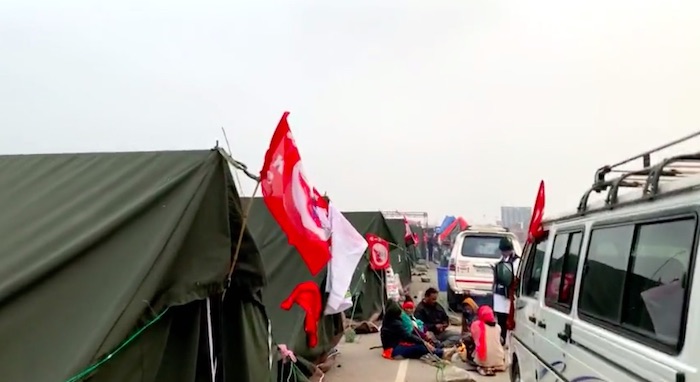
Massive tent city coming up at Shahjanpur, courtesy of Hemkunt Foundation
By Asia Samachar Team | INDIA |

#FarmersProtest | Amazing job by Hemkunt Foundation. They have established the fourth tent city, this time in in Shahjanpur, for the farmers turning up in droves to power their protest against Indian farm laws passed in September 2020.

Shahjanpur is a historical districts of Uttar Pradesh, located about 300km from Delhi.

To view the Hemkunt Foundation video, click here

The rows and rows of water proof and insulated tents are occupied by farmers mostly from Rajasthan, the largest Indian state area, as well Maharashtra and Gujrat. The foundation is also providing them Langgar and dry ration.

The tents are a huge help to the farmers battling the nail biting cold and rainy weather.


RELATED STORY:

Year 2021: Crucial Year for Panjab and Indian Farmers (Asia Samachar, 4 Jan 2021)


ASIA SAMACHAR is an online newspaper for Sikhs / Punjabis in Southeast Asia and beyond. Facebook | WhatsApp +6017-335-1399 | Email: editor@asiasamachar.com | Twitter | Instagram | Obituary announcements, click here |

Attack on Sikh talk radio host simply wrong

7
Harnek Singh anchoring Radio Virsa
By Hb Singh | OPINION |

Toward the close of last year, a Sikh talk radio host sustained serious injuries when he was stabbed in his home driveway in New Zealand.

The attack is worth discussing on two accounts. One, that it even happened at all. Second, the glee that greeted the attack as the victim was fighting for his life. Harnek Singh, 53, is still recovering in the hospital.

Harnek Singh Neki, as he is popularly known, is the face of New Zealand-based Radio Virsa. The talk radio has garnered a strong following. He talks about anything and everything on the Sikh faith and the Panjabis. His strong views views have garnered both admiration and ire. Over time, he has been roundly condemned by some segments who believe he is promoting a ‘wrong’ version of Sikhi. They claim he is blasphemous or bordering it.

In June 2018, the Sikh jathedars had ‘excommunicated’ him after he was supposed to have been summoned to make an appearance three time prior. Akal Takhat jathedar Giani Gurbachan Singh announced the order. Joining the meeting were Takht Kesgarh Sahib jathedar Giani Raghbir Singh, Takht Patna Sahib jathedar Giani Iqbal Singh, Takht Damdama Sahib jathedar Giani Harpreet Singh and Akal Takht head granthi Giani Malkeet Singh.

I had placed the word excommunicated in quote marks as I believe this is a practice that needs some serious revisiting. But that’s a topic for another day. Suffice to say, the ‘excommunication’ by the jathedars did not stop Harnek from continuing to share his thoughts on Sikh matters.

To begin with, let it be said: the attack was wrong. You can swing justifications one way or another, but it won’t cut ice. You cannot justify an attack simply because you disagree, however strongly, with his way of thinking.

The simple truth is that people can disassociate themselves from Harnek and his ilk. Disconnect. Don’t dial into his programmes. Ignore his social media presence. There are many others out there whom you would probably not agree with. You don’t lose sleep over them, right?

But there’s a problem. His arguments are resonating with an increasing number of people. His audience is building up. More sane and sober people are tuning in and going away convinced with his arguments.

People may not welcome his direct and piercing words, at times, but you cannot deny his logic. I have heard him many a time. Personally, I’m attracted to some of his views. They make sense. They project the Sikh faith forward, instead of dragging the teachings into age-old beliefs.

Of course, he may not be correct all the time. No one can stake such a claim. I wouldn’t, for example, turn to him on matters I suspect he may be on shaky grounds. With the on-going Panjab farmers’ protest, he did share some views, but I didn’t really pay attention to them. I felt he was not an expert on the subject. On that issue, I have turned to others who I felt were closer to the ground, and know better why the farmers are up in arms against the three farms laws recently passed by the Indian parliament.

Some people had tried to use the farmers’ issue as an excuse for the physical assault on Harnek. Really?

If not for some personal matter beyond our knowledge, it is likely that the attack was connected to the Sikhi slant taken by Harnek. He has challenged many existing and prevailing norms in Sikhi understanding. Some have taken that as an affront to the Sikh Gurus themselves.

Well, one thing is sure. People get emotional pretty easy when discussing faith. So, it is not surprising that many cannot stomach it when challenged by the likes of Harnek and Radio Virsa.

But here’s the real deal. He’s just another talkback radio host. If you think he has got it wrong, put forward your argument or ignore him. There is always the legal recourse, as well. But you don’t have the right to harm him physically.

What was more unfortunate were the almost glee-like responses by some folks to the attack. Check out remarks and comments on the social media. You would find a good number trying to justify the attack.

If you have made up your mind on this matter, I suggest you give yourself a chance to review your thoughts if you have not personally heard Radio Virsa. Don’t listen to the version coming from someone else, however respected they are in the eyes of the public. Believe me. Many seemingly good and sober folks out there carry a jaundiced view on a good number of issues. And some lie outright. I caught one Panjabi solo broadcaster dishing out an outright lie about Harnek’s background. I could detect the lie because I have followed closely the issue.

Let me say it again. If you want to judge the likes of Harnek, you need to do some homework. Listen to him for yourself. Don’t let others tell you what he’s saying. Hear it for yourself. Then, hopefully, you can make some sort of a judgment call.

Hb Singh is a Kuala Lumpur-based journalist with some experience in dealing with Sikh organisations, both from within and outside. 

* This is the opinion of the writer, organisation or publication and does not necessarily represent the views of Asia Samachar.

RELATED STORY:

NZ Sikh radio host stabbed in suspected religiously motivated attack (Asia Samachar, 26 Dec 2020)

ASIA SAMACHAR is an online newspaper for Sikhs / Punjabis in Southeast Asia and beyond. Facebook | WhatsApp +6017-335-1399 | Email: editor@asiasamachar.com | Twitter | Instagram | Obituary announcements, click here |