
















UA-56202873-1
Page 436

Book Review: Sakhi Sikh Rehat Maryada Ji Ki

1
Title: Sakhi Sikh Rehat Maryada Ji Ki
Author: Gurucharanjit Singh Lamba
Publisher: Sant Sipahi LLC (USA)

Price: Indian rupees 550 and US Dollars 15.

By Bhai Harbans Lal BOOK REVIEW |

The book under review, Sakhi Sikh Rehat Maryada Ji Ki, contains a narration, an extensive commentary, and the day-by-day accounts of how the present version of the Sikh Maryada was brought into existence.

There are several previous book narrations of rehatname but they are each derived and written by a single author. Also, they are only narratives. In contrast, Gurcharanjit Singh made a radical departure towards stating the real advances of the processes used in constructing the current Rehat Nama. Further, in contrast to others, the Shromni Gurdwara Parbandhak Committee (SGPC) Rehat Maryada is not tainted as rehat of the Khalsa, but it is the Rehat for the whole Sikh nation that included also others than Khalsa like sehajdharis.

The writer, Sardar Gurcharanjit Singh Lamba is an attorney by training but has been an activist on Sikh issues particularly related to the evolution of the Sikh message through the glorious history of the Sikhs.

I met Sardar Lamba during our youth days in India when we were both activists in the All-India Sikh Students Federation (AISSF). I found him very committed to the Sikh causes and particularly the functioning of the SGPC and Akal Takhat.

To know why the Sikh leadership felt the necessity of formulating the Rehat Maryada, you must go back to the days when its necessity seems to have been felt. In 1849 British annexed the Northern Indian subcontinent that the Sikhs considered as their kingdom and their homeland. This annexation became a visible embarrassment among Sikhs, and they tended to easily succumb to religiosity available elsewhere for their identity. Hindu radicalism visibly began to take advantage of the situation by engaging in exploitation of the Sikhs’ recession. Hindu fanatics found the opportunity to suck Sikhs into their religious practices.

For illustration, in 1897, in a large public meeting at Lahore, the Sanatanist Hindus passed a resolution that the Sikhs were a part of the Hindu community. The Bharat Dharm Mahamandal took notice of this issue and passed a resolution in a meeting at Delhi, asserting that the ten Gurus of the Sikhs from Guru Nanak to Guru Gobind Singh were revivalists of Hindu Dharma. Hindu activists recruited Baba Khem Singh Bedi, a descendant of Guru Nanak, and Bawa Sumer Singh (Bhalla), a descendant of Guru Amar Das, to subscribe to the view that Sikhs were Hindus as their Gurus were revivalists of Hinduism.

Further, Hindu statutes including a Shivling and others began to reappear in the circumambulatory passage (parikrama) of the Golden Temple. Similarly, a painting showing Guru Gobind Singh standing with folded hands before the Hindu Goddess asking for Amrit, an elixir of life, began to appear in the historical Sikh Gurudwaras.

The Sikh leadership of the time reacted. They felt a necessity to formulate the Sikh religiosity, often contra to the Hindu religiosity, as a wall between the Sikhs and those who were not. In the book under review, Sardar Lamba details how the Sikh leadership took almost a century to come up with the document now known to be the Sikh Rehat Maryada as authored by SGPC. Mind you this is different than re-writing of the Sikh history. That task is left to the scholars appointed by the Sikh institution of higher education. In contrast, the Sikh Rehat Maryada was formulated by the Sikh clergy with the help of the Sikh academicians.

Sardar Lamba starts from January October 1910 when Chief Khalsa Diwan asked a special committee to formulate a Sikh Rehat. In March 1915, Chief Khalsa Diwan published a description of the Sikh religiosity. However, the formulation of the current Rehat Maryada, then labeled Roho Reeti, began with a meeting on March 13-15, 1927, and ended with the report to SGPC on February 3, 1945. SGPC then accepted the report in its general body meeting and gave it the title of Sikh Rehat Maryada. I take pride in becoming a part of its history in that, when the Maryada was first printed as hard copies at Guru Ram Das Printing Press, in March 1945, late Principal Satbir Singh and I were asked to read and correct the final proof to catch and correct the type-setting errors. It was the occasion when AISSF was meeting in Amritsar to formulate its bylaws at its annual general body meeting.

Sardar Lamba narrates all Rehat Maryada meetings concerning their attendees and the proceedings. One may notice that all attendees were required to be practicing rehat of the khande-di-pahul as was practiced at that time. Only one sehajdhari Sikh attended that too only once. Representatives from the USA and Burma were among those who attended the meetings. All suggestions and amendments were recorded. There was the rule of 90% agreement before any amendment was accepted for incorporation.

The book gives 118 keywords at the end to search in the book of 465 pages. In the second part of the book, the author narrates the religious procedures to follow as they are derived from the language used in the final document.

The author religiously adhered to the hard evidence on how, who and when? He does not miss any detail including the evolution of the color of the Sikh flag. I feel disturbed when I notice the tendency of using the RSS ‘s bhagwa or saffron color of the flag today being hurled on some gurdwaras in the west or in the east. Author religiously observed to the hard evidence on how and when the saffron color of the flags hoisting on our gurdwaras replacing the Basanti color prescribed in the Rehat. While discussing the final text, the author emphasizes that a Sikh in Rehat Maryada was defined by one’s implicit and explicit faith in the teachings of the gurus as imbibed in SGGS. That was the only criterion not to be ever compromised.

The book is recommended for not only general readings but for research scholars and academicians; all those interested in the implicit and explicit religiosity of a Sikh’s religious life will benefit. It will also serve as a resource for those interested in comparative religion studies, and those interested in the colonial influences on the practices of the Sikh religion. Graduate students and established scholars will equally benefit.

Harbans Lal, Ph.D.; D.Litt (Hons) is the Professor Emeritus & Chairman at the Dept of Pharmacology & Neurosciences, University of North Texas Health Science Center. He is also the Professor Emeritus at the Amritsar-based Guru Nanak Dev University as well as President of the Academy of Guru Granth Studies. He can be reached at Japji2050@gmail.com. Link to the original article.

* This is the opinion of the writer, organisation or publication and does not necessarily represent the views of Asia Samachar.


RELATED STORY:

(Asia Samachar, 31 May 2020)


ASIA SAMACHAR is an online newspaper for Sikhs / Punjabis in Southeast Asia and beyond. Facebook | WhatsApp +6017-335-1399 | Email: editor@asiasamachar.com | Twitter | Instagram | Obituary announcements, click here |
Determined nurse, farmer at frontline of farmers’ protest

0
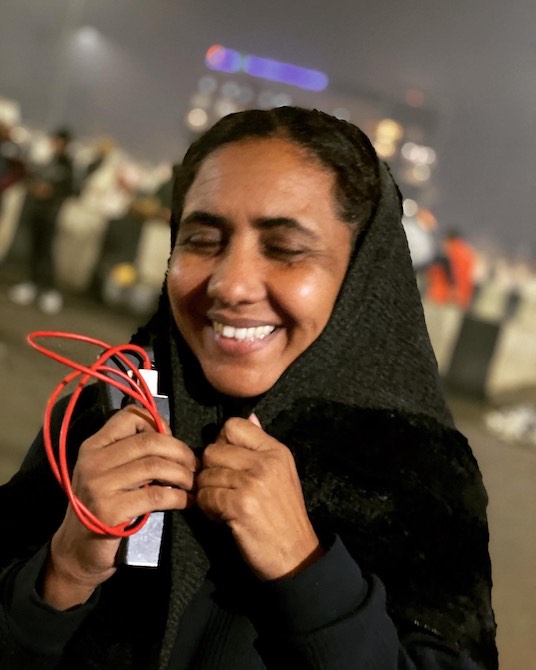
Gurpreet Gill – Photo: Shared by Gurpreet Wasi qt Facebook
Text and Photo by Gurpreet Wasi | INDIA |

Around 10pm when I was prepping to get back home from Ghazipur site, I stopped by to meet Gurpreet Gill, who had already gone in her tent. Oblivious of that fact I call for her name and she came out smiling thinking i needed some help. She is one of the two nurses who have come along with a team of physio therapists and other nursing staff from Ludhiana to treat farmers sitting at the protest site.

She has been here since 9th Dec. With zero amenities for women on site,things have been difficult for these two ladies, but with a big grin she says “jadon Mann ch soch hi leya ke sewa karni hai, tan kathinaiyan ki” (when we have decided to serve, then difficulties don’t matter) she told that they arrived at night on 9th and spent the entire night setting up a make shift medical facility and in morning got to work, slept after almost 48 hours. They nursed wounds that had gone real bad. Today she is at peace because those wounds have started to heal.

Now she and her friend have their own tents and are mentally at peace that they are contributing for the larger good. Wishing them a good good night sleep, i bid her bye to meet tomorrow. May we all find a way to heal wounds of others…

#farmersprotest #standwithfarmers #farmersprotestchallenge #trollytimes

“It’s going to be a month since I saw my children. We came prepared for a long fight, but does it matter to anyone. Hun nava saal wi ethhe hi chadhna sada” – Photo/Text by Gurpreet Wasi on her Facebook page, 30 Dec 2020
RELATED STORY:

Farmers struggle and remembering the martyrdom of Chhote Sahibzade (Asia Samachar, 1 Jan 2021)


ASIA SAMACHAR is an online newspaper for Sikhs / Punjabis in Southeast Asia and beyond. Facebook | WhatsApp +6017-335-1399 | Email: editor@asiasamachar.com | Twitter | Instagram | Obituary announcements, click here |

Jaspal Singh joins Singapore’s competition and consumer commission

0
Jaspal Singh
By Asia Samachar Team | SINGAPORE |

Jaspal Singh Gurbachan Singh, a Colombo Plan scholar who joined the Singapore administrative service in 1978, is one of four new faces to join on the Competition and Consumer Commission of Singapore (CCCS).

Jaspal, who is currently a senior research fellow (part-time basis) at Institute of Policy Studies (IPS), was one of the three board members appointed effective 1 Jan.

Prior to joining IPS, Jaspal was the chief executive officer (CEO) of ComfortDelGro (UK & Ireland) for 14 years from 2004 to 2018. As CEO, he headed 12 passenger land transport (bus, coach, taxi and private hire) businesses. These businesses collectively accounted for £500 million in revenue in 2017, or 22% of ComfortDelGro Group’s annual turnover.

Prior to joining the private sector, he had over 26 years of senior executive and board-level experience in the Singapore public sector. His key past appointments in the Singapore public sector include deputy secretary at the Ministry of Finance and Ministry of Transport, and director of budget at the Ministry of Finance.

He is currently a senior advisor to Singapore Press Holdings Ltd (UK Business) and a board member of Singapore Institute of Directors and University of Newcastle, Singapore.

He graduated with an Advanced Management Programme Certificate and Master in Public Administration from Harvard University. In 1998, he received the Public Administration Medal (Silver).

Jaspal’s appointment was announced in a Ministry of Trade and Industry (MTI) statement dated 30 Dec 2020. It also announced the appointment of Max Loh Khum Whai, 58, the managing partner at Ernst and Young in Singapore and Brunei since 2019, as the new CCCS chairman.

Two other new board members appointed were Singapore Exchange chief risk officer Koh Puay Eng Agnes and Deutsche Bank (Singapore) chief operating officer (Asia Pacific) and deputy chief country officer Chandra Mallika.


RELATED STORY:

Mohar Medical to the rescue (Asia Samachar, 8 Sept 2020)


ASIA SAMACHAR is an online newspaper for Sikhs / Punjabis in Southeast Asia and beyond. Facebook | WhatsApp +6017-335-1399 | Email: editor@asiasamachar.com | Twitter | Instagram | Obituary announcements, click here |

Reincarnation redefined

3
“When you stop living the spirituality of coming back a second time, you start living this one and only life to the fullest.” Source: Karminder Singh Dhillon (Sikhi Concepts – Part 5/12 – Reincarnation)
By Asia Samachar Team | OPINION |

More than 100 billion people have lived and died before us. Not a single one of them have come back and filed a report on the reincarnation cycle, says a Sikh thinker.

“Yet reincarnation is presented as a religious fact and religious truth. It is presented as a reality of life, believed by millions and accepted by millions more,” argues Karminder Singh Dhillon in the latest (5/12) series of his video discussion entitled Sikhi Concepts. Click here.

In this segment, he explains how pre-existing spiritual concepts are re-defined within Gurbani. He explores the REDEFINING of the concept of REINCARNATION or aavaa gaaun in Gurbani.

“A vast majority of Sikh mistakenly think, and accept, that reincarnation and aavaa gaavaa is the narrative of Gurbani. Nothing can be further from the truth.”

“The first thing Gurbani does is to debunk the notion that reincarnation of the soul is the outcome of the judgment of deeds of the soul after death,” he says.

He then refers to some verses (shabads) from a Guru Granth Sahib to discuss the Sikh narrative of reincarnation.

This is one of the shabads discussed:

jab kach na sio, tab kya karta, kavn karam kar aiya. apna kheyl aap kar deykhay, thakur rachan rachaiya – SGGS, 748

Dr Karminder believes that the shabad shreds the concocted theory of reincarnation and throws it out of the spiritual window.

“Logic has a force of its own. This is very powerful logic presented by Guru Arjan Ji,” he says.

“If a Sikh thinks for himself or herself, this one verse alone is enough to debunk the whole concocted theory of judgment, 8.8 million, aavaa gaavan and reincarnation. That is how powerful Gurbani is. One verse is enough to debunk an entire theory.”

He then refers to a number of other quotations from SGGS before moving forward to discuss the objective of the ‘aavaa gaaun’ as understood in Gurbani.

Karminder, a retired Malaysian civil servant and a regular speaker on the Sikh faith, is author of five recently released books on Sikhi, including The Hijacking of Sikhi.

Source: Karminder Singh Dhillon (Sikhi Concepts – Part 5/12 – Reincarnation)


SIKHI CONCEPTS VIDEO SERIES BY KARMINDER SINGH DHILLON

Part 1: Guru Nanak’s Canvas

Part 2: Death

Part 3: After Life

Part 4: 8.4 million (Chaurasi Lakh)

Part 5: Reincarnation

Part 6: Heaven and Hell

Part 7: Salvation in Afterlife (Mukti)

Part 8: Court of Judgement (Dargah)

Part 9: Dhrm Raj


RELATED STORY:

Chauraasi lakh or 8.4m. What do they mean Gurbani-wise? (Asia Samachar, 21 Dec 2020)

Revisiting death (Asia Samachar, 5 Dec 2020)

Hijacking Sikhi (Asia Samachar, 19 Dec 2020)

Karminder talks about what shaped his thinking, and his latest books on Sikhi (Asia Samachar, 20 Nov 2020)


ASIA SAMACHAR is an online newspaper for Sikhs / Punjabis in Southeast Asia and beyond. Facebook | WhatsApp +6017-335-1399 | Email: editor@asiasamachar.com | Twitter | Instagram | Obituary announcements, click here |

Amrita Sher-Gil: Often overlooked Indian art pioneer

0
Amrita Sher-Gil: Untitled self-potrait -Photo: Sothebys
By Tariro Mzezewa | NEW YORK TIMES |

Amrita Sher-Gil, a pioneer of modern Indian art, used her paintbrush to depict the daily lives of Indian women in the 1930s, often revealing a sense of their loneliness and even hopelessness.

She painted women going to the market, women at a wedding, women at home. Sometimes she showed women bonding with other women. At times the works seemed to convey a sense of silent resolve. It was a rendering rarely seen in depictions of Indian women at the time, when portrayals tended to cast them as happy and obedient.

The melancholic painting “Three Girls” for instance, shows women wearing passive expressions, their solemn brown faces a contrast to the vibrant reds, greens and ambers of their clothing. The mood is despondent, as though the women are waiting for something they doubt will ever come along.

With her style and her emphasis on women, Sher-Gil became known as the “Indian Frida Kahlo.” 

Amrita Sher-Gil: Self portrait (middle) and The Little Girl in Blue (source: Sothebys)

Amrita Sher-Gil Biography

Born in 1913 in Budapest, Sher-Gil grew up in a cultured and intellectual family who initiated and supported her early interest in art. Her mother was a Hungarian-Jewish opera singer and her father was an Indian Sikh aristocrat and scholar. She lived in Hungary, India and Paris during her lifetime and due to her bi-racial and bi-cultural upbringing, and her constant travels between India and Europe, her work comes across as an immersion, absorption and very detailed understanding of aesthetic styles and traditions of the West and the East.

From an early age Sher-Gil had shown an aptitude for drawing. “It seems to me that I never began painting that I have always painted. And I have always had, with a strange certitude, the conviction that I was meant to be a painter and nothing else.” (Amrita Sher-Gil, ‘Evolution of My Art’, Y.Dalmia, Amrita Sher-Gil Art & life, A Reader, Oxford University Press, New Delhi 2014, p. 3). Sher-Gil moved to Paris in 1929 when she was 16, studying at L’Académie de la Grande Chaumière and later at the École des Beaux-Arts. Whilst in Paris, she was exposed to the work of Paul Cézanne, Amedeo Modigliani and Paul Gaugin. She was particularly enamoured with their uncanny ability to blend the old with the new. Much like Gaugin’s depictions of Tahitian women, Sher-Gil’s paintings were stylistically simple yet visually complex.

In November of 1937, Sher-Gil’s works were unveiled in an inaugural exhibition at Faletti’s Hotel in Lahore. The landmark exhibition would fundamentally change the perception of Indian audiences towards contemporary art forever. Embodying a bohemian combination of East and West, Sher-Gil’s work belonged to no particular school or style of painting. She forged a revolutionary new path informed by her experiences in Hungary, Paris and India, creating a body of work that was simultaneously aggressively modern and decidedly Indian. At a time when most artists portrayed women as content and compliant, Sher-Gil’s treatment of female subjects was singularly unique, revealing their loneliness or silent resolve. This was perhaps a reflection of her own isolation in a life caught between different worlds. Nonetheless, she came to be seen as an arbiter of style in India, a symbol of the glamour of the inter-war years. When the elites of Lahore arrived to view her exhibition in 1937 they are said to have come as much to see Sher-Gil, as to view her art.

Amrita Sher-Gil is considered to be one of India’s most important early modernist painters. In December of 1976, India declared her a national treasure with regard to her ‘artistic and aesthetic value’ and prohibited the exportation of her paintings outside the country. Sher-Gil’s constant travels not only resulted in her meeting and engaging with people of great artistic and intellectual temperament, but also resulted in an absorbing of influences from varying cultures such as French, Hungarian, and Indian that shaped and impacted her oeuvre. Her natural talent, education and observations made during her stay in Europe enabled her to start a dialogue with the then veterans of modern Indian art, such as Karl Khandalavala, and allowed her to create for herself a very significant position in the history of modern Indian art. She wrote several essays on art and penned innumerable letters to her family and friends vocalising expansively her thoughts and vision on the form and image she felt modern Indian Art must acquire. She thus played a vital role in the articulation of twentieth century Indian art and was a seminal influence on generations of Indian artists.

There are a very limited number of works made by Sher-Gil before her sudden and untimely demise at the age of 28. In total, 172 paintings have been documented and of those, 95 are in the permanent collection of museums and institutions within India, notably the National Gallery of Modern Art in New Delhi, and will never be allowed to leave the country.

In life and art Sher-Gil was a woman both within and ahead of her time, breaking boundaries that make her one of India’s most compelling figures of the 20th century. – Source: Sothebys website


She understood the loneliness of her subjects well, since their moods were a reflection of her own. Because of her upbringing, she lived between worlds, often searching for a sense of belonging.

Sher-Gil was born in Budapest on Jan. 30, 1913, to the Hungarian-Jewish opera singer Marie Antoinette Gottesmann and Umrao Singh Sher-Gil Majithia, a Sikh aristocrat and a scholar of Persian and Sanskrit. She began taking formal art lessons at age 8, when her family moved to Summer Hill, Shimla, in northern India.

At 16, she moved to Paris and continued studying art, first at the Académie de la Grande Chaumière and later at the École des Beaux-Arts. She had early success.

Her 1932 painting “Young Girls” received a gold medal in 1933 at the Paris Salon, the renowned art show. It depicts her sister, Indira, wearing European clothing and a look of confidence while sitting with a partially undressed friend, Denise Proutaux, whose face is obscured by her hair — one woman bold and daring and another reserved and hidden. The painting reflects the different aspects of Sher-Gil’s personality — outgoing and sociable, as she was known among those who encountered her at Parisian parties, or tucked away and painting vigorously.

In addition to paintings of relatives, lovers and friends, she created self-portraits that showed her “grappling with her own identity,” one of her biographers, Yashodhara Dalmia, wrote in Amrita Sher-Gil: A Life (2006).

Read the full story, ‘Overlooked No More: Amrita Sher-Gil, a Pioneer of Indian Art’ (New York Times, 20 June 2018), here.


RELATED STORY:

Birmingham Sikh artist reveals sculpture to honour health workers (Asia Samachar, 7 Oct 2020)


ASIA SAMACHAR is an online newspaper for Sikhs / Punjabis in Southeast Asia and beyond. Facebook | WhatsApp +6017-335-1399 | Email: editor@asiasamachar.com | Twitter | Instagram | Obituary announcements, click here |

How Are Farmers Surviving On The Streets? Inside Singhu Border

0
By Asia Samachar Team | INDIA |

Thousands of farmers have been protesting against the center’s farm laws for months now. Amitha Balachandra and Arun Rengaswamy spent 24 hours with these farmers who are camping at the Singhu border in Delhi to find out how they are managing to pull through.

0:00 – Introduction
1:42 – Langar and its significance
4:00 – Where are the donations coming from?
5:00 – What other help are people getting apart from the food?
7:51 – Medical langars at Singhu border
9:17 – What are farmers doing for electricity?
11:49 – Students support for farmer’s protest
13:46 – Crack of dawn at Singhu border
15:51 – Farmers explain why they want the laws repealed
16:10 – Farmers explain issues with redressal
16:50 – Farm leader, Balbir Singh Rajewal, on how he spearheaded the movement
18:06 – Farmers from Tamil Nadu extend support to the movement
18:47 – Conclusion


RELATED STORY:

Farmers struggle and remembering the martyrdom of Chhote Sahibzade (Asia Samachar, 1 Jan 2021)


ASIA SAMACHAR is an online newspaper for Sikhs / Punjabis in Southeast Asia and beyond. Facebook | WhatsApp +6017-335-1399 | Email: editor@asiasamachar.com | Twitter | Instagram | Obituary announcements, click here |

#FarmersProtest Update: Temperature dropping, visibility low as protests enter Day 37

0
Morning scenes at Delhi border protests site – Photo: Amaan Bali
By Aman Singh Bali | INDIA |

LATEST UPDATES ON THE INDIAN FARMERS’ PROTEST

#FarmersProtest enters day 37 and into 2021. Key Updates.

1. The temperature has gone down & continues to be around 6 at 8am as well. The visibility is very low as well.

2. As a part of New Year celebrations, farmers are scheduled to organise Kirtan Rally and many program.

3. The borders, Ghazipur, pyau Maniri, Kundli, Singhu, tikri, Palwal, Shahjahanpur remain closed.

4. Protests enter day 100 in Punjab with Guru Jandiala being the protest site like Singhu border.

5. Farmers at Tikri have also planned programs and functions for new year.

6. Punjab CM Amrinder singh has wished protesting farmers a new year and has expressed and prayed that they return home soon.

7. The number of towers restored back is 1121 out of 1678 damaged. Restoration is going on.

Extracted from @amaanbali tweet on 1 Jan 2021. You can follow more updates at his Twitter page

Farmers at the UP-Delhi border protest site on 4 Dec 2020 – Photo: Chaudhary Rakesh Tikait Facebook page
RELATED STORY:

Don’t let be propaganda fool you (Asia Samachar, 2 Dec 2020)


ASIA SAMACHAR is an online newspaper for Sikhs / Punjabis in Southeast Asia and beyond. Facebook | WhatsApp +6017-335-1399 | Email: editor@asiasamachar.com | Twitter | Instagram | Obituary announcements, click here |

Aruni Bagga releases Mere Mann Pardesi Ve

0
KIRTAN | NEW RELEASE: Bangkok-based Aruni Bagga as released ‘Mere Mann Pardesi Ve’, rendering a shabad (hymn) by Guru Ram Das. It describes the wavering minds and the need to return home (go inwards) to experience the Source of the Universe. It invites us to become conscious of the Light present within us, to find the inner strength. Click here to view the video.

[TAKE NOTE OF ASIA SAMACHAR OFFICIAL WHATSAPP NUMBER: +6017-3351399. You can contact us to provide news alerts, community updates or obituary announcements. Stay in chardi kalaa]


RELATED STORY:

Thai singer Aruni releases song on Guru Nanak’s travel to Baghdad (Asia Samachar, 17 Oct 2019)


ASIA SAMACHAR is an online newspaper for Sikhs / Punjabis in Southeast Asia and beyond. Facebook | WhatsApp +6017-335-1399 | Email: editor@asiasamachar.com | Twitter | Instagram | Obituary announcements, click here |

Farmers struggle and remembering the martyrdom of Chhote Sahibzade

0
By Pritam Singh | OPINION |

It is of great historical and political importance that the historic farmers’ protest currently going on in India against the BJP governments’ agro-business market reforms in Indian agriculture has understood the significance of the martyrdom of the Sahibzadas, and the link between the current struggle and the great sacrifices of the Sahibzadas. The farmers organisations have taken a wise and important decision which might have long term implications for strengthening the farmers movement in Punjab in particular but possibly in India to honour the memory of the Sahibzdas’ martyrdom at the protest sites.

I am using the word honouring the memory and not using the word celebration which some people wrongly use in relation to the martyrdom. To emphasise the point about honouring the memory and not celebrating the day, I should mention that it was a tradition for many centuries in the areas surrounding the site of the martyrdom that people used to fast on those days and also sleep on floor and not on proper bed to remember the suffering of the Guru de lalan di (Guru’s sons). It is the nature of majoritarian Hindu bias in Indian historiography which permeates the accounts even by historians who would claim to be not so biased that the story of the Sahibzadas is largely unknown to the majority of Indians outside Punjab.

The farmers organisations, by deciding to honour the memory of Sahibzada’s martyrdom at the protest sites around Delhi, have brought to the forefront the significance of this martyrdom in Indian imagination for fight against oppression.

In the end of month of December, every year the global Sikh community honours the memory of the two younger sons of Guru Gobind Singh who were martyred at a very young age. The youngest Fateh Singh born on 25 February, 1699 was not even seven when he was martyred on Dec 12, 1705 along with his elder brother Zorawar Singh, born on 17 November 1696, who had just turned nine. As childhood in all cultures is associated with innocence and purity, the story of children as young as the two Sahibzadas were, being subjected to brutal torture leading to death, is one of the most painful memories in Sikh history.

When we reflect on the martyrdom of the two Sahibzadas, several aspects of human history and human character come to the mind.

First let us look at some aspects of human history. Throughout human history, there has been struggle between, on one hand, those who are in power and use that power to commit atrocities on those whom they consider as their opponents, and, on the other, those who stand for the dignity of human freedom and are willing to give even their life for their faith and beliefs. In some accounts, this is described as the perpetual conflict between evil and good. In this case, Wazir Khan, the faujdar of Sirhind represented evil and the two Sahibzadas represented good. Those who are in a position of power are, most often, able to recognise the exercise of their power only through inflicting pain on those they consider as a threat –real, potential or imaginary- to their power. In some cases, the powerful are so deranged by their power that they turn sadistic – they enjoy inflicting pain on others. There are several accounts of prisoners or persons in police or army custody who are no threat to their captors but they are subjected to inhuman torture by prison officers or police or army personnel for the sheer sadistic pleasure derived by torturing them. Momentarily, those who are in power feel victorious but in the long run, humanity recognises those who bear torture for their beliefs and ideas, and dumps the torturers to the dustbin of history. Who remembers that Wazir Khan or that Qazi who was fist reluctant to pronounce the verdict of guilty on the Sahibzadas because according to his understanding of Islamic law, the boys were not guilty of any crime but then succumbed to the pressure of Wazir Khan and ordered the execution of the Sahibzadas by bricking them up alive? We do not know if there are any descendants of Wazir Khan and that Qazi but if there were to be any, they would be ashamed of family association with them. On the contrary, the Sahibzadas are remembered with love, admiration, reverence and inspiration by millions and they would continue to be remembered this way. A broad lesson of history is that evil wins momentarily but good wins eventually.

Let us now look at several aspects of human character. Let us first reflect on the conduct of the Sahibzadas who at that young age climb to the heights of wisdom, bravery, steadfastness and unshakeable faith. They were obviously conscious of the great tradition set by their grandfather Guru Tegh Bahadur who had given his life to defend the religious human rights of his ideological opponents- the Kashmiri Brahmins. It is not difficult to imagine that they were educated about their family history and the high traditions of their faith by their grandmother Mata Gujari who would have taught them about the prime need to remain firm in their belief and faith, and that remaining true to one’s faith was of higher order even if it meant giving one’s life than abandoning faith for the mere physical survival of one’s body They were young in age but mature in their understanding of their historic role. This also tells us that although there are physical and biological limits associated with age, these limits are flexible. Someone can be young but very wise and brave while someone else can be mature in age but infantile in behaviour and character.

One can imagine the immeasurable pain caused to Guru Gobind Singh when he would have heard the news about the two Sahibzadas being tortured to death. And it is here that Guru Gobind Singh rises to those heights of character that are rarely ever witnessed in human history. There was not even one instance in his life where he had retaliated either himself by harming an uninvolved Muslim civilian or hinted about the need to retaliate this way to any of his followers. There must have been explosion of anger amongst his followers against Wazir Khan but the high moral values the Guru had inculcated among his Sikhs acted as a powerful constraint against any unethical retaliatory behaviour against the family or relatives of Wazir Khan. No doubt, later on, Banda Bahadur led the attack on Sirhind and one of his commanders, also named Fateh Singh, killed Wazir Khan in one of the battles.

Even in the most hateful regimes, there are individuals who respond to the voice of their conscience. One such individual was Sher Mohammad Khan, the Nawab of Malerkotla, who protested against the death sentence pronounced on the young Sahibzadas in spite of the fact that his brother had been killed by Guru Gobind Singh’s forces. He argued that his brother had died in a battlefield and the young Sahibzadas were totally innocent. That one brave act of kindness by the Nawab of Malerkotla has earned him a high place in history, and it is good that the Sikh community has never forgotten that humane intervention by the Nawab of Malerkotla. That gratitude to the Nawab of Malerkotla is so deeply embedded in Sikh consciousness that even during the mad days of 1947 partition violence, no Muslim was ever harmed if he/she entered the territory of Malerkotla. It is due to this that despite the barbaric ethnic cleansing that took place in both West Punjab (against Sikhs and Hindus) and East Punjab (against the Muslims), Malerkotla remains a Muslim majority city in Indian/East Punjab. From the Malerkotla constituency, it is always a Muslim who is elected to the Punjab’s state assembly and, sometimes, finds berth in the Punjab Cabinet.

Then there is the despicable character of Gangu Brahmin who had served the Guru’s family primarily as a cook for decades and at a crucial moment when Mata Gujri and the Sahibzadas took refuge in his house at his own request, he betrayed them to the local police leading to the arrest of Mata Gujri and Sahibzadas. His character shows how greed can lead human beings to the act of betrayal.

In contrast with Gangu Brahmin’s act of betrayal, is the act of deep loyalty of Baba Moti Ram Mehra who displayed an exemplary character. He arranged to serve milk to Mata Gujari and the Sahibzadas in the Thanda Burj (Cold Fort) where they were imprisoned. When Wazir Khan came to know that Moti Ram Mehra had served milk to Mata Gujari and the Sahibzadas, he ordered his arrest along with that of his mother, wife and a very young son. Moti Ram Mehra defended his action as morally correct for which he along with whole family was tortured to death.

Similarly was the great character of Diwan Todar Mal who paid with gold coins the land for cremating the bodies of Mata Gujari and the Sahibzadas.

In our memory and historical texts, Wazir Khan and Gangu Brahmin are treated with contempt while we honour the young Sahibzadas and also Nawab of Malerkotla, Baba Moti Ram Mehra and Diwan Todar Mal. This way of remembering has another significance in the current Indian and diasporic context where Hindutva ideologues are trying to appropriate Sahibzadas martyrdom as a weapon against Islam and Muslims. Contrary to the Hindutva narratives, one of the villains in this case was a Brahmin Gangu and one of the defenders of the Sahibzada was a Muslim Sher Mohammad Khan, the then Nawab of Malerkotla.

The current farmers struggle is, in different ways, carrying on the same legacy of fighting for justice against injustice, and the role of many individuals in strengthening or sabotaging the struggle would be similarly remembered as the role of individuals who sided with tyranny or opposed it at the time of the martyrdom of the Sahibzadas.

Pritam Singh is Emeritus Professor at Oxford Brookes University, UK

* This is the opinion of the writer/s and does not necessarily represent the views of Asia Samachar.


RELATED STORY:

BJP’s farming policies: Deepening India’s agrobusiness capitalism and centralisation (Asia Samachar, 18 Oct 2020)


ASIA SAMACHAR is an online newspaper for Sikhs / Punjabis in Southeast Asia and beyond. Facebook | WhatsApp +6017-335-1399 | Email: editor@asiasamachar.com | Twitter | Instagram | Obituary announcements, click here |
Who are the real enemies of India?

0
Panjab farmer – Photo: BSB Photography
By Gurnam Singh | OPINION |

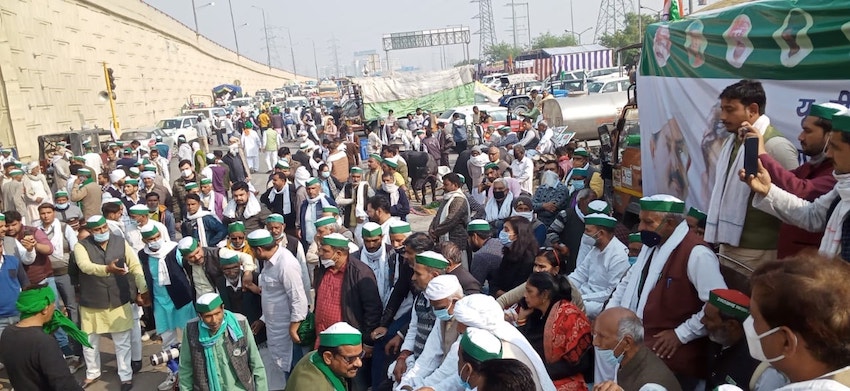
The siege of Delhi by an estimated half a million protesters (and growing by the day) is now entering its second month. Most major arteries in and out of the Indian nation’s capital are controlled by well organised protesters and plans are in motion to completely encircle the capital in the coming days and weeks.

Amazingly, the vast majority of the population of Delhi, some 20 million, is supporting the protests. Moreover, Arvind Kejriwal, head of the Delhi State Government, which is controlled by the AAP, declared that free wifi will be provided at the various sites.

Though the protests began in the Punjab, they have morphed into to an international social movement that cuts across regional, religious, class, caste and gender boundaries. In cities across the world, transcending differences of generation, gender and geography, we see daily protests, which are intensifying, outside symbols of the India state.

The Indian state, through a specially established IT cell, known popularly as ‘Godhi Media’, is spending millions on a social media campaign of disinformation and intimidation. They have sought to discredit the movement by making various unsubstantiated allegations, such as suggesting the farmers movement, especially in Panjab and Haryana is a front for ‘terrorist groups’ invariably made up of ‘Khalistani’s’, ‘Pakistani’s’, ‘Naxalite’s’ and other so called ‘anti-rational elements.’ But, because of citizen journalism, all their attempts to defame and misrepresent the protesters and movement have backfired.

Bhartiya Kisan Union (BKU) leader Rakesh Tikait addressing a farmers’ protest at the Grain Market, Delhi’s Bahadurgarh Tikri border on 29 Dec 2020 – Photo: Chaudhary Rakesh Tikait

Writing a the very insightful piece in The Print, political theorist and anti-caste activist from Telangana, Kancha Ilaiah Shepherd, suggests the Sikh farmers movement has caught the imagination of oppressed people of India. He suggests that their struggle embodies a larger battle between the RSS Elitist class and the vast majority of Indians, who are classified as low caste. He argues that this egalitarianism, which lies at the heart of Sikh thought and history, is capturing the imagination of many other groups, and that the RSS monster may well have met its match. This is because, as he notes, “The Sikh farmer-youth are not only more educated, they are also globally spread out and can give a fitting reply to the Hindutva army.”

So the question that we need to focus on is, what can we do to support this movement? Unless you are in a position to engage in direct peaceful action, then, as well as offering material and moral support, we have a duty to become educated and educate others about what is really happening in India. We also need to begin to work together to establish a new vision for this vast sub-continent. One that is able to heal the wounds and divisions caused by the British Imperialists and which are now being exploited by Hindutva fascists.

Above all we need to make it clear that the subcontinent of India does not belong to the corporates or the political classes, but to the people. In doing so we need to say loud and clear to ALL fanatics and fascists, religious or secular, we reject your politics of violence and hate! We need to say, we are the followers of Guru Nanak who spoke to humanity with one message, that was of universal love and oneness! And if we can achieve this level of consciousness, then anything is possible.

[Gurnam Singh is an academic activist dedicated to human rights, liberty, equality, social and environmental justice. He is an Associate Professor of Sociology at University of Warwick, UK. He can be contacted at Gurnam.singh.1@warwick.ac.uk]

* This is the opinion of the writer and does not necessarily represent the views of Asia Samachar.


RELATED STORY:

We stand with our farmers (Asia Samachar, 29 Dec 2020)


ASIA SAMACHAR is an online newspaper for Sikhs / Punjabis in Southeast Asia and beyond. Facebook | WhatsApp +6017-335-1399 | Email: editor@asiasamachar.com | Twitter | Instagram | Obituary announcements, click here |