The original article, entitled “Starlit ‘doctor of cricket’”, appeared in The Malay Mail, 9 Dec 2017
By Frankie D’Cruz
When someone is as charismatic and imposing as Datuk Dr Harjit Singh, it is easy to be seduced into giving credit.
The ever-sprightly Dr Harjit, an ornament to cricket, has deservedly gained pride of place in the pantheon of sporting legends. His induction into the Olympic Council of Malaysia Hall of Fame on Thursday added another gem to his catalogue of awards as a cricket player and administrator.
At age 67, the ‘doctor of cricket’ pulses with explosive energy, embracing the virtues of every great sportsman — undying passion and dedication.
“It’s a tireless job but I love it because of my passion for sports,” he told Malay Mail after receiving his award.
He embodies grassroots development; his achievements illustrate the visionary he is; and his desire hinges on creating opportunities.
“By creating opportunities, you develop player keenness, go on to broaden the base and finally improve standards,” he said.
Setback: “The lack of sporting facilities and the neglect of school sports is today the bane of Malaysian sport.”
As schools are the heartbeat of sports, Dr Harjit honked up his guts to pioneer the Kancil Programme “Catch ‘em Young” in 1987. Aim: To popularise cricket in schools in the state and raise its standard in the country.
A cricket revolution was born and Dr Harjit, who has been president of the Johor Cricket Council since 1987, entrenched his reputation as a game changer. The scheme batted off with 17 schools in Johor Baru but today, it has spread to some 200 schools in 11 districts. Schools in rural Johor including Felda schemes get a taste of cricket.
Dr Harjit, deputy president of the Malaysian Cricket Association from 1990 to 2003 and chairman of development, then went national with the programme.
An exciting chapter was added to the extraordinary story of Dr Harjit’s career as healer of cricket when the Johor government allotted 14 acres for the first cricket academy in Southeast Asia.
That cricket is not considered an elite sport has not deterred Dr Harjit from pushing forward with the help of sponsors.
It speaks volumes of his vigour that Dr Harjit continues to raise funds for the development of cricket.
That bags of love for cricket stemmed from his father Meva Singh, an ex-Selangor and Kilat Club cricketer. His wife of 35 years Kaldip Kaur, sons Dr Rajinder and Gurdip keep his passion burning.
Dr Harjit learnt to score at the age of five, earned his personal bat at six and came under the watchful eye of the late legend Mike Shepherdson at the Kilat nets. He was a star player in his teens, representing the state in 1966 and continued playing into the late 1990s. When he returned home in 1980 after medical studies in India, Dr Harjit was a national player until a knee injury ended his competitive playing days.
Since then he has honed, toned and burnished cricket to an A-list shine.
The original article, entitled “Starlit ‘doctor of cricket’”, appeared in The Malay Mail, 9 Dec 2017
[ASIA SAMACHAR is an online newspaper for Sikhs in Southeast Asia and surrounding countries. We have a Facebook page, do give it a LIKE. Follow us on Twitter. Visit our website: www.asiasamachar.com] 16964
[Fastest way to reach Asia Samachar: Facebook message or WhatsApp +6017-335-1399. Our email: editor@asiasamachar.com. For obituary announcements, click here]
INTO THE FUTURE: Ranjit Singh facilitating the brainstorming session for Gurdwara Sahih Kajang master plan for 2018-2030 – Photo / Asia Samachar
The 95 year old Kajang gurdwara has kickstart a process to draw up a master plan for the next decade with a view of positioning the place of worship as a focal point for the Sikh community where individuals and families can gather and flourish in Sikhism.
In drawing up the master plan for 2018-2030, Gurdwara Sahib Kajang (GSK) is looking at how it can attract a wider participation of the local Sikh community as well as more effective ways to reach out to them.
“For a start, we will gather comprehensive data on the Sikh population in Kajang and its surrounding areas. The brainstorming session today underlined the importance of proper data to better serve the congregation,” GSK committee president Ranjit Singh told Asia Samachar after the completion of a one-day brainstorming session at the gurdwara today (9 Dec 2017).
The session also discussed ways and means to enhance learning of Gurmat and the Punjabi language as well as preparing a succession planning for the gurdwara committee leadership.
“One of our goals is to be a centre of excellence for education,” he said.
The gurdwara committee last launched a master plan in 2004, believed the first such plan drawn up for the gurdwara in modern times.
“We were in a bit of crisis at the point of time. We were on the verge of losing the gurdwara land as the authorities were drawing up plans for other developments around the gurdwara,” Ranjit told participants of the session.
How things have changed. Since then, the gurdwara committee has managed to purchase a piece of land, measuring just under one acre, adjoining the gurdwara for RM833,000. Today, it is estimated to be worth some RM5 million.
The committee had also successfully built a four-storey building to house its Punjabi Education Centre which has some 80 students learning the mother tongue on weekends. The building also consist of the committee office, library, meeting room and 13 classrooms.
“We took a bank loan to build the building. We still owe the bank about RM2.2 million,” he said.
The gurdwara committee is one of the trustees for a road fronting land, just under three acres, between the towns of Kajang and Serdang.
Gurdwara Sahib Kajang, Malaysia – Photo / Asia Samachar
Sikhs moved to the Kajang area in the early 1880s. The earliest Sikh pioneers who settled near Kajang were two brothers, Bhan Singh (later appointed the first Sikh Justice of the Peace in the state of Selangor in 1920) and his younger brother Dhan Singh.
They established their bullock cart transport service after obtaining a lucrative contract to fill up the marshy land where the present High Court building in Kuala Lumpur stands. By the early 1990s, the brothers had established the Guru Nanak Rubber Estate in Ulu Langat that was over 500 acres in size, according to a write-up on the gurdwara.
Due to their efforts, the authorities had allotted a land in Kajang, a town in the Ulu Langat district, as a Sikh Temple Reserve. It was gazetted on 4 Nov 1921. A single storey wooden structure with concrete pillars and an tiled roof was completed in 1922. In 1970, it was rebuilt at a cost of RM45,000, with RM25,000 funding from the state government.
The GSK welcomes input for the GSK Master lan 2018-2030. Please email to: gurdwarakajang@gmail.com or call Ranjit Singh at +6012-2811042
ASIA SAMACHAR is an online newspaper for Sikhs / Punjabis in Southeast Asia and beyond.Facebook | WhatsApp +6017-335-1399 | Email: editor@asiasamachar.com | Twitter | Instagram | Obituary announcements, click here
[ASIA SAMACHAR is an online newspaper for Sikhs in Southeast Asia and surrounding countries. We have a Facebook page, do give it a LIKE. Follow us on Twitter. Visit our website: www.asiasamachar.com] 16939
[The fastest way to reach Asia Samachar is by sending us a Facebook message. For obituary announcements, click here]
PATH DA BHOG: 16 December 2017 (Saturday), 9:30am – 11:30am, at Gurdwara Sahib Sentul, Kuala Lumpur |Malaysia
Karam Kaur Deol (1935-2017), Batu Caves
MATA KARAM KAUR DEOL
Village: Dillawali
Born: 17 February 1935
Departed: 07 December 2017
Husband: Late Gurbaksh Singh Gill
Children/Spouse:
Subindar Singh & Late Sarjit Kaur
Ranjit Singh & Kulvan Kaur
Amreek Singh & Dhanwant Kaur
Inderjit Kaur
Harmeet Kaur & Pagwant Singh
Manjit Kaur
Sadly missed by Grandchildren,Great Grandchildren, Brothers, Sister, Sister In Law host of relatives and friends.
Path Da Bhog: 16 December 2017 (Saturday), 9:30am – 11:30am, at Gurdwara Sahib Sentul, Kuala Lumpur
Contact:
Jasvinderpal 012-9771411
Ranjit 012-2875247
Amreek 012-2875248
Asia Samachar | Entry: 7 Dec 2017; Update: 11 Dec 2017 | Source: Family
[ASIA SAMACHAR is an online newspaper for Sikhs in Southeast Asia and surrounding countries. We have a Facebook page, do give it a LIKE. Follow us on Twitter. Visit our website: www.asiasamachar.com] 16928
[The fastest way to reach Asia Samachar is by sending us a Facebook message. For obituary announcements, click here]
Some of the speakers at the Chicago conference – Photo / Asia Media USA via WSN
By World Sikh News | CHICAGO, US |
Chicago took the lead over many Sikh organizations in the Diaspora and homeland Punjab in collectively taking a decision to adopt the original -Mool Nanakshahi Calendar while making a fervent appeal to all social and religious organisations of the Sikhs to not only implement themselves but make serious attempts to ensure full implementation of the Mool Nanakshahi Calendar.
The Chicago Mool Nanakshahi Calendar Implementation Conference was also supported by several other Midwest Gurdwaras from the states of Illinois, Ohio, Michigan, Indiana, Iowa, and Wisconsin. Many of these Gurdwaras have also adopted, or are in the process of adopting, resolutions of the conference.
This and many other far-reaching resolutions were adopted in the presence of Sikh representatives from the US, Canada, India and Australia at the Mool Nanakshahi Calendar Implementation Conference held last month hosted by the Sikh Religious Society of Chicago.
While the committee set up by the Akal Takht Sahib, accepted the Nanakshahi calendar with three reservations, in 2003, the Chicago conference has sought to rest all confusion for all times to come by adopting the fixed dates for the three contentious days as suggested by Pal Singh Purewal, namely,
Guru Nanak’s Parkaash Purab on April 14th (1-Vaisaakh), Vaisaakhi
Bandee Chhorrd Divas on February 12th (1-Phaggan)
Holla Muhalla on March 14th (1-Chet), Mool Nanakshahi New Year Day
The sheet anchor of the calendar, Pal Singh Purewal, the chief speaker at the conference narrated the years that he spent in Punjab to convince scholars, religious and political leaders to create awareness about the need and implementation of the Mool Nanakshahi calendar. As someone who is well-versed in Calendar science, Pal Singh Purewal clearly enunciated steps to be taken by the Sikh Sangats across the whole world to ensure smooth and universal implementation of the Nanakshahi Calendar, which he sees as the signal sovereign symbol of the distinct Sikh faith.
FOR MORE STORIES ON GURU NANAK’S BIRTHDAY, CLICK HERE
Speakers at the conference expressed confidence that the universal acceptance of the Mool Nanakshahi calendar would bring consistency of Gurpurab and other Sikh festival dates all across the Sikh world.
Various speakers who spoke at the conference included Bibi Jasbir Kaur from Ohio, Sarabjit Singh from Sacramento, Irwin Preet Singh, Prof. Niranjan Singh Dhesi and Surinder Singh of Talking Punjab radio station and Harkirat Singh Ajnoha from Australia.
The following significant resolutions were adopted at the conference:
Whereas, 1999 was a watershed year in the Sikh history when the Sikh scholars and SGPC (Shiromani Gurdwara Parbandhak Committee) introduced historically and scientifically accurate Mool Nanakshahi Calendar, a tropical calendar; on 300th anniversary of Khalsa’s Saajna and conforming to Gurbani.
Whereas, the Mool Nanakshahi Calendar forever fixed drifting Sikh historical Bikrami dates and synchronized these dates in the Common Era (CE) tropical calendar.
Whereas, accurate recurrence of these Sikh historical dates and preservation of Gurbani’s relevance has profound implication for Sikh generations to come.
Whereas, the Mool Nanakshahi Calendar asserts independence of Sikh religious principles.
Whereas, not adopting Mool Nanakshahi Calendar in entirety, or delaying its complete implementation, would only make the confusion within the Sikhs more acute.
Whereas, many Sikh organizations have already been following Nanakshahi Calendar for many years, except for the three dates of Guru Nanak’s Gurpurab, Bandee Chorrd Divas, and Holla-Muhalla.
Well-meaning Sikh activists yearn to see the possibility that beginning with the celebrations of Guru Gobind Singh Purab on January 5, the momentum catches on and what has begun from Chicago, spreads across to all other Sikh residence towns of the US and other countries. – The World Sikh News (3 Dec 2017)
ASIA SAMACHAR is an online newspaper for Sikhs / Punjabis in Southeast Asia and beyond.Facebook | WhatsApp +6017-335-1399 | Email: editor@asiasamachar.com | Twitter | Instagram | Obituary announcements, click here |
THE BIG CAMP: SNSM Jathedar Dr Jasbir Singh (left) talks about preparation for the Annual Gurmat Parchaar Samelan 2017 to be held at Khalsa Land, Malaysia, starting Dec 17. Right: A photo from the 2016 camp at the picturesque campsite
By Jagdesh Singh
Some 40 volunteers, young and old, are involved in the preparations for Malaysia’s largest Sikh camp that will be held at Khalsa Land, a Sikh camp site located about an hour’s drive from Kuala Lumpur.
The camp, called the Annual Gurmat Parchaar Samelan, is organised by Sikh Naujawan Sabha Malaysia (SNSM), a national Sikh youth organisation that started holding camps in the early 1960s.
“We want to share with the participants practical Sikhi, i.e. read and acquire, understand and apply. Otherwise, everything will remain as mere information,” SNSM Jathedar Dr Jasbir Singh tells Asia Samachar in an interview.
The annual camp, simply called samelans by most Malaysians, is probably the largest annual Sikh camp around the world in terms of participant numbers. The one-week camp usually hosts about 1,300 participants and volunteer facilitators, with a few hundred daily visitors.
Since 2015, the camp has been held at the camp site called Khalsa Land, a 20-acres camp site in Kuala Kubu Bharu (KKB) bought by SNSM in 2002.
Here is the full interview.
Q: How are the preparations coming up for this year’s Samelan?
SNSM is all geared up for the coming Samelan which is from 17 to 23 December 2017. We are constructing classrooms to provide a comfortable place for the participants to learn and acquire knowledge.
Q: What is your vision for this year’s Samelan?
The aim for the Samelan this year is to share with the participants the following learning objectives:
a. Know that we are all One
b. Identify & overcome obstacles that separates us
c. Accept & respect diversity
d. Shabd Guru is the unifying factor
e. Amrit is an initiation to bhaicara of Khalsa Panth
We want to share with the participants practical Sikhi, i.e. read and acquire, understand and apply. Otherwise, everything will remain as mere information.
Q: How does your vision for the Samelan fall with your KPIs for the Sabha?
I had spelt out SNSM’s vision which will cover the following areas: Parchar (preaching), youth development, education, welfare and administration.
Q: How big is the team organising the Samelan?
We have nearly 40 Naujawans and Seniors working together to ensure the participants’ stay is memorable, educational and comfortable. 90% of the section heads comprise of the Exco members of SNSM. Many volunteers are involved in preparing the Learning Modules for Miri Piri, Mighty Khalsa and Nikkey Khalsa; afternoon activities; competitions, etc. We will also have a group of Gursikhs coming from the US to share with the participants.
Q: What will be different from previous Samelans?
We will be introducing two forums for the afternoon activities slot. The first forum will be on Unity, the other on Striving for Excellence. The Heart to Heart session will be in the afternoon for two days and this will conducted differently compared to past years. The different learning methodologies which were used in the past two years will continue to be used. These methodologies allow more interactive sessions and a short lecture.
Q: Any special guests coming in this year?
We will also have a group of Gursikhs coming from the US to share with the participants. There will be 9 of them and are known as MySimranInfo.
Q: How are you attracting newbies to this year’s Samelan?
The social media team has been publishing very frequently on Twitter, Facebook and Instagram to attract the youth. Kirtani Jathas (groups singing Sikh hymns and conducting lectures) have been touring and booths have been set up to publicise.
Q: How has your personal journey been from a participant, sewadar to now Jathedar been?
It has been a very memorable journey and I thank Waheguru for blessing me with this sewa. I feel very fortunate where the opportunities made me learn to face challenges and become a better human being. I was never a person who knew what Sikhi was all about, the opportunities provided by all the sewadars made me learn what Sikhi was all about, the motivation that led me to learn Gurmukhi, even though I was 20 years old then,
The experience that I have gone through makes me realise that I have a lot to learn, to be humble, to be patient and to be a good human being.
A lot of challenges but I have many good people around me who continuously motivate me. This keeps me moving forward and keeps reminding me that I am not alone, I cannot do it on my own and I am useless without the people around me.
Q: What is your personal message to the sewadars this year?
I will remind myself and also share with my brethren that Guru Nanak shared with us who our Guru is, i.e. Shabad Guru and we all are the ‘chelays’. We need to be knowledgeable to understand our purpose in life and for these we must acquire the divine knowledge our Guru has given to us. It will only be worthwhile if we apply what we have acquired in our jiwan (lives). We belong to One Father and we have to be one and this is in line with this year’s theme shabad, Ek Pita Ekaas Keh Hum Barakh.
Q: What is your personal message to the participants this year?
Whether we are sewadars or participants, the message remains the same. We are all learners, we learn and we grow together.
Q: KKB is mainstay now. What are the infrastructure changes this year?
As mentioned earlier, we have constructed classrooms to have a more conducive environment for learning. The classrooms will be air-conditioned with learning facilities.
SNSM sources its funding from members and general public. They have never let down SNSM whenever funding is required. SNSM is here today because of the support provided by the Sangat and we pray the support continues as we need to further develop KKB for our future generation. Although the process is slow, by Waheguru’s grace, we are proud to say this place is ours.
[ASIA SAMACHAR is an online newspaper for Sikhs in Southeast Asia and surrounding countries. We have a Facebook page, do give it a LIKE. Follow us on Twitter. Visit our website: www.asiasamachar.com] 16912
[Fastest way to reach Asia Samachar: Facebook message or WhatsApp +6017-335-1399. Our email: editor@asiasamachar.com. For obituary announcements, click here]
Blame is the curtain we use to veil our fears. It is simpler for us to look at someone else than face ourselves. The painful task of reflecting within is the most difficult of all – this is the true spiritual journey. Prayer and meditation play a significant role in my life. Through these methods awareness of the ‘self’ arises. People often think that those who pray/meditate exist in a perpetually blissful state. However, in my experience, I find that the universe presents me with situations I am meant to encounter at that moment in my growth.
When I was younger we would go on camping trips with my school. We had to live in tents and collect water from the river for cooking and drinking. Our instructors would remind us that the places in which the water does not move contain harmful bacteria. If you walk along the very same river you will also find places where the water moves. It is there you will find pure drinking water. I see myself as a river. Some parts moving, free and healthy; some parts sedentary, murky and poisonous. Meditation pushes me into the murky parts, the parts I hold little awareness of. The process of recognising and overcoming an aspect of my ego begins there. Each time I conquer something I reach a healthier state. I overcome one fear and often realise I am behind another one but with a new knowing, one that will assist me in my next breakthrough.
I have been lucky. A majority of the mistakes I have made have been with people who have a genuine care for me. They have known my inner intention is not to harm. Every new test has provided me with a deeper understanding and humbling realisation that I am not above anything. We are capable of all human acts – good or evil, pure or murky. The blame I may have held, inadvertently or not, towards someone who has hurt me, reduces and often completely dissipates with each experience I have within myself. The understanding that our behaviour is a manifestation of our fears saturates me with compassion because to me this is the human experience – to make mistakes, understand the ‘why’, face whatever it is that keeps us in that self-destructive cycle and evolve. We may fear losing control or fear being powerless. Fear being less valued or loved. Fear some kind of loss such as financial, reputational or societal damage. Some of us go our entire lives self- fulfilling our worst fears. We remain victims to our Ego.
For me, the realisation, that we are all the same, is so pivotal to discovering humility. Herein you find a love and compassion so powerful, so pervasive, that all ill-conceived judgements begin to strip away. This slow and arduous process of removing layers is the journey to singularity, to oneness. The home of the soul. The recognition that there is no one to blame came through prayer and meditation. Whilst meditating recently I travelled back into a situation in my past where I was constantly afraid but this time I saw it with a brand new perspective.
I no longer see myself as the victim, I see the gift the universe was trying to give me. I have always struggled to love myself. This is why I remained silent and allowed negativity to take hold in my life. I always attracted bullies. I never stood up for myself but was always ready to stand up for others. The more women I speak to the more I realise how common this is amongst us as a gender. How many of us are afraid to be brazen and bold because of the fear of being judged. Yet we judge women who are just that. This is even more prominent in Asian culture.
I grew up seeing a mother who sacrificed constantly. That became the role I adopted for myself. Only on the steps of death’s door, after I delivered my son, did I have a vital awakening. The universe grabbed me by shoulders and shook me into submission, finally bending me to its way.
The doctor who delivered my son performed an episiotomy. The depth and breadth of her incision, coupled with the tightly bound stitches, left me in excruciating, constant pain. When I voiced my agony, I should never have accepted the responses I received during this time from the doctor or those around me. “Girls these days only know how to complain”. “You’re such a good actress”. “It’s your own fault”. I was overwhelmed. I naively expected to be loved and cared for.
The nurses could hear my crying throughout the nights. Lack of sleep and blood loss rendered me unable to breastfeed my son. My constant cry for help to the staff resulted in the doctor bringing in a psychiatrist. I was given drugs to subdue my senses. It was a confusing time filled with pain and fear. I numbly took the pill she prescribed me. That was the first time I slept in 5 days. However, sleep did not mask my pale face and my blue lips. A blood test revealed that my iron was dangerously low. It proved I had significant blood loss during delivery, which had led to me requiring blood transfusions.
After 14 days of chaos, horror and negligent treatment, my husband took me to another hospital. It was there that I came into contact with my new doctor. When she examined my wound she looked up at my husband with tears in her eyes. His eyes teared in turn as she said to him, “You’re lucky your wife isn’t dead! This is complete negligence. Who is responsible for her?” She was disgusted that I was left in such a condition for 14 days. The doctor immediately removed the stitches and admitted me. She was even more perturbed when she found that I had E.coli. She would tell me that I was her miracle patient.
She generously and graciously poured love into my wounds. I stayed a week in the hospital under her care and managed to begin the slow process to recovery.
It took 3 months before the stitches were removed. An abnormal amount of time to heal. At my last meeting with her, she started the process of healing for my soul and my mind, not just my body. She explained to me exactly what happened to me. In detail. That knowledge empowered me. Not fully understanding what happened to my body made me feel powerless. She gave that back to me.
For months after this ordeal I would have panic attacks triggered by anything related to birth. I remember seeing the doctor who messed up my delivery and having a meltdown. If I brought up the incident at home I was told not to speak about it or would be compared to someone else who had cancer or some kind of health issue. I was on a lot of pain killers and antibiotics, I could not sit without being in pain. Every part of me ached. My wrists would constantly throb from the intravenous needles. The road to recovery was long and tough. In all of this I learned to be what I needed for myself. I would not change that experience. I would not ask to suffer less, I would not ask for less pain. That constant agony taught me about the endless depths of physical and emotional suffering. It gave me the ability to empathise.
Most importantly it was during this time that I finally learned to love myself. It has taken years to come to this understanding but recognition is the key to freedom. I am no longer a prisoner of that experience, that doctor or anyone else. When I think back to that time it was as if I took birth myself. I was reborn. That experience prepared me for the many things I would face later, and will face in times to come. It has made me stronger. It has slowly built up a confidence in me I lacked my entire life.
We as a society have created the habit of villainizing people. We need a bad guy so we can be the good guy or the victim. Whatever role our ego thrives on. What if there was no bad guy? What if in every situation we were both the inflictor and inflicted? What if we could look upon someone’s unkindness and recognise that the place that it comes from is pain and fear and remember that we are all capable of allowing our pains and fears to bring out the worst in us. The less distinctions and judgements we make the more loving, boundless and free we become.
In certain South African tribes, when someone does something wrong or commits a crime, the tribe will circle around him for two days and speak of all the good he has done. They believe that when we make a mistake it is a cry for help, this ritual is to encourage the person to reconnect with his true nature. This is known as Ubuntu, the belief that unity and affirmation have more power to change behaviour than shame and punishment. If we could approach each other in this way than we could possibly reach the apex (point of singularity) within much sooner, if we were peaceful creatures then and only then can we have a peaceful world.
Osho, a well-known philosopher said “The spiritual path is a treacherous one”. This has been my experience. Treacherous, immensely painful at times, but absolutely awe inspiringly beautiful.
[First published at the author’s blog under the title Reflections #birthblog. See here]
[ASIA SAMACHAR is an online newspaper for Sikhs in Southeast Asia and surrounding countries. We have a Facebook page, do give it a LIKE. Follow us on Twitter. Visit our website: www.asiasamachar.com] 16907
[Fastest way to reach Asia Samachar: Facebook message or WhatsApp +6017-335-1399. Our email: editor@asiasamachar.com. For obituary announcements, click here]
Param Ajeet Singh Bal – Photo / SINGAPORE AT 50: 50 SIKHS AND THEIR CONTRIBUTIONS
Born in 1936 to a father who was a military contractor, Mr Param Ajeet Singh Bal grew up helping his father in his trade. Like many other Singaporeans, life for his family was simple and the standard of living was not very high. He fondly remembers visits to places like the Botanic Gardens as a key form of entertainment for the family.
However, Param Ajeet did not spend too much of his childhood in Singapore. Before the outbreak of the Second World War, his family left for India where it lived off a piece of land. It was perhaps a blessing in disguise for this young Sikh and his family. He stated: “During the Japanese Occupation, we were extremely lucky not to be in Singapore. We managed to escape the atrocities and deprivation which other people suffered then.”1 While Singaporeans in Singapore suffered under Japanese reign, Param Ajeet and his family lived comfortably in India.2
As soon as the Japanese left Singapore, Param Ajeet and his family decided to return to Singapore. It was another blessing in disguise for him as he narrowly avoided becoming a victim of the partition of India and Pakistan in 1947. An estimated hundreds of thousands of people died, as Hindus and Sikhs fled to India, Muslims to Pakistan, and many others were caught up in a chaotic transition.3 Although back in Singapore, Param Ajeet still had a strong attachment to India in his early days and clearly remembers the pride he felt when he sang India’s national anthem at the Indian High Commission in Singapore once India announced its Independence.
Fortune soon changed for Param Ajeet as he started his life back in Singapore. With the help of the Sikh community, Param Ajeet succeeded in enrolling into Khalsa English School. He did extremely well in his studies and joined Raffles Institution. There, he was an all-rounded individual – he played hockey and joined the sea-cadet core. He was also an outstanding student at Raffles Institution and performed admirably to secure a place in University of Malaya where he received a Bachelor of Arts (Honours) in History. He then went on to obtain a Master of Arts (Honours) in Economics from Australian National University in Canberra. For his academic excellence, Param Ajeet received the prestigious Commonwealth Scholarship and Fellowship award.
Param Ajeet was an assured, focused and ambitious young man. He was clear about the purpose of his education – he wanted to join the highly regarded Singapore Administrative Service – and he put all his effort in ensuring that he succeeded in his quest. “I wanted to be in a position where I found the job challenging and where I could make a contribution at the highest level possible.”4 For him, the experiences in the civil service significantly shaped him as a person and created anchors for him to hold on to in times of hardships.
ADMINISTRATIVE SERVICE
In 1963, Param Ajeet was offered a job in the Singapore Administrative Service. For the next 11 years, he worked judiciously with the Ministry of Finance to devise multiple forward-looking policies relating to Singapore’s fiscal and revenue structure that helped to shape its economy. A year earlier, Singapore had held its first general election that marked the first step towards self-government. This made Param Ajeet’s role and that of his colleagues at the ministry even more relevant as Singapore needed to ensure that it had sound fiscal and revenue policies in an effort build its economy. His work was considered a pioneer in its area and led to him receiving the Pingat Pentadbiran Awam (Public Administration Medal)5 in 1969.
Param Ajeet’s career then took him to the newly formed Ministry of Environment. Again, this was an important appointment since Singapore faced acute environmental challenges, particularly relating to the slums and the Singapore River. It was indeed challenging times for Param Ajeet as he astutely used his social and communications skills to tackle the many complains and issues faced by the Ministry. As Param Ajeet looks at the clean and green landscape of Singapore today, he cannot but help appreciate the work his Ministry did to start Singapore onto this path by taking hard decisions in the 1970s.
Param Ajeet’s achievements at the Ministry of Environment brought him into the spotlight and he was approached by the Singapore Broadcasting Corporation to be one of the heads of the Department of Broadcasting. Due to his strong economic background, Param Ajeet was also placed in charge of creating sound financial policies and welfare schemes for the corporation. Param Ajeet rose to become Senior Vice President of the Television Corporation of Singapore (the successor of the Singapore Broadcasting Corporation) where he oversaw various divisions.
Param Ajeet and I belong to the pioneer generation which was given many opportunities in the then newly-independent Singapore. I like to believe think that we did make some contributions under the radar towards SG50! I got to know Param Ajeet well in the early 1960s when we were fellow students in Canberra, Australia. ereafter, Param Ajeet joined the Singapore civil service where his Economics training was put to good use in the Economic Planning Unit of the Ministry of Finance, Ministry of the Environment and Singapore Broadcasting Corporation.
We saw each other more frequently after we had retired. I became more aware of his involvement in community a airs such as in my former Ulu Pandan constituency as well as in Indian and Sikh matters. I hope that younger Singaporeans, who enjoy opportunities to contribute towards SG100, will also enjoy the kind of friendship that Param and I, and those of our generation, have had for over half a century.
Dr Chiang Hai Ding
Former Member of Parliament for Ulu Pandan and Singapore’s Ambassador (1971-73 & 1978-94)
Param Ajeet Singh Bal in an undated photo – Photo / SINGAPORE AT 50: 50 SIKHS AND THEIR CONTRIBUTIONS
BRINGING CULTURE TO THE COMMUNITY
In spite of his highly challenging job with the Singapore government, Param Ajeet also found time to contribute to the Sikh community. In fact, even before he joined the workforce, he had been active in the Sikh community and he was credited with bringing culture to the community.
Together with a few Sikh undergraduates and young educated Singapore Sikhs, Param Ajeet established the Singapore Sikh Cultural Group (SSCG) during his time at the university. His team organised the Vesakhi Mela in the 1960s and it turned out to a massive success. However, Param Ajeet faced several challenges during his time as a Secretary of the SSCG as some members of the Sikh community were not in favour using the SSCG’s funds for cultural activities. However, being a visionary, Param Ajeet saw great value in promoting the Sikh culture and in it becoming the bedrock of the identity of Singapore Sikhs in the future. He was indeed right!
At the same time, Param Ajeet was also involved in the construction of the Singapore Khalsa Association (SKA) building through his efforts on the Fundraising Committee. “Funds were not easy to come by but we had to do our best and to construct the building”,6 he explained. Eventually, this effort, too, became a success. He proudly exclaimed: “We made SKA into a cultural organisation, not just a sporting organisation. For me, that was an important achievement.”7
In addition to SKA, Param Ajeet was a member of the Sikh Council of Elders, the Sikh Gurdwara Board and the Sikh Welfare Council.
For him, being involved in the Sikh community, despite his hectic work schedule, was never an issue. He belonged to the Sikh community and had a duty to ensure that it progressed with the rest of Singapore society. For him, it has always been country and community before self.
SERVICE, TIME AND MONEY
Today, Param Ajeet is retired but still keeps abreast of developments in the various Sikh institutions. He expressed great confidence in the future of the Sikh society in Singapore. Sikhs now have a better standard of living and this provided them with an opportunity to advance themselves in life and to make more telling contributions to the community in particular and society in general.
He expressed the hope that Singapore Sikhs today, like their ancestors who came to Singapore with very little in their pockets, will continue to make important financial contributions and create time to be involved in the Sikh institutions. He also believes that Sikhs can start their communal and societal contributions on a small scale such as helping at the Sikh temple or community clubs. This will help them gain the value of service. He feels that, only with the combination of value of service, time and money will the Sikh community in Singapore fulfill its full potential as part of the larger society.
Param Ajeet has great hope for young Sikhs as they are the vanguard of the Sikh community. He stressed the need for them to capitalise on the opportunities Singapore provides to educate and upgrade themselves. He expressed his delight at the establishment of Young Sikh Association (Singapore), stating that it is a great initiative by Mr Hernaikh Singh, Mr Satwant Singh and several other like-minded and forward-thinking young Sikhs. It is an important platform to connect young Sikhs to developments around them.
Param Ajeet’s early life journey took him from Singapore to India and back as he avoided two major catastrophes in the process. He personifies the true values of perseverance, hard work and determination – traits that saw him taking advantage of the opportunities that came his way as he went on to make significant contributions to Singapore’s national landscape and the Sikh community.
Endnotes
1 Interview with Mr Param Ajeet Singh Bal, August 6, 2015.
2 V Kor, Simple Living and High Thinking, The Vine, 1(5), 1997, p 20.
3 See http://www.globalsecurity.org/military/world/war/indo-pak-partition2.htm.
4 Interview with Mr Param Ajeet Singh, op. cit.
5 The Pingat Pentadbiran Awam was instituted in 1963. There are three grades of the Medal, namely, gold, silver and bronze. The Medal may be awarded to the following persons for outstanding efficiency, competence and industry – a public officer; officer employed by any statutory authority; any person who is or has been in the service of any organisation rendering services in education; or any person employed in any company which is wholly-owned by the government and which is carrying on business mainly as an agent or instrumentality of the government. See http://www.pmo.gov.sg/nationaldayawards.
6 Interview with Mr Param Ajeet Singh Bal, op cit.
7 Ibid.
[This article is courtesy of SINGAPORE AT 50: 50 SIKHS AND THEIR CONTRIBUTIONS, a book published in 2015 by the Young Sikh Association, Singapore (YSA) in conjunction with Singapore’s 50th birthday]
ASIA SAMACHAR is an online newspaper for Sikhs / Punjabis in Southeast Asia and beyond.Facebook | WhatsApp +6017-335-1399 | Email: editor@asiasamachar.com | Twitter | Instagram | Obituary announcements, click here |
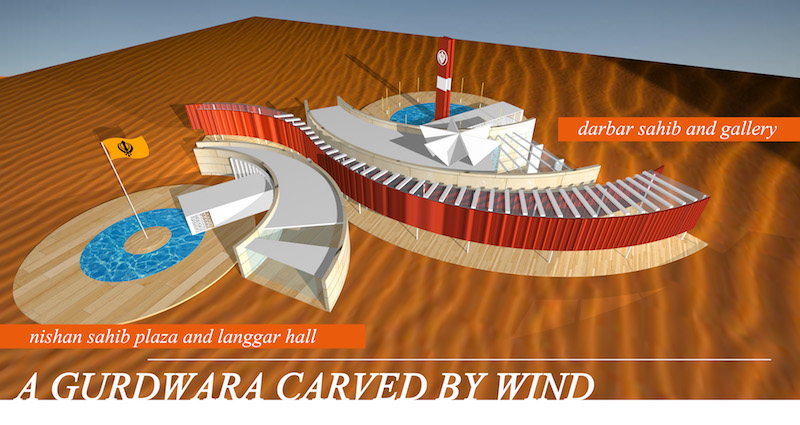
A gurdwara carved by Sahara winds – Visual by Vishal
By Vishal J. Singh
The desert is a fascinating place.
Exotic and ruthless at the same time, it truly presents a surreal landscape of curves of graceful formations and scorching waves of heat, making living here a daily challenge for the inhabitants of this part of the world. However, life, being as resilient as it is, has still found a way not only to survive in such harsh conditions, but in some instances even thrive and prosper in the most unlikeliest of places within the landscapes of the desert. And this of course includes us human beings as well and where human beings come together, inevitably commerce and culture will begin to take shape and society starts to flourish.
Along with the development of commerce and culture, which are the backbones of societal progress, cities too, will start to take shape, which is only a natural extension of the needs of humanity to survive, to socialize, and to eventually succeed in the greater scheme of things. In the past two decades or so, one part of the world where things have really progressed at an astonishing pace is in parts of the Middle East, undoubtedly fuelled by the wealth generated through oil-based revenues.
Dubai in particular has seen tremendous progress on its shores, where it almost seems as if an entire city of steel and glass seemed to have appeared out of nowhere, akin to a modern day mirage found in a desert. Surrounding the merciless sands that border Dubai, a world famous Gurdwara, The Guru Nanak Darbar was built and now stands as being one of the most well known in the world. Inspired by history and culture, the Guru Nanak Darbar projects a majestic identity celebrating architectural tradition, and lovingly serves the sangat of Dubai.
However, as an architect, I can’t help but wonder that if I was given a chance to design a Gurdwara in a desert, how would I go about accomplishing such a privileged task and what design strategies would I employ when setting out such a blessed commission. And so, in this article, I visualize myself in a position where I was asked to design a Gurdwara in the Middle East and allow my imagination take a fanciful flight to purely engage in a hypothetical situation.
[CHECK OUT ASIA SAMACHAR FACEBOOK PAGE FOR THE DESIGNS]
Before I continue, let me please make it perfectly clear that design being proposed here is not an alternative design to the The Guru Nanak Darbar in Dubai, but simply my personal interpretation of what I would like a Gurdwara in the desert to be, and the inspiration for the design, in terms of material and form, comes from the very landscape in where the proposed Gurdwara is situated.
In architectural circles, there are some architects who believe that the best designs are directly inspired by the sites in which those buildings are based. This approach, where the design of a building is based on its environment is called an architecture that follows “The Analogy Of The Landscape” and for this design, this was the strategy that was used as a concept. In studying the topological features of a desert, there emerges a certain visual and tactile palette of forms, materials and colours that precisely reflect the environment of the desert. The most obvious of these elements is the sand itself, which gathers and curves as silhouettes and dunes in the landscape, generally in light beige, possessing a fine or coarse texture.
A gurdwara carved by Sahara winds – Visual by Vishal
It is this physical characteristic of the sand itself and all the wondrous forms it naturally takes, carved by wind, that serves as the primary inspiration behind the design of this Gurdwara, in terms of planning, form, materiality and aesthetics, and the end result of the design is meant to allow the architecture of the Gurdwara to visually “blend” in with the landscape itself [Photo 1].
The general form of the Gurdwara follows a curvilinear shape, inspired by the curves found in sand dunes and silhouettes. It is a physical attempt to create a connection with the environment, by mimicking the curved formations found in the desert into the very structure itself, resulting in a graceful building composition.
The front visually incorporates elements of the desert, which includes light stone finishes for walls and floors related to the colours of the sand. The dome is a folded triangular dome, inspired by Bedouin tents, and a water plaza, reminiscent of an oasis, marks the entrance. Symbolically water in the desert represents the very essence of life itself, and the location of the water plaza here signifies the flourishing of life within the complex of the Gurdwara in such an unforgiving locale.
The entrance is a long sheltered corridor inspired by intricate geometrical patterns typically found in many buildings in the Middle East, which leads straight into the complex and into the Darbar Sahib on the left. These screens are culturally important in this part of the world, but also serve to allow for winds to flow through while providing shading from the scorching desert sun.
A gurdwara carved by Sahara winds – Visual by Vishal
An open gallery (or atrium) allows wind to flow from one end of the Gurdwara to another and also serve to ventilate the interiors of the complex naturally where possible, and provide open verandahs and corridors for the Sangat to walk through unhindered from anywhere they like along the building [Photo above].
The same open gallery or atrium (Photo 4) curves along the whole building, allowing wind to flow from one end of the Gurdwara to another and its form and colours are meant to convey the same graceful curves found the desert landscape.
And finally, the long sheltered corridor that marks the entrance of the Gurdwara goes right through the end where it leads to the Nishan Sahib Plaza and the Langgar Hall, also adopting a curvilinear form in its appearance. The Gurdwara is solidified by strong stone walls of a light beige colour meant to connect closely to the material components and visual elements found in the desert, and its presence helps to shade and cool the interiors of the building as well.
The proposal for this Gurdwara honours and pays respect to the unforgiving environment it is based in, and to view that environment not as a source of difficulty, but as a source of inspiration. It is meant to serve as a testament that like the Gurdwara, the Sikhs themselves take inspiration from the challenges they face everywhere they go, and via the true spirit of ‘Chardi Kala’, inevitably overcome such challenges and obstacles to emerge triumphant in the face of adversity. This Gurdwara is a physical representation of that idea of Sikhs and their culture being strong and resilient, expressed in architectural form, and is meant to celebrate the strength of that faith and culture on the world stage.
[NEXT: The next proposal will centre on the idea of building a Gurdwara placed in a winter landscape, such as the mountains of Scandinavia or the Himalayas, as a tribute to the coming year end festivities]
Vishal J.Singh, an aspiring architect, holds a Bachelor of Architecture Degree from Infrastructure University Kuala Lumpur and enjoys engaging in architecture and its theories as his first love.
* This is the opinion of the writer, organisation or publication and does not necessarily represent the views of Asia Samachar.
[ASIA SAMACHAR is an online newspaper for Sikhs in Southeast Asia and surrounding countries. We have a Facebook page, do give it a LIKE. Follow us on Twitter. Visit our website: www.asiasamachar.com] 16883
[Fastest way to reach Asia Samachar: Facebook message or WhatsApp +6017-335-1399. Our email: editor@asiasamachar.com. For obituary announcements, click here]
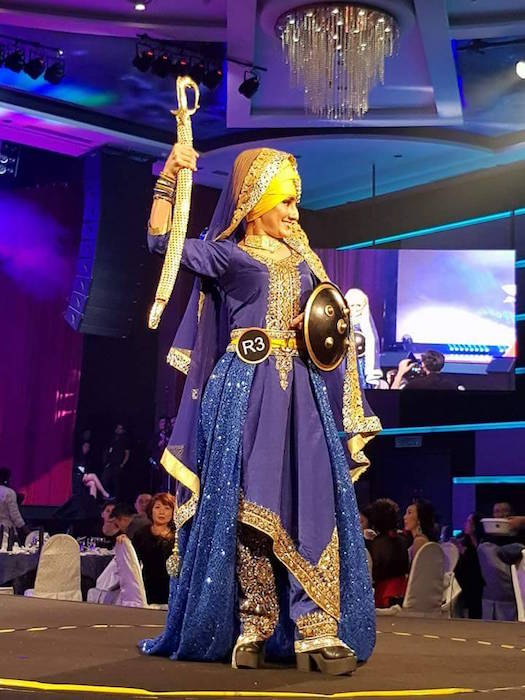
PRINCESS KNIGHT: Harjinder Kaur Seran all dressed in the Sikh attire, complete with Sri Sahib (sword), a shield and a turban
A Sikh lady warrior in a beauty pageant? That’s exactly what Harjinder Kaur Seran tried to portray in a recent beauty pageant in Kuala Lumpur. She went on stage in the Sikh bana, complete with a sri sahib (sword) and a shield. She also spotted a turban.
The princess knight, a mother of three daughters, certainly caught the eye of the crowd at the Mrs. Malaysia & Borneo International Global 2017 pageant, winning the Mrs. Popularity 2017 award.
“It was like a sudden idea planted by some Supreme Power. I had no control over it,” she told Asia Samachar when asked how did the idea come about.
On the whole, she was thrilled to be part of the competition.
“I felt proud to bring forward our Sikh warrior costume at the pageant. Truly felt like a Warrior at the ramp,” she said.
Harjinder Kaur Seran (middle) won the Mrs. Popularity 2017 at the Mrs. Malaysia & Borneo International Global 2017 pageant – Photo / Supplied
[ASIA SAMACHAR is an online newspaper for Sikhs in Southeast Asia and surrounding countries. We have a Facebook page, do give it a LIKE. Follow us on Twitter. Visit our website: www.asiasamachar.com] 16874
[Fastest way to reach Asia Samachar: Facebook message or WhatsApp +6017-335-1399. Our email: editor@asiasamachar.com. For obituary announcements, click here]



















 By Manika Kaur | Reflections