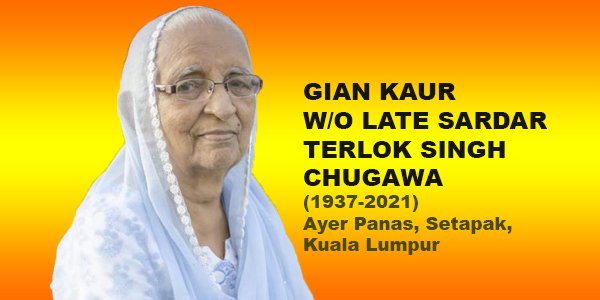
PATH DA BHOG:7 March 2021 (Sunday), 9.00am-11.30am, followed by Guru Ka Langgar at Gurdwara Sahib Selayang Baru | Malaysia
KALEH AYE NANAKA SEDHE UTH JAYE
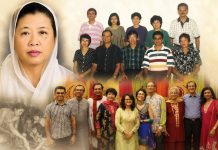
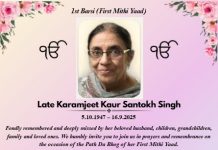
LATE MATA JI JOGINDER KAUR W/O LATE SARDAR KARAM SINGH (Ex Sentul Railways)
(18.7.1930 – 23.2.2021)
Age: 91 Years
You will be dearly missed, fondly remembered and forever cherished
Leaving behind children
Dr Sohvinder Kaur (Malacca) / Dr Kulwant Singh
Late Baldev Singh
Munjeet Singh (Seremban) / Jagdish Kaur
Balbeer Singh (Selayang) / Nermal Kaur
Davinder Kaur (Cheras) / Jasbeer Singh
Pritpal Singh (Seremban) / Jasminder Kaur
Jaspal Singh (Seremban) / Balbinder Kaur
Brother & Sisters (Punjab, India)
Grandchildren, Great Grandchildren, Nephews & Nieces, In Laws, Family & Friends
Sahej Path Da Bhog: 7 March 2021 (Sunday), 9.00am-11.30am, followed by Guru Ka Langgar at Gurdwara Sahib Selayang Baru
Contact : Balbeer Singh (012-2072156)
| Entry: 4 March 2021 | Source: Family
ASIA SAMACHAR is an online newspaper for Sikhs / Punjabis in Southeast Asia and beyond.Facebook | WhatsApp +6017-335-1399 | Email: editor@asiasamachar.com | Twitter | Instagram | Obituary announcements, click here |
Seasoned banker Manjit Singh joins Sun Life Financial Inc, Canada’s second largest insurer by market value, as its executive vice-president and chief financial officer.
Prior to this, Manjit had spent close to two decades at TD Bank. His most recent designation was executive vice president for enterprise finance.
With more than 25 years of finance, strategy, risk and treasury experience, Manjit has worked in financial services both in Canada and internationally.
In his new role, Manjit will have responsibility for leading Sun Life’s Finance organization, including finance, tax, capital, corporate development, investor relations and strategic finance initiatives including implementation of the new IFRS 17 accounting standard. He will also be a member of the executive team, according to a statement by the Toronto-based insurer.
He was also a board member at of Lung Cancer Canada, TRIEC, Sikh Foundation of Canada and the American Red Cross.
A native of Mississauga, he holds a Bachelor of Arts degree from the University of Waterloo and Masters of Business Administration from the Richard Ivey School of Business. He is a Fellow of the Chartered Professional Accountants (CPA) of Ontario, has earned the CFA designation, and completed the Advanced Management Program at the Harvard Business School.
Manjit is married with two teenage daughters and lives in Mississauga.
Sun Life provides insurance, wealth and asset management solutions. It has operations in Canada, US, UK, Ireland, Hong Kong, the Philippines, Japan, Indonesia, India, China, Australia, Singapore, Vietnam, Malaysia and Bermuda.
ASIA SAMACHAR is an online newspaper for Sikhs / Punjabis in Southeast Asia and beyond.Facebook | WhatsApp +6017-335-1399 | Email: editor@asiasamachar.com | Twitter | Instagram | Obituary announcements, click here |
Insert: One of the promotional material from a UK-based Sikh organisation
By Baldev Singh Dhaliwal | OPINION |
Now that the UK Census for 2021 are fast approaching, the Sikhs are being advised by the leading UK organisations, to write SIKH under “Other”. For some time now there has been a concerted push and demand by a majority of UK Sikh organisations (debated on Sikh networks) to obtain a dedicated SIKH tick box on the Census form under Ethnicity. As that has not been successful, now the advice therefore is to write SIKH under “Other” on the Census form. The reasoning remains the same.
At the peak of that previous debate about getting a dedicated SIKH tick box I had put forward my reasoning as a Sikh Australian, which I re-produce below.
Every time the Census time comes around, we, the Sikh Australians, are divided as to what a Sikh should write under the question of ANCESTRY, which is the equivalent of UK’s ETHNICITY question. Perhaps to be divided, by now, is an established Sikh trait!
What has puzzled me somewhat though is as to why a Sikh writing down “Sikh” under the ETHNICITY question (in UK) or therefore the equivalent question ANCESTRY (in Australia) is committing some sort of a sin against Guru Nanak’s Sikhi principles, as is being repeatedly suggested. If so, many of us have been committing that sin every time we have filled the census form and by that same reasoning continue to do so when we think of Sikhs as some sort of an identifiable group. Yet fill that census form and answer the ethnic question truthfully we must, by ticking a box or writing under other, as our civic responsibility. Wonder why this issue of somehow transgressing from Guru Nanak’s Sikhi principles has risen only since the push for a “Sikh” tick box under the ethnicity question?
Regarding the SIKH tick box: To me asking for the provision of a Sikh tick box under the ethnicity question is doing what we have been doing before, only better. It gives a clear choice for those in doubt. One will always have the choice to tick some other box or write what they wish under “other” as before, if they so wish. Sikhs have always been responsible citizens of the countries they have lived in. By demanding a Sikh tick box they were simply exercising their legitimate right. With the Sikh tick box the outcome might be a better demographic picture of the community for monitoring, access & equity and other similar purposes. In my opinion it would have been irresponsible not to push for that right. Accurate statistics and numbers do matter.
Most Sikhs, believe that they are a distinct identifiable group (more than a religion) under whatever name; Panth, Qaum or Nation. If it was not clear before, Guru Gobind Singh Ji left little doubt about the Niara Khalsa and Panth! The question does come to mind: Were the Sikh regiments formed just on the basis of religion or was there more? As regiments in the name of religion are generally not heard of. I could be wrong.
Just to recap on the Ethnic question [which really should be the main focus], the definition of Ethnicity, for the purpose, is provided under the UK Government Web Archives:
Department of Health
National standards for ethnic group and related matters
What is an ethnic group?
Ethnicity is complex to define as it is multi-faceted. Importantly, ethnicity is subjective: a person should self-assign his or her own ethnic group. While other people may view an individual as having a distinct ethnic identity, the individual’s view of their own identity takes priority. Features that help to define ethnic group are as follows:
a shared history;
a common cultural tradition;
a common geographical origin;
descent from common ancestors;
a common language;
a common religion; and
forming a distinct group within a larger community.
I suspect in the Mandla case the Lords elaborated and applied theabove National Standards, in the case of the Sikhs. Guided of course by community mentors plus their own knowledge about the Sikhs particularly in regards to the Sikh Regiments.
In reference to Australia, the Australian census pamphlet starts in bold print, “Your community is counting on YOU”. Clearly drawing one’s attention to the importance of the Census. The pamphlet explains, “Information provided on the Census form helps to provide an accurate picture of their communities. Census information also assists in the fair allocation of government funds to ethnic communities.” Then the pamphlet draws one’s attention to the most important questions, these being of language, ancestry and religion.
So for the purpose of the census the term “Ancestry” (in Australia) simply means an identifiable, meaningful group with common characteristics, for the purpose of collecting demographic information essential in developing policies and services, for monitoring purposes, for distribution of resources, special needs, issues etc. In the case of UK (or for any other country) it would be no different.
Ethnicity question in UK and Ancestry question in Australia clearly are for the same purpose. The authorities are looking for meaningful identifiable groups. And the Sikhs fit into that requirement. Seems a no brainer! The argument that if the Sikhs unite under that group it will somehow compromise Guru Nanak’s Sikhi principles is simply pointless and a red-herring!
Somewhere, Dya Singh of Australia wrote, “If you are not counted, you don’t count”
Regarding the UK forthcoming Census I can add, “As a Sikh if you write anything other than SIKH under Ethnicity you are helping to score your own goal.”
[Baldev Singh Dhaliwal JP-Ret’d British Telecom engineer settled in South Australia since 1986, and involved with community cohesion, Sikh welfare and advancement. He received the South Australia Governor’s Multicultural Award for 2011]
ASIA SAMACHAR is an online newspaper for Sikhs / Punjabis in Southeast Asia and beyond.Facebook | WhatsApp +6017-335-1399 | Email: editor@asiasamachar.com | Twitter | Instagram | Obituary announcements, click here |
By Lakhpreet Kaur and Simran Jeet Singh | Teen Vogue |
Since November of 2020, hundreds of thousands of Indian farmers, laborers, and allies have flooded the Delhi border to protest against new agricultural bills that they feel will undermine their livelihoods. Protesters have set up temporary housing camps demanding change through speeches, marches, and strikes. While the protesters themselves have been largely peaceful, the Indian government’s forceful response has caught the attention of observers around the world concerned about significant allegations of human rights abuses.
And yet, despite the reports of police brutality, questionable detentions, and repression of free speech, the protestors remain undeterred. More people continue to join the demonstrations daily, making it one of the largest protest movements in modern history. The protesters have been on the streets for more than two months, enduring the brutal cold of winter in North India — and they have no plans to go home anytime soon.
In a sea of elderly people, one strikingly younger face is a mainstay. With her long black hair pulled into a ponytail, switching flawlessly between Hindi, Punjabi, and English, Dr. Ritu Singh can often be found standing before a camera, giving fiery interviews in support of the farmers.
“This moment has awakened so many people who were sleeping,” she tells Teen Vogue. “It has awakened those who never thought about what we are eating, and that what we have [on] our plates is because of those who work so hard in their fields each day in order to feed themselves and to feed us all.”
While proponents of the farm bills say they will modernize Indian agriculture, opponents say they are “anti-farmer” and likened them to a “death warrant.” Many farmers are concerned that the new legislation will facilitate a corporate takeover of small farms and further reduce the power of agricultural workers. About 58% of India’s 1.3 billion people rely on agriculture as their primary source of income, and farmers comprise a substantial voter block in India, making farming a central political issue in the world’s largest democracy.
The farmers protest has garnered support internationally, from global figures like Rihanna and Greta Thunberg, and locally, from Indian activists, artists, and students. “Dr. Ritu,” as she is lovingly known among the protestors, is one of the latter who is using her voice to stand up for the working class.
Dr. Ritu is a psychologist and social activist who approaches advocacy by working from the ground up: attending farmers meetings with men, speaking with women farmers about their needs, and sharing their concerns through YouTube videos and media interviews. “As an activist, my primary role is to make people aware of the negative impacts of these newly passed farm laws,” she says. “That’s why I need to be connected with the farmers.”
Dr. Ritu has been connected with farmers her entire life. Although she currently lives in New Delhi, she hails from a farming family and agrarian community in Tarn Taran Sahib, Punjab. These personal roots drew her to the farmer protests as they spread to India’s capital in November.
“I had been closely following the farmer protests in Punjab, and when I found out that they were coming to the borders of Delhi to protest the farm laws, I wanted to go be with them,” she says. “I went to the Singhu Border just to experience the moment and to stand in solidarity with them. I was so moved that I have been joining them regularly ever since.”
Dr. Ritu immediately became a notable presence at the Delhi protests. Many of the farmers are older men. She’s a young woman with advanced degrees and is unrelenting, unapologetic, and unwilling to take sh-t from anyone — especially from the government.
She attributes her outspoken activism to being raised in a feminist household. “From the beginning, my parents have always given us full freedom and full confidence. They would tell us often that it’s our responsibility to fight for our rights and raise our voices against injustice.”
Dr. Ritu was born into a faith, Sikhism, that advocates for gender equality; she was also born into a culture that is deeply patriarchal. While her family’s staunch feminism fits within Sikh worldviews and practices, it runs counter to how many in her community perceive and treat women.
See the full story, ‘India Farmer Protests: Women Like Dr. Ritu Singh Are on the Front Lines’ (Teen Vogue, 1 March 2021), here.
ASIA SAMACHAR is an online newspaper for Sikhs / Punjabis in Southeast Asia and beyond.Facebook | WhatsApp +6017-335-1399 | Email: editor@asiasamachar.com | Twitter | Instagram | Obituary announcements, click here |
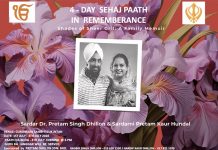
AKHAND PATH: 5 March 2021 (starting @ 8.30 am) to 7 March 2021 at Guru Nanak Darbar Tatt Khalsa Diwan Gurdwara. PATH DA BHOG around 11.00 am on 7/3/2021 | Malaysia
ASIA SAMACHAR is an online newspaper for Sikhs / Punjabis in Southeast Asia and beyond.Facebook | WhatsApp +6017-335-1399 | Email: editor@asiasamachar.com | Twitter | Instagram | Obituary announcements, click here |
By Mark Mathen Victor | The Sun Daily | Malaysia |
OUTSHINING other contestants to clinch second place in the finals of the inaugural The Harvinth Skin Fans’ show last month, Shaunvinder Singh, 22, gave a remarkable performance by playing contemporary music using traditional Indian instruments to display his talent.
Although the show boasted vocally-diverse talents, Shaunvinder set himself apart from the others, captivating the judges by showing his finesse in playing the dhol and tabla, hence transcending music boundaries.
The Harvinth Skin Fans’ talent show was created by comedian and YouTuber Harvinth Skin. The show initially began on a small scale, literally inside the comedian’s car but was later turned into an actual show, intended as a platform to showcase Malaysia’s diverse talents.
Seeing it as an opportunity to bring his talents to a bigger platform, Shaunvinder seized the opportunity and took part in the show.
“I analysed the show and saw that there were many singers with various talent. I asked myself what would make me stand out from the others.
“The idea was to be creative and to get the judges on the edge of their seats. I think I managed to do that,” said Shaunvinder, who goes by the stage name Shaunvinda.
A computer science graduate, the aspiring musician revealed that music had begun as a hobby, before it progressively became more important after he began posting his music on social media.
Read the full story, ‘Musician Shaunvinda uses traditional percussions to play modern music‘ (The Sun Daily, 23 Feb 2021), here.
ASIA SAMACHAR is an online newspaper for Sikhs / Punjabis in Southeast Asia and beyond.Facebook | WhatsApp +6017-335-1399 | Email: editor@asiasamachar.com | Twitter | Instagram | Obituary announcements, click here |
She snuggled under the thick blanket, knowing well that she was already late for bedtime. Her mother glared at her, because she was still trying every trick in her book to prolong the inevitable. She needed to sleep, because half past ten was too late for a precocious 9 year old girl. She threw her last dice.
“Mama, can you and Papa please kiss? I wanna see you two behave like a real husband and wife…”
We both instantly knew what this was about even though it was a new trick. She has been getting night frights, which wasn’t really a surprise for us because this was a girl with a wild imagination, sometimes in overdrive. This coupled with her access to YouTube and short burst of Netflix meant for adults when she ‘accidentally’ walks into her sisters catching up with their horror fix, her conjuring scary images was not unexpected.
Being afraid of the dark meant she got to share the bed with me and her mother. This instantly meant that I had to find substitute sleeping arrangements from the ones I share with my beloved wife. After a week or so, this young daughter of ours, after successfully occupying my comfortable space with my lover, was supposedly hit with guilt that I was no more playing the role of a husband to her mother.
Hence, the request for a show of affection and intimacy.
We both smiled and obliged her very willingly. It wasn’t really something that we’ve kept hidden from our children since their births. I mean, we don’t get down and dirty in front of them, but a touch on the waist, holding hands, a peck on the cheek or on the neck was fairly par for course.
But this request of our daughter, even though cunning in intent to buy more time before forced bedtime, got me thinking. Are we, my wife and I, being a little too liberal exhibiting affection and intimacy to our children? Being of Asian and Punjabi background, modesty seemed like the overriding trait that we are supposed to exhibit. Dare I say, we have a somewhat conservative culture. I never saw my parents nor my uncles and aunts being openly affectionate with each other. Sure, there’s banter and there’s laughter back and forth between couples, which blanketed as a lack of animosity or dislike. If there was an argument, the making up was more vocal than physical.
But showing affection through physical touch, through affirmative sayings like “I love you” or “I’ve missed you” out in the open, in front of their children or with other family members, was very far in between. Perhaps it was the sign of the times then. While some of them seemed steep in the more liberal Western ideals and even Western education, almost all couples of past generations never embraced romantically in the open.
We do, however, have a lot of platonic embraces. Hugging is a big thing in our culture. Just observe our celebrations like weddings or birthdays.
Back to my question. I decided to test my elder daughters. How do they genuinely feel about our affectionate touches?
“Sometimes it’s just cringe lah Papa”, says the younger louder one. My surprised look gave her a more probing signal.
“I mean we can see lah when you guys kiss and giggle… and it’s honestly ok lah”, she recovers after a couple of seconds.
“Would you rather we don’t?” I took aim at the eldest, now a full blown sixteen year old teenager. “You know, like when me and Mama sometimes fight?”
She was more convincing and deliberate. “Of course not! We’re really used to it, especially when it’s just so normal in the tv shows we watch. So, I don’t even notice you guys anymore. I’d rather you be you, Papa. It’s cool”
I was satisfied with this answer but even more proud with her matured response, and her respect for my individualism. Perhaps she would be able to articulate the impacts of all this when she’s a full blown adult, I hope.
I also hope my affection to my wife, in the amounts shown to them today, would be a platform of memories of a simple loving family, caring for one another, filled with more kisses than arguments.
Jagdesh Singh, a Kuala Lumpur-based executive with a US multinational company, is a father of three girls who are as opinionated as their mother
* This is the opinion of the writer, organisation or publication and does not necessarily represent the views of Asia Samachar.
ASIA SAMACHAR is an online newspaper for Sikhs / Punjabis in Southeast Asia and beyond.Facebook | WhatsApp +6017-335-1399 | Email: editor@asiasamachar.com | Twitter | Instagram | Obituary announcements, click here |
Sehajpreet Singh had volunteered for a number of initiatives as the world underwent a Covid-19 pandemic. The 17-year old senior high school student from Bayside, Queens, was one of give young people picked up by the New York Times.
“As a Sikh in New York, you are aware of racist behavior but nothing like what happens in other parts of the country,” Sehajpreet told the newspaper. “Hearing stories from someone from the same culture and religion and how poorly they’ve been treated made me feel really sad. I haven’t experienced that here.”
Read the full story, ‘These 5 Teenagers Managed to Volunteer This Year. Here’s How.’ (New York Times, 26 Feb 2021), here.
ASIA SAMACHAR is an online newspaper for Sikhs / Punjabis in Southeast Asia and beyond.Facebook | WhatsApp +6017-335-1399 | Email: editor@asiasamachar.com | Twitter | Instagram | Obituary announcements, click here |
By Karminder Singh Dhillon | Sikhi Concepts | Part 9 of 12 |
What is the narrative of Dhrm Raj within Gurbani? We can develop the basic principles by examining some verses that discourse the concept.
The first thing Gurbani does is to REMOVE the myth of Dhrm Raj. The second thing Gurbani does is to ELIMINATE the fear that has been instilled by the purveyors or transmitters of this myth.
Meaning: My Guru has provided me with a bounty of enlightenment. As a result of which a deceit has been exposed and removed from my mind. The deceit of Dhrm Raj cannot work on me as I have done my own accounting within, I have torn up, I have shredded this entire myth of accounting in the afterlife.
The myth is destroyed and the fear is eliminated. The notion that I do my own accounting of my deeds WITHIN – is being introduced in place of the myth.
Meaning: I have realized Divine virtues and discarded human vices. In so doing – I have shredded the account books of the concocted Dhrm Raj. (I have destructed the entire notion of Dhrm Raj as an entity of any function in the afterlife.).
Again, the myth is destroyed and the fear of Drhm Raj in the afterlife is eliminated. The notion that I do the accounting of my spiritual deeds WITHIN myself is being emphasized.
Meaning: The One Creator resides in the entirety of my mind. His divine Virtues are ingrained therein. (As a result) I have ransacked the office of the concocted Dhrm Raj and have left nothing to be accounted for therein.
The message is clear. Ransacking the office is idiomatic for saying for me the myth of Dhrm Raj – the judge, the court, the judgement – all of that does not exist. Why? Because I account for my actions to the Creator Within – and that is the only judge, court and judgement that I am concerned with.
Meaning: The Creator has blessed me with realization within. Nanak, the account papers of the concocted Dhrm Raj do not exist for those beings who have become enlightened of the reality of accounting of our deeds.
The message is clear again. As far as Gurbani and Guru Ram Das ji is concerned, the reality of accounting of our deeds does NOT involve Dhrm Raj.
Verse 5: Guru Ramdas ji says again on page 1326 of the SGGS.
Meaning: I have discarded ego and all desire for worldly pride; and come into the company of my Guru. He has removed the subjugation and fear of the concocted Dhrm Raj and pulled me out from the debilitating fear of the invented myth.
In summary, the Gurbani position pertaining to the concocted myth of Drhm Raj as the judge in the afterlife is as follows:
The beginning point of Sikhi is that the Creator is Within. If the Creator is within. Then His court is within. If the Court is Within then the judge is also within. And the judgement is within.
Gurbani has also REDEFINED the concept of Dhrm Raj. Raj means Kingdom and Dhrm means spirituality.
So Not only is the Creator, His court, His judgement and the judge who is within. The kingdom (Raaj) is also within. The Kingdom within is one of spirituality (Dhrm). So Dhrm Raaj is when spirituality reigns within us. The Entity That Sits On the Throne of Spirituality Within Is Our Conscience. So Dhrm Raj is when spirituality Reigns within our conscience.
Meaning: My Guru has blessed my temporal world. All my senses that were engaged in evil thoughts, speech and misdeeds have all begun to function to serve You O Guru. You are the Creator, You the sustainer, you reside within all. In such realization, the Kingdom of Spirituality has been wondrously installed within me. All my senses have surrendered to become subjects of this Kingdom of spirituality within.
It is clear that the Dhrm raj of Gurbani is an entirely different concept and no relation whatsoever with the Dhrm raj of the pre-1468 beliefs and that of the 4,000 year old Canvas. The latter has to be discarded and the former inculcated. The myth of Dhrm raj must be removed from our spiritual mindsets to make space for the Kingdom of Spirituality or Dhrm raj of Gurbani. Only then will we be able to establish the Raj of Dhrm within our minds and conscience IN THE HERE AND NOW.
Verse 7: Bhagat Kabir makes his choice and lets us know about it on page 1158 of the SGGS.
I have no conflict in my mind whatsoever. No struggle within me anymore. (I have achieved such as state because) I have discarded all the claims of the clergy.
All that the clergy of Pandit and Mullah have presented us I have discarded while walking the path of my spirituality. I discarded it all and have accepted nothing at all.
This kind of an overhaul of our belief system and psyche is necessary to allow the truths of Gurbani to find space within us.
Meaning: (The Outcome of the discarding is that) I am able to fill my cleansed mind with pure love for my beloved Creator and fill it with love of the Creator; enabling me to Contemplate Within the self and bring about realization of the Creator within.
We need to note that whenever and wherever the words Dharm raj or Dhrm Rai appear within Gurbani it appears in two contexts. The first is in the context of the pre-1469 beliefs namely the Dhrm Raj of the afterlife. When used in this context – the purpose of the Bhagat or Guru is to destruct the myth, critique it as unacceptable, point out its un-believability and its non-acceptance, and to declare that I am above such a myth. That I have ransacked that office, that I have torn up all the papers therein.
The second usage is in the redefined context. Dhrm Raj in the Gurbani context is the Kingdom of Divine Spirituality that we need to build within us.
Our task – as Sikhs of Gurbani within the Sri Guru Granth Sahib (SGGS) – is to be able to know which of the two contexts are being applied by the composer of the shabd.
In essence then, what Gurbani has done is to Liberate us from the entire pre-1468 Canvas. To free us from the debilitating and crippling fear of the clergy concocted concepts of the 4,000 year old canvas.
When you stop fearing the Drhm Raj of the after life, you start to construct the Raj of Dhram in the Here and Now. When you discard the concocted notion of Dhrm Raj in the after life, you acquire the Gurbani notion of Drhm Raj. You start to build the Kingdom (Raj) of Divinity (Drhrm) within yourself in the Here and Now.
Sikh thinker, writer and parcharak Karminder Singh Dhillon, PhD (Boston), is a retired Malaysian civil servant. He is the joint-editor of The Sikh Bulletin and author of The Hijacking of Sikhi. He can be contacted at dhillon99@gmail.com.
ASIA SAMACHAR is an online newspaper for Sikhs / Punjabis in Southeast Asia and beyond.Facebook | WhatsApp +6017-335-1399 | Email: editor@asiasamachar.com | Twitter | Instagram | Obituary announcements, click here |
Most countries around the world categorise their inhabitants by race, ethnicity, and/or national origins, but how and for what purposes such data is collected can vary considerably. Motives can range from counting for political control, non-counting in the name of national integration, recognition of national hybridity, and development of anti-discrimination policies.
Counting for political controlling purposes is typical of colonial census administration, and the British were particularly adept at this. Additionally, we see related examples, such as apartheid-era South Africa, the Soviet Union, Bosnia, Serbia and Rwanda, where racial origins discourse was deployed, for keep population groups separated and exclusionary policies, up to and including genocide or what was euphemistically termed ‘ethnic cleansing’.
In relation to the rejection of ethnic identities in the name of promoting national unity, typically Western European nations, such as France, Germany, Italy and Spain are prominent. In these cases one also needs to note the history of state led violence, as in the case of the Nazis, and racial and ethnic divisions.
In terms recognition of hybridity, we see this in many Latin American countries, where governments take different decisions about whether to enumerate by ethnicity. However, in such cases we see a broader discourse praising interethnic mixture or hybridity.
The final category is characterised with examples from Latin America (e.g., Brazil, Colombia) and Asia (China and India), but the principal cases discussed here are those of England, Canada, and the United States. In these case ethnic census data serve as tools in combating discrimination.
Across the world, we can see any number of terms employed to categorise people, associated with ‘race’, caste, ethnic origin, religion, language, nationality, ancestry, country of birth, tribe, social status, indignity and so on. A further complication is the way in the meanings of these terms may differ across time and place; what is called “race” in one country might be labeled “ethnicity” in another, while “nationality” means ancestry in some contexts and citizenship in others. Even within the same country, one term can take on several connotations, or several terms may be used interchangeably. A further complication is the issue translation where concepts are simply not equivalent. Perhaps the best example of this concerning Sikhs directly is the concepts of quom and panth which do not have precise equivalents in the English language.
Along with the issue of definition, another important issue is one of consent, legitimacy and efficacy. Who for example, decides the labels? do citizens have a choice to refuse them?
Moreover, sociologists remind us that data collection essentialises, (reduced them to a singular entity) ethnic groups that ironically can lead to compounding of race discrimination.
Turning to the U.K. Census that is to be held on the 21st March this year, we see a strange conflation of community identity politics with a genuine attempt by the British Government to gain an accurate picture of national diversity.
Though the Census should be a non-political exercise linked to collecting data on the population in order for government and public bodies to make effective policies, over the past 30 years it has increasingly become a proxy for Indian sub-continent identity politics; it seems more like an election campaign than a data collection exercise!
Over the coming weeks, I have no doubt there will be much ‘electioneering’ with all the various ‘representative’ groups falling over each other to tell people how they should identify themselves. I thought the whole point of the census was for citizens to exercise their right to decide how they perceive their own identity, rather than be blackmailed by self-appointed leaders, who mostly have little concern about the daily struggles of ordinary citizens.
Amongst other things, we have recently seen the appearance of graphics on social media ‘advising’ members of specific communities which boxes they should tick. Amongst other things, this has sparked off a wave of politics of identity amongst the various South Asian communities settled in the U.K.. One such graphic from Vishva Hindu Parishad U.K. offers very clear advice how Hindus should identify themselves. Bizarrely, under ‘National Identity’, the graphic advises Hindus in Pakistan and Bangladesh to write ‘Pakistani Indian’ and Bangladeshi Indian’. Besides the obvious oxymoron, the implication is that ALL Hindus are in some way Indian! The irony is that, just like the Hindu faith, the mythical ’India’ they refer to has never existed as a singular entity.
In a similar vein some Sikh groups, most notably groups allied to the Sikh Federation UK, have also been seeking to influence people to tick boxes to maximise the Sikh count under religion and ethnicity. However, like voting in an election, though we should listen to all the arguments, we should not be coerced or intimidated into making choices against our free will.
And so at the moment, exercising my free will, I have decided to completely reject the Indian category. This is not because I harbour any hatred or malice towards ‘India’ or those who identify as Indians. That would be absurd. My rejection is simply because I do not feel I can identify with such a vast and diverse entity as India which only came into existence due to British colonialism.
So personally, I am unsure what to put in the ethnicity box; my mind says Panjabi but my heart says Sikh.
For what it’s worth, I think the central problem is that Sikhs are neither a “religion’ or a ‘nation’ but a people or ‘quom’. There is no English language equivalent to this concept, so, the ultimate resolution would be to have a different category, where perhaps Sikhs, Jews, and other nations that are not bounded by anyone geographical space. In truth people of the Sikh Quom are to be found across the world though for historical reasons we are concentrated in Punjab at the moment.
My position is this: absolutely make sure you tick the Sikh box in religion and Punjabi in Language. As for the ethnicity box, you decide where you fit in, though I am inclined to write in British Punjabi. But even more importantly, do NOT follow my advice but your own conscience and free will. Our identity is precious, which is why we should never allow others to tell us who we are or what we should think.
What will you be doing?
[Gurnam Singh is an academic activist dedicated to human rights, liberty, equality, social and environmental justice. He is an Associate Professor of Sociology at University of Warwick, UK. He can be contacted at Gurnam.singh.1@warwick.ac.uk]
* This is the opinion of the writer and does not necessarily represent the views of Asia Samachar.
ASIA SAMACHAR is an online newspaper for Sikhs / Punjabis in Southeast Asia and beyond.Facebook | WhatsApp +6017-335-1399 | Email: editor@asiasamachar.com | Twitter | Instagram | Obituary announcements, click here |