




Daljit leads Malaysian tourism delegation to New Delhi
| New Delhi India | 31 Jan 2016 | Asia Samachar |

Malaysian Tourism Promotion Board director Daljit Singh led a group of 50 Malaysian travel trade players and state tourism authorities to the South Asia Travel and Tourism Exchange (SATTE) in New Delhi, India.
The three-day exhibition ends today (31 Jan 2016).
India is one of the top 10 tourist generating markets for Malaysia with some close to 800,000 Indian tourists visiting Malaysia in 2014, according to one online news report.
SEE ALSO: Malindo booking for Amritsar opens today
Daljit, a former senator and a central committee member of Indian-based political party MIC, is also the Indian community relation advisor to Minister of Tourism and Culture Mohamed Nazri Abdul Aziz.
In the recent months, Malindo Air had begun flights to Amritsar, Punjab, and now plans to fly to Lahore, Pakistan, by March 2016.
In December 2015,Singapore-based Scoot Airline had announced plans to fly to Amritsar from 2016 after securing all necessary licenses and no objection certificates (NOCs).
In an event at SATTE 2016, Daljit had presented a sketch book on Malaysia to India’s Minister of Union Tourism Culture and Aviation Dr Mahesh Sharma.
The Malaysian Tourism Promotion Board, or simply known as Tourism Malaysia, was established to promote Malaysia as an exciting tourism destination. In India, it has offices in Mumbai, Delhi and Chennai.
To boost Indian arrivals, Tourism Malaysia will encourage and persuade more tour operators to develop and sell holiday packages to Malaysia with a focus on niche products like luxury travel, shopping, and sports tourism.
A discussion will be carried out with the top travel trade associations in India, namely Travel Agents Association of India (TAAI), Travel Agents Federation of India (TAFI), India Tourism Golf Association, and Outbound Tour Operators Association of India (OTOAI), the same report added.
[ASIA SAMACHAR is an online newspaper for Sikhs in Southeast Asia and surrounding countries. We have a Facebook page, do give it a LIKE. Follow us on Twitter. Visit our website: www.asiasamachar.com]
RELATED STORY:
Malindo to fly direct to Lahore from March, tickets now on sale (Asia Samachar, 13 Jan 2016)
Senator Jaspal, Daljit win in MIC party election (Asia Samachar, 6 Nov 2015)
Amardeep journeys deep into Pakistan in search of Sikh legacy (Asia Samachar, 21 Sept 2015)
Malindo Air launches inaugural flight to Amritsar (Asia Samachar, 27 Oct 2015)
Amritsar-Singapore flight from summer 2016 (Asia Samachar, 14 Dec 2015)
Malindo, SpiceJet opens up Amritsar skies (Asia Samachar, 10 Oct 2015)
Malindo booking for Amritsar opens today (Asia Samachar, 2 Sept 2015)
BHAI MAHARAJ: A freedom fighter like few others (Asia Samachar, 20 Sept 2015)
Malaysia urged to relax visa service fee on Indians (Asia Samachar, 31 Aug 2015)
Malaysians now eligible for India e-Tourist Visa (Asia Samachar, 18 Aug 2015)
Amritsar-Kuala Lumpur flight from Oct – TRIBUNE (Asia Samachar, 6 Aug 2015)
Dentistry student Kiran crowned Miss Universe Malaysia
| Kuala Lumpur, Malaysia | 31 Jan 2016 | Asia Samachar |

Dentistry student Kiran Kaur Jassal was crowned Miss Universe Malaysia 2106 at the pageant finals in Kuala Lumpur yesterday.
It’s quite a moment for the 20-year old lass from Subang Jaya. Her mum, lawyer Ranjit Kaur, took home the main title at the Mrs Malaysia World 2015 pageant in October 2015.
“I believe that life is about taking chances and believing in yourself,” Kiran says in a Facebook update during the contest.
SEE ALSO: Lawyer Ranjit wins pageant, Soni and Rita pick up titles
Kiran, the youngest in a family of four, will represent Malaysia at the International Miss Universe pageant.
Mumbai-born Swarna Naidu emerged as the third runner up while Nisha Sema, an Indian-Japanese descent, came up fifth.
Kiran, the youngest in a family of four, was trained in classical harmonium for nine years from the age of seven. Kiran became active in public speaking competitions to overcome her stage fright.
A straight ‘A’s student throughout her schooling years, she dreams of running her own orthodontic practice.
A straight ‘A’s student throughout her schooling years, she dreams of running her own orthodontic practice.

[ASIA SAMACHAR is an online newspaper for Sikhs in Southeast Asia and surrounding countries. We have a Facebook page, do give it a LIKE! Visit our website: www.asiasamachar.com]
RELATED STORIES:
Miss Universe Malaysia Kiran Jassal grabs limelight (Asia Samachar, 5 April 2016)
Sarawak lass Harnesh a princess with purpose (Asia Samachar, 4 Jan 2016)
Dentistry student Kiran crowned Miss Universe Malaysia (Asia Samachar, 31 Jan 2016)
Sarawak lass Harnesh a princess with purpose (Asia Samachar, 4 Jan 2016)
Lawyer Ranjit wins pageant, Soni and Rita pick up titles (Asia Samachar, 27 Oct 2015)
Jagdeesh wins SME100 awards (Asia Samachar, 24 Oct 2015)
Robotic girl wins NCWO Young Women Award (Asia Samachar, 25 Aug 2015)
Tanisha goes to Miss Supranational in Poland (Asia Samachar, 2 Aug 2015)
Amreet wins Penang beauty pageant (Asia Samachar, 2 Aug 2015)
Prof Abtar wins teaching UNESCO award (Asia Samachar, 15 June 2015)
SNSM former jathedar Dhiraj Singh passes away
Saskar: 2pm, 31 Jan 2016 (Sun) at Hindu Cremetorium, Jalan Kebun Teh, Johor Bahru | Malaysia

Dhiraj Singh, a former jathedar of Sikh Naujawan Sabha Malaysia (SNSM), passed away today. He was 90.
The retired engineer from national utility Lembaga Letrik Negara (LLN), or National Electricity Board, served as a jathedar of the Malaysian Sikh youth organisation in 1973-1974.
He used to be a generous donor towards Gurmat camps and other youth activities.
Dhiraj Singh s/o Isher Singh
Year born: 1926
Date of passing away: 30 Jan 2016
Wife: Jaswant Kaur
Children (spouses in bracket):
1.Jasbinder Kaur
2.Rajinder Singh(Gurmit Kaur)
3. Surinder Kaur
4. Dr Navinder Kaur
Grandchildren: Mandeep Singh, Sundeep Singh
Hearse leaves: 1.15pm, 31 Jan 2016 (Sun)
Hearse leaves from: 17, Jalan Meranti, Melodies Garden 80250, Johor Bahru
Cremation: 2.00pm, 31 Jan 2016 (Sun) at Hindu Cremetorium, Jalan Kebun Teh, Johor Bahru
Path Da Bhog: Akhand Path Bhog from 5-7 Feb 2016 at Gurdwara Sahib Johor Bahru
Contact persons:
1.Rajinder Singh(012-2182040)
2.Surinder Kaur(017-7033771)
3.Navinder Kaur(013-7876522)
Asia Samachar | Entry: 30 Jan 2016, 23:20 |
[ASIA SAMACHAR is an online newspaper for Sikhs in Southeast Asia and surrounding countries. We have a Facebook page, do give it a LIKE! Visit our website: www.asiasamachar.com]
Canadian region makes Amrik police service board chief
| Brampton, Canada | 30 Jan 2016 | Asia Samachar |

A Canadian regional municipality with 1.4 million residents has appointed Amrik Singh Ahluwalia, a businessman and also a former general manager of Shell Canada, to head its police services board.
Brampton Mayor Linda Jeffrey had nominated Amrik for the job as chair of the Regional Municipality of Peel Police Services Board effective 29 Jan 2016.
“Mr. Ahluwalia has served our community well for many years as a civilian member of this oversight board. I believe that, as Chair, he can provide the guidance, leadership and insight necessary to deal with the challenge of addressing community trust and confidence in our Peel Regional Police while also helping to foster innovation and modernization in Peel Police,” Jeffrey says in an Facebook update.
Amrik was first appointed to the board in 2011 and re-appointed for a second term in 2014.
The Region of Peel serves 1.4 million residents and approximately 143,000 businesses in Brampton, Caledon and Mississauga, according to the region’s website.
Amrik’s leadership could spell trouble for Peel police chief Jennifer Evans if she continues to challenge the board on the controversial issue of police street checks, known as carding in Toronto, according to one news report.
The board is the civilian body governing the Peel Regional Police. It is responsible for the provision of adequate and effective police services, law enforcement and crime prevention within the Region, a duty it discharges through the enactment of policies, according to information on the board’s website.
The board will generally determine, after consultation with the Chief of Police, objectives and priorities for the police service.
It is responsible for the police budget, oversees the actions of the Chief of Police and is the employer for the police service.
Amrik is a business leader with extensive background in manufacturing and petro-chemicals. He retired from Shell Canada as General Manager after 29 years in various capacities in projects, strategy, optimization and creating new opportunities, according to information made available on the board’s website.
It adds that Amrik has organised several youth camps, served as President of Sikh Society Calgary and is the founding director of Khalsa Credit Union, Calgary. He is a volunteer with Seva Food Bank Mississauga.
Amrik has a Masters in Engineering from Carleton University and an MBA from McMaster University. Amrik is a keen golfer and likes to travel. He lives in Brampton with Inderbir, his wife of 40 years.
[ASIA SAMACHAR is an online newspaper for Sikhs in Southeast Asia and surrounding countries. We have a Facebook page, do give it a LIKE. Follow us on Twitter. Visit our website: www.asiasamachar.com]
RELATED STORIES:
Mohan remains only Sikh counsillor in Selangor, two others dropped (Asia Samachar, 28 Jan 2016)
Harjit Sajjan: Canada’s ‘bad-ass’ defence minister (Asia Samachar, 11 Jan 2016)
Harjit Sajjan visits Syrian refugee camp in Jordan (Asia Samachar, 30 Nov 2015)
4 Sikhs take up Cabinet berth in Canada (Asia Samachar, 5 Nov 2015)
Punjabi now third language in the Canadian parliament (Asia Samachar, 3 Nov 2015)
Canada politics changed forever from personal to community perspective (Asia Samachar, 30 Oct 2015)
Canadistan goes red, liberal (Asia Samachar, 21 Oct 2015)
5 Sikh women, 5 turbaned Sikhs among 19 Indo-Canadians elected MPs (Asia Samachar, 21 Oct 2015)
Pritam named Aljunied-Hougang Town Council chairman (Asia Samachar, 3 Oct 2015)
No turbans in next Singapore parliament, Pritam returned (Asia Samachar, 12 Sept 2015)
Largest Khalsa Day parade outside India (Asia Samachar, 8 May 2015)
MP Inderjit to call it quits (Asia Samachar, 25 July 2015)
Sikh lady runs for Surrey mayorship (Asia Samachar, 13 Nov 2014)
Women: ‘Property’ of Men – Part 1
| Gursharan Singh | Opinion | 30 Jan 2016 | Asia Samachar |

1.0 Introduction
Women have been perceived as the ‘property’ of men and they have been subservient to men since time immemorial. This subservient status of women can also be noticed in the scriptures of most religions that are dominated by men and where every thing is stated from the man’s viewpoint. Also ‘GOD’ or ‘Almighty’ by any other name is referred to in the male gender and that man has been made in ‘HIS’ image. The female is deemed to be of lower status in some societies and impure due to her periodical menstrual status [though natural] and thus not fit to take part in religious rituals/functions except in supportive roles. The absence of any female prophets or why the ‘rewards/benefits’ that can be enjoyed in heaven are all male orientated, has never been explained.
1.2 It has been the practice in some societies to have many women partners either in the form of wives, mistresses or slaves and the man’s wealth could be measured by the number of slaves [including women] or of other women in his ‘household’. It is reputed that one maharajah in India had over 3,000 ‘wives’ until they were ‘released’ by the son on his father’s death, the Moguls had harems that had women in the hundreds who may have been brought in as wives, bought as slaves or received as ‘gifts’ and similar situation may also have existed in many other countries. The Chinese royalties/nobles/rich had ‘concubines’ while the European royalties/nobles/rich had ‘mistresses’. The instance of multiple ‘wives’ had been officially declared illegal in most countries but the practice continues in certain sections of societies that are described as tribal such as the ‘Mormon’ society in the USA.
1.3 In fairness it may be noted that there is one case in Hindu mythology where one woman had five husbands. In Mahabharat it is mentioned that Draupadi married the eldest Pandawa brother but when he told his mother that he had a ‘gift’ the mother told him without looking at Draupadi, to ‘share’ the ‘gift’ with his four brothers. Sadly the eldest husband ‘lost’ her when he used the ‘wife’ as a wager in a gambled in a rigged game and the other four husbands just stood by idly as did the elders of the family.
PART 2: Women: ‘Property’ of Men – Part 2
PART 3: Women: ‘Property’ of Men – Part 3
1.4 There have also been royalties/rich women in European-American-Asian-Chinese-Indian-other countries who have had several male ‘concubines’ or ‘escorts’ and they have been able to go against the society/religious norms due to their power, statues or riches.
1.5 This situation commences from the time women are conceived/born and continues until they return to their Maker. The subjugation of women continues from childhood when they are indoctrinated via religion and man-made customs to accept their subservient role to the male members of the family and society.
1.6 The women are reminded repeatedly that the woman’s main function for ages has been to serve the sex and other needs and ‘wants’ of the males [willingly or unwillingly], maintain their households and provide children. Women are regularly reminded through the various ceremonies, seminars, lectures and social leaders of their responsibility to serve the men whereas the men are rarely reminded of their responsibilities toward women though the same scripture provide for responsibilities of men towards the women whether they are own mothers-sisters-wives-daughters of others.
1.7 Unfortunately the role of indoctrination and subjugation is also [willingly or unwillingly] supported by the female members of the family, society and women who may have ‘achieved’ [in name with male support] the ‘leadership’ status in the society. This situation is common in probably all societies whether in the east or west, developed, developing/undeveloped countries, urban or rural communities and also in most religions. The probable cause of this practice could be attributed to the rules and norms that are designed and dictated by the male dominated society. Countries like India-England-Germany-Israel and many others have had women Prime Ministers while many others have had many women in high political-corporate-society positions and many have been instrumental in enacting laws to protect women but the enforcement is still with the male dominated agencies/judiciaries and thus the provided laws may be little more than cosmetic in nature to placate the women.
1.8 In several societies the birth of daughters has generally been looked upon as a ‘curse’ or ‘liabilities’ resulting in termination of pregnancies [‘murder’] of female fetus while awaiting birth or ‘murder’ soon after birth or through pregnancy tests for selective male birth. This practice is prevalent even in the modern days [including] among the ‘educated’ and ‘enlightened’ as it continues to be so reported periodically in the media of several countries though more prevalent in the conservative and rural poor families. The educated women may object to the practice but they appear to be helpless due to their own subservient status and lack of support. This has resulted in shortage of women for marriage purposes in several societies that could be attributed to the practice of preference for male children. Further the well being of daughters is neglected especially in conservative societies, in the field of upbringing, health and education in favor of her brothers.
It is reported that there are less than 72 women for every 100 men in Punjab, India. The position in other Indian States may not be any better. The other country that may be guilty of this mass murder of females by termination of pregnancies of females could include China due to its ‘One-Child’ policy and the preference for male children. The problems associated with insufficient women have given rise to ‘importing’ of wives from other countries and may be rape cases including gang rapes of young women in countries like India and may be some others. The position in many other countries is little different and yet men want more than one wife while limiting women to one husband or share in one husband.
1.9 In some countries/societies though the females may not be dumped or ‘murdered’ it may be a common practice to ‘sell’ their young daughters/sister some of whom may not even have reached puberty, to old and moneyed males in the name of ‘marriage’ where these rich/old husbands may either divorce them or abandon them leaving them to become prostitutes. The sad part is that the ‘sale’ of daughters is done by the fathers who could be poor and thus not able to support them.
1.10 However the same fathers rarely ‘sell’ their sons who are expected to bring wealth and are expected to assist to support the family including the unemployable sons who migrate to foreign countries and promise to remit part of their income back home. Sadly there have been cases in most countries where the sons ‘dumped’ their old unproductive and without any wealth parents in old folks homes or abandon them in Government hospitals and then forget about them. These ungrateful sons forget that their parents sacrificed all their wealth and sometimes health-welfare-wealth for the education and careers of the sons including some who make achieve high positions in society and sadly their wives also become ‘partners’ in the ill-treatment of the husbands’ parents.
1.11 It is the daughters/sisters/mothers who normally lose their birth surname and original identity on marriage and take on the surname of her husband and be referred to as the Mrs. or wife of so-and-so and thus denoting that her ‘ownership’ has changed from the father to the husband and may be likened to change of ownership of land in the official records of land offices. Women’s marital status is displayed in some societies with a ring on their finger, a ‘thali’/‘mangal sutra’ around the neck of the bride, putting red color [sindoor] in the parting of their hair or a mark on the forehead [Indian custom] to denote their ‘ownership’ by the husband. This is similar to the western custom of branding the cattle or similar to Indian custom of putting a ring in cattle to denote ownership]. In India it is also a custom to ‘gift’ a bell [payal or ‘anklets’] that is attached to a piece of jewellery which the women wear and the bells make music when they walk. The objective is more to know the whereabouts of the women. Sadly the women prominently wear and display with pride these signs of ‘subjugation’ or ‘ownership’ as they have been convinced by the male dominated religious-society leaders that it provides them with honor, respect and protection.
1.12 Sons never lose their identity and similar identification is not mandatory for the husbands and they are free to be ‘predators’ who can ‘hunt’ other women for their pleasures. A ‘multiple used’ man is acceptable as a husband by women but the bride must be a virgin. Old widower/divorced men are still in demand whereas a young widow/divorcee is looked down upon by society including those of their own kind who include sisters, mothers, friends, female relatives. Though many women led organizations [NGOs] talk about women’s rights not many may be willing to make sacrifices that may impair their own status and positions in society. The only difference today is that the financially independent women when they marry an older man/widower the marriage, it is an informed decision made voluntarily and not dictated or forced on them by the fathers or the male dominated society.
1.13 In the Indian society there is another custom [rakhi/raksha bandan] whereby the brothers are required annually to pledge their protection of their sisters as long as they live. Unfortunately the brothers do not live up to their pledges for whatever reason and in some cases are the culprits. It appears that the promises are only valid as long the promises are not required to be fulfilled. Women also appear to lost confidence in these male promises resulting in them wanting to become economically independent that begins with higher education and financial independence. This double standard is another indication of the man’s dominating status and the women’s subservient/lower status. Fortunately the urban educated/professional-financially independent women appear to have learnt to be self-sufficient and not be dependent on the male relatives for protection.
What is important is now to teach the rural women but then this is a herculean task.
2.0 Women as a ‘Commodity’
2.1 Women have also become a ‘commodity’ whose ‘bodies’ and ‘services’ was and is tradable in societies even today in most countries [developed or otherwise] regardless of the economic system. The price would be depended on the age, beauty and origin of the females and on the supply and demand of the market forces. In some countries the trade in women is a significant contributor to the national economy either directly or indirectly. Trade in women is normally referred to as ‘procurement’. In most urban areas there are specific areas known as the ‘red light districts’ that are center for this sex trade where the commodity is normally women. The ‘trade’ has become international in nature and its contribution is estimated to be crucial to the national economy where women go to foreign countries and repatriate their income which has become major contributors to the countries’ forex earnings.
2.2. The trade has been legalized in some Western countries with a view to control the diseases that are associated with such trade while their ‘trade’ is ‘accepted’ by the Authorities in some countries. The sex trade is declared illegal in most countries but enforcement of laws is ineffective. Action is normally not taken against those who organize the trade and profit from it but against women who are victims of the system. The social leaders provide token opposition through slogans and periodical call to authorities to take effective action on those responsible for the trade. Leaders deny the existence of the sex trade but it flourishes due to weak enforcement/penalties.
2.3 Some women have become entrepreneurs and sell sex services or parts of their bodies such as ‘ovaries’ and become surrogate mothers while others sell their breast milk for those who are not willing to breastfeed. The trade flourishes as professional women do not want motherhood as it may have adverse effect on their career prospects while others for fear of losing their firm breasts. Young and old educated women have realized their own body’s commercial value and their services and this have resulted in some of them entering this market willingly even when some of them may be financially rich. It is perceived that the tourism industry is one of the major contributors to the escalation to this increase in women trade that is expanding with younger women. Another contributory factor is the immigration policies that allow single men to migrate to developed countries who are sex ‘customers’.
2.4 Physical/mental violence and ill-treatment of women has been existent in societies and any complaint against the perpetrators receives little remedial and deterrent action and the full force of the law is rarely applied. Regular reports about rape/gang rape/children rape and other violence and the delays and ineffective action of the relevant male dominated authorities is evidence of the perception is that this injustice is due to the insincerity of the relevant male dominated enforcement agencies/authorities. The absence of effective action by the few women leaders in the society and system allows the men to continue their ill-treatment of women except for periodical slogans and concerns.
3.0 Status of Men
3.1 This situation does not apply to sons as who are deemed to be to-morrow’s men [‘owners’] who will ‘carry’ their father’s name but replace their father’s name on wealth documents and enjoy the rights. Thus the arrival of male babies is a cause for grand celebrations whereas the birth of a daughter is just an event that may be celebrated for the first birth but deemed to be a disappointment or curse for subsequent births. Regrettably it is also the mothers who are blamed and perceived to be ‘defective’ and at fault for the birth of daughters or if they fail to conceive, Furthermore the male dominated society and the women members of the family/society also refuse to even consider the possibility that the fault could be with the male partner who is not required or is reluctant to undergo medical examination to ascertain the truth. Society forgets that it may be the man whose seed determines the sex of the baby but the woman is the one who is punished and even the female members of the family/community/society do not support their own kind.
3.2 A son is referred to as an ‘asset’ but a daughter is referred to as a ‘liability’ as she is deemed to be held in trust by the father to be maintained, looked after and to be handed over to another man [husband] at some future date. Some Indian religions call the marriage of a daughter as a best good deed [or punya’] that is received by the fathers but the mother is not even mentioned. The cost of looking after this ‘trust’ property and cost of ceremonies for the ‘handover’ can be substantial and beyond the means of many especially the poor. The families consider sons as assets which is used to extract dowry from the bride’s families resulting in some families becoming bankrupt in their efforts to accede to the demands of the groom which is normally made by the father. In some cases last minute demands are made by the groom’s party who threaten to leave the ceremony which can ruin the lives of many brides and their sisters not to mention the reputation of the bride’s parents.
3.3 Dowry problems may also exist in cases of some wealthy families where it is deemed that the family wealth will be reduced on marriage of the daughter to an outsider. This has resulted in marriage between related siblings or in-breeding which can result in health risks in the next generation. It is for this purpose that in some countries the prospects are required to go for medical check-ups to ascertain that there are no health risks.
3.4 In most societies it is perceived that the sons will take care and look after the welfare of aged parents and thus may be referred to as old age support. With this assumption many fathers use up all their savings for the education/career of the sons and may have little financial resources to cater for their own old age referred to as the ‘golden years’. Unfortunately it has been proven time and again that sons generally neglect their aged/sickly/financially needy parents when they need the most support even when the sons are financially rich and can afford. The senior citizens homes and the many Government/charities funded welfare homes in many countries are evidence of this.
3.5 The growing number of old folk’s homes is testimony to the neglect by sons of their parents. A visit to any hospital, nursing home or old folk’s home will show that the daughters and wives are the ones who look after the men in their time of need. Normally it is the daughters who generally standby and provide care to their parents when they are in ill-health/old age/financially need. It has been observed that in most cases there is strong bond between the parents and daughters.
Gursharan Singh, C.M.I.I.A., a retired audit officer from the Malaysian civil service, is also a trainer. This article was written in November 2015. He can be reached via emails at gursharan38@gmail.com or sharwant38@yahoo.com, or via mobile at +6019.2927178
RELATED ARTICLES:
Lessons in building a gurdwara (Asia Samachar, 9 Dec 2015)
JAGIR: Without guidance, all gurdwaras would be on their own (Asia Samachar, 20 Nov 2015)
HS Dillon: Restless dedication to Indonesia (Asia Samachar, 17 Sept 2015)
ASIA SAMACHAR is an online newspaper for Sikhs / Punjabis in Southeast Asia and beyond. Facebook | WhatsApp +6017-335-1399 | Email: editor@asiasamachar.com | Twitter | Instagram | Obituary announcements, click here |
Finance & Admin Manager vacancy at CSGB Singapore
| Advertisement | Singapore | 28 Jan 2016 | Asia Samachar |

FINANCE & ADMIN MANAGER
The Central Sikh Gurdwara Board (CSGB) manages and operates two religious organisations, namely the Central Sikh Temple and Silat Road Temple and the Sikh Centre, where various activities for the Community are organised.
CSGB has an opening for a Finance & Administration Manager to oversee the Finance and Administration functions of the Board.
Responsibilities
- Responsible for accounting and admin functions
- Prepare and maintain full set of accounts
- Responsible for statutory reporting and annual budgets
- Prepare monthly financial and management reports
- Provide financial analysis and projections
- Manage maintenance contracts and insurance
- Handle the legal, statutory and regulatory compliance requirements
- Liaise with auditors, banks and advisors on all related issues
- Ensure work processes and practices comply with financial policies and procedures
- Continuous review of processes to improve and streamline them
Requirements
- Degree/Diploma in Finance/Accounting
- Minimum 3 years working experience
- Proficient in MYOB (preferred), MS Excel and MS Power-point
- Team player with good interpersonal and communication skills
- Singapore Citizen or PR.
Remuneration
Salary will be commensurate with qualifications and experience.
Interested applicants are invited to write in with full resume (in word/pdf format) stating details of qualifications, working experience, present and expected salary, together and a recent photograph latest by 15 February 2016 to: secretary@sikhs.org.sg
We regret that only short-listed applicants will be notified.
[ASIA SAMACHAR is an online newspaper for Sikhs in Southeast Asia and surrounding countries. We have a Facebook page, do give it a LIKE. Follow us on Twitter. Visit our website: www.asiasamachar.com]
RELATED STORY:
43 kirtan groups to pep up historic Malaysia-Singapore raag darbar (Asia Samachar, 19 Jan 2016)
Singapore lecture series on Banda Singh Bahadur starts on Jan 10 (Asia Samachar, 4 Jan 2016)
CSGB donates S$50,000 for new nursing hospital ambulance (Asia Samachar, 30 Sept 2015)
CSGB urges Singapore Sikhs to do personal prayers for Punjab (Asia Samachar, 20 Oct 2015)
Mohan remains only Sikh counsillor in Selangor, two others dropped
| Petaling Jaya, Malaysia | 28 Jan 2016 | Asia Samachar |

Mohan Singh remains the sole member of the Sikh community in the new lineup of local councillors in Selangor, one of the most developed and populated states in Malaysia.
The 43 year old was sworn as a councillor for Majlis Perbandaran Subang Jaya (MPSJ), or the Subang Jaya municipal council, for the 2016-2018 term yesterday.
Previously, the other two councillors from the Sikh community were Keshminder Singh, also in MPSJ, and Santokh Singh at the Sepang municipal council.
Councillors are appointed based on the recommendation of the political parties. Selangor fell to the hands of the loose coalition of Pakatan Rakyat (PR) in 2014, and the coalition managed to keep the state within its fold in the 2015 state elections which were held simultaneously with the general elections.
Mohan and Santokh are alliged to DAP while Keshmider was nominated by Parti Keadilan Rakyat (PKR).
Santokh, who was also involved at one with Gurdwara Sahib Klang, had served as councillor at Hulu Langat (2008-2009) and then Sepang (2010-2015).
“I’ve been asked to take rest,” the engineer turn businessman told Asia Samachar.
Another past councillor was B. Awtar Singh, the current Gurdwara Sahib Puchong management committee president, who had served from 2004 to 2008. He is local branch chairman of MIC, an Indian-based political party under the Barisan Nasional (BN), which is at power at the Federal level.
Mohan is a special officer at the office of Puchong Member of Parliament (MP) Gobind Singh Deo.
“I will be happy to serve members of the public who require assistance in dealing with the state,” Mohan tells Asia Samachar. He can be contacted via his mobile at +6019.2682863.
[ASIA SAMACHAR is an online newspaper for Sikhs in Southeast Asia and surrounding countries. We have a Facebook page, do give it a LIKE. Follow us on Twitter. Visit our website: www.asiasamachar.com]
RELATED STORIES:
Harjit Sajjan: Canada’s ‘bad-ass’ defence minister (Asia Samachar, 11 Jan 2016)
Some Sikhs ignore call to shun Modi function in KL (Asia Samachar, 23 Nov 2015)
4 Sikhs take up Cabinet berth in Canada (Asia Samachar, 5 Nov 2015)
Canada politics changed forever from personal to community perspective (Asia Samachar, 30 Oct 2015)
5 Sikh women, 5 turbaned Sikhs among 19 Indo-Canadians elected MPs (Asia Samachar, 21 Oct 2015)
No turbans in next Singapore parliament, Pritam returned (Asia Samachar, 12 Sept 2015)
PPP’s Inder, Dr Satber gets datukship (Asia Samachar, 16 Jan 2015)
Sikh lady runs for Surrey mayorship (Asia Samachar, 13 Nov 2014)
The fragmented self
| I.J. Singh | Opinion | 28 Jan 2016 | Asia Samachar |

My alternative title for this essay would have been “Think Death – But Why?” But I stepped away from it because it might have fostered a black mood. That’s not my goal since I hope for a more optimistic stance of life – the essence of Charhdi Kalaa, a core value of Sikhi.
All life runs on two very diverse wheels of “wants” and “needs.” And it is no secret that these are often so apart from each other that they seem entirely contradictory. When they collide then our lives get redefined as split realities.
Making a living is a practical imperative of survival and a critical necessity. On the other hand, chasing happiness, socializing or plumbing the untold depths of spirituality, in other words, making a life may seem like an entirely unnecessary luxury. A balanced life, however, demands focus on both – making a living and making a life. Both preoccupations demand time, energy and commitment. If they are not in balance, it is fair to conclude that a life is seriously misaligned.
But there is a value index on very activity that we indulge in and that may vary for each of us. Each year around the beginning of a new year we resolve to reduce our passion for activities that may be wasteful of our resources, time and passion — and every year we fail.
What do people find more fulfilling? What matters most to them? The work that puts food on the table and guarantees a certain material lifestyle, or is it social activity, family connections or could it be something that is best labeled a spiritual path.
In this data driven world what do experts and talking heads tell us?
Around the celebrations for the New Year that dawned just days and weeks ago, Arthur C. Brooks, a columnist at the New York Times framed the relevant questions succinctly. I offer you a modified and abbreviated version of his queries.
If I had only a few hours or only this one year to live, he wondered, what would I do? Would I spend the next hour(s) mindlessly traveling the social media, would I spend time reading and contemplating something philosophical and uplifting, or would I think and do something that would leave my footprints in the sands of time after I am gone? Would recognition of death at the door make me grim and bitter or happily forgetful of the slings and arrows of outrageous fortune that I have tried mightily to ignore all my life?
How do you measure satisfaction in life? Brooks reasons that most likely people would place higher premium on their time at work-related activities, because they spend close to half their adult life on them. Or would our focus shift to the simple pleasures of life to fill the time available?
But, as he tells us, in a 2004 report in Science magazine a team of reputed scientists, including a Nobel Prize winner (Daniel Kahneman), found that women reported higher satisfaction from prayer, worship and meditation than from watching television.
Yet, a decade later (2014), a report on labor statistics tells us the average respondent spent five times more watching TV than engaging in spiritual activities, socializing, bonding or communicating with family and friends.
As one respondent quipped: “If I have one year to live, I’d run up my credit cards.” But that may not be a serious answer because surveys tell us that most people in that predicament do not run up their debt. In fact the looming death focuses their attention more on the present than on an uncertain and vague future.
As Benjamin Franklin noted: “Nothing focuses the mind quite as well as the prospect of a hanging.” Perhaps a year preceding an assured death is too long to actively and productively ruminate on the inevitable – the end of life. Here then is the crux of the misalignment between our needs and wants. I have not yet come across comparable data on men; but there is no reason to assume that results would be markedly different.
Humans often live in a largely imaginary past and pine for an unknown but rosier future; the present is thus lost in these two enduring pastimes.This is the crux of our misalignment — our existence between utopia and dystopia.
How then to retrain and rein the mind and bring it to the present. In Thailand, Buddhist monks meditate on dead bodies (corpses) to direct the focus to the present. This is meant to enable us to come to terms with the transitory nature of our puny but not pointless existence, indeed of all life.
Sikhi takes this issue head on. A plethora of citations can be mustered on this topic but I offer you only three to drive home my point. First, the Guru Granth (p. 917) pointedly challenges us with “Eh sareera meriya iss jug meh aye ke kya tudh karam kamaaya” (What footprints will you leave in the sands of time?), and then it tells us (p. 1102), “Pahila marn kabool kar jeevan ki chhudd aas” (Accept first the reality of death and abandon all hope of endless life).
And then comes a most challenging, direct and enticing citation (p. 660), “Hum aadmi hae(n) ik dami…. (We humans are creatures of one single breath). This tells us bluntly that life is really the one breath that one is engaged in at any given moment. The breath that preceded it is the past; the breath yet to be taken is the future, even though only a moment away. The breath we are in defines the present; and that alone is life. It is best then to live life in the present to its hilt in that single breath that defines the present. In fact, to me the idea of “Hukum” or divine will that pervades Sikh teaching means exactly that — living fully and productively in the moment.
Is it that easy? Not at all, but it is essential.
In Punjabi and related Indic languages the word “Admi” for a human can be parsed as “Aa” and “Dum” where Dum means breath and Aa stands for the first primal number, One. So, admi speaks to me of a creature of one breath – the singular reality of a single breath. Granted that I am not a linguist but it makes me wonder if the Biblical Adam and the Punjabi Admi are related terms that come to us from shared linguistic and philosophic antecedents and roots.
So, this new year, let’s stop worrying about the mundane and turn our attention to a realignment of our lives by becoming fully alive to the reality of the moment that stands between life and death.

I.J. Singh is a New York based writer and speaker on Sikhism in the Diaspora, and a Professor of Anatomy. This article was dated 25 Jan 2016. Email: ijsingh99@gmail.com
[ASIA SAMACHAR is an online newspaper for Sikhs in Southeast Asia and surrounding countries. We have a Facebook page, do give it a LIKE. Follow us on Twitter. Visit our website: www.asiasamachar.com]
FROM THE SAME AUTHOR:
You want to respect Guru, make shabad accessible (Asia Samachar, 14 Jan 2016)
Beyond Chamkaur: Wars, battles and memories (Asia Samachar, 23 Dec 2015)
Vand Chhakna: The Sikh way of sharing & caring (Asia Samachar, 4 Dec 2015)
To remember & to celebrate (Asia Samachar, 10 Nov 2015)
The purpose of life (Asia Samachar, 14 Oct 2015)
On sects and denominations in Sikhi (Asia Samachar, 27 Sept 2015)
Mixed marriages in gurduaras (Asia Samachar, 31 Aug 2015)
The fallen amongst us (Asia Samachar, 22 Aug 2015)
Is Sikhism Turning Into The Superbowl? (Asia Samachar, 4 Aug 2015)
Human savagery & nobility (Asia Samachar, 30 July 2015)
When ignorance is bliss… (Asia Samachar, 24 July 2015)
WORSHIP…Love of God: Greed or Mortal Dread (Asia Samachar, 8 July 2015)
Deras & Babas: Why So Many? (Asia Samachar, 24 Oct 2014)
Are our Gurdwaras Dysfunctional? The Root Causes
| Karminder Singh Dhillon | Opinion | 26 Jan 2016 | Asia Samachar |

There is no denying that the dysfunctionality of our Gurdwaras is deeply entrenched and widespread.
There can also be no denying that the root causes are varied. Yet any discussion over the causes of the distortion and corruption of Gurdwara roles and functions must begin with those who (mis)manage our Gurdwaras – namely parbhandakhs.
DYSFUNCTIONAL PARBANDHAKS.
Sikh intellectual Gurbachan Singh, Professor and Principal of Sikh Missionary College Punjab, writes – in his latest book – within the chapter titled The Mayhem in our Gurdwaras, that there existed a “stampede of anti-Gurmat stuff in our Gurdwaras” and that the blame lay squarely on those who managed them. He argues:
“Parbandhaks are dishonest, have no integrity and are untrustworthy. They have no concerns whatsoever with Gurmat. Their only interest is to stick on to being Parbandhaks and collect money. This stampede of anti-Gurmat activities allows them to achieve both aims.” – Gurbachan Singh Panwa, Jaggon Tervian, (Punjabi) Ludhiana: Doaba Graphics, pg 42-45
What the professor is saying is that such parbandhaks have allowed Gurdwara roles and functions to be corrupted so they can stay in control and hang on to their positions. It is thus in the interest of corrupted parbandhaks for Gurdwaras to remain dysfunctional.
PART ONE: Roles and functions of a gurdwara
PART TWO: Are our Gurdwaras Dysfunctional? The Assessment.
PART THREE: Are our Gurdwaras Dysfunctional: The Root Causes.
Renowned Sikh parcharak Sant Singh Maskeen concurs. Distilling 40 years of extensive travel across the globe and dealing widely with parbandhaks, he opines in his book:
“Being self-serving, our parbandhaks are incapable of acting according to Gurmat…Their egocentric traits have turned Gurdwaras into businesses… They think of themselves as lords who rule over helpless granthis and ragis… they create and strive on conflicts within sangats. The have failed miserably, indeed…” – Sant Singh Maskeen, Desh Videsh Dey Gurduarian Da Parbhandkee Dhancha Atey Parcharak Shareni, (Punjabi), Amritsar: Singh Brothers. See Introduction, Pp 39, 41
Maskeen is essentially saying that for Gurdwaras to return to their Gurmat intended functions, these type of parbandhaks would have to be thrown out.
THE MAYHEM THAT IS GURMAT-ILLITERATE PARBANDHAKS.
A majority of parbandhaks do not have the slightest clue regarding the Guru-intended roles and functions of a Gurdwara. A vast majority has not lifted the rumalla of the Guru Granth Sahib (GGS) to read, let alone understand a single page of banee.
Why are such people parbandhaks of our Gurdwaras then? Have they no realisation that they are unqualified and unfit to be the managers of an institution they understand nothing about?
How do they get elected year after year, some hanging on to their posts life-long: clamouring to remain in office at all costs? The sight of individuals in poor health and unable to climb the stairs of the Gurdwara but feverishly contesting for parbhandhak posts is not an uncommon one.
The sangat has a term for such parbandhaks – chaudhar. It is a term that combines a need to assert authority with arrogance and the urge to appear a bigwig despite not having the qualifications, skills or even knowledge required for the position.
The ragi and parcharak community – because they are in closer proximity with, and at the mercy of chaudhar type parbandhaks – have their own terms and narratives. Most of these narrations are unfit for publication and not for the faint hearted, but the following two milder versions are sufficient to make the point.
One version has it that those individuals who are unable to command and assert authority in their own homes are the ones that are driven by uncontrollable urges to become chaudhar type parbandhaks so that they can lord over helpless granthis, ragis and even the sangat.
To show his conviction, Maskeen has said such openly and repeatedly in his lectures – many of which are recorded and available in both audio and video.
The second version goes like this. Question: Gyani ji, what happened to all the enemies that were slain in battle at the hands of our Guru? Did they go to hell because they were the enemies of the panth, or to heaven because they died in the Guru’s presence?
Answer: Because they died in the Guru’s company they were reborn as Sikhs. But because they were enemies of the panth to begin with, they will become chaudhar parbandhaks.
My objective is neither to demean any one including the chaudhars, nor to establish the believability of such concocted narratives. But the narratives are a reflection of the deep-seated resentment amongst the two most important parties in our Gurdwaras – parbandhaks and parcharaks. Is it any wonder that our Gurdwaras are deeply dysfunctional?
MISPLACED PRIORITIES OF GURMAT-ILLITERATE PARBANDHAKS.
How and why do dysfunctional parbandhaks get elected and remain in office?
One reason is perhaps that a good majority of them are of standing and status within their professions. It is thus not uncommon to see doctors, lawyers, engineers, civil servants, uniformed officers, businessmen – both serving and retired ones – being elected as pardhans and secretaries of Gurdwaras.
The Sikh community has a great deal of regard for professionals and wealthy people and thus vote them in with the belief that they are the best choice to lead the community spiritually.
What is blatantly overlooked is the fact that being a professional – albeit highly successful – and having an understanding of Gurmat, Gurbani and Maryada are two STARKLY different things.
Gurbani and Gurmat are at the CORE of a Gurdwara’s roles and functions. Thus no matter how qualified a surgeon, or how reputable an engineer one is – he or she would be UNFIT to be a Gurdwara parbandhak as much as a Gurmat-illiterate plumber, gardener or brick layer is.
Why is it so difficult for our community to get this?
We cannot deny that the Gurmat-illiterate professionals could be a better managers, administrators, organisers, directors, and supervisors than a Gurmat-illiterate blue collar person.
But ALL these are PERIPHERAL functions. When it comes to the CORE functions of the Gurdwara based on Gurmat and Gurbani both the professional and blue collar groups are equally clueless, and thus equally dysfunctional.
A focus on peripheral functions makes for misplaced priorities. This is why our “professional” parbabdhaks are obsessed with peripheral activities. They want to give the Gurdwara a new carpet, a new coat of paint, a new set of roof tiles, change the langgar hall floor tiles from 4 x 4 to 6 x 6 and change the washroom taps from copper to silver.
They spend large amounts of time and money on building extensions, renovating the wash rooms, and installing new sound and lighting systems.
They spend lots of effort on raising the Nishan Sahib from 20 feet to 30 feet, or from 30 to 40. They add wash basins to the existing ones in the langgar hall. They tar the Gurdwara car park. They install neon lights around the Gurdwara. And start planning to add yet another floor to the Gurdwara.
Those with more money install domes of gold and silver. Those with even more are obsessed with building a new Gurdwara all together – bigger, taller and newer.
The more “educated and professional” parbandhaks organise blood donation drives, rally the sangats to provide material aid to victims of some earthquake somewhere, and conduct campaigns relating to recycling of waste products.
No attention is paid to the CORE roles and functions of the Gurdwara. These are peripheral activities that take place at the expense of core. That is what is wrong.
While in the process of undertaking the above mentioned peripheral “jobs” the biggest fear of parbandhaks is that they will be replaced by others who could perform better doing the same stuff. Some fear that their “projects” will be derailed if they are voted out.
Yet others fear that if they got replaced by others, they will be denied credit for undertaking these “projects.” Many start to think of the Gurdwara as their personal property.
So to cling on to office, they have no qualms about using all sorts of tactics – dividing the sangat into cliques, parties and groups; creating conflict; using gangsterism methods; denying membership to those who may oppose them; cronyism and downright cheating.
There isn’t a single Gurdwara that does not have a “multi-party” system. Each “party” wants to take over the Gurdwara and the results are fights, boycotts, showdowns, law suits, police shut downs of Gurdwaras and much more. One only needs to conduct a Google search for fights in Gurdwaras to see the extent of such ugliness.
One of the most ironical outcomes of conflict arising out of the multi-party system is the setting up of rival Gurdwaras.
There are approximately 130 Gurdwaras in Malaysia; with most towns having multiple Gurdwaras, some within a stone’s throw from another but sharing the same sangat. I dare say that a great number were built by parbhandak groups who were ejected in Gurdwara elections and then went on to build their own Gurdwaras nearby so that they could continue to be parbandhaks.
These are what one could call Gurdwaras that are conceived in rivalry and born out of conflict.
So the gold plated structures, sprawling marble-adorned complexes, modern architectural constructs and beautiful buildings that these “professional” Gurmat-illiterate and chaudhar parbandhaks have delivered have come at the cost of utter neglect of Gurmat based spirituality and the permanent inculcation of conflict, divisions, and despair amongst out sangats.
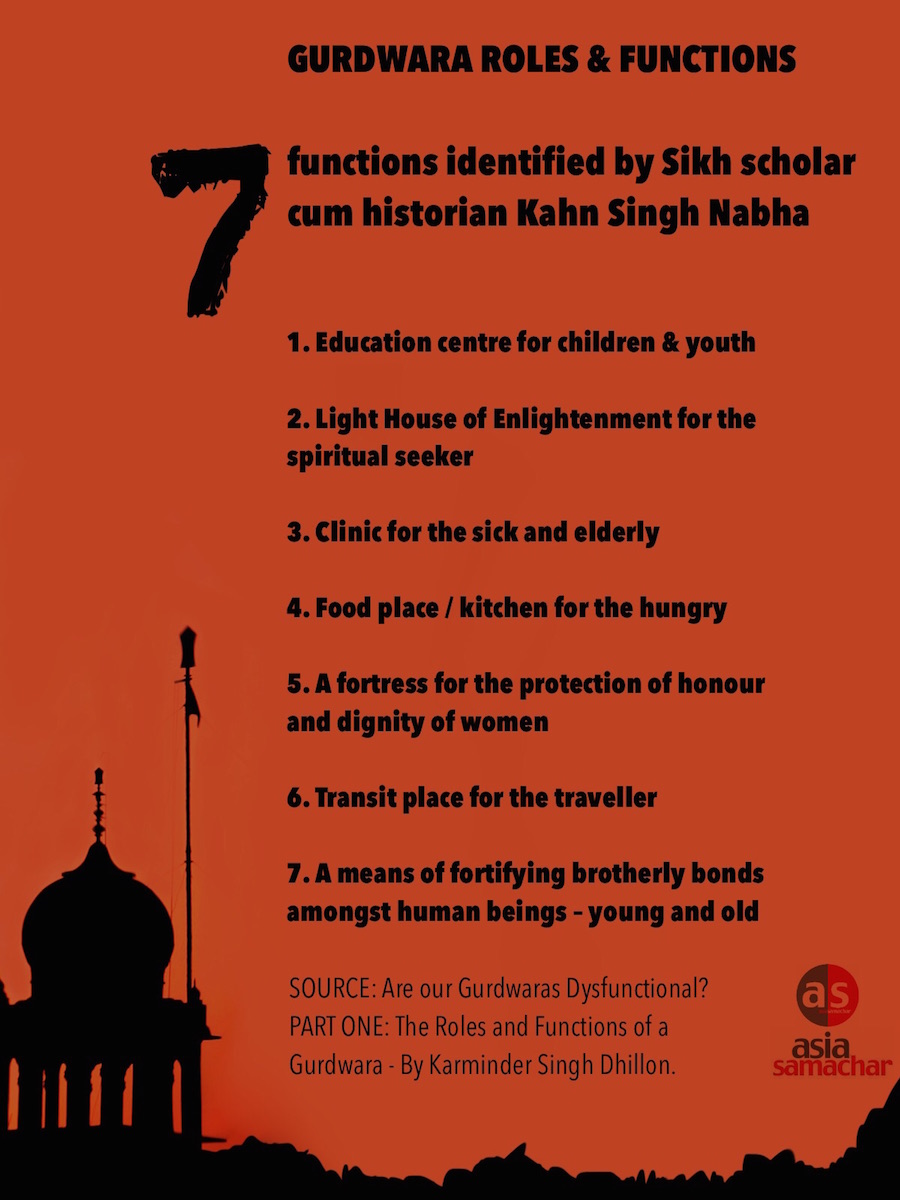
Virtually all the time, energy, effort and money of parbandhaks are exhausted in peripheral “projects” and in the resulting conflict, leaving them with virtually no interest in the CORE 7 functions aspired by our Gurus.
In their desire to remain in office, these chaudhar parbandhaks look for and employ granthis, ragis and parcharaks who themselves are NOT interested in Gurmat, but who, in their own self-serving interests, are ever willing to assist the parbandhaks in their manoeuvrings.
It is for this reason then, that this group of Sikhs – granthis, ragis and parcharaks – takes the second spot in any discussion regarding root causes of Gurdwara dysfunctionality.
DYSFUNCTIONAL GRANTHIS, RAGIS AND PARCHARAKS.
In the Sikhi that was envisaged by Guru Nanak and the succeeding nine Sikh Gurus over some 240 years; there did not exist any class of Sikhs called granthis, ragis and parcharaks. Guru Nanak did not believe in the creation of a priestly class in Sikhi.
A healthy portion of his banee is a strident critique of the priestly class. Guru Nanak held the priestly classes primarily responsible for the corruption of all Indian spiritualties.
The Gurus wanted local communities to run their Gurdwaras, perform all ceremonies and undertake all the 7 roles and functions collectively and in turn according to the sewa bahvna of each. So if a Gurdwara catered for 20 families – these families would all do the kirtan, ardas, katha, hukumnama and all other activities by themselves.
What we have today is a “professional” priestly class – one that earns a living from spiritual activities. Virtually all kirtan in our Gurdwaras is done by professional ragis; katha or sermon is rendered by a professional kathakaar; and akhand path readings are undertaken by professional pathis.
By and large these “professionals” are disconnected from the sangats they serve and have no interest in the spiritual challenges facing their congregations or the Gurdwara. Their primary motive is to earn a living through their “professional” activities.
Up to 95 percent of Indian granthis, ragis and parcharaks have their roots in deras – the root places of Sikhi deviancy. They are either trained in deras or have permanent affiliations with deras. They thus sing, preach and discourse the deviant messages that they have learnt.
Their deviancy is the core reason for the spirituality of our Gurdwaras to be focussed largely on rituals instead of centring on the true messages of banee.
The local granthi’s answer to each and every spiritual problem of the Sikh family is for more Akhand Paaths or Shej Paths or other ritualistic banee reciting or chanting sessions which are anti-thesis to the principles of Gurmat.
The ragi’s mainstay is to transform kirtan from spiritual to commercial (kan rus) and presenting it as crowd-pulling entertainment that constitutes a show of musical skill and vocal artistry.
The kathakaar’s lifeblood lies in retelling of sakhis – a euphemism for un-authenticated, miracle based and unbelievable stories, plagiarised from the texts and belief systems discarded by our Gurus; but entertaining nevertheless.
By and large parbandhaks are content with such granthis, ragis and parcharaks. A parasitic relationship seems to exist. The granthis & ragis don’t rock the boat by pointing out the flaws and dysfunctionality of the parbhandaks and Gurdwaras. And the parbhandaks ensure such granthis and ragis of a sustained livelihood in their Gurdwaras.
The biggest loser is undeniably the sangat because the outcome of this unhealthy relationship is that the Gurdwara has become the source of much that is anti-Gurmat: rituals, superficial spirituality, commercialised singing and rote recitation and chanting.
Any discussion on the root causes of the dysfunctionality of our Gurdwaras cannot be thus complete without discussing the part played (or not played) by the sangat. After all, the decaying, broken-down, and crumbling state of affairs of our Gurdwaras could not have happened had the sangat not allowed it to come to that.
THE HANDS-OFF ATTITUDE OF THE SANGAT
In general, the involvement of the Sangat in the Gurdwara can be described as passive and of reciprocal attendance.
We are passive in the sense that we accept just about anything that is dished out for us in the name of spirituality by our parbandhaks, granthis, ragis and parcharaks. Our attendance is reciprocal because by and large we fear that if we didn’t attend the functions, then others will not come to our functions.
In this regard then the dysfunctionality of the Gurdwara is not our real concern. Many in the sangat can be heard saying stuff to the effect: “We go to the Gurdwara to metha tek. All else is not our concern,” and taking false pride in saying so.
Others say “we are only interested in the Kirtan,” and do not appear concerned that large portions of what is sung as Kirtan in our Gurdwaras is not Kirtan as it is from outside of the Guru Granth Sahib. We don’t know that and don’t want to know it either.
A good deal of the sangat does not want to get involved in Gurdwara activities because we do not want to caught up in the ugly conflicts, contests and fights that can and do happen.
A majority of the sangat are unable to take issue with the anti-Gurmat and ritualistic practices of our granthis, ragis and parcharaks, and the anti-Sikhi acts and activities of our chaudhar type parbandhaks because we simply have no knowledge of banee, Gurmat and the Rehat Maryada. Or we don’t care.
The philosopher Plato was apt when he said: when wise men refuse to lead, they suffer fools as leaders. Within the dysfunctional Gurdwara, the sangat suffers Gurmat and Gurbani illiterate leaders.
In our slumber then, we the sangat have actively contributed towards Gurdwaras becoming dysfunctional. This article proportions a good deal of blame on chaudhar parbandhaks as well as granthis, ragis and parcharaks. But the ultimate responsibility falls with the sangat.
It is after all the the sangat that provides the pool from which our parbandhaks are created. Enlightened sangats would produce good parbandhaks. And if we as the sangat invest in learning how do to the kirtan, katha and ardas etc, we can wean ourselves from the Indian make-a-living type.
SANGAT MUST SHOULDER ULTIMATE RESPONSIBILITY FOR DYSFUNCTIONAL GURDWARAS.
Sangats need to start holding their parbandhaks, granthis, ragis and parcharaks accountable for the dysfunctionality of our Gurdwaras. The sangat has three powerful weapons at its disposal – funds, attendance and choice.
Ask your parbandhaks why the 7 CORE functions of the Gurdwara are being neglected. And so long as the parbandhaks show no signs to making efforts in that direction, members of the sangat should withhold giving any funds to such parbandhaks.
It is naïve and irresponsible to think that we are giving our money to the Guru and that we do not have to be concerned how it is spent. The Guru does not exist within a dysfunctional Gurdwara setting. So the reality is that we, the sangat are funding the dysfunctionality of the Gurdwara.
And by continuing to donate blindly to the dysfunctional Gurdwara parbandhaks we are emboldening them and saying it’s OK to continue to be dysfunctional.
The sangat has a responsibility to free the community from the bedlam of building newer, bigger and taller Gurdwaras, from putting up gold domes and installing thicker carpets, newer air conditions, bigger tiles etc.
We can do this by withholding funds for such activities and channelling out daswandh to worthy causes, outside the Gurdwara system if necessary – even if only to send a message to our parbandhaks.
It is ONLY when we FREE ourselves from this unending egoistic quests of further beautifying dysfunctional Gurdwaras that our parbandhaks specifically and the community generally will get the TIME and OPPORTUNITY to think about the core functions of the Gurdwaras that they already have under their charge.
Sangats should also discard the habit of blindly offering shabad bhet to granthis, ragis and parcharaks who preach anti-Gurmat messages.
The habit of offering shabad bhet to them immediately (and blindly) after metha tek contributes to the problem. We need to be discerning. This can be done by sitting in the diwan and listening to messages first.
Ragis and parcharaks who sing from outside the GGS, tell half cooked sakhis, preach anti Gurmat stuff, demean women etc. should not be given any shabad bhet. They need to get the message that the sangat does not tolerate such, and that they should change their professions.
The sangat must exercise choice. Vote out parbandhaks who are dysfunctional. Choose to not have dysfunctional Ragis and parcharaks perform at your jor-melas. Choose not to sit and listen to them. Choose to tell them off. Choose to censure them on social media of your choice.
Not attending anti-Gurmat functions is yet another weapon. Banee and mantar chanting sessions, Akhand Paths by so called professional pathis, celebrating occasions belonging to other faiths etc. only work because we attend passively.
Some of these suggestions may sound callous and cold hearted. But we need to admit that the dysfunctionality has come to a critical point. And near drastic measures are required.
If we let it slide further, our Gurdwaras will become centres of ALL that is anti-Sikhi. We may then have to keep our children away from the Gurdwara just to enable them to be Sikhs in the correct sense of the word.
It seems to me that our youth already know that. And that is perhaps why our Gurdwaras are already emptying out of generation Y and Z youth and hence become dysfunctional.
PART ONE: Roles and functions of a gurdwara
Part TWO: Are our Gurdwaras Dysfunctional? The Assessment.
Part THREE: Are our Gurdwaras Dysfunctional: The Root Causes.
Karminder Singh Dhillon, PhD (Boston) writes on Gurbani and Gurmat issues in The Sikh Bulletin, USA. He also conducts Gurbani Katha in local Gurdwaras. He is based in Kuala Lumpur, Malaysia.
- This is the personal opinion of the writer or publication and does not necessarily represent the views of the Asia Samachar.
RELATED STORIES:
‘Dysfunctional’ gurdwaras a bit rough on the ears (Asia Samachar, 20 Jan 2015)
JAGIR: Without guidance, all gurdwaras would be on their own (Asia Samachar, 20 Nov 2015)
FROM THE SAME AUTHOR:
Are our Gurdwaras Dysfunctional? The Assessment. (Asia Samachar, 9 Jan 2015)
Roles and functions of a gurdwara (Asia Samachar, 11 Dec 2015)
Sikh Nishan Sahib demystified (Asia Samachar, 2 Oct 2015)
Nanak Shah Faqir: A Controversy of Epic Proportions – PART TWO (Asia Samachar, 5 June 2015)
Nanak Shah Faqir: An Epic of Sorts – PART ONE (Asia Samachar, 4 June 2015)
Artee and Sikhi – KARMINDER (Asia Samachar, 10 Mar 2015)
Giani Rann Singh – the Passing of an Era (Asia Samachar, 26 Jan 2015)
Lohree, Birthdays, Culture and New Year (Asia Samachar, 21 Jan 2015)
Kee Lohraa Aa Gya (Asia Samachar, 13 Jan 2015)
Moshi Moshi debacle and Sikh Reht Maryada (Asia Samachar, 12 Jan 2015)
ASIA SAMACHAR is an online newspaper for Sikhs / Punjabis in Southeast Asia and beyond. Facebook | WhatsApp +6017-335-1399 | Email: editor@asiasamachar.com | Twitter | Instagram | Obituary announcements, click here |


