



















By Gurnam Singh | Opinion
“If the Indian government attacks the Golden Temple, it will lay the foundation stone of Khalistan.” 42 Years after 1984 and the dialectics of the Sikh struggle for autonomy.
Introduction
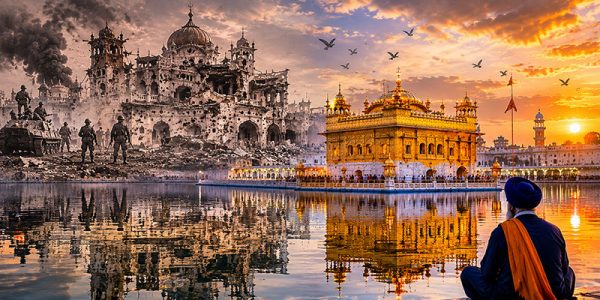
Every year on June 6th, the global Sikh community pauses to commemorate one of the deepest, most defining wounds in its modern history: the anniversary of Operation Blue Star. In June 1984, the Indian military launched a full-scale assault on the Harmandir Sahib (the Golden Temple) complex in Amritsar, ostensibly to flush out armed militants led by Sant Jarnail Singh Bhindranwale. The resulting loss of 1000’s of civilians caught in the crossfire, the deaths of defenders, including Bhindranwale, along with countless Indian Army soldiers. Along with the loss of life, the symbolism of the destruction of the Akal Takht, the ultimate seat of Sikh temporal authority, resulted in the shattering relations between the Sikh Panth and the Indian state.
To understand how a complex provincial dispute over relatively minor demands, such as access to river waters, religious rights, agricultural pricing, and federal devolution permanently morphed into a generational and global campaign for an independent homeland of Khalistan), it’s worth looking at the nineteenth-century German political philosopher G.W.F. Hegel and his take on the forces of historical change, including moments of rupture.
Hegel posited that history progresses through a dialectical process: a dominant condition or idea (Thesis) inevitably generates its own internal opposition (Antithesis), and the explosive clash between the two forces a new, messy reality into existence (Synthesis). When looking at political movements, Hegel’s core psychological truth is stark: the exact moment a front achieves its victory is the precise moment an internal split begins within it.
1947 and the Tragedy of the Imperial Collapse
The structural justification for Khalistan traces directly back to the geopolitical trauma of 1947, a textbook execution of Hegelian fracture. For decades, Hindus, Muslims, and Sikhs operated as a unified anti-colonial front against British imperial rule. But the moment that front won, the moment the British drew their exit lines and the binding agent vanished.
Without a common enemy to enforce unity, the movement split catastrophically along religious lines. One can speculate if this was a spontaneous rupture, or if there were other forces at play, but the reality was that, in the moment of rupture, Muslims secured Pakistan and the Hindu majority inherited India. And the Sikhs, who were demographically concentrated right in the centre of Punjab, faced a unique tragedy. The Radcliffe Line sliced Punjab in half. Millions of Sikhs became refugees overnight, fleeing horrific violence and leaving behind ancestral lands.
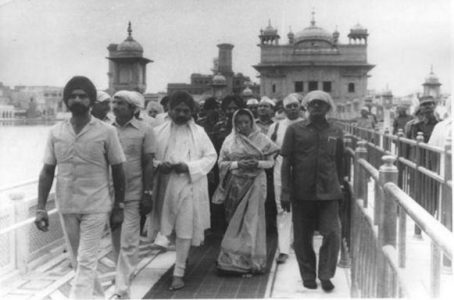
This left Sikhs being concentrated in what was now effectively East Panjab though they were still denied what they felt was a right to establish an autonomous state where Sikhs and other Punjabi’s could could safeguard their cultural, religious and economic interests. However, decades that followed, with the newly formed Indian state adopted a highly centralised model, the reverse was the case. Fearing that a deeply diverse, subcontinent-sized country would shatter, New Delhi aggressively accumulated administrative and fiscal power. To the Indian centre, centralization was survival; to Punjab, it was an oppressive betrayal of the federalist promises made during independence.
The Rise of the Antithesis
By the late 1970s, this structural tension reached its boiling point. The Sikh leadership launched the Anandpur Sahib Resolution, a document demanding greater regional autonomy, local control over river waters, and religious recognition within the Indian constitutional framework.
However, as Hegel points out, when a dominant authority refuses to accommodate or negotiate with moderate, peaceful contradictions, it accelerates the birth of its own radical opposition. As political avenues stalled, a militant faction emerged, spearheaded by Bhindranwale. His philosophy echoed a raw Hegelian truth: a highly centralized state would never willingly surrender power to a minority; equity had to be demanded by force.
This culminated in Bhindranwale’s most famous, and ultimately self-fulfilling, prophecy: “If the Indian government attacks the Golden Temple, it will lay the foundation stone of Khalistan.” Bhindranwale understood the psychological dialectic of sovereignty. He knew the Golden Temple was not mere brick and mortar; it was the physical manifestation of historical Sikh independence. When Prime Minister Indira Gandhi sent tanks into the complex, the state believed it was using absolute force to crush a contradiction. Instead, they codified it.
By desecrating the Akal Takht, the state destroyed the illusion that Sikhs could find dignity within the centralized Indian framework. The paradigm shifted instantly. What had been a localized legislative debate about federalism was vaporized, replaced by a deep-seated, generational demand for a separate state.
The Dialectic of Decline and the Soft Hegemony of Hindutva
Yet, if Hegel’s dialectic explains the birth of the movement, it also explains its subsequent fragmentation. Following the brutal counter-insurgency of the late 1980s and 1990s, the armed phase of the Khalistan movement declined, exposing deep internal fractures.
Without a singular, unifying figure or an immediate, existential threat on the ground, the internal contradictions of the Panthic front rushed to the surface. A profound split emerged between a well-funded, ideologically unyielding diaspora operating safely within western liberal democracies, and the local population of Punjab, who had to navigate daily economic stagnation, agrarian crises, and the realpolitik of living under New Delhi. The movement fractured into competing Akali factions, semantic disputes among seminaries, and fragmented leadership, proving that an abstract ideal, lacking a concrete, practical blueprint for governance, will eventually consume itself from within.
Simultaneously, the geopolitical landscape evolved. In the modern arena, the state rarely relies on the crude, bloody violence of 1984, which only creates martyrs. Instead, the current right-wing BJP government utilizes a highly sophisticated strategy of co-optation and sublation.

Rather than attacking Sikhism, the modern Hindutva framework seeks to absorb it. The state actively bypasses traditional, independent Panthic institutions like the SGPC to cultivate direct alliances with specific sectarian leaders, such as Baba Harnam Singh Dhumma of the Damdami Taksal and Baljit Singh Daduwal, alongside various traditional Nihang orders and Sants who openly celebrate the connections between modern day Sikhism and the Sanatan traditions associated with Hinduism. The recent commemoration of the 350 Martyrdom of Guru Tegh Bahadur is a perfect example of how the Hindutva is implementing this policy of co-option. By giving the occasion widespread governmental support and publicity, whilst at the sometime manipulating the narrative to that Guru Sahib sacrificed his life to save Hinduism from being wiped out by the
Mogul imperialists.
Moreover, in keeping with its ‘pro-Sikh’ credentials, the narrative aggressively pushed by the BJP Government is that the horrors of 1984 were exclusively the fault of the secular Congress party, whereas a “friendly” Hindutva state is the true custodian of Sikh interests. By celebrating historical Gurus on a national scale, building corridors, and removing historical taxes, the state seeks to resolve the contradiction by redefining the Sikh identity as the defensive, “Indic” vanguard of a greater Hindu civilization.
The Implosion of centralised autocratic states.
If history is any guide, however, this hyper-centralized, autocratically driven homogenization carries the seeds of its own destruction, something that advocates for an independent Sikh homeland need to bear in mind. The current Indian state is operating on the same flawed premise that doomed the Soviet Union: the belief that a vast, extraordinarily diverse, multi-ethnic, and multi-linguistic empire can be permanently governed by a single, rigid, centralized ideology dictated from a distant centre.
Though the structural decline of the Soviet Union lasted several decades, the sudden political avalanche that took just two to three years, beginning with the Baltic states (Lithuania, Latvia, and Estonia) declared their independence in 1990. In August 1991, communist hardliners tried to launch a coup to overthrow Mikhail Gorbachev and restore strict centralized control, but this failed spectacularly within three days leaving the authority of the central government in tatters. 4 months later, Russia, Ukraine, and Belarus met to declare the Union dead and on December 25, 1991, with the resignation of President Gorbachev the USSR officially ceased to exist.
When a state suppresses regional autonomy, ultimately it creates an unsustainable pressure cooker. The Soviet Union, despite its massive military apparatus and pervasive internal security, collapsed precisely under the weight of its own forced centralization. The lesson of history is that an uncompromising, hyper-centralized state does not achieve permanent unity; it achieves brittle rigidity, making it uniquely vulnerable to sudden, catastrophic implosion. In short, it sows the seeds of its own destruction!
Conclusion
For those who continue to dream of a sovereign destiny for Punjab, the lesson of the Hegelian dialectic is clear: sovereignty cannot be built on isolation, nostalgia, or fragmented, internal doctrinal warfare. The path to a viable future does not lie in a singular, isolated struggle that can easily be painted into a corner or co-opted by the state’s patronage networks. Instead, the advocates for Punjab’s struggle for self-determination must build broad, democratic, and horizontal alliances with other regional, marginalized, and federalist forces across the subcontinent who are equally choked by centralized overreach. In this regard, less emphasis should be place on the name of that state, and more on building common cause.
Only by uniting with diverse movements fighting for resource rights, language preservation, and regional autonomy can an alternative political paradigm be constructed. True sovereignty is not merely won by the destruction of an old state, but by the slow, painstaking construction of an alliance capable of governing an independent, prosperous, and pluralistic Punjab.
For sure, such a vision can be found in the utopian and secular ideology that is woven into Sikh teaching. However, there is much work to be done to build trust amongst the vast majority of Panjabis who, against the history of sectarian violence and repression in both India and Pakistan, will be weary of anything that hints of a theocratic Sikh dominated state.
42 years after the Indian army assault on the Darbar Sahib, the priority for those who still dream of an independent Sikh homeland in Panjab, should move beyond talking laying of the foundation stone that Bhindranwale predicted would accompany any army invasion of the Darbar Sahib and begin the hard work of developing a blueprint for a new nation in order to offer a positive alternative vision for ordinary Panjabis.

Gurnam Singh is an academic activist dedicated to human rights, liberty, equality, social and environmental justice. He is a Professor of Sociology at University of Warwick, UK. He can be contacted at Gurnam.singh.1@warwick.ac.uk
* This is the opinion of the writer and does not necessarily represent the views of Asia Samachar.
RELATED STORY:
How India’s super-intelligence agency destroyed peace in Panjab (Asia Samachar, 16 June 2022)
ASIA SAMACHAR is an online newspaper for Sikhs / Punjabis in Southeast Asia and beyond. You can leave your comments at our website, Facebook, Twitter, and Instagram. We will delete comments we deem offensive or potentially libelous. You can reach us via WhatsApp +6017-335-1399 or email: asia.samachar@gmail.com. For obituary announcements, click here