| The Sun | Malaysia | 4 July 2016 | Asia Samachar |
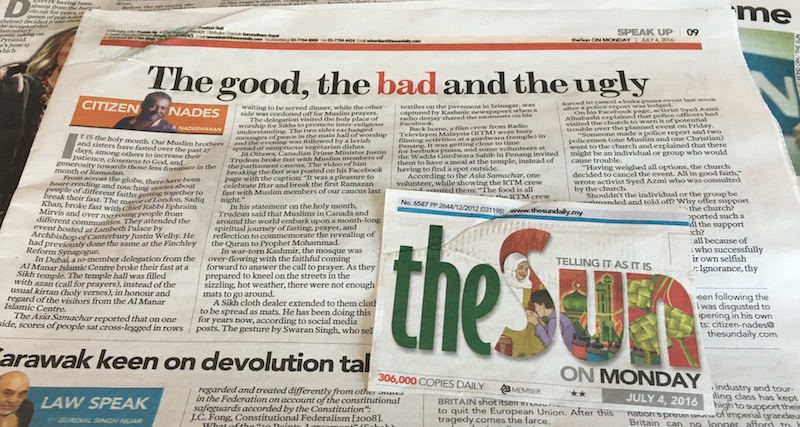
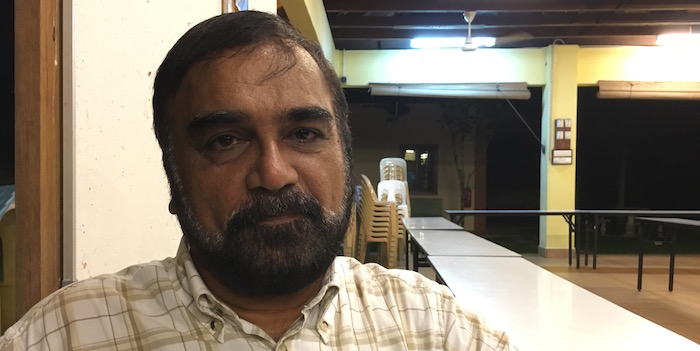
Malaysian daily newspaper The Sun editor and columnist, R Nadeswaran, quotes Asia Samachar in his weekly article – PHOTO / ASIA SAMACHAR
By R. Nadeswaran
IT is the holy month. Our Muslim brothers and sisters have fasted over the past 27 days, among others to increase their patience, closeness to God, and generosity towards those less fortunate in the month of Ramadan.
From across the globe, there have been heart-rending and touching stories about people of different faiths getting together to break their fast. The mayor of London, Sadiq Khan, broke fast with Chief Rabbi Ephraim Mirvis and over 100 young people from different communities. They attended the event hosted at Lambeth Palace by Archbishop of Canterbury Justin Welby. He had previously done the same at the Finchley Reform Synagogue.
In Dubai, a 10-member delegation from the Al Manar Islamic Centre broke their fast at a Sikh temple. The temple hall was filled with azan (call for prayers), instead of the usual kirtan (holy verses), in honour and regard of the visitors from the Al Manar Islamic Centre.
The Asia Samachar reported that on one side, scores of people sat cross-legged in rows waiting to be served dinner, while the other side was cordoned off for Muslim prayers.
The delegation visited the holy place of worship for Sikhs to promote inter-religious understanding. The two sides exchanged messages of peace in the main hall of worship and the evening was followed by a lavish spread of sumptuous vegetarian dishes.
In Ottawa, Canadian Prime Minister Justin Trudeau broke fast with Muslim members of the parliament caucus. The video of him breaking the fast was posted on his Facebook page with the caption: “It was a pleasure to celebrate Iftar and break the first Ramazan fast with Muslim members of our caucus last night.”
In his statement on the holy month, Trudeau said that Muslims in Canada and around the world embark upon a month-long spiritual journey of fasting, prayer, and reflection to commemorate the revealing of the Quran to Prophet Mohammad.
In war-torn Kashmir, the mosque was over-flowing with the faithful coming forward to answer the call to prayer. As they prepared to kneel on the streets in the sizzling, hot weather, there were not enough mats to go around.
A Sikh cloth dealer extended to them cloth to be spread as mats. He has been doing this for years now, according to social media posts. The gesture by Swaran Singh, who sells textiles on the pavement in Srinagar, was captured by Kashmir newspapers when a radio deejay shared the moments on his Facebook.
Back home, a film crew from Radio Televisyen Malaysia (RTM) were busy filming activities at a gurdwara (temple) in Penang. It was getting close to time for berbuka puasa, and some volunteers at the Wadda Gurdwara Sahib in Penang invited them to have a meal at the temple, instead of having to find a spot outside.
According to the Asia Samachar, one volunteer, while showing the RTM crew around, assured them: “The food is all vegetarian.” Not long after, the RTM crew experienced their first ever berbuka puasa in a Sikh place of worship.
These are great anecdotes which reflect humanity, friendship, attachment and acceptance. Religion has no barriers – seen or unseen; no suspicion; no misgivings and no obstacles. It’s the people who create them.
And when ill-informed and self-proclaimed leaders of religions issue diktats and oppose for the sake of opposing, any attempt to forge unity and understanding will fail. The mere ignorance of their own religion and being oblivious to what’s happening in local surroundings and globally adds to the woes.
That’s why a church in Petaling Jaya was forced to cancel a buka puasa event last week after a police report was lodged.
On his Facebook page, activist Syed Azmi Alhabashi explained that police officers had visited the church to warn it of potential trouble over the planned event on Friday.
“Someone made a police report and two policemen (one Muslim and one Christian) went to the church and explained that there might be an individual or group who would cause trouble.
“Having weighed all options, the church decided to cancel the event. All in good faith,” wrote activist Syed Azmi who was consulted by the church.
Shouldn’t the individual or the group be reprimanded and told off? Why offer support by conveying the message to the church? Shouldn’t the police have supported such a gracious move by affording all the support and co-operation to the church?
Another opportunity lost all because of two pea-brained individuals who successfully used the police force for their own selfish reasons. Didn’t someone say: Ignorance, thy meaning is universal?
R. Nadeswaran had been following the trends internationally and was disgusted to learn what was happening in his own backyard. Comments: citizen-nades@thesundaily.com
The article, a column by veteran Malaysian journalist R. Nadeswaran, appeared in The Sun on 3 July 2016. View here for original article.
| Sungai Siput, Malaysia | 4 July 2016 | Asia Samachar |
First phase renovation of Gurdwara Sahib Sungai Siput underway – PHOTO / SUPPLIED
The recent resignation of a senior Malaysian Federal Government minister has put a damper on renovation efforts of a 90-year old gurdwara in Sungai Siput, a small town in the state of Perak.
The Gurdwara Sahib Sungai Siput (GSSS) team were pinning hopes for some funds to come through the office of Ahmad Husni Hanadzlah, the local Member of Parliament who was the Second Finance Minister, an influential Federal post.
“We were in extensive talks with his office. His resignation is a major setback for us,” GSSS committee president Harbans Singh tells Asia Samachar. “The renovation work is progressing well, but we are running short of funds.”
Husni, a Member of Parliament for Tambun, Perak, secured RM200,000 Federal Government funds for the Wadda Gurdwaras Sahib Ipoh (WGSI) for its renovation last year.
The well-liked minister shocked various quarters when he announced his resignation on 27 July as minister and all relinquished all political party. He is known to have good relations with the grassroots, including Sikhs, in Ipoh and its surrounding areas. Sungai Siput is located about 35km from Ipoh.
The gurdwara is undergoing a three-phase renovation estimated to cost RM800,000. Phase one involves the 90-year old kitchen, phase two the granthi quarters and toilets, while phase three involve the langgar hall, guest rooms and classrooms.
Todate, they have raised about RM350,000.
“The Guru Ka Langgar hall is 80% ready. We are ready to start with Phase 2, hence we need to raise the funds quickly,” said Harbans.
Until now, the Sikh sanggat of Sungai Siput have been managing with their old, dilapidated, structure for years, affecting minor repairs here and there, as and when the situation demands. Last year, the kitchen ceiling had started to fall and the leakage of the roof had also worsened.
First phase renovation of Gurdwara Sahib Sungai Siput underway – PHOTO / SUPPLIED
ACCOUNT DETAILS:
| Bank: RHB Bank | Acc No: 25822600002516
| CHEQUES PAYABLE TO: Building Fund Gurudwara Sahib'
Code for telegraphic transfer from outside Malaysia:
RHBBMYKL (TELEGRAPHIC CODE) followed by "Building Fund Gurudwara Sahib" and account no 2582 2600 0025 16
[ASIA SAMACHAR is an online newspaper for Sikhs in Southeast Asia and surrounding countries. We have a Facebook page, do give it a LIKE. Follow us on Twitter. Visit our website: www.asiasamachar.com]
1989: Karpal Singh waving to friends after leaving the courtroom with his wife Gurmit Kaur and son Jagdeep (2nd from right).
Two years heretofore, this nation lost a man. A man who was just as ordinary but chose to be an uncommon man – for he felt, that this was his right. He was a lawyer and a statesman. More than that, however, he cherished a place that was vastly more sacred and noble in form: in the hearts of commoners. He was their hero. He was a selfless defender and guardian, of the law and righteousness, a friend, to the marginalised and oppressed.
A towering beacon of hope he was, for those whom the roots of injustice had imperiled. He was Karpal Singh – the people’s lawyer.
Karpal was an indefatigable and gallant defender of the Rule of Law and the Malaysian Constitution. He fought both – in the causes he believed in and the causes of the people at large, fierily without any fear or favour. And the price for this – came hefty in form of detrimental consequences to Karpal and his family.
In 1987, he was detained without trial for two years under the Internal Security Act (ISA) during Ops Lalang. His family was unsure each long day that passed, if there was to be food on the table the next, as Karpal was the sole breadwinner of the family. They lived, dashed with uncertainty, about the fate that was to be.
Upon his release from detention in 1989, many had expected a dispirited and crestfallen Karpal to trudge through the overshadowing gates of the Kamunting Detention Camp. Some had even gone to the extent of predicting that he would withdraw from the political arena completely. A detention without trial under the ISA was harsh and unforgiving. Detainees were subject to vile and iniquitous treatment. What more when: his detention stretched over a period of two years.
However, what came, was instead a man who marched valiantly through those very gates; enraged and even more determined, to set proper the course of justice that had been misdirected and trampled upon. This was what inspired people the most about Karpal. His warrior-spirit. Despite the impossible odds that may be, he was one to ever see pass them with ultimate optimism.
He was not a lawyer who won every case that he took on. He, too, had his fair share of losses. What was admirable about Karpal was the fact that every case he fought, he fought with diligence and courage. He gave every legal challenge he mounted, an equal and unqualified share of his utmost best. No case was paid less attention to or given less priority. If he lost a case, it would be with dignity. His clients, too, knew this well.
Lionhearted, Karpal was. A man so true to what he believed in, that no possible form of affliction, persecution or injustice, could ever cause him to be untrue to what he held on to and triumphed so dearly. In his words: “They can lock me up, they can do whatever they want to me. But I know that I’ll be in there with my integrity intact.” He represented a fearless source of unfettering inspiration to all.
Karpal Singh on a wheelchair after an accident. Still as spirited as ever – PHOTO / THE STAR
What led Karpal to command the respect of the legal fraternity and his political opponents was his independence and forthrightness in giving legal interpretations truthfully, as they stand. This was the case several different times even when it failed to favour Karpal or his political standing. He remained steadfast to his principles in upholding the Rule of Law.
Many of Karpal’s cases were also taken on a pro bono basis. He refused to accept payment or legal fees. This was especially such when a client had been a victim of manifest injustice. As he said to Anwar Ibrahim when the family attempted to pay him for his legal services rendered: “How could I accept payment from you Anwar!? You’ve been a victim of injustice. You fought them and they’re persecuting you! Don’t talk to me about money again. I’m a man with dignity”.
The news of his passing in the wee hours of 17th April 2014 shook the nation. The people lost their hero. Their defender, their guardian, their inspiration, gone forever. Many were unaccepting at first, suspicious of a hoax as similar messages and news had also circulated several times before. But as the hours went-by, it was confirmed. The Tiger of Jelutong had passed on.
A three-day wake was held at Karpal’s home in Penang. People, citizens from all walks of life, in the hundreds of thousands, thronged to pay their last respects to their hero, on his final journey. Men and women, of all races, age, creed and colour, stood by his coffin, teary-eyed and some even crying uncontrollably, as they bid the people’s lawyer, farewell. This just stood to show lucidly the place he enjoyed and held in the hearts of the ordinary men and women of this nation.
It is said that there will never again be another like Karpal Singh – at least for a long time to come. However, I beg to differ. We are all Karpal. We should all aspire in his aspirations for justice, integrity and freedom and bring effect to these notions. We are change.
Live his dream and walk in his shadow. He taught us exactly on how not to fear the government and for that is what we must do. Let us not disappoint in what Karpal devoted his life to. Even in his passing, he remains a beacon of hope and a tower of inspiration shadowing over us. Reminding us, that even an ordinary man can make extraordinary changes, if he wishes to.
Thank you Mr. Karpal, for all that you had dedicated unwaveringly to this nation, its people and its defining fundamentals.
You were a true Malaysian.
Harinder Singh is a law student at Multimedia University (MMU)
This is the personal opinion of the writer or publication and does not necessarily represent the views of the Asia Samachar.
[ASIA SAMACHAR is an online newspaper for Sikhs in Southeast Asia and surrounding countries. We have a Facebook page, do give it a LIKE. Follow us on Twitter. Visit our website: www.asiasamachar.com]
PUNJABI LADIES IN SAREE: (L-R) Kashminder Kaur, Amrit Kaur, Paviter Kaur, Amreet Kaur Sra and Malkit Kaur
Saree has been the talk of the nation in Malaysia for more than a week after an invitation card from local city council in Perak for a festive function apparently barring Indian women from wearing the traditional attire.
The invitation from the Ipoh City Council, known by its Malay acronym of MBI for Majlis Bandaraya Ipoh, for Hari Raya Aidilfitri went viral on the social media. The council later apologised and said that the words had been misinterpreted.
The event took place on 1July 2016 with many ladies turning up in sarees. Across the nation, other ladies, too, took to the saree, one of the world’s oldest and perhaps the only surviving unstitched garment from the past.
Asia Samachar puts together some photos of Malaysian Punjabi ladies in saree.
One of them is Amreet Kaur Sra, a finalist at the Miss World Malaysia 2016, who was at a fashion event in Alor Setar, Kedah.
“Such a coincidence, today is International Saree Day, and I am wearing a beautiful saree by designer Brandon Tan. Such an honour, to show support and also be a part of it,” she shared on her Facebook page yesterday.
Also featured is Malkit Kaur, an active sports enthusiast from Kuala Lumpur. Paviter Kaur Johal also shared with Asia Samachar of her photo with two family members in saree.
ASIA SAMACHAR is an online newspaper for Sikhs / Punjabis in Southeast Asia and beyond.Facebook | WhatsApp +6017-335-1399 | Email: editor@asiasamachar.com | Twitter | Instagram | Obituary announcements, click here |
| Johor Bahru, Malaysia | 3 July 2016 | Asia Samachar |
Amarjit and Manjit proudly showcase Nauraj’s medals. — Picture by Roslan Khamis /The Malay Mail
Malaysian high jumper Nauraj Singh Randhawa will be able to bring along his father when he competes in the Rio de Janeiro Olympics next month, thanks to the fund raising efforts of Johor Sikh Golf Association (JSGA) and Johor Cricket Association (JCA).
Nauraj qualified for the Rio Olympics after clearing 2.29m to equal the Rio qualifying mark at the Singapore Open in April. The high jumper had earlier rued that his unemployed father, 56, could not go to Rio as “we are short of money”.
“It is just a gesture on our part to give Nauraj a boost in his bid to create history. It is also our way to honour him for his contribution. We want to see Amarjit watch his son in action at the highest level and be proud of all the sacrifices he had made,” said JSGA president Manjit Majid Abdullah in a news report.
JSGA raised RM10,000 in a golf tournament on Friday. The amount was then matched by Tengku Abdullah Sultan Ahmad Shah of Pahang. JCA Dr Harjit Singh then raised another RM7,500, the report added.
[ASIA SAMACHAR is an online newspaper for Sikhs in Southeast Asia and surrounding countries. We have a Facebook page, do give it a LIKE. Follow us on Twitter. Visit our website: www.asiasamachar.com]
Fair query indeed. And I would invite any others who are similarly confused, in doubt or perhaps exasperated in deciphering the massage enveloped in any Charitar to pose their queries as Dr Karminder Singh has eloquently and graphically done. This is all part of the learning process.
As a rule of thumb whence reading a particular Chariter containing graphic descriptions of a given story, know in your minds that the primary injunction is one of abstinence therefrom. Guard against ending up in those situations. Indeed “Charitr – Opakhyan” means stories which have been told prior hereto. Dr Karminder infact validated my comment (which was a responsive post here on Sikhi Leher Malaysia and which the editors of Asia Samachar deemed fit to reproduce in the said publication).
Firstly, I had commented that Kaam Vashna is exposed in every permutation imaginable. The Chariter which Dr Karminder deemed fit to zoom in on, involves sexual relations with an animal. Known today as Bestiality or Zoophilia. It is perhaps not as common a facet of sexuality. Hence only a solitary Chariter on this. Be weary of even these brazzen facets of sexuality. Like it or not, this is a prevalent (and sick) type of sexuality of today.
There are really no stones left unturned. Every permutation is dealt with. You express shock and revulsion. Understandably so. But you really need to arise from the tongue being thrust into the Mare’s genitalia! Do not gleefully rejoice at sharing only the literal meanings.
Oh yee exponents of Gurbani. How do you interpret: “Pheel Rababi Baldh Pakhawaj Keuwa Taal Bejaway. Peher Cholna Gedha Nachay Bhaisa Bhagat Keravay“. Would you say that the meaning cannot be any other than …the Elephant plays the Rebab, the Bull the Pakhawaj, the Crow the ‘Teliaan’. The Donkey dons a long robe (chola) and dances while the ‘Bhainsa’ is engrossed in meditation. You’d need to decipher the message if the same is not immediately apparent.
The other message which is instantly culled by those who understand Sri Guru Granth Sahib (SGGS) ji is this. You ARE the animal that you deem a lesser being than you. Your actions are equivalent to those of animals/lesser beings if you are devoid of Naam/Guru’s “Mat”. “Gur-mantar Heenes Jo Prani, Trighent janam Bhreshtneh. Kookereh, Sookereh, Gerdhebeh, Kaakeh, Serpeneh Tul Kheleh”. You ARE the equivalent of a dog, a swine (pig if you like), donkey, crow, snake etc if you are devoid of Gurmantar.
Thirdly, know this o you Learned folk. Kaam Vashna will ENSURE that you falter regardless of your learning and intellect. You will fall in the most unimaginable way as did the ‘Baidh’ in the Chariter. Be weary …all doctors (medical or otherwise), lawyers, lecturers, professors, holy men, self styled saints .. no one will be spared come the time that you are put through the test.
“Hey Kaamang, Nark Bisramang, Boh Joni Bhrmavnay”
On a separate note, Dr Rattan Singh’s non-purposive and purely literal work lacks credibility. He has retracted his works and altered his stand on Dasam Granth. Giani Narain Singh’s work is definitely preferred.
The central message conveyed in CP that Dr Karminder has opinionated is that women cannot be trusted? That is touted to be the focal point of Charitropakhyan? Similar to when the message of faithfulness and loyalty to your spouse was sidestepped completely and twisted with a view to zooming in on “the bed” of another woman?
If you remain obstinate and refuse to budge from literal interpretations, your bones may well break. But reading CP against the knowlegde of Gurbani that you already possess in abundance, you would be able to Bend it like Beckham! Your exasperation will vanish. You will begin to see light at the end of the tunnel.
“Futo Anda Bharam Ka, Maneh Bheya Pargaas”.
Gurmukh Singh is a lawyer and an accomplished kirtani based in Kuala Lumpur, Malaysia.
This is the personal opinion of the writer or publication and does not necessarily represent the views of the Asia Samachar.
[ASIA SAMACHAR is an online newspaper for Sikhs in Southeast Asia and surrounding countries. We have a Facebook page, do give it a LIKE. Follow us on Twitter. Visit our website: www.asiasamachar.com]
[ASIA SAMACHAR is an online newspaper for Sikhs in Southeast Asia and surrounding countries. We have a Facebook page, do give it a LIKE. Follow us on Twitter. Visit our website: www.asiasamachar.com]
| Opinion | Malaysia | 2 July 2016 | Asia Samachar |
The first three jathedars of Sikh Naujawan Sabha Malaysia (SNSM), as taken from a 1992 issue of the youth body’s magazine The Sikh – PHOTO / ASIA SAMACHAR
By Sangat Singh
I first met Master Gurbachan Singh in 1959 in Seremban (Malaysia) where he had come to attend his newly-wed nephew’s wedding reception. He easily stood out in the crowd in his immaculate white turban that exuded a regal aura.
A few people approached me to find out if I knew him.
“No, I don’t know him yet but I will get to know him for sure,” I told them.
By the time the party ended we were talking to each other. I persuaded him to spend a night at the plantation in Port Dickson, since we had some common interests.
We had both read Bhai Vir Singh’s books and were inspired by them. More importantly, I felt strong vibes of meditative sensations in his presence. In the next couple of days he returned to his post as the headmaster of a school in Pekan, Pahang, leaving behind a delicious feeling of his presence.
My prayer for a gurmukh had been answered.
“Ha-oo bhaal vikunne ho-ee / aadhaarai raahu na ko-ee” – “I have searched in vain, and I am so confused in this darkness and cannot find the path” [GGS:145:11].
In 1960, Master ji — as I came to call him henceforth — just before retiring got himself transferred to Port Dickson and bought himself a house on the seaside. He aptly named it ‘Mansukh’.
Since I was posted on Sua Betong Estate in Port Dickson and not far from where he lived, we started to meet regularly, particularly on Sundays to attend the Sunday diwan at the PD Gurdwara.
In 1961 I got married in India. It was an arranged marriage and my good lady, Upkar Kaur, coming from a large, well known family, found herself literally in the wilderness, living in a huge sprawling bungalow away from any habitation for miles. She was inconsolable and ready to go back to India the next day.
Luckily for me, there was my colleague Siva Nanthan’s mother living nearby, some 7 miles away on Siliau Estate, whom we fondly called ‘mum’ since I had my first posting as Cadet Planter. She literally saved our days old marriage and truly remained a ‘mum’ till she passed away in 1986.
The other family was that of newly arrived Master Gurbachan Singh in Port Dickson that became the nearest home. Then, of course, there was Dr. Dalbir Singh and his good wife Harmangal Kaur who provided the warmth of a home in Seremban.
We became a part of these extended three wonderful families.
The offspring from these two new families were soon to fully occupy Upkar and Mangal in rearing them. Those families remain the closest of friends to this day.
I worked for Guthrie & Company, then the largest plantation group in the world. It had mostly Scottish planters with the usual heavy-accented Scotish homilies to fight loneliness among the womenfolk. One recipe offered by them was: “Keep them pregnant and keep them in the kitchen”.
SIKH NAUJAWAN SABHA, MALAYSIA (SNSM)
In the company of Master Gurbachan Singh, I became a willing sounding board. The seeds of Sikh youth organisation in the community had been dormant for some time. “Catch them young!“ and “Look after the nursery!” became the key slogans.
The time was ripe for action since Master ji was on the verge of retirement. Others who were roped in were: Bhai Surjit Singh Bassian; Master Joginder Singh, a lecturer in Teachers Training College in Tanjong Malim; Master Karaminder Singh’ and Master Hardial Singh.
Unknown to many, there was this benign old granthi sahib of Port Dickson Gurdwara who was the first to bless the idea of a sabha (congress) for the youth. He was Bhai Bishan Singh.
I first met him in 1959. He was around 80, of frail frame that had suffered the ravages of time. He was a picture of humility and his lips flickering and eyes half closed, repeating ‘Waheguru’ at all times. He did no kirtan or katha but had profound knowledge of gurbani. He spoke little but smiled more. He was deeply respected by the sangat of Port Dickson. He was a living example of “jinh pat andar bahar gudar te bhale sansar“ – “Those who have silk on the inside and rags on the outside, are the great ones of the world” [GGS:373.16].
Baba ji was known to have ‘waak satya’ — that is, whatever he said would turn out to be true. I would try to sit at his feet at least once a week.
One day a car came bearing a sickly girl of about 16. She was helped out by her father to approach Baba ji in a typical fashion: “Baba ji, do something for this girl”.
“Oye bhalay loka, if my saying something would come true, shouldn’t I cure first my own asthmatic affliction,” he replied. “Nevertheless, let’s go up and do an ardaas. If it pleases Him, He will help.”
Every year during the Annual General meeting, Baba ji’s usual refrain was to reduce his already paltry gaji (salary in Malay) … because, he said, he was now quite old.
There was a small Muslim mosque nearby and was in need of repairs and some extensions. The mosque committee decided to raise some money by organising a film show and sell the tickets at RM1/- each. They went to see Baba ji, hoping to sell him a ticket or two. But Baba said that he had never been to a cinema hall, but since they needed money for a House of God, he donated RM100/-. The mosque committee was astounded.
This was more than his month’s salary, which he gave away without a second thought.
The Port Dickson Gurdwara had a few rooms that they would sometimes rent out. There was a Public Works Department (PWD) labourer by the name of Kikar Singh who approached Baba ji, asking if he could rent a room. The rental fixed by the committee was RM30/- per month, but Kikar Singh said that he could afford only RM20/-
“Koi gal nahee – Never mind, you pay RM20,” said Baba ji.
Without his knowing, Baba ji added RM10 from his own pocket. This went on monthly for nearly 2 years.
Since Kikar Singh did his own cooking, one day following a ‘jhor mela,’ he couldn’t find his half-filled ghee tin and approached Baba ji in a rather abrasive manner.
‘Oye Baba, mera ghayo da teen kitthey gaya?”
Baba ji told him that he never used any ‘ghayo’ and usually had a bit of cereal.
“No, who else is in the gurdwara, so it must be you,” Kikar Singh shouted at the top of his voice.
Just opposite the gurdwara lived S. Bhagat Singh, an erstwhile Head Clerk of the PWD, who knew how to treat the likes of Kikar Singh (who looked every bit like the acacia tree, too). He came out and held Kikar by the neck and informed him that the Baba had been paying RM10/- a month from his own pocket to make up the shortfall in his, Kikar’s, rental for the last two years. “Why would he take your paltry RM2/- worth of tin?”
Hearing this, Kikar fell at Baba ji’s feet, and soon after did find the tin lying in a corner.
There are hundreds of other stories about Baba ji … but for another time. I thought I would give you a glimpse of a real Granthi.
More importantly, Master Gurbachan Singh and I would often visit Baba ji and seek his blessings for the Naujawan Sabha which was still in a formative stage in our minds. Quite often, we would take Baba Bishen Singh with us to visit Sant Sohan Singh in Melaka to seek his blessings.
On one occasion, I remember he sat in my car to go to Melaka when suddenly he asked me to stop and said: “Let me take some sevadars with me.” He came back in a jiffy and said, ‘let’s go’.
Said I: “where are the sevadars, Baba Ji?”
“Oh! they are in my pocket!” Meaning – money, of course.
Such was the richest care-free man in seeming rags who was the first to bless the formation of SNSM.
I have it on authority from Master Joginder Singh that he offered half of his princely salary of RM80 per month to SNSM as his monthly contribution. This was, of course, graciously refused.
* * * * *
The first two annual Sikh camps, called Annual Gurmat Parchaar Samelan, by Sikh Naujawan Sabha Malaysia (SNSM). Photo grab of its December 2013 issues of , as taken from a 1992 issue of The Sikh – PHOTO / ASIA SAMACHAR
In 1963, the first ever, albeit a mini version, ‘Semalan’ took place in Port Dickson Gurdwara. If I am not mistaken, there were just 20 boys. Dya Singh (now a world-renowned musician), then a lad of 13, was prominent among the group. I had a group photograph from the period, which unfortunately I cannot track down now.
This batch was housed in Sunshine Youth Hostel and Camp — not far from Master Gurbachan Singh’s house on the 3rd mile. The children had a whale of a time and could swim in the sea just steps away. Dya Singh has already recounted the history of the period in his excellent article earlier on sikhchic.com.
An application was finally made to the Registrar of Societies to formally register SNSB. It took quite a while to meet all the requirements and finally the much awaited letter of approval arrived. The registered address was the Gurdwara Sahib, Seremban, and I believe it is so till this day.
Bhai Isher Singh was then the presiding Granthi of Seremban Gurdwara. Master Gurbachan Singh quite rightly was chosen the first Jathedar. According to the constitution, the Jathedar appointed his cabinet. I was elected as the first treasurer with a opening balance of RM50/- in the kitty. The monthly subscription was just RM 1/- so as to make it affordable. I also became a life member and if I am not mistaken, my number was ‘10’ (das numberyia) … which in Punjabi parlance was considered a slur (in good humour) for some reason.
The first eminent guest we invited was Dr. Ganda Singh, the celebrated historian. This was arranged by S. Joginder Singh, a lecturer in Teachers’ Training College in Tanjong Malim. We had the honour of hosting him at the plantation for a week. What an exhilarating period it was to sit at his feet and learn first hand from him and see him bring Sikh History alive with his vivid descriptions.
He did go on a lecture tour and the last one was at Ipoh. An interesting thing happened. On his return to Seremban, he realised that he had left his shoes at the Ipoh Gurdwara. The next day he had an appointment with the Indian High Commissioner, Tayabji. I offered to buy him a pair of shoes but he flatly refused and chose to go in his suit … and wearing a pair of plastic chappals.
His retort was that Tayabji was meeting him, not his shoes.
For a full account, I commend you to read Dya Singh’s excellent account, “SIKHING OUTSIDE THE BOX” and the comments that follow.
Dya Singh ji — together with his brother, S. Gurmukh Singh ji — has filled in some of the missing details to complete the picture of SNSM. They have retraced their own fateful journey when they were amongst the first ones to attend SNMS’ seminal beginning – a modest inaugural sammelan in the early 60’s at the unassuming wooden Port Dickson Gurdwara, followed quickly by a couple more sammelans.
It was really one man‘s dream — Master Gurbachan Singh’s — that has made SNSM a force to reckon with today. Dya Singh ji, you were a part of that seeding operation. In so doing we relive that history through the eyes of our children and thus cheat death.
Now, we celebrate the Sikh Naujawan Sabha – Malaysia‘s 50th birthday.
[The article, dated 7 Jan 2013, first appeared at SikhChic.com and in the March 2014 issues of Calcutta-based The Sikh Review]
ASIA SAMACHAR is an online newspaper for Sikhs / Punjabis in Southeast Asia and beyond.Facebook | WhatsApp +6017-335-1399 | Email: editor@asiasamachar.com | Twitter | Instagram | Obituary announcements, click here |
[ASIA SAMACHAR is an online newspaper for Sikhs in Southeast Asia and surrounding countries. We have a Facebook page, do give it a LIKE. Follow us on Twitter. Visit our website: www.asiasamachar.com]
| Opinion | Malaysia | 1 July 2016 | Asia Samachar |
Former Malaysian national tennis champ Kuldip Singh – PHOTO / ASIA SAMACHAR
My first Gurdwara Cup was in 1967 in Kuala Lumpur. I was 12. I was a reserve player for the Kelantan Sikhs hockey team. We stayed in Tatt Khalsa. It was wonderful. When you stay in gurdwara, alcohol is surely out of the question.
In the second year, I got to play. I believe it was in Ipoh. Kelantan barely had enough players to make up a team. Half the Kelantan team were made up of students.
Kelantan first sent a hockey team to Gurdwara Cup in 1965 when Singapore hosted the games. The next year, they went to Penang.
I remember seeing top international players like Singapore’s Kartar Singh, Selangor’s Harnail Singh and Kuldip Singh, Perak centre half Satvinder Singh, Malacca’s Dr Mahinder Singh and his elder brother Dr Parim Singh Marne (now a medical specialist in Seremban). They were our inspiration. [Name corrected].
This led me to play for Kelantan U-20 in 1970. I was 15 then. When I moved to Penang, I played for Penang Schools U-16. We were runners-up in a national tournament.
Later, I became too involved in national level tennis. I didn’t get a chance to participate in the Gurdwara Cup.
I don’t recall anything about alcohol. My father, Durbara Singh, was the team manager. He was a strict person. He was the headmaster of Sultan Ismail Primary School (1) in Kota Bharu, Kelantan. We had just enough money, and just enough players, so we stayed in the Gurdwara. So, no alcohol.
Gurdwara Cup is one additional national tournament for our young players. The more they play at higher levels, they better they get. Hence, tournaments like the Gurdwara Cup has a role.
(Kuldip Singh s/o Durbara, former Malaysian national tennis champion, is still very much involved in sporting matters. He is now 61)
[ASIA SAMACHAR is an online newspaper for Sikhs in Southeast Asia and surrounding countries. We have a Facebook page, do give it a LIKE! Visit our website: www.asiasamachar.com]