





















By Harjinder Kaur-Aujla | Opinion |
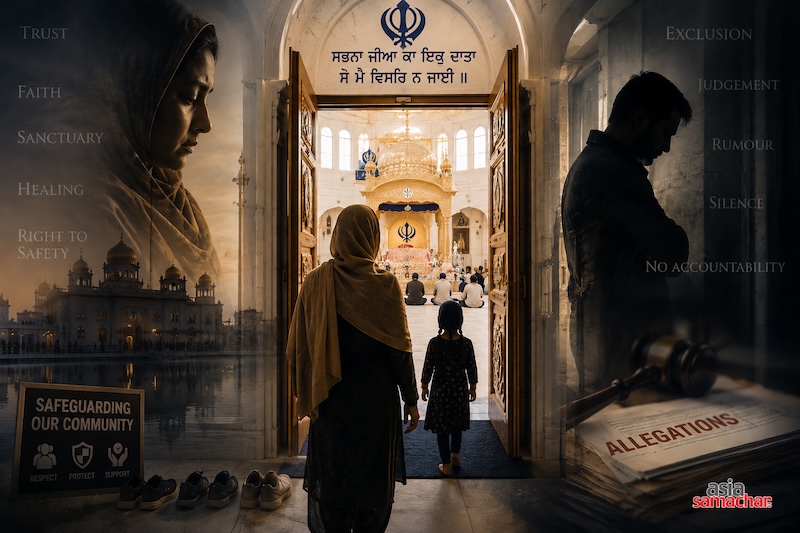
Historically, our Gurdwaras were a place of sanctuary for all – not the privileged, but for the destitute. There is an old saying in Sikhi, “Ghareeb da mooh, Guru di golak.”
Key to disputes on safeguarding is UK legislation, namely the Rehabilitation of Offenders Act, which means that those whose convictions are legally spent have immunity from continued legal sanction. However, community judgement can be lifetime, leading to incarceration for those who wish to repent for even crimes unrelated to vulnerable adults and children. They cannot be barred from praying, and this is the black swan to why faith spaces cannot just bar people as some think. Rather, measures to protect the vulnerable need to recognise that the Gurdwara is a public space for all, including those seeking to move away from their past or who are on a journey of recovery or seeking sanctuary.
The grim conundrum is that not all reports lead to a conviction, and not all victims come forward. Even where reports are made, few result in successful prosecutions due to lack of evidence, while many victims are unwilling to endure a prolonged court process. In this absence of legal resolution, rumour and conjecture can become judge and jury, leading to breaches of confidentiality and defamatory claims online and elsewhere. In other cases, allegations appear to be driven by factional motives with little consideration for the victims themselves, raising false hopes of justice among those already in a vulnerable state.
The growing focus on spiritual abuse in faith spaces has led to the introduction of Disclosure and Barring Service (DBS) checks and wider safeguarding measures for vulnerable adults and children. The DBS is a UK government-run system used to identify individuals with criminal records or those barred from working with vulnerable groups. This is a vital first step in ensuring that those in positions of trust within religious institutions are properly vetted and safe.
However, DBS checks are not foolproof. Public officials can exploit gaps within the system, while some offenders use name-change loopholes to distance themselves from their pasts. True protection therefore requires active oversight and accountability, not just paperwork.
Informal mechanisms often falter when investigations lack independence and become clouded by competing interests. To move from merely “checking boxes” to creating genuine safety, there is a need for a community-led safeguarding model supported by grassroots organisations that possess the cultural literacy and local trust required to manage communal safety. Yet even these groups can face discrimination based on philosophical beliefs or political affiliations.
There is also a double-edged issue around trauma and due process. Parcharaks (preachers) and granthis often lack any form of union representation or institutional support to defend themselves, while at the same time some victims may be encouraged to believe they have a strong case even before a proper police investigation has taken place. Where investigations do occur, they can become entangled in political interests and funding agendas, with vulnerable stories exposed online without proper consideration of capacity, privacy, or informed consent. In cases where victims have died through homicide or suicide, families are often retraumatised with little meaningful outcome or accountability.
1. The “blind spots”: pacharak home visits and tutors
While Gurdwaras are becoming increasingly regulated, the private sphere remains a significant area of risk.
- The problem: Predators can operate within the Sangat or exploit the trust and sanctity associated with pacharak home visits and private tutoring.
- The solution: A centralised risk-assessment mechanism and a national register of DBS-compliant parcharaks should be established. No home visit should take place without a verified chaperone and a pre-approved safeguarding and management plan.
2. The reality of the “guest list”: violent intrusions
Safeguarding is also about protecting faith spaces from external hate, hostility, and non-Sikh intrusions. These incidents matter because they pose a direct threat to the safety, dignity, and sanctity of places of worship.
- Targeted desecration: Attacks on sacred images in Coventry (Dec 2025) and Nuneaton (July 2025). [Link to article]
- Physical violence: The weapon attack in Gravesend (July 2024), alongside religiously aggravated assaults in Oldbury and Walsall (late 2025). [Link to article]
- The digital threshold: Attention must also be given to the “digital guest list” — addressing the censorship, harassment, and online bullying of Sikhs that can often precede or escalate into physical violence.
3. The RAG risk assessment tool
We propose a Red-Amber-Green (RAG) safeguarding system designed specifically for faith spaces. Under this model, “Green” represents low risk, “Amber” identifies concerns requiring monitoring or intervention, and “Red” signals an immediate threat requiring urgent action.
The purpose of this tool would be to trigger a rapid, multi-agency response linking sewadars, community organisations, safeguarding leads, and relevant state authorities whenever incidents of hate, abuse, or violence are identified.
4. Reclaiming the sanctuary: the 2030 vision
Gurdwaras are places of refuge and sanctuary. Yet a sanctuary cannot truly feel safe if a survivor is expected to pray alongside their alleged perpetrator following separation or disclosure. At the same time, exclusion is not straightforward, given that the Gurdwara is fundamentally a space open to all, particularly the vulnerable, disenfranchised, and those seeking spiritual refuge.
- Protected time: Introducing designated hours where girls and women can worship in a guaranteed perpetrator-free environment, recognising that perpetrators are often men.
- Women-only spaces: Building on innovations introduced by Gurdwaras such as Central Gurdwara and Seven Sisters (Ilford), there should be a transition from occasional “Women’s Day” events to regular, protected women-only days. Kaur-led groups would likely support such initiatives.
- Community policing models: Developing community-led safeguarding models that work alongside the police, such as the approach demonstrated by Injection Singh, who has been active in promoting female allyship on the streets, role-modelling Sikhi and the protection of girls and women without scapegoating communities.
- The 50% goal: Many allies, both within and outside the Sikh community, are calling for 50% female representation on all Gurdwara committees. Alongside this, the role of independent investigators — neutral parties who examine safeguarding failures without institutional bias — can provide an objective framework for ensuring accountability for institutions and justice for victims.
- Independent oversight and monitoring: Some argue that systems such as independent chauffeurs or video surveillance during home visits and other vulnerable interactions may be among the few ways to ensure maximum protection for all parties, although such measures remain open to debate.
- A due diligence register: The Sikh Council and other temporal authorities may wish to establish a due diligence register for approved home visitors, tutors, sports clubs, chauffeurs, and safeguarding personnel who meet recognised standards without compromising community safety. Any such framework would need to balance safeguarding requirements with the right to worship, pacharak employment rights, and protections against decisions driven by conjecture or rumour.
Finally, as the Guru Granth Sahib teaches, “The king and the beggar are both the same, if they both contemplate the Name of God.” The rights and dignity of the vulnerable must therefore be protected within the framework of the law, without hatred and without fear.
(Harjinder Kaur-Aujla is a mental health practitioner, researcher and doctoral candidate whose work focuses on trauma recovery, gender-based violence, grief, and the intersection of faith, law and mental healthcare. She also serves with Sikhs in Academia and the British Association for Behavioural and Cognitive Psychotherapies, while contributing as a reviewer for OMEGA: Journal of Death and Dying.)
RELATED STORY:
Faith, Culture and Clarity: A Sikh Perspective on Diwali in Malaysia (Asia Samachar, 21 Oct 2025)
ASIA SAMACHAR is an online newspaper for Sikhs / Punjabis in Southeast Asia and beyond. You can leave your comments at our website, Facebook, Twitter, and Instagram. We will delete comments we deem offensive or potentially libelous. You can reach us via WhatsApp +6017-335-1399 or email: asia.samachar@gmail.com. For obituary announcements, click here