























By Gurnam Singh | Opinion |
One of the most common questions asked about Sikhi is: if Sikh teachings reject ritualism and idol worship, why do Sikhs bow before Guru Granth Sahib?
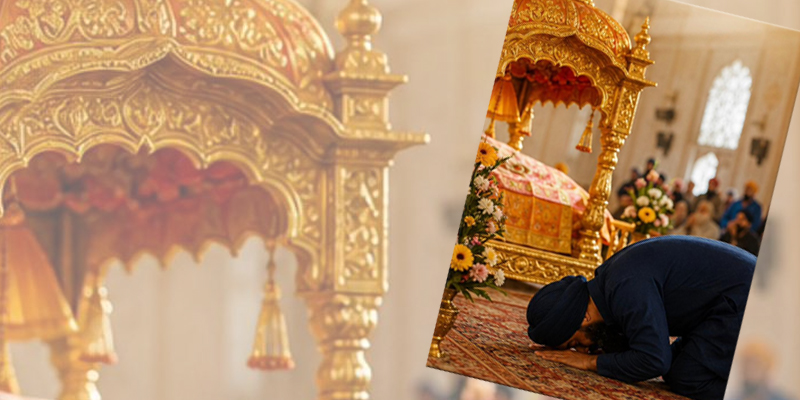
At first glance, particularly to those unfamiliar with Sikh philosophy, the practice may appear contradictory. In gurdwaras across the world, Sikhs enter the presence of Guru Granth Sahib, remove their shoes, cover their heads, and bow respectfully before the Guru. Some may even circumambulate the palki, lie fully prostrate, or touch their forehead to the floor. To an outside observer, such actions can appear similar to ritual worship found in other religious traditions.
Yet this interpretation misunderstands the theological foundations of Sikh practice.
Sikhi and the rejection of empty ritual
Generally speaking, Sikhi is largely devoid of ritualism, especially rituals that possess neither spiritual nor ethical significance. Gurbani repeatedly critiques empty religious formalism and what may broadly be described as poojarivaad — ritualistic devotion directed towards objects, places, or personalities in the hope of securing divine favours or worldly gain.
Such practices often involve appeals for miracles, material success, healing, the birth of a child, the resolution of family problems, or personal prosperity. Gurbani challenges the notion that spiritual liberation can be achieved through outward performances divorced from inner transformation.
The Sikh Gurus consistently emphasised that the true spiritual struggle lies within the human mind. The central obstacle is haumai — ego-consciousness — which gives rise to greed, anger, attachment, pride and lust. Consequently, Gurbani teaches that the greatest gift one can seek from the Divine is Naam: spiritual awareness and remembrance of the Divine presence. It is Naam that transforms consciousness and liberates the individual from self-centredness.
Then why bow before Guru Granth Sahib?
This naturally raises an important question: if Sikhs reject ritual worship, on what basis do they place Guru Granth Sahib on a raised throne and bow before it?
The answer lies in how Sikhs understand the nature of the Guru.
Guru Granth Sahib is not worshipped as a physical object. The spiritual authority does not reside in paper, ink, or binding. Rather, the Guru resides in the Shabad — the Divine Word and wisdom contained within Gurbani. The power of Guru Granth Sahib lies in the revealed teachings, in the sound-current of the recited word, and in the spiritual insight that emerges through reflection and lived practice.
When Sikhs refer to Guru Granth Sahib as the “living Guru”, this should not be misunderstood in a literal or superstitious sense. The Guru is “living” because the wisdom of the Shabad continues to guide, challenge, illuminate and transform human consciousness across generations.
If one were merely to bow mechanically before the scripture while ignoring its teachings, then the practice could indeed risk descending into ritualism. Bowing without understanding or engagement would reduce the act to empty symbolism.
However, when a Sikh bows before Guru Granth Sahib with awareness and humility, the act becomes something entirely different. It is a conscious affirmation of the authority of the Guru in one’s life. It is an expression of loyalty to the Shabad Guru and an acceptance of the spiritual path revealed by the Sikh Gurus.
An expression of love and allegiance
Following Guru Gobind Singh’s declaration that the line of personal Gurus ended with Guru Granth Sahib, Sikhs recognise the scripture as the eternal Guru of the Panth. Bowing before Guru Granth Sahib is therefore comparable to the respect and allegiance that Sikhs would have shown to the ten living Gurus.
Historically, subjects bowed before kings and emperors as a sign of acknowledging their authority. In Sikhi, however, there is no coercion or fear attached to such reverence. The Sikh bows before the Sacha Patshah or the True Sovereign, not out of blind submission, but out of devotion, gratitude and love.
The distinction is crucial. Blind ritual demands obedience without understanding. Sikh devotion, by contrast, invites reflection, ethical responsibility and inner transformation.
Beyond outward gestures
Just as in human relationships, symbolic gestures can express affection and respect, but genuine love requires deeper emotional and intellectual connection. The same principle applies in Sikhi.
Bowing before Guru Granth Sahib is only meaningful when accompanied by an ongoing dialogue with the Guru. This dialogue takes place through reading Gurbani, listening attentively to kirtan, reflecting upon the teachings, and striving to apply them in everyday life.
One often observes Sikhs standing silently before Guru Granth Sahib with folded hands. In those moments, they may be seeking strength, clarity, humility or guidance. But the ultimate aim is not worldly reward. Rather, it is the aspiration to walk the path of Sikhi: to overcome ego, to live truthfully, to earn an honest living, to share with others, to serve humanity, and to stand against injustice and oppression. These are the ethical and spiritual foundations of Sikh living.
True devotion in Sikhi
The real test of devotion in Sikhi is therefore not how low one bows physically, but how deeply one internalises and lives the Guru’s teachings.
A Sikh who bows before Guru Granth Sahib yet continues to live through greed, hatred and ego has missed the essence of the Guru’s message. Conversely, one who genuinely strives to embody compassion, humility, justice and remembrance of the Divine is engaging in the highest form of devotion.
In this sense, bowing before Guru Granth Sahib is not an act of idol worship or ritualistic pooja. At its best, it is a visible expression of an inward relationship with the Shabad Guru; a relationship grounded in understanding, love, discipline and spiritual awakening. That is true devotion in action!
Join the conversation on this story on Asia Samachar’s Facebook and Instagram pages.

Gurnam Singh is an academic activist dedicated to human rights, liberty, equality, social and environmental justice. He is a Professor of Sociology at University of Warwick, UK. He can be contacted at Gurnam.singh.1@warwick.ac.uk
* This is the opinion of the writer and does not necessarily represent the views of Asia Samachar.
RELATED STORY:
The Demise of the Akali Dal and the Badal Dynasty: What Next for the Panth? (Asia Samachar, 5 Aug 2024)
ASIA SAMACHAR is an online newspaper for Sikhs / Punjabis in Southeast Asia and beyond. You can leave your comments at our website, Facebook, Twitter, and Instagram. We will delete comments we deem offensive or potentially libelous. You can reach us via WhatsApp +6017-335-1399 or email: asia.samachar@gmail.com. For obituary announcements, click here





Beautiful response to my article. Indeed, you considerably surpass and advance the points I made. Many thanks for sharing you insights.
May I expand to say, bowing is in actual fact “Reverence Beyond Ritual:” The Inner Meaning of Bowing
In every civilisation, human beings have bowed before something greater than themselves. Kings were bowed to as symbols of authority. Saints were revered as enlightened souls. Scriptures were honoured as carriers of wisdom. Temples, mosques, churches and gurdwaras became spaces where humanity expressed humility before the Divine. Mankind bowed based on their traditional upbringing.
Yet the true value of bowing has never rested in the physical act alone.
The recent discussion on bowing before Guru Granth Sahib rightly explains that in Sikhi, bowing is not rooted in fear, coercion or blind submission. A Sikh bows before the Guru Grant Sahib ji with love, gratitude, reverence and devotion. The gesture is meant to reflect an inner relationship with the Shabad, the Divine Wisdom embodied within Gurbani.
However, an even deeper question must be asked: What gives bowing its true spiritual meaning?
The answer is Reverence.
Without reverence, bowing slowly loses its soul and risks becoming mere ritual. This truth applies not only in Sikhi but across all spiritual traditions. Whether one bows before Guru Granth Sahib, before a deity, before saints, or before divinely inspired souls from East or West, the outward gesture becomes hollow if the heart is absent from the act with reverence.
True reverence is not fear. It is not emotional slavery, social pressure or inherited habit. Reverence is a sincere inner surrender to the Divine Presence. It is a state where the human being recognises something spiritually higher and feels naturally humbled and extremely small before it.
Such reverence has transformative power. It uplifts the human spirit through peace, joy, clarity, humility and grace. At times, it may even manifest as unexpected blessings or profound emotional healing. But the greatest upliftment is spiritual awakening itself.
When this awakening deepens, bowing no longer feels forced or ceremonial. The head bends automatically because the ego softens naturally before truth and divinity. In that state, humility is not performed; it flows spontaneously from within.
On the other hand, a person may bow daily yet remain consumed by ego, greed, hatred or pride. In such circumstances, the act risks becoming nothing more than a cultural performance transmitted through generations without reflection or inner connection. Then the physical action survives, but its spiritual essence fades away.
Perhaps this is why many spiritual teachers warned humanity against empty ritualism.
Kabir expressed this beautifully in his revered lines:
“Pooja karu na namaz guzaroo, ek Nirankar le ridai namaskaroo.” PG 1136
The spirit behind these words is profound. True devotion is not confined merely to outward ceremonies. The deepest bow happens within the heart — toward the One Formless Divine.
From that realisation emerges an even greater transformation: one begins to bow inwardly before the entire universe, recognising creation itself as a wondrous expression of the Divine Presence. Every human being, every breath, every element of nature becomes interconnected within that sacred awareness.
In Guru’s teaching therefore, the highest devotion is not measured by how low one physically bows, but by how deeply one lives His Divine Knowledge. So one becomes a seeker and a learner called a Sikh… The true Sikh’s journey is to overcome ego, live truthfully, earn honestly, serve humanity, share with others, and stand firmly against injustice and oppression.
Bowing is meaningful only when it reflects this inner transformation.
The highest bow is ultimately not of the head, but of the ego.
Comments are closed.