






















By Amarjeet Singh @ AJ | Opinion |
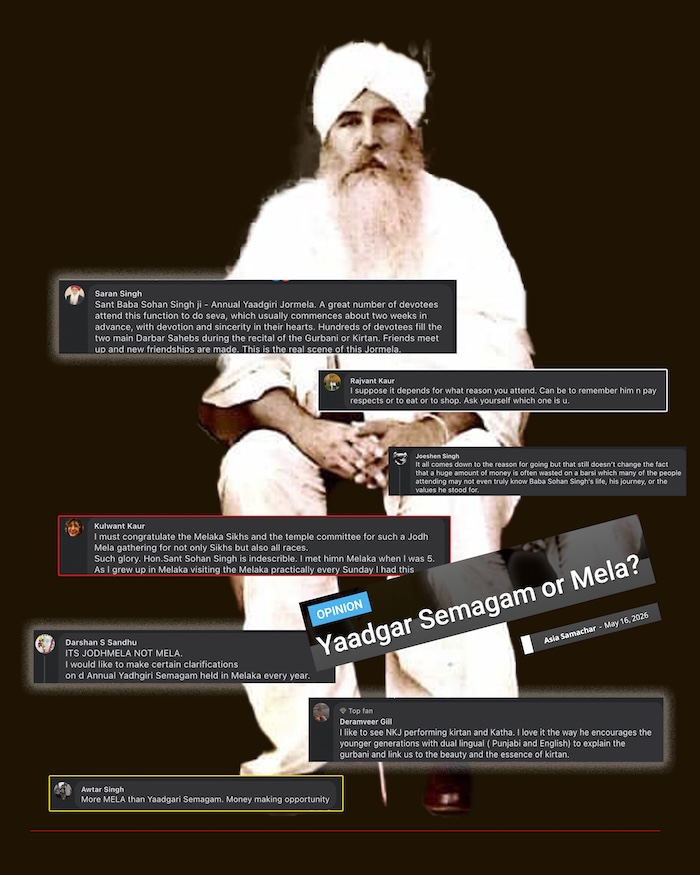
Following the earlier reflections surrounding the Melaka Yaadgiri Semagam, many responses emerged from different members of the Sikh community. Some agreed with the concerns raised, while others felt the discussion overlooked the deeper spiritual and community value that the gathering continues to hold for thousands of people worldwide.
That itself reflects something important.
This conversation was never truly about choosing sides. It was never about attacking organisers, committees, sewadars, jathas, or the sangat. Rather, it has evolved into something much bigger — a reflection on how Sikh gatherings, institutions, and community spaces are evolving in the modern world.
Community members including Parigeet Singh, Saran Singh, Deramveer Gill, Joeshan Singh, Walveer Singh, Darshan S Sandhu, Tarlochan Singh, and others shared perspectives on Facebook based on the first article and that reflected both the emotional connection and evolving complexity surrounding such gatherings. Their responses showed that while opinions may differ, the underlying concern remains deeply rooted in the Panth, spirituality, sangat, and the future direction of Sikh institutions.
GO HERE FOR THE FIRST ARTICLE: Yaadgar Semagam or Mela?
It is important to acknowledge the many valid points raised by those who continue defending the spirit and value of the Melaka Yaadgiri Semagam.
For many individuals, this gathering is deeply personal and spiritual. Thousands attend yearly not because they are forced to, but because they feel spiritually connected to the legacy of Sant Baba Sohan Singh Ji and the atmosphere of seva, sangat, Gurbani, and remembrance that surrounds the programme.
RESPONSES
Many Sanggat members begin seva weeks in advance with sincerity and devotion. Inside the Gurdwara and the Sant Sohan Singh Ji Melaka Memorial Society Malaysia (SSSJMMSM) (commonly referred to as the Vidyala) premises, Akhand Paths, Kirtan, Katha and various forms of seva continue throughout the programme. Hundreds fill the Darbar Sahib to listen to Gurbani wholeheartedly. Old friendships reconnect, new friendships are formed, and many individuals who may otherwise remain distant from Sikh spaces reconnect with the sangat once again. Like people who travel to prepare the sukh prasad and the Santana Biker yearly ride to assist in cleaning and also contribution in meals.

As one community member reflected, people connect to the Semagam in different ways — through prayer, Kirtan, seva, reflection, or simply reconnecting with the community. Ultimately, intention remains deeply personal between the individual and Guru Sahib.
These realities should not be dismissed lightly.
It is also fair to acknowledge that many aspects outside the official religious premises are beyond the direct jurisdiction of organising committees. Public stalls, businesses, hotels, social gatherings, and activities occurring elsewhere within the town are often organised independently under approvals from local authorities. No Gurdwara committee realistically possesses the authority to police an entire town, control individual behaviour, or monitor every personal decision made by visitors during a large public gathering.
Several respondents also stressed this point strongly — that organisers cannot realistically control what occurs outside official Gurdwara premises, and that individuals themselves remain responsible for their own actions, intentions, and choices during such gatherings.
That distinction is important.
At the same time, the deeper conversation is not really about jurisdiction or blame at all. It is about recognising how major Sikh gatherings themselves are evolving globally into larger social, cultural, economic, and identity ecosystems.
Because whether openly acknowledged or not, major Sikh programmes today no longer function only as purely religious events. They also become spaces where communities reconnect, businesses operate, social identities strengthen, younger generations meet, families gather, tourism increases, merchandise appears, and social media visibility expands.
BEYOND MELAKA
This is not unique to Melaka alone.
It is part of a wider evolution affecting Sikh gatherings across the world.
Growth itself should not automatically be viewed negatively.
History teaches us that truthful teachings and sincere spiritual legacies often continue growing long after individuals leave this world. During Guru Nanak Sahib Ji’s lifetime, the number of direct followers was relatively small compared to the millions worldwide today who celebrate Gurpurabs, reflect upon Gurbani, and honour his jyoti jot. Teachings rooted in sincerity, humility, compassion, and truth naturally continue expanding because people continue finding guidance and meaning within them across generations.
In many ways, this also explains why large numbers continue gathering today in remembrance of Sant Baba Sohan Singh Ji. His legacy of seva, humility, discipline, and dedication towards the Sikh community left a lasting impact on many lives and institutions. Through programmes organised in his memory, significant funds have also been raised that continue benefiting the wider Sikh community, including contributions towards projects such as KhalsaLand and other community-based initiatives.
Many therefore see the Semagam not merely as an annual gathering, but as a living continuation of Sant Ji’s influence upon the Panth and community.
Others also raised an important point regarding Kirtan Jathas and Pathis.
Some members of the sangat genuinely value renowned jathas because of their ability to explain Gurbani meaningfully, connect with younger generations bilingually, and inspire spiritual reflection through Katha and Kirtan. Many younger Sikhs today understand Gurbani more deeply precisely because certain jathas are making efforts to communicate beyond traditional formats.
One respondent openly shared how bilingual Katha and Gurbani explanations helped younger generations appreciate the beauty and deeper meaning of Sikh teachings in ways that traditional formats sometimes struggled to achieve.
At the same time, concerns raised regarding the welfare and appreciation of Pathis should also not be ignored. The Akhand Path remains the spiritual backbone of the programme itself, and many agree that Pathis deserve equal dignity, respect, and proper care alongside all other contributors involved in the Semagam.
Another thoughtful reflection raised the question of how future Semagams could further expand Sant Ji’s legacy through scholarships, welfare initiatives, educational support, and long-term community development efforts carried out in his name. Such ideas reflect a growing desire among sections of the sangat to see remembrance translated into ongoing social impact and community upliftment.
Some also felt that beyond organising large gatherings, greater emphasis could continuously be placed on educating the sangat about Sant Ji’s life, values, discipline, humility, and spiritual teachings so that remembrance becomes rooted not only in attendance, but also in understanding.
This is where the discussion becomes more balanced and meaningful.
Not one side completely right.
Not one side completely wrong.
Rather, it is a community trying to navigate modern realities while preserving spiritual foundations.

Some members of the sangat feel strongly that personal intention matters most. If one attends with sincerity, humility, and spiritual focus, then distractions outside should not weaken one’s own connection to Gurbani and Guru Sahib. Others believe that as gatherings grow larger, communities must continuously reflect on whether spirituality remains central amidst increasing scale, visibility, commercial activity, and event culture.
Both perspectives emerge from people who ultimately care about the Panth.
This is why such conversations should not immediately be viewed as attacks, negativity, or attempts to create division.
DIFFICULT QUESTIONS
Sometimes difficult questions emerge precisely because people still care deeply about preserving integrity, maryada, humility, and spiritual purpose within Sikh institutions.
Likewise, organisers, sewadars, and volunteers who sacrifice enormous time and energy behind the scenes also deserve fairness and appreciation. Large-scale gatherings involving thousands of attendees require tremendous commitment, coordination, patience, and resources that often go unseen by the wider sangat.
The Sikh community today does not need more division between “supporters” and “critics.”
It needs more mature conversations about how Sikh institutions and gatherings can continue evolving responsibly in a rapidly changing world shaped by social media, visibility culture, tourism, commercial pressures, and generational shifts.
How do we preserve spirituality while navigating modern public culture? How do we maintain humility within large-scale events? How do we ensure seva remains sincere even when programmes become professionally organised?
How do we continue educating younger generations not only about attending Semagams, but also about understanding the lives, sacrifices, teachings, and values of personalities such as Sant Baba Sohan Singh Ji?
And most importantly: How do we ensure remembrance continues inspiring inner transformation rather than only external expansion?
Because ultimately, large crowds alone do not define spiritual success.
What truly matters is whether Gurmat values — humility, seva, discipline, compassion, integrity, and truthful living — continue remaining alive within the sangat long after the programme itself ends.
And that is the bigger picture worth reflecting upon together as a community.
Join the conversation on this story on Asia Samachar’s Facebook and Instagram pages.
Amarjeet Singh @ AJ is a Malaysia-based business consultant with over 25 years experience
RELATED STORY:
The most respected Sikh in Southeast Asia (Asia Samachar, 20 May 2020)
ASIA SAMACHAR is an online newspaper for Sikhs / Punjabis in Southeast Asia and beyond. You can leave your comments at our website, Facebook, Twitter, and Instagram. We will delete comments we deem offensive or potentially libelous. You can reach us via WhatsApp +6017-335-1399 or email: asia.samachar@gmail.com. For obituary announcements, click here