





















By Gurnam Singh | Opinion |
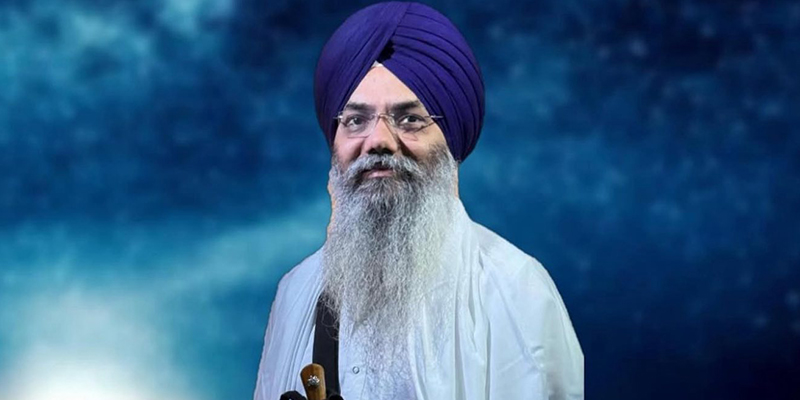
The recent and deeply troubling episode involving the un-ceremonial prevention of Bhai Manpreet Singh Kanpuri doing kirtan during the Annual Akhand Kirtani Jatha’s (AKJ’s) Vaisakhi programme in Amritsar raises urgent and uncomfortable questions for both the Jatha and the Panth.
The manner in which he was physically confronted – and played out in full public view across social media – was deeply distressing. Equally disconcerting was the visible distress of his son, who instinctively sought to shield his father from being forcibly removed from the stage by some individuals who were adamant he would not be allowed to perform kirtan. What kind of impression will this have left on him and many other Sikh you who look up to Manpreet Singh.
Compounding this was the conduct of a particular female ‘Gursikh’ whose angry outburst and threatening gestures towards Manpreet Singh represented a complete breakdown of Gurdwara decorum. That such behaviour was subsequently honoured with a ‘siropao’ by some members of Amritsar AKJ is difficult to comprehend and risks setting a dangerous precedent. Indeed, at a time when we should be joining hands, sadly, like many other Panthic groups, both political and dharmic, there is a real fear that this could lead to further fragmentation of the AKJ, where unity was already strained.
COMMERCIALISATION
Taken together, these events do not simply reflect a lapse in judgement or the egotistical behaviour of a few individuals, but point to deeper structural and ethical tensions within our Panth. That is, beyond this immediate unsavoury episode, which the AKJ will need to resolve, a far more significant and pressing concern, namely, the growing commercialisation of our institutions, most notably Gurdwaras.
Gurbani repeatedly reminds us that ego, power, and attachment to maya can entrap even those who appear outwardly pious. No institution or jatha is immune from these pressures. It is precisely for this reason that responses to such events must be measured, principled, and rooted in collective wisdom.
The arbitrary exclusion or banning of individuals is neither just nor sustainable. Such actions risk deepening divisions while ignoring the complexity of the underlying issues within the Panth. It is to the credit of the current Akaal Takht Jathedar, Giani Kuldeep Singh Gargaj, that over the past two years, not only have we seen a move away from the trend to excommunicate and ban Sikhs parcharaks, but to bring those previously banned back into the fold under the aegis of the Panthic Maryada.
In order to avoid the kinds of fallout seen at the AKJ function in Amritsar recently, what is required is thoughtful and inclusive dialogue, one that seeks to balance two essential imperatives: the fair and dignified support of Gursikh kirtanis who choose to dedicate their lives to serving Sikhi and the need to resist the steady drift towards the commodification of Sikh religious life.
If one’s love for Gurbani is genuine, then the act of receiving financial support for performing kirtan should not, in itself, diminish the spiritual integrity of that seva. Those grounded in ethical discipline will not compromise their principles merely for monetary gain. Indeed, the very notion that Gurbani can be “sold” is, in essence, absurd. Intention, as much as action, must remain central when making such serious judgements.
At the same time, accountability cannot be ignored. In all professions, individuals are held to clear ethical standards; a doctor, for example, may be disciplined or even struck off for serious misconduct. The same principle must apply within religious spheres.
Nevertheless, we cannot overlook a growing and genuine concern: the increasing commercialisation of Sikh practices. Payments for Akhand Paaths, kirtan programmes, and religious services have become normalised, while so called Babas continue to exploit and defraud vulnerable individuals for financial gain.
What often begins with sincere intention can, over time, become corrupted by ego and materialism. This is not unique to any one group; it is a broader human frailty that has, regrettably, affected individuals across different religious roles, including sants, babas, and gianis.
It is also worth asking whether inconsistent or inadequate financial support structures may themselves contribute to this problem. When individuals who dedicate their lives to the Panth are not supported in a fair and dignified manner, there is a risk that religious service becomes increasingly transactional.
REFLECTIONS
This brings us to a number of critical questions that require collective reflection.
First, how should Sikhi understand the relationship between seva, modern day commercial imperatives? Is there, in fact, a contradiction between the two? To what extent does receiving financial compensation undermine the principle of nishkam seva? And how should we interpret the concept of ‘kirat’ and ‘nishkam seva’, for those whose full-time work may be devoted in service of the Panth?
Second, what responsibilities do our institutions carry? Gurdwaras must consider how they can ethically support granthis, raggis, and staff without reducing the sangat to consumers and religious practice to a service economy. Financial arrangements and investments must be transparent, fair, and aligned with Sikh values, not dictated by market logic and the profit motive.
Third, how can we avoid the corrupting influences of commercialisation, which Gurbani reminds us of? When profit motives begin to shape religious spaces, there is a real danger that kirtan, parchaar, and even education become commodified. Increasingly, we see Gurdwaras competing to attract larger congregations by inviting high profile kirtanis and speakers, often at significant cost. This raises uncomfortable questions about whether we are inadvertently creating a culture of celebrity religiosity.
Fourth, and perhaps most crucially, there is the issue of accountability and governance. Who has the authority to decide who may or may not perform kirtan? As Sikh institutions grow into complex, multi-million-pound organisations, they require professional management and full-time commitment. Yet how do we balance this need for professionalism with the foundational Sikh principles of humility, equality, and the rejection of a priestly hierarchy?
The modern Panth stands at a crossroads. On one hand lies the practical necessity of supporting those who dedicate their lives to religious service. On the other lies the imperative to protect Sikhi from the encroaching forces of commercialisation and institutionalisation.
These are not easy questions, nor do they admit simple answers. The financial realities of the contemporary world cannot be ignored. Yet neither can we compromise the spiritual integrity of Gurbani and the principles upon which Sikhi is founded.
If the Panth fails to engage with these challenges collectively and with an open mind, we risk further division, fragmenting into smaller groups. As we navigate this evolving landscape, one principle must remain non-negotiable: the selfless core of the Panth must not be eroded by the transactional pressures of the modern world.
Join the conversation on this story on Asia Samachar’s Facebook and Instagram pages.

Gurnam Singh is an academic activist dedicated to human rights, liberty, equality, social and environmental justice. He is a Professor of Sociology at University of Warwick, UK. He can be contacted at Gurnam.singh.1@warwick.ac.uk
* This is the opinion of the writer and does not necessarily represent the views of Asia Samachar.
RELATED STORY:
The Demise of the Akali Dal and the Badal Dynasty: What Next for the Panth? (Asia Samachar, 5 Aug 2024)
ASIA SAMACHAR is an online newspaper for Sikhs / Punjabis in Southeast Asia and beyond. You can leave your comments at our website, Facebook, Twitter, and Instagram. We will delete comments we deem offensive or potentially libelous. You can reach us via WhatsApp +6017-335-1399 or email: asia.samachar@gmail.com. For obituary announcements, click here