




















By Gurnam Singh | Opinion |
The quest to define “the human” has historically been a project of purification. From the gilded halls of religious devotion to the sterilized laboratories of secular humanism, we have consistently sought to frame human identity as an aspirational journey toward a universally positive ideal. We speak of “humanity” as a synonym for kindness and “inhumanity” as a representation of cruelty, yet this linguistic sleight of hand ignores a fundamental reality: the cruelty is just as human as the kindness. In this article, however uncomfortable this may seem, I argue that human identity is not the pursuit of goodness, but the management of contradiction.
Seen like this, we need to view human behaviour not as something that is necessarily in need of correction, but as the defining characteristic of our species. I know this sits uncomfortably with many which have a profound belief in universal goodness. However, by acknowledging the “dark side” of humanity as a natural component of our identity, we move toward a more realistic conception of selfhood that facilitates genuine moral agency and global solidarity. The tendency to frame human nature as inherently good is largely driven by a psychological need for redemption. Religious frameworks attempt to resolve this contradiction in distinct but structurally similar ways.
In the Abrahamic traditions, this is often articulated as a cosmic battle between good and evil. Identity is framed through the lens of a “fallen” nature that must be redeemed through prayer, submission, and divine grace. Within this framework, the “dark side” is externalized as a tempter or a spiritual failure. Conversely, the Indic Dharmic schools of thought, such as Sikhi or Hinduism, internalise this struggle as the conquest of the ego, or Haumai. In these traditions, the goal of identity is the cultivation of virtues, such as mercy, contentment, and truth and to subjugate the “five thieves” of lust, anger, greed, attachment, and pride. Here, identity is a project of merging the individual self into the Divine, a process that effectively seeks to dissolve the paradox by eradicating the self or ‘me’. This is perfectly captured in the Guru Granth Sahib (p1375) by Kabir when he says: ਤੂੰ ਤੂੰ ਕਰਤਾ ਤੂ ਹੂਆ ਮੁਝ ਮਹਿ ਰਹਾ ਨ ਹੂੰ ॥ ਜਬ ਆਪਾ ਪਰ ਕਾ ਮਿਟਿ ਗਇਆ ਜਤ ਦੇਖਉ ਤਤ ਤੂ ॥੨੦੪॥. repeating, ‘You, you, I have become like You. In me, no ‘I’ (ego) remains. When the difference between myself and others is erased, then wherever I look, I see only You.”
THE SECULAR WORLD
In the secular world, the framing of good and evil shifts from the spiritual realm to the material and structural. This introduces a second paradox: the tension between human agency and social structure. Marxism offers a compelling critique of morality by suggesting that human behaviour is a product of material circumstances rather than innate character. From this perspective, individual ‘immorality’ is not seen a personal defect but a symptom of systemic conditions.
As Karl Marx (1859, A Contribution to the Critique of Political Economy) famously posited, it is social existence that determines consciousness. If we view the human through the analogy of a tree, it becomes illogical to blame the tree for its stunted growth or withered leaves if the soil is toxic and the water is scarce. While this view correctly identifies the importance of “structural flourishing,” it risks a different kind of darkness. While this view identifies the conditions necessary for human flourishing, it simultaneously risks eroding the very concept of personal responsibility. If we are merely products of our environment, the concept of a “self” becomes a hollow vessel.
To resolve this, we must turn to Friedrich Nietzsche, who sought to break the binary of good and evil entirely. Nietzsche (1886, Beyond Good and Evil) argued that the moral categories used by both religion and secular society were often “slave moralities” designed to suppress the vibrant, often dangerous, vitality of the human spirit. Nietzsche’s philosophy suggests that a realistic conception of humanity must accept our “darker” instincts—ambition, power, and even aggression—as raw materials for self-overcoming. To be “human” is not to be “good” in a conventional sense; it is to have the strength to create one’s own values in a world devoid of inherent meaning. However, Nietzsche’s exaltation of the individual, if not balanced by a theory of social responsibility, risks slipping into a form of unrestrained individualism or nihilistic egoism.
This is where Hannah Arendt provides a vital bridge. In The Life of the Mind (1978), Arendt explores the mechanism of “thoughtlessness,” a state where individuals relinquish their moral agency to follow the rules of a group or a system. Arendt argues that the greatest evils in history the greatest evils are not acts of monstrous intent, but the consequence of ordinary people who abandon thought. For Arendt, identity and agency are maintained through the internal dialogue of the mind—the “two-in-one” conversation we have with ourselves. Thoughtfulness is the faculty that allows us to stand apart from the crowd and take responsibility for our actions. This suggests that moral agency is not about being “naturally good,” but about the constant, active engagement of the mind to resist the pull of groupthink.
By synthesizing Nietzsche’s embrace of the whole self with Arendt’s demand for thoughtfulness, we arrive at a theory of identity that is “immanent”. It is always in a state of development and grounded in both the acceptance of one’s inner drives as argued by Nietzsche and the disciplined practice of reflective judgment that is emphasised by Arendt. This conception of identity allows us to destabilize the rigid group categories, such as race, ethnicity, religion, or class, that so often serve as proxies for moral worth. When we define ourselves primarily through these boxes, we lose the very agency that makes us human. We become “thoughtless” members of a tribe rather than autonomous agents.
However, navigating the world as a purely autonomous agent is physically and materially difficult. There is security in the group. To address this, we can adopt what Gayatri Chakravorty Spivak (1990, The Post-Colonial Critic) describes as “strategic essentialism.” Spivak suggests that while identities like “nationality” or “gender” are social constructs, we may need to use them as a “strategic” tool for political solidarity and social change. The key, however, is that these attachments must remain conditional. We may stand with a group to fight inequity, but we must never let the group define the limits of our moral imagination.
SIKH THOUGHT
In Sikh thought, the self is recognized as a vital site of spiritual experience, yet it is perennially threatened by Haumai or the “I-am-ness”, an ego-consciousness that acts as a veil between the individual and the Universal (Ik Onkar). The goal is not the literal annihilation of the person, but the dissolution of the egoistic boundary. When the ego is “stilled,” the individual does not lapse into non-existence; rather, they achieve a state of Jivan Mukti (liberation while alive). In this state, the self becomes a transparent vessel for Divine Will (Hukam), enabling a more profound, selfless agency dedicated to justice and service.
Nietzsche, writing from a radical anti-metaphysical stance, similarly rejects the notion of a “soul” as a fixed substance. Instead, he views the self as a dynamic, shifting hierarchy of drives and affects. For Nietzsche, the ego is often a “grammatical illusion” that masks the chaotic reality of the body. However, he does not advocate for the ego’s destruction in a Buddhist or ascetic sense. Instead, he calls for a refinement of the self: the “Will to Power” involves organizing these competing drives into a singular, creative force. Through self-overcoming, the individual transforms the self into a disciplined tool for aesthetic creation and the assertion of new values.
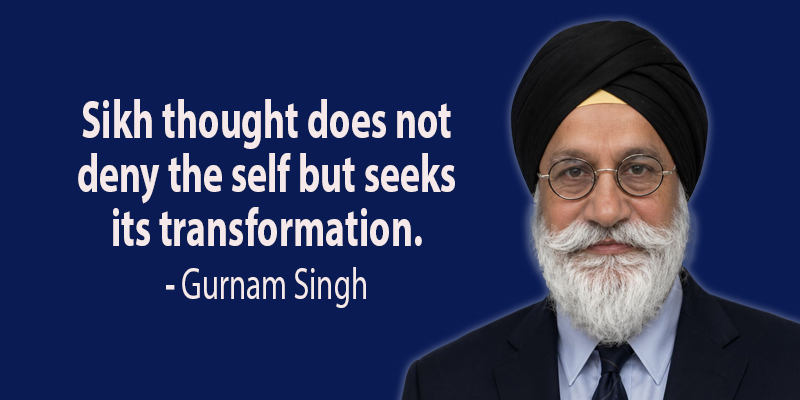
Like Nietzsche, Sikh thought does not deny the self but seeks its transformation. What brings both frameworks together is the idea that the unrefined, reactive ego must be transcended to unlock “true” agency. Where they converge is in the belief that authentic existence is a process of becoming, not a state of being. While Sikhi finds this authenticity through alignment with the Infinite, Nietzsche finds it through the radical affirmation of the finite, yet both view the “conquered” self as the only one truly capable of meaningful action.
The paradox of identity, therefore, is that we are both products of our DNA, ‘karma’ and the wider social structure, yet in some way also responsible for our agency, and therefore actions. Accepting the dark side of humanity and our capacity for thoughtlessness, ego, and violence, does not mean endorsing it. Rather, it means acknowledging that these elements are permanent fixtures of the human mind. By recognising that our identity is a state of constant “becoming” rather than a fixed state of “goodness,” through continuous critical reflexivity and an open mind, we discipline ourselves to maintain autonomy. In the long run, the preservation of this agency is the only way for a human being to truly thrive. It offers less security than dogma and less comfort than tribal belonging, but, I believe, it is the only path that fully honours the complexity of being human.
Join the conversation on this story on Asia Samachar’s Facebook and Instagram pages.
Gurnam Singh is an academic activist dedicated to human rights, liberty, equality, social and environmental justice. He is a Professor of Sociology at University of Warwick, UK. He can be contacted at Gurnam.singh.1@warwick.ac.uk
* This is the opinion of the writer and does not necessarily represent the views of Asia Samachar.
RELATED STORY:
The Demise of the Akali Dal and the Badal Dynasty: What Next for the Panth? (Asia Samachar, 5 Aug 2024)
ASIA SAMACHAR is an online newspaper for Sikhs / Punjabis in Southeast Asia and beyond. You can leave your comments at our website, Facebook, Twitter, and Instagram. We will delete comments we deem offensive or potentially libelous. You can reach us via WhatsApp +6017-335-1399 or email: asia.samachar@gmail.com. For obituary announcements, click here