
























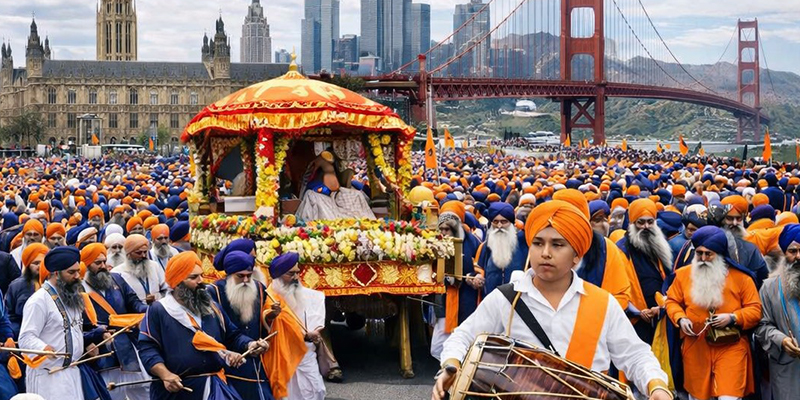
Nagar Kirtans have become prominent public expressions of Sikh identity, especially in diaspora communities. While often praised for fostering visibility, unity, and collective joy, their contemporary practice raises concerns about spiritual depth, social disruption, and alignment with Gurmat and Sikh maryada. Drawing on examples from India, New Zealand, and elsewhere, this article examines how large-scale processions can unintentionally lead to commercialization, public inconvenience, and a dilution of kirtan’s contemplative essence. It argues that symbolic visibility alone is insufficient for meaningful parchar(dissemination) and may even create social friction. The article proposes Gurmat-centred alternatives grounded in education, seva, and ethical engagement to nurture Sikh identity while promoting social harmony.
By Dr. Devinder Pal Singh | Opinion |
Public religious processions have long served as visible markers of faith, identity, and communal belonging. Within Sikh communities worldwide Nagar Kirtan has become one of the most recognizable expressions of this tradition, particularly during Gurpurabs and Vaisakhi celebrations. What began as a modest, localized practice has, over recent decades, expanded into large-scale public events involving elaborate floats, amplified kirtan, mass participation, and extensive logistical coordination. For many Sikhs, these processions evoke pride, joy, and a sense of unity, especially in multicultural societies where minority identities seek affirmation and recognition.
However, the growing scale and frequency of Nagar Kirtan have also prompted critical reflection. Questions are increasingly raised about their effectiveness as tools of spiritual education, their conformity with Sikh maryada, and their impact on wider society. Incidents of public resistance, traffic disruption, and commercialization highlight the need for a more nuanced evaluation of these events. This article seeks to move beyond polarized positions of uncritical celebration or outright rejection. By examining both the benefits and the limitations of Nagar Kirtans, it aims to encourage thoughtful dialogue on how Sikh public engagement can remain spiritually grounded, socially responsible, and true to the core principles of Gurmat.
The Perceived Benefits of Nagar Kirtans
Nagar Kirtans have, for many Sikh communities worldwide, become a powerful symbol of collective identity and visibility. In diaspora settings, especially, these public processions offer a sense of cultural affirmation and belonging. Sikhs walking together behind the Panj Pyare, performing seva, and sharing langar in public spaces often experience a deep emotional connection with their faith and community. Such events can strengthen intergenerational bonds, allowing elders to transmit tradition and younger Sikhs to feel pride in their heritage.
From a social perspective, Nagar Kirtans can raise basic awareness about the Sikh presence in multicultural societies. In cities across Canada and the United Kingdom, media coverage of Vaisakhi processions has introduced non-Sikhs to Sikh symbols, values of service, and communal harmony. The visible practice of langar, freely offered to all, frequently leaves a positive impression on observers and reinforces Sikh ideals of equality and generosity.
Nagar Kirtans also provide an opportunity for communal mobilization. Volunteers coordinate logistics, safety, food preparation, and cleanup, fostering a spirit of cooperation and seva. When conducted thoughtfully and respectfully, these processions can momentarily transform urban spaces into expressions of joy, faith, and collective discipline, reminding participants of their shared responsibility toward both their tradition and the wider society.
The Growing Concerns and Limitations (Internal Sikh Perspective)
Despite their popularity, Nagar Kirtans raise serious concerns within the Sikh community regarding spiritual depth and alignment with Gurmat. One central issue is the gradual shift from substance to spectacle. As processions grow larger, louder, and more elaborate, the focus often moves away from meaningful engagement with Gurbani toward visual display, entertainment, and numerical success. Kirtan, which traditionally requires attentiveness, serenity, and reflection, risks being reduced to background sound in chaotic environments.
Another concern relates to the sanctity of Sri Guru Granth Sahib. Taking the Guru into unpredictable public spaces, commercial districts, tourist zones, and crowded streets raises questions about maryada, dignity, and respect. Sikh teachings emphasize the Shabad Guru as a source of inner transformation, not a symbol for public exhibition. When reverence gives way to pageantry, the deeper spiritual purpose can become obscured.
SEE ALSO: Nagar Kirtan and Sikhi
SEE ALSO: Nagar Kirtan Beyond India: Faith in Motion or a Misplaced Idea?
Additionally, the resources invested in Nagar Kirtans, time, money, and volunteer energy, are substantial. Critics argue that these resources could be more effectively used for Gurbani education, youth engagement, and long-term parchar(dissemination) within gurdwaras. The risk, therefore, is not only spiritual dilution but also missed opportunities to address pressing internal challenges facing Sikh communities worldwide.
The Growing Concerns and Limitations (Societal and Public Impact)
Beyond internal considerations, Nagar Kirtans increasingly generate friction with surrounding communities. Large processions often lead to traffic congestion, noise pollution, and disruption of daily life. Real-world incidents highlight this tension. In Manurewa, New Zealand, in December 2025, local residents openly protested a Nagar Kirtan, expressing frustration over repeated disruptions and what they perceived as cultural imposition. Similar resistance emerged in Tauranga shortly thereafter, indicating a pattern rather than isolated hostility.

Historical examples from India also reveal the scale of disruption. Reports from Chandigarh documented massive traffic chaos caused by processions involving hundreds of vehicles and animals, raising concerns about public safety and emergency access. Such situations risk portraying Sikhs as inconsiderate or entitled, an image contrary to Sikh ethical teachings of humility and social responsibility.
Commercialization further complicates matters. Sponsored floats, advertising stalls, and competitive displays can transform spiritual observances into market-like events, blurring the line between faith and commerce. When Nagar Kirtans are perceived as nuisances or spectacles rather than sincere expressions of spirituality, they may unintentionally fuel resentment rather than understanding, undermining their stated purpose of outreach and harmony.
Constructive Alternatives to Reduce Conflict and Deepen Impact
A more sustainable path forward lies not in abandoning public expression altogether, but in rebalancing priorities toward Gurmat-centred engagement. One constructive alternative is shifting emphasis from large-scale processions to meaningful parchar (dissemination). Public lectures, interfaith dialogues, Gurbani workshops, and educational exhibitions allow for voluntary, respectful learning rather than forced exposure. Such formats align more closely with Sikh principles of humility and wisdom.
Seva-based outreach offers another powerful alternative. Free medical clinics, food banks, blood donation drives, and environmental initiatives demonstrate Sikh values in action. These efforts generate lasting goodwill, reduce social friction, and address real community needs, often receiving positive public recognition without disruption.
Where Nagar Kirtans are held, moderation is key. Smaller, localized processions near gurdwaras, conducted with discipline and minimal disruption, can preserve dignity while reducing conflict.
Finally, investing in youth education, Gurmukhi literacy, classical kirtan training, and Sikh ethics, strengthens the community from within. A spiritually grounded and educated Sikh population is better equipped to represent its faith authentically, ensuring that public engagement flows naturally from lived values rather than spectacle.
Conclusion
The contemporary practice of Nagar Kirtan stands at a crossroads. On one hand, it offers Sikh communities moments of collective joy, cultural affirmation, and public visibility. On the other hand, its increasing transformation into large, entertainment-driven spectacles raises serious concerns about spiritual depth, social responsibility, and alignment with Sikh teachings. Real-world instances of public disruption and resistance demonstrate that good intentions alone do not guarantee positive outcomes. When form begins to overshadow substance, symbolic display risks replacing meaningful engagement with Gurbani, ethics, and lived seva.
Sikh tradition places profound emphasis on humility, wisdom, and inner transformation. The Shabad Guru is meant to be internalized and lived, not merely displayed. Likewise, kirtan is intended to cultivate attentiveness and serenity, conditions that are difficult to sustain in chaotic public environments. These principles invite the community to reassess whether current expressions truly serve their intended purpose.
Constructive alternatives offer hopeful pathways forward. Education-focused parchar (dissemination), seva-driven outreach, and modest, disciplined forms of public observance can preserve Sikh values while reducing social friction. Investing in youth literacy, Gurmat understanding, and community service builds a foundation that speaks more powerfully than any procession.
Ultimately, the challenge is not whether Sikhs should be visible, but how that visibility reflects the spirit of Sikhi. A thoughtful recalibration, guided by Gurmat rather than spectacle, can ensure that Sikh public engagement remains both meaningful and harmonious in an increasingly plural world.

Dr. D. P. Singh, M.Sc., Ph.D. is Director, Center for Understanding Sikhism, Mississauga, Ontario, Canada. He is a physicist by training, a teacher by profession and a writer by choice. He specializes in writing on Science, Religion and Environmental topics. Currently, he is working as Director, CanBridge Learning & Educational Consultant to various educational institutions in Canada. Email: drdpsn@gmail.com
RELATED STORY:
NZ group abuse haka to disrupt Sikh nagar kirtan in New Zealand (Asia Samachar, 22 Dec 2025)
ASIA SAMACHAR is an online newspaper for Sikhs / Punjabis in Southeast Asia and beyond. When you leave a comment at the bottom of this article, it takes time to appear as it is moderated by human being. Unless it is offensive or libelous, it should appear. You can also comment at Facebook, Twitter, and Instagram. You can reach us via WhatsApp +6017-335-1399 or email: asia.samachar@gmail.com. For obituary announcements, click here.




Agree with the introductory paragraphs:
>> Nagar Kirtans can raise basic awareness about the Sikh presence in multicultural societies. In cities across Canada and the United Kingdom, media coverage of Vaisakhi processions has introduced non-Sikhs to Sikh symbols, values of service, and communal harmony. The visible practice of langar, freely offered to all, frequently leaves a positive impression on observers and reinforces Sikh ideals of equality and generosity.<<<
Nagar Kitans DO raise awareness about Sikhi and VISIBLE Sikh ID as a projection of Sikhi values. Sikh institutions of Simran, sewa and sharing are highlighted. Generally, the police and the public praise Sikh self-discipline. Own 65 years experience in the UK.
There also need to be clear protocols established when, how and the objectives of Nagar Kirtans. After the NZ debacle there has been a lot of outpouring of anti-Sikh/Indian sentiments. The NZ First a coalition partner in the current government has become even more vocal against immigration. It has also given a further opportunity to those Indians in NZ who have been harboring/spreading anti Sikh feelings.
In Singapore and M’sia Nagar Kirtan is a recent phenomenon phenomena. Popular with diaspora in Canada, US, NZ and UK.
We are an older diaspora.
However I see value in Nagar Kirtan that it enhances cultural and religious connections and I do agree with author that the religious aspect needs to be enhanced.
Comments are closed.