


















By Gurnam Singh | Opinion |
Gurbani is written almost entirely in poetic form or what in Panjabi is termed ‘kav roop ’/ ‘ਕਾਵਿ ਰੂਪ’. This is no accident. Across all the faith traditions, poetry has long been the chosen medium for conveying spiritual truths. From the mystical verses of Rumi in the Sufi tradition, to the Psalms of the Hebrew Bible, to the hymns of the Upanishads in ancient India, to the emotional rendition of the Quran, sacred poetry has been deployed to stir emotions and inspire devotion.
Broadly speaking, language can be divided into two forms: factual and expressive. Factual language is objective, aiming to communicate information neutrally and accurately. It deals with verifiable data, logical reasoning, and evidence, and is commonly used in fields such as science, law or journalism. Its purpose is to inform and to minimise personal bias.
Expressive language, by contrast, is subjective. It conveys subjective experiences, feelings, emotions, and insights, often through imagery and metaphor. This is the language of poetry and creative writing. It seek to evoke awareness rather than only impart knowledge. In short, one can say that factual writing is concerned with knowing, whereas expressive language is concerned with being.
For this reason, the Sikh Gurus and Bhagats chose poetry as the principal vessel of revelation. While Gurbani does contain references to people, events and places, it is not intended as a set of instructions. For instance, when Gurbani speaks of ‘offering one’s head to the Guru’, this is not a call for physical sacrifice but a poetic expression of humility and self-surrender.
Gurbani, therefore, is best understood as a living, creative and evocative force that stirs the soul towards awakening. Its purpose is not to establish dogma but to draw the seeker into the realisation of Ik Oankar, the oneness of all existence. This is not a theoretical concept but a lived experience of non-duality, in which all distinctions, between self and other, creator and creation, dissolve. Such realisation requires transcending the ego and the five vices of lust, anger, greed, attachment and pride.
The poetic form of Gurbani enables this transformation. Recurring metaphors, such as ‘bride and groom’, ‘light and darkness’, ‘intoxication and awakening’ etc, are not to be read literally. Rather, they serve as symbolic gateways into deeper truths, pointing the seeker beyond words towards inner search for meaning.
Sikh scholars often distinguish between two modes of interpretation: akri arth (ਆਕ੍ਰੀ ਅਰਥ), the literal or grammatical meaning of a verse, and bhav arth (ਭਾਵ ਅਰਥ), the interpretative sense that conveys its spiritual intent. While akri arth provides a necessary foundation, it cannot capture the fullness of meaning. This is where Bhav arth becomes necessary to uncover the essence of Gurbani, connecting verses to broader themes in Sikh theology, such as the nature of the Divine, the human condition, and the path to liberation.
To remain at the literal level is to miss this essence. Taken at face value or out of context, metaphors can appear contradictory or obscure, stripping Gurbani of its transformative power. At best, this leads to misunderstanding; at worst, it results in distortion.
Today, we see how literalist readings are too often exploited by self-proclaimed authorities – Sants, Gianis and Parcharaks (preachers) – who reduce Gurbani to sets of prescriptions and instructions. In doing so, they flatten its universality into dogma and use it as a tool for influence, power, control and ultimately money making. Sadly today, with notable exception’s, the ‘parchar’ in most Gurdwara’s has become reduced to ritualistic recitation of Gurbani and literal explanations often associated with all manner of rituals and miracle stories.
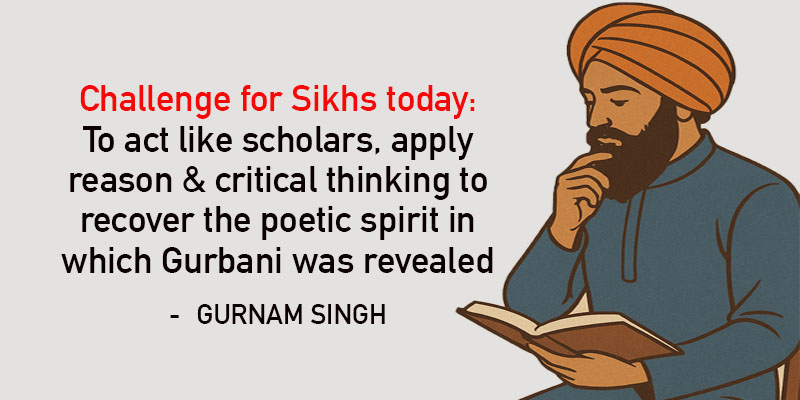
The challenge for Sikhs today is to live up to title given to us by our Gurus’s. That means we must act like scholars and to apply reason and critical thinking to recover the poetic spirit in which Gurbani was revealed. Poetry, by nature, resists being fixed to one interpretation. It invites creative thinking, imagination, openness, and a willingness to encounter truths beyond the grasp of physical reality. Gurbani, understood in this way, is not a text to be mastered intellectually but a living voice that speaks to the soul.
Only by entering into this poetic depth can we hope to realise the oneness of Ik Oankar, and to embody the humility, compassion, and freedom that arise when the ego is transcended.

Gurnam Singh is an academic activist dedicated to human rights, liberty, equality, social and environmental justice. He is an Associate Professor of Sociology at University of Warwick, UK. He can be contacted at Gurnam.singh.1@warwick.ac.uk
* This is the opinion of the writer and does not necessarily represent the views of Asia Samachar.
RELATED STORY:
The Demise of the Akali Dal and the Badal Dynasty: What Next for the Panth? (Asia Samachar, 5 Aug 2024)
ASIA SAMACHAR is an online newspaper for Sikhs / Punjabis in Southeast Asia and beyond. You can leave your comments at our website, Facebook, Twitter, and Instagram. We will delete comments we deem offensive or potentially libelous. You can reach us via WhatsApp +6017-335-1399 or email: asia.samachar@gmail.com. For obituary announcements, click here