





















By Gurnam Singh | OPINION |
Somebody recently drew my attention to a video which is a narrated transcript of a talk given by Sant Teja Singh at the 8th Congress of World Religions and Peace in 1956 at Shinzo, Japan. Teja Singh was an influential Sikh intellectual and preacher who, unlike most Sikh preachers who were then schooled in religious seminaries in India, was educated at three of the worlds greatest universities, namely. University College London, Columbia University, in New York City, and Harvard University in Boston. Teja Singh preached the universal message of Guru Nanak across the world to Sikh and non Sikh audiences.
There is a lot in the talk, but there is one slide that particularly captured my attention. This is the one where Sant Teja Singh makes reference to Albert Einstein’s assertion that he believed in the ‘God of Spinoza’. The full quote is as follows: “I believe in Spinoza’s god, who reveals Himself in the lawful harmony of the world, not in a god who concerns himself with the fate and the doings of mankind.”
Einstein’s reference to Spinoza is interesting in many ways but particularly so in that one would not immediately connect these characters with a belief in God. Einstein, we all know is the father of modern cosmology known for his rejection of the idea of a theist God.
However, a good scientist, he does not say that God does not exist, just that there is no evidence to prove his existence! Hence he declared himself as an agnostic, or a “religious nonbeliever.” Einstein also stated he did not believe in life after death, adding “one life is enough for me.” And as for the Bible he was very clear in his view that the text represented “an incarnation of primitive superstition.”
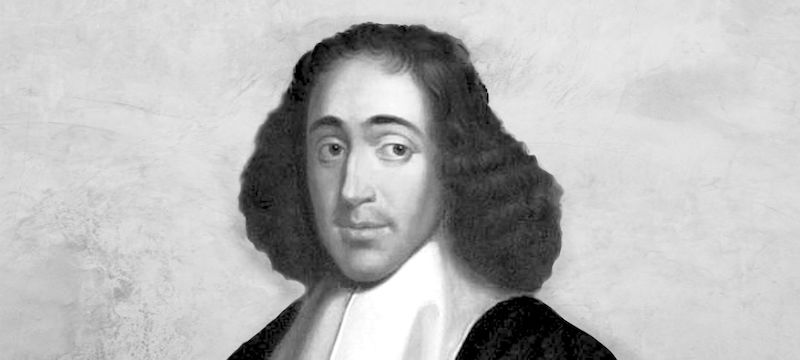
As for the Dutch philosopher, Baruch Spinoza, he is considered one of the great exponents in rationalist philosophy of 17th-century philosophy, with a particular interest in biblical criticism and modern conceptions of the self and the universe.
The God of Spinoza does not see any distinction between creator and creation. Put simply, for Spinoza, the divine creator made the whole universe, including the laws of nature, and he then infused himself into the creation. This view is characterised as Pantheism.
The question is, based on this world view, namely, that God and Nature are synonymous, where and how do we see/experience God or the divine? And, given this somewhat impersonal and abstract construction of the divine, what might be the function of worship and prayer?
What we do know is that after setting out his basic conception of the divine entity in the ‘mool mantra’, which is not to dissimilar to Spinoza’s conception, Nanak goes onto critique the 4 main religious practices if the time, namely bathing in holy water, aestheticism, fasting and ritual/rote learning of scriptures.
For Nanak, the only way them to become enlightened is to appreciate the divine nature of things (hukam). This, Nanak says has over the ages been done in many ways, but for Nanak there is something universal about singing the divine compositions of the Saints or ‘Prem Bhagti’.
An important point to note here is that, in locating God in nature, like Spinoza, Nanak is clearly rejecting the idea of an anthropomorphic God entity. That is why when the Naath Yogis asked Nanak to describe his God, he replied that the ‘Shabad’ or divine vibration was his God and his consciousness was the disciple.
Hence, for both Nanak and Spinoza is no place for ritualistic God worship that is characteristic of most/all traditional religions. Though Spinoza doesn’t provide a method for realising his God, one can infer that this would be would not be by prayer but through simple realisation of contemplation on the divinity of all of nature, in the shape, form and function of nature.
Similarly for Einstein, rather than performing religious rituals, realisation of divinity would be through simple observation of the universe around him, to the discovery of mathematical equations and theories unlocking the secrets of the nature and the universe.
One of the tragedies for Sikhs today is that some, perhaps many, have forsaken the amazing critical, radical and reasonable vision of divinity for a rather narrow perspective that reverts back to irrational superstition that Nanak rejected.
 [Gurnam Singh is an academic activist dedicated to human rights, liberty, equality, social and environmental justice. He is an Associate Professor of Sociology at University of Warwick, UK. He can be contacted at Gurnam.singh.1@warwick.ac.uk]
* This is the opinion of the writer and does not necessarily represent the views of Asia Samachar.
RELATED STORY:
Science, religion and the Covid-19 crisis (Asia Samachar, 30 May 2020)
ASIA SAMACHAR is an online newspaper for Sikhs / Punjabis in Southeast Asia and beyond. Facebook | WhatsApp +6017-335-1399 | Email: editor@asiasamachar.com | Twitter | Instagram | Obituary announcements, click here |



Sat Shri akaal ji,
All information of Sikhs struggler for freedom is correct.
But, Now new generation not reading any history of Sikhs, because all one Sikh young not have comnen sense . It’s better
Start in Punjabi also asiasmachar. Thanks
I concur with a majority of the sentiments emphasized in the article, but in my humble opinion the ‘Prem Bhagti’ epithet is a misnomer. It would be conducive for the author to underline how the concept is light years apart from it’s conventional counterpart which is highly irrational.
Comments are closed.