






















By Balraj Kahlon | Opinion |
In October 2021, in the midst of the farmer’s protest, a Nihang group maimed Lakhbir Singh and strung him up to die while he begged for mercy. His death was punishment for desecrating the Sarbloh Granth (not the Sri Guru Granth Sahib) which are scriptures revered by the Nihang community. Sikhs should know that the Sarbloh Granth is considered an encyclopedia on Hindu mythology, and there are doubts of its origins or if it was written by Guru Gobind Singh Ji.
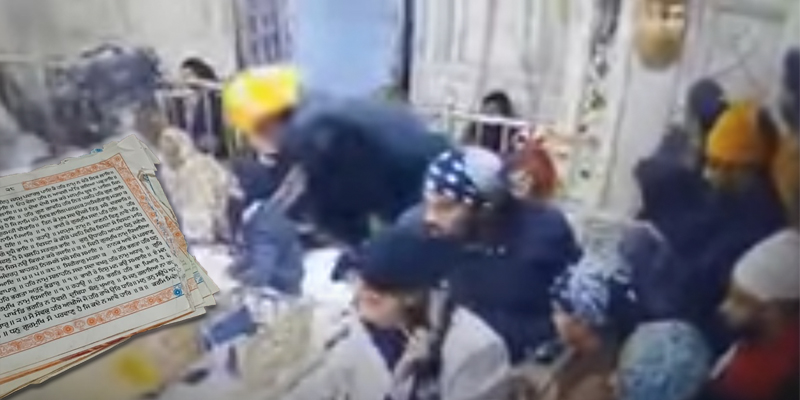
Later that year a man jumped over a railing at Darbar Sahib and snatched a kirpan lying in front of Sri Guru Granth Sahib. SGPC employees grabbed the man within seconds and he was subsequently beaten to death. His dead body was found lying on the floor of the complex with men gathered around treating it like a trophy killing.
The defence of these killings are not only troublesome but also reveal the dishonesty and lack of credibility among those with an extremist mindset.
The Nihangs first claimed the sacrilege was of the Guru Granth Sahib Ji but then said it was the Sarbloh Granth. They claimed the sacrilege is part of a government conspiracy but their leader Aman Singh was revealed to be breaking bread with political leaders. They said they have proof of the sacrilege but proof was never provided even though Lakhbir’s father pleaded for proof. Moreover, 27 UK Sikh organizations issued a statement in support of the killing and falsely claiming Lakhbir committed sacrilege of Sri Guru Granth Sahib Ji. Their statement goes onto say that Indian agencies are using addicts and oppressed people to attack the Granth Sahib. But if they know the masterminds then why kill oppressed people. Then, three years later the Sikh PA is still claiming that Lakhbir attacked the Guru Granth Sahib Ji.
The Akal Takht Jathedar also claimed the sacrilegious cases are a political conspiracy but then he is himself with India’s Minister of Home Affairs. Baaz news, a news outlet geared towards diaspora-born Sikhs, described the Darbar Sahib killing as Khalsa’s justice. This begs an explanation how a just penalty for picking up the sword is death.
Desecration acts should be addressed but a thinking person does not take such a cavalier attitude towards using lethal force. Moreover, the religious fanaticism condoning the killings has given license for continued nonsensical violence.
This includes a man hacked to death for chewing tobacco on a public street near Darbar Sahib. Parvinder Kaur was shot dead for drinking liquor in a gurdwara. She was a divorced woman struggling with alcohol addiction and depression. A Dalit daily wager tied up and beaten to death for trying to steal money from a gollack (money box). In January 2024, a Nihang killed a man because he planned to commit sacrilege.
It should be noted that the Sri Guru Granth Sahib was never touched in these incidents. So does this mean does anything considered disrespectful give Sikhs permission to kill? Then should we murder those who misuse the Sri Guru Granth Sahib for fraudulent or contract marriages? Should we murder people who engage in caste-based discrimination in gurdwaras? And should we murder SGPC members for distributing drugs and alcohol during SGPC elections?
To understand Sikh principles regarding conflict and lethal force Sikhs only need to look to Guru Gobind Singh Ji – the person who institutionalized the martial tradition in Sikhi.
The devout, Bhai Kanhaiya served water to both Guru Gobind Singh Ji’s soldiers and enemy soldiers. He was brought before Guru Gobind Singh Ji to explain himself. Bhai Kanhaiya explained that he only sees humans and he wants to destroy the enmity of their enemies. Guru Gobind Singh Ji praised him for understanding the true meaning of Gurbani and encouraged him to continue.
The ruler Aurangzeb was responsible for countless deaths including Guru Gobind Singh Ji’s children. Yet Guru Gobind Singh Ji offered to meet and forgive Aurangzeb if he would change his ways (Zafarnama verse 60). Guru Gobind Singh Ji was also known to shoot golden tipped arrows to provide for the families of enemies killed in battle. Above all, Guru Gobind Singh emphasized practising restraint in using force. In Zafarnama (verse 22) he explains:
When all means for solving a conflict or problem are exhausted,
only then placing your hand to the sword is legitimate.
Given these examples I don’t think anyone can conclude Guru Gobind Singh Ji would approve of these sacrilege killings.
Most perplexing is how Sikhs who so revere Sri Guru Granth Sahib Ji that they support killing in its name, disregard Sri Guru Granth Sahib Ji’s teachings. The Granth clearly condemns the powerful attacking the weak (p. 360) and stresses the virtue of forgiveness. The people killed in these incidents were not powerful threats.
Many critical of this article may be more devout than myself but I try to understand the Sikh Gurus’ teachings; I cannot find anything justifying taking a human life for sacrilege. People also must realize that many Sikh leaders and public figures justifying the violence are not killing anyone themselves and suffering the consequences. Moreover, nobody can argue killing will solve the problem because the sacrilege continues.
To end, we should be heedful of those who disguise their personal views as religious doctrine. Such people will dismiss their critics as too modernized or sell-outs. However, even Guru Nanak challenged religious authorities and promoted dialogue.

Balraj S. Kahlon is a community volunteer and public policy professional in the civil service in Canada.
RELATED STORY:
Behind the Beadbi (Asia Samachar, 11 May 2023)
ASIA SAMACHAR is an online newspaper for Sikhs / Punjabis in Southeast Asia and beyond. You can leave your comments at our website, Facebook, Twitter, and Instagram. We will delete comments we deem offensive or potentially libelous. You can reach us via WhatsApp +6017-335-1399 or email: asia.samachar@gmail.com. For obituary announcements, click here