| Letter | Shah Alam, Malaysia | 16 July 2016 | Asia Samachar |
If the need is urgent, then Gurdwara Sahib Petaling Jaya (GSPJ), Sikh Naujawan Sabha Malaysia (SNSM) and other gurdwaras in Malaysia (especially Kuala Lumpur and Selangor) and Sikh non-governmental organisations (NGOs) with excess funds can be of assistance. Rather than placing the excess funds with banks and earn a meager annual interest income of 3% to 3.5%, they can assist by advancing the money and may charge current fixed deposits (FD) interest rate which the Shah Alam gurdwara management committee (GMC) can pay and then return the money when donations come in.
Most may reject the request for reasons that they need the money for their own projects eventhough the proposed projects are not expected to materialise for several years or that they may not have confidence of the loan being repaid or for differences among the various goths-clans-etc. But these may all be excuses thought it is a win-win situation which needs spirit of assisting and trust.
Malaysian Gurdwaras Council (MGC) should step in to assist by being the party to bring those with excess funds and GSGNSA together.
Tatt Khalsa received such an advance when it needed funds urgently some years ago but this was from the principal office bearers who mortgaged their own houses to provide the funds and an individual. My congratulations to the Tatt Khalsa management for helping own self before going to others for help.
In addition there are several multi-millionaire Sikhs businessmen and professionals in KL-Selangor-Malaysia who may be financially able to assist in this noble cause and hope that they will come forward with cost free or cheap loans but sadly most may be spiritually poor to use their millions for this purpose.
Finally, the GSGNSA GMC office bearers should look to their own members for the required funds before they go to outside as was done by Tatt Khalsa management committee members.
Sungai Siput is also asking for donations. MGC should coordinate the requests and verify their needs and if justifiable then MGC should assist in whatever way it can.
I have always emphasised in the past that one should venture into any project only after the availability of funds have been confirmed and not hoping that others will come to finance the higher costs of their ambitious projects. It may be noted that there are several other gurdwara managements in other places who are also embarking on large projects without confirming that the required funds have been provided for.
Finally, it has been observed that it is a rare case where GMCs have been transparent and made the Sanggat aware on how the collected funds were expended. Questions raised at AGMs by members are rarely answered with supporting information and if the question is raised by non-members the answer is that ‘you are not entitled’. But there is never a rejection of donations from non-members.
It is a common perception that trust funds such as those managed by religious organisations may be mismanaged by some committee members due to possible lack of expertise relevant to the construction projects implementation.
When questions are raised, the reply is that the management of funds had been done by ‘honorable’ and ‘honest’ people with ‘integrity’ but the accounts are rarely made public for the Sanggat to know. I had written an article on transparency and accountability of gurdwara and NGOs funds where examples were given and the article was published at Asia Samachar. There was not a single comment by any gurdwara or Sikh NGO on the contents of the articles.
Other articles relevant to management-audit-monitoring of construction projects are available on request to anyone interested.
No malice or reference to any person or Gurdwara or NGO is intended. If anyone feels offended then to him/her my apologies. I am ever willing to have a discussion with anyone interested at any time mutually convenient or can call by phone or contact by e-mail.
WAHE GURU JI KA KHALSA WAHE GURU JI KI FATEH
Gursharan Singh
Gursharan Singh, C.M.I.I.A., a retired audit officer from the Malaysian civil service, is also a trainer. This article was written in November 2015. He can be reached via emails at gursharan38@gmail.com or sharwant38@yahoo.com, or via mobile at +6019.2927178
[ASIA SAMACHAR is an online newspaper for Sikhs in Southeast Asia and surrounding countries. We have a Facebook page, do give it a LIKE. Follow us on Twitter. Visit our website: www.asiasamachar.com]
| Announcement | Shah Alam, Malaysia | 15 July 2016 | Asia Samachar |
The opening ceremony of Gurdwara Sahib Guru Nanak Shah Alam on 11 Dec 2015 – PHOTO SIKH INSIDE
ANNOUNCEMENT FROM GURDWARA SAHIB GURU NANAK SHAH ALAM (GSGNSA), PICKED UP VIA SOCIAL MEDIA
Dear Sadh Sanggat Ji.
?With the blessings of Guruji and support of the Sanggat, Gurdwara Sahib Guru Nanak Shah Alam nears to 100% completion. We will like to say a big thank you for all the support given during this beautiful journey.
?We are now in the process of final donation drive to pay off the outstanding payments of RM700, 000 which includes both building and fittings.
?We humbly request you kind donation in this Noble cause. For all donations, an official receipt will be issued.
???????
?Can we hv pledges as litle as RM100 per month from now till Dec 2016?
?Arrange a Standard Instruction (SI) with your bank to direct debit. Our acc MAYBANK 5121 0190 0000 GSSA BUILDING FUND.
?Encourage at least 5 others to do the same. Let the power of multiplication works.
?PM us for details or Receipt
+60163617226
Kelvinder Singh
+6019-2792473
Major Suwaran Singh Dhillon
Website www.gssabuildingfund.com
FINAL DONATION DRIVE: Note from GSGNSA
[ASIA SAMACHAR is an online newspaper for Sikhs in Southeast Asia and surrounding countries. We have a Facebook page, do give it a LIKE. Follow us on Twitter. Visit our website: www.asiasamachar.com]
| Kuala Lumpur, Malaysia | 15 July 2016 | Asia Samachar |
Pulapol Eagles emerged champs for Akaal Premier League 2015
By Jagdesh Singh
As the Copa America and Euro 2016 tournaments slowly become an afterthought with far and between memories, local football enthusiasts can start gearing up for another high intensity tournament on our shores.
The Akaal Premier League (APL) is back in its second incarnation. Action will begin on Sunday (17 July) at the Akaal Arena, the futsal field at Gurdwara Sahib Jalan Kg Pandan, Kuala Lumpur.
After its successful stint in December 2015, three additional teams are stepping forward for the challenge. They are the Seremban Lions, Selayang Sardars and Klang Rangers.
The original six — Pulapol Eagles, Rawang Akaal Warriors, Pandan Village Lions, Beruntung Hills Twin Lions, Iron River Kings and Titiwangsa Panthers — will continue with their campaigns from where they left off last year.
Defending champions Pulapol Eagles will have their work cut out fending off so many new challengers this season. Early reports indicate that the Iron River Kings have made some interesting acquisitions and are looking like the team to beat, if pre-season preparations are anything to tell by.
But the same could be said for the rest of the teams. Fresh faces, new managers, new coaches, all eager and motivated to up their game with so many lessons learned from last season. From a neutral’s perspective, expect better quality and more action this season.
Asia Samachar will be providing coverage for the whole season, hopefully providing answers to some hot burning questions for fans and neutrals alike.
Will Sumi of Beruntung Hill Twin Lions be the only lioness amongst the lions this season or will there be new female faces impressing us?
Which of the Lions would stand tall, Kg Pandang Lions or the newly promoted Seremban Lions?
Would Eagles be able to retain the championship after a head to head finish with the Rawang Akaal Warriors last season?
APL is organised by the Akaal Sports Academy which is headquartered at Gurdwara Sahib Jalan Kg Pandan. It is supported by Sikh Naujawan Sabha Malaysia (SNSM). The Naam Medic are the official medical staff at grounds. Official media partners are Asia Samarchar and Sikh Inside.
The action start 17 July. Be there or be square.
Akaal Premier League (APL) teams for 2016
[ASIA SAMACHAR is an online newspaper for Sikhs in Southeast Asia and surrounding countries. We have a Facebook page, do give it a LIKE! Visit our website: www.asiasamachar.com]
Full service airliner Vistara has appointed Ravinder Pal Singh as its Chief Information Officer, a role which will see him leading tits IT and innovation functions.
Ravinder moves from Gurgaon-based Air Works (Engineering) Pvt Ltd, a provider of aviation maintenance repair and overhaul, where he was the Global Chief Information and Technology Officer.
Previously, he has been associated with corporates such as Microsoft, Accenture and Wipro, and is a holder of several technology patents.
“I am excited to be a part of Vistara, a company that is the amalgamation of two iconic brands, TATA and Singapore airlines and is at the forefront in the product & service innovation space,” he said in a statement issued by the company.
Vistara is a joint venture between Tata Sons Ltd. and Singapore Airlines (SIA).
In his role, Ravinder will consolidate, identify, acquire, evaluate and incubate the right technology to support the airline’s IT and digital platforms.
He will also be responsible to induce innovation as core to Vistara’s culture thereby creating communities and co-creation projects to realize ideas as true business differentiators, the statement added.
“Ravi is a seasoned technology expert and we are keen to leverage his extensive technology leadership experience to enhance the level of operational excellence at Vistara and delivering greater value to our customers,” said Vistara CEO Phee Teik Yeoh.
[ASIA SAMACHAR is an online newspaper for Sikhs in Southeast Asia and surrounding countries. We have a Facebook page, do give it a LIKE! Follow us on Twitter. Visit our website: www.asiasamachar.com]
| Kuala Lumpur, Malaysia | 14 July 2016 | Asia Samachar |
The TITAS book used by UTM. It did not use the Ministry of Education approved subject book used at other universities.
The Johor-based Universiti Teknologi Malaysia (UTM) lecturer responsible for the controversial slides belittling the Hindu and Sikh faiths have been sacked.
Malaysian Higher Education Minister Idris Jusoh made the announcement in a radio interview in Kuala Lumpur this morning.
“They (UTM) are autonomous … they hired the lecturer and they have the right to fire him. And I was told yesterday that he has been fired,” he said in a morning Breakfast Grille talk show at the BFM radio station.
The lecturer was teaching the Tamadun Islam Tamadun Asia (Titas), a compulsory subject for all university students in Malaysia, whether public or private.
The matter came to the public eye when the erroneously and ridiculously worded slides, supposedly used to teach the subject at UTM, were shared on the social media last month. Asia Samachar first reported on the issue on 13 June 2016, see here.
The exposure of the slides led to a storm of protest and expression of disgust of the a wide segment of the Malaysian community, with the highest ranking UTM official expressing ‘utmost regret and deep remorse for the lack of sensitivity’ on the part of its lecturers.
The university had then moved to investigate the matter.
When asked if Titas was still relevant, Idris told the listeners that it was the lecturer who “went out of the way”.
“He was not using the co-curriculum provided by the ministry and that has got to be fully understood…We are telling the lecturers that they have to be in line with the Government policies,” he said, according to one media report.
Erroneous presentation slides on the Hindu and Sikh faiths from UTM, a Malaysian public university.
Asia Samachar understands that the lecturer responsible who was on contract with the university.
The slides shared on the social media suggested that the Sikh faith was introduced by Kabir and later spread by Guru Nanak. It added that Kabir did not thoroughly understand Islam, hence he got influenced by the Hindu ways.
The actual text, in Malay: “Dikemukakan oleh Kabir yang kemudiannya dikembangkan oleh Guru Nanak….Kabir yang tidak memahami secara mendalam ajaran Islam terpengaruh dengan persekitaran kehidupan masyarakat Hindu telah merangka gagasan awal agama Sikh ini.”
Bhagat Kabir is one of the Muslim saints whose writings are contained in the Sikh scripture called the Guru Granth Sahib.
The reference notes on the Hindu faith were downright derogatory. It suggested that Islam introduced courteousness to the Hindus in India, and thought them the importance of hygiene.
“Islam memperkenalkan kepada masyarakat Hindi di India erti kesopanan dalam kehidupan…Islam juga telah mengajar masyarakat Hindu tentang pentingnya kebersihan tubuh badan dan penjagaan kesihatan,” read the slide.
[ASIA SAMACHAR is an online newspaper for Sikhs in Southeast Asia and surrounding countries. We have a Facebook page, do give it a LIKE. Follow us on Twitter. Visit our website: www.asiasamachar.com]
| Kuala Lumpur, Malaysia | 14 July 2016 | Asia Samachar |
Susheel Kaur, Bhangra fitness enthusiast
Bhangra is a traditional folk dance originating from Punjab, the land of five rivers. It’s a vibrant, colourful and infectious dance that would have you grooving, non-stop. It’s a group dance usually performed by the men folk but not limited to them.
It’s a heart pounding, adrenaline pumping and leg stomping movement which would have you sweating by the end of it, almost like a good cardio exercise. And that is exactly what one bhangra enthusiast has done with this traditional dance.
Susheel Kaur, from Kuala Lumpur now residing in Sweden, shares with Asia Samachar her journey turning this dance art into a fitness workout that has many Swedish, both Punjabi and the non-Punjabi excited.
Asia Samachar: When and why you started bhangra fitness classes?
Susheel Kaur: Bhangra has been part of my life since I was a kid. Not only do I enjoy dancing bhangra, but I am just as passionate about teaching it. I started teaching bhangra when I started my own company 4 years ago. What started of as a hobby has gone on to become one of the most precious things in my life. Here in Sweden, I have been teaching bhangra to almost all age groups ranging from little kids to adults for more than 4 years.
Generally I think when most people hear of “Bhangra dancing” they immediately associate “club, parties and drinking”. I wanted to show that is not always the case and provide an avenue where people can get together for a good, fun and stress busting workout.
AS: How has bhangra benefited you, health wise?
SK: Bhangra workout has improved overall cardiovascular functions, renewed physical stamina, increased lung power, enhanced muscle tone and flexibility, and weight loss. It´s also like a stress and tension buster.
AS: What are your qualifications as a bhangra fitness instructor?
SK: I have been dancing since I was a kid. Most of the steps are self-learned and also meeting other like-minded bhangra instructors from all around the world, exchanging ideas and techniques has helped tremendously in ensuring I dish out a good workout session.
AS: How has the respond been like from non-Punjabi in Sweden to your bhangra class?
SK: Most of my students are non-Punjabi and they totally love bhangra. It has enjoyed a surge in popularity because it is easy to do and fun at the same time. It has also provided a new dimension to the fitness industry because of its positive results.
AS: You are traveling to Malaysia soon, why are you bringing this bhangra aerobics to Malaysia?
SK: Being a Malaysian myself, I just wanted to reach out to everyone and share that bhangra is a fun and pleasurable social affair that can be achieved anywhere. The workout takes place with an infectious and upbeat music that has everyone is in a happy mood throughout the session and afterwards. It is like having the best of both worlds – getting healthy while doing something that is fun and happy.
AS: Is it easy to teach non-Punjabi the bhangra aerobics?
SK: It is easy to pick up bhangra aerobics if you have the rhythm in you whether you are a Punjabi or non-punjabi but it´s not compulsory because over time you’ll get a hang of it and would be enjoying yourself.
AS: It is a fun blast and stress buster fitness class or does the bhangra steps target specific body parts?
SK: It is a fun and stress buster fitness for sure but it also targets most of the muscles on the body parts. Parts that you didn’t even know you had.
AS: Is it a 100% cardiovascular class or mix? If mixed what other areas does it target (resistance/weight/stability/toning) ?
SK: The bhangra aerobic dance involves continuous, rhythmic body movements designed to raise heart rate, strengthen the lungs and work out all the major muscle groups in the body like the legs and buttocks. This workout is done to music with pulsating beat to set the tempo. When one does the bhangra workout, the body muscles demand more oxygen-rich blood and give off more carbon dioxide and other wastes. This makes the heart beat faster to keep up. Overtime, with regular workout, the heart grows stronger and can meet the muscles’ demands with little effort. The bhangra workout also helps one avoid chronic diseases such as heart disease, hypertension, and stroke. It also lowers blood pressure, builds strong bones and helps control weight. A 45-minute bhangra aerobic dance burns 500 calories. How’s that for motivation?
AS: What is the proper attire to attend this class?
SK:The most important thing to remember is lightweight clothing for easy movement and sweat wicking capabilities. It is beneficial to wear proper aerobic shoes as to avoid injuries.
AS: What is your future plan with bhangra fitness classes?
SK: My mantra is; When you follow your passion with determination, perseverance, conviction and focus, success follows without having to run behind it. And most importantly since you love what you do, happiness, mental satisfaction and peace of mind are yours forever.’ My journey has been the most amazing and satisfying. Of course, nothing comes easy and you always have to choose one thing over another, and I chose fitness over everything else and hope to pursue till I can no more.
AS: Who can join your bhangra classes? Please state if any clearance from doctor is required for those suffering from knee injuries or heart problems?
SK: Bhangra is suitable for participants of all ages and fitness levels. A word of caution: Get a medical check-up before embarking on the bhangra workout or any fitness regimen, for that matter.
AS: Please share with us why you chose bhangra over a normal workout?
SK: You are having fun while you work out; hence, you are inclined to keep at it and bhangra workout is a dance form exercise and you will definitely enjoy every moment of it. Also, there is a dessi connection that helps me to navigate myself in this foreign land so I don’t feel too homesick. It keeps my metabolic rate high, which in turn gives optimum weight loss results. And, it tones and conditions the entire body.
If you are interested in meeting Susheel Kaur in person and learning more about bhangra aerobics, she will be holding two workshops in KL in the month of July. Details as listed below:
23rd July 2016, 7pm-8.30pm Dance Blaze Academy 2nd floor, 7A, Jalan Bangsar, 59200 Kuala Lumpur, Malaysia
24th July 2016, 7pm-8.30pm Shamballa Tribeni Dance & Music House 31-B Jalan Bayu Tinggi 2B, Batu Unjur, 41200 Klang, Selangor, Malaysia
Places are limited. Book your slot now. Kindly contact Liitha at 016-2203237 or drop an email to writeimagemarketing.net@gmail.com for registration.
[ASIA SAMACHAR is an online newspaper for Sikhs in Southeast Asia and surrounding countries. We have a Facebook page, do give it a LIKE! Follow us on Twitter. Visit our website: www.asiasamachar.com]
| Opinion | Malaysia | 13 July 2016 | Asia Samachar |
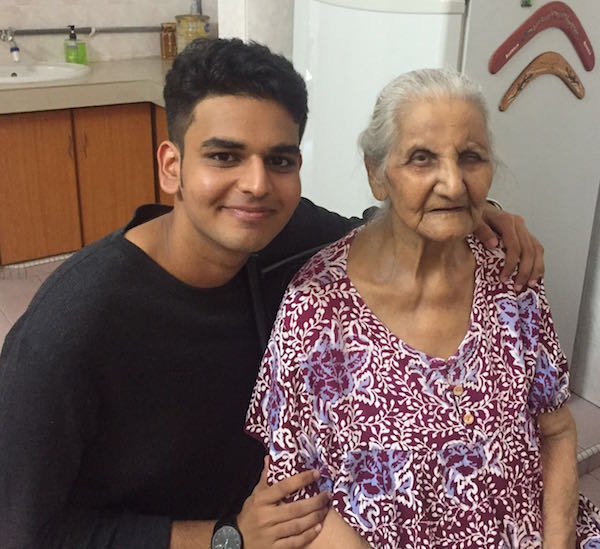
Manroshan and his grandmother – PHOTO / SUPPLIED
by Manroshan Singh Bhatt
The loss of a family member is tough to swallow, especially so, if it is the passing of the older generation, the stalwarts of the family. The passing of grandparents should not be seen as the passing of a generation per se, but more than that, it should rightly symbolise the passing of deeply guarded values and traditions to the next generation of the family.
We, Generation Y, often forget the vital role grandparents play in nurturing us and are quick to look past them for our own self-interest. It is a bleak scenario, as we see moral values and ethnic practices that were once so cherished by our forefathers now becoming an afterthought amongst the younger generation. Let us all remember that we reap the harvest of our grandparents’ ploughing. Grandparents are to any extent, the most important people in our society. Our existence on this planet is traced back to them and while times have changed, their role in families should most definitely not. They continue to be our source of support and encouragement when we feel low.
The same can be said of my late paternal grandmother, Mata Swaran Kaur, who left us on 1 July. She was a gem of a lady, lovingly known as Maa by her descendants. Hailing from Punjab, she and my late grandfather, Sardar Dara Singh Bhatt, sailed Malaysian shores in late 1940s. As he, along with his brothers, founded the well established Punjabi restaurant Jai Hind in Kuala Lumpur, my grandmother was the sturdy pillar of the family and dedicated her time and energy to nurture the family. Maa will be remembered for her excellent interpersonal skills and meticulous nature, paying fine attention to every detail in her endeavours, especially in instilling the value of self-management and discipline in her children. A noteworthy thought is her multiple talents and her aptness in multitasking, while still managing to raise her four children. She was a fine seamstress, gifted in stitching garments of sorts to support the household’s textile shop in Taiping.
This truly exemplifies the efforts of the older generation and how they were able to hold the family together while succeeding at pulling in income to sustain themselves. These female elders cannot be marginalized as mere homemakers, but their strong economic contribution to the sustenance of the household has to be acknowledged.
The same cannot be said of the majority of the current crop of youths, who often lament about their inability to juggle multiple tasks. It boggles me how our grandparents did it with such ease and endurance, all with limited resources at their disposal. A moment of reflection on our actions will help us count our blessings as we ravel in luxury, thanks to the blood, sweat and tears of our grandparents.
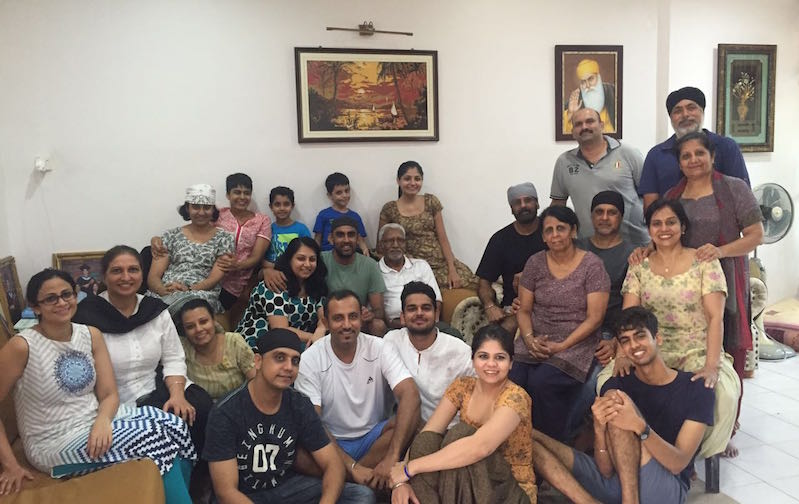
MY FAMILY: The baton of values is now handed to our family of 23 members – PHOTO / SUPPLIED
An ode must be made to Maa in respect to how she valued and held on to traditions, values and cultural beliefs. Rwaaj (customs), as we call them, were keenly observed as well as by other people of her time, who found it sacrilegious to not adhere to these deeply rooted traditions. Unfortunately, it is a far cry for the younger kids on the block, who more often than not ridicule some of these beliefs and always find opportunities to question these traditions. Being inquisitive can be praised upon, but outright criticisms under the guise of rational and logical reasoning are sometimes displaced and unfortunate; we fail to cherish and embrace these traditions and values that have been handed down by our grandparents. We often like to think we’re better than the preceding generation, hence some actions of the said generation are frowned upon and dismissed as frivolous.
This derogatory mindset must change, as practising these values does not only reflect the family legacy, but also the continuation of culture for the race, as a whole. In the name of progress and in pursuit of material wealth, we have forgone many traditions and customs as we render them useless and insignificant. Whilst some may be deemed illogical, on a broad spectrum, these customs are largely in place for a reason. With that being said, it is imperative that we make an effort to keep these traditions and customs going strong (as long as they do not contradict or go against Sikhi principles).
As modernisation and globalisation threaten to wash off our traditional beliefs, the onus is then on us to treat traditions with utmost value as they form the backbone of the Punjabi / Sikhi culture. As a minority race, acculturation and assimilation are inevitable, but we are often inclined to dilute more than we should, hence, a firm standpoint is crucial.
The elders (like my Maa) who cherished these customs knew what they were doing based on timeless judgement, but we, the youngsters, never fail to question and blatantly reject these notions. It is with deep regret that the newer generation may be educationally and intellectually esteemed, but we sorely lack wisdom, knowledge and fill ourselves with egotism and individualism, a stark contrast to the people of the past.
The love and respect we have for our grandparents must not only be expressed in our words, but also portrayed in our actions and behaviour. The older generations are the pillars and building blocks of our society, and as such, we should cherish them and hold them in the highest regard. The passing of my grandmother has opened my eyes to a wider world and made me wonder on the true meaning of life, and that the precious human life we are blessed with is finite in nature, hence we should all make the most out of it. Holding on to her values, practices and teachings in the biggest ode I can pay to my Maa, and I plan on doing such to continue her legacy.
Let us all appreciate our grandparents while we can as they truly are one of God’s angles that touch our lives.
Manroshan Singh Bhatt, 19, is pursuing Bachelor of Accounting at Universiti Malaya, Kuala Lumpur.
[ASIA SAMACHAR is an online newspaper for Sikhs in Southeast Asia and surrounding countries. We have a Facebook page, do give it a LIKE! Visit our website: www.asiasamachar.com]
Karamjeet Singh Sandhu of the Singh Easy Rider Motor Club at a police station in Rimmoei, Thailand. - PHOTO / SUPPLIED
Singh Easy Rider Motor Club on their 4-nation bike expedition in April 2016 - PHOTO / SUPPLIED
Singh Easy Rider Motor Club on their 4-nation bike expedition in April 2016 - PHOTO / SUPPLIED
THE signboard for Gurdwara Sahib Chiang Rai and the Uma Devi Mandir in Chiang Rai, Thailand. PHOTO / SUPPLIED
MYANMAR POINT: Singh Easy Rider Motor Club members on their 4-nation expedition in April 2016. They are (L-R) Harjit Singh Cheema, Pardeep Singh Dhaliwal, Harjit Singh Pannu, Karamjeet Singh Sandhu and Harbajan Singh Sangha - PHOTO / SUPPLIED
Gurdwara Sahib Chiang Rai: The bikers posing with Pandit Narain Dass who is the caretaker of mandir. The gurdwara's granthi was away to India - PHOTO / SUPPLIED
Five Sikhs from the Malaysian-based Singh Easy Rider Motor Club travelled some 6,000km across four nations over a nine-day bike expedition in April 2016. One of the interesting discovery was a Sikh gurdwara and Hindu mandir sharing the same space in Chiang Rai, the northernmost large city in Thailand.
The journey began on 29 April with an ardas (prayer) at the Gurdwara Sahib Sentul in Kuala Lumpur. At 6am, the bikers headed for the the Malaysia-Thailand border at Bukit Kayu Hitam, Kedah.
The group, headed by club president Harbajan Singh Sangha, visited four nations: Thailand, Myanmar, Laos and Cambodia.
The towns visited included Tachileik in Myanmar; Chiang Khong in Laos; Poipet (officially Paôy Paêt) in Cambodia.
They also visited a few gurdwaras in Thailand, including Gurdwara Sahib Chiang Rai (also known as Wat Umarani and Gurdwara Sahib Chiang Mai. The Chiang Rai gurdwara is located in the same compound with a Hindu temple called Mandir Umarani.
On their journey in Thailand, the bikers managed to negotiate the 1,864 corners of Mae Hong Son which is known to be ultimate road of curves.
“They are very sharp and will test your skills on corners. All bikers are given a certificate upon completing the curves,” one of the bike members told Asia Samachar.
Since the club bikers successfully negotiated the curves, they got their certificates.
The team reached home safely on 7 May. They performed a shukrana ardaas (thankful prayer) at Gurdwara Sahib Tat Khalsa Diwan on 12 May.
[ASIA SAMACHAR is an online newspaper for Sikhs in Southeast Asia and surrounding countries. We have a Facebook page, do give it a LIKE! Follow us on Twitter. Visit our website: www.asiasamachar.com]
| Kuala Kubu Bharu, Malaysia | 12 July 2016 | Asia Samachar |
A Sikh youth camp organised by Seremban Naujawan Sabha at Khalsa Land, the camp site of Sikh Naujawan Sabha Malaysia in Kuala Kubu Bharu, Selangor – PHOTO / PROVIDED
If there’s one word to sum up the recent youth camp organised in Khalsa Land by Seremban Sikh Naujawan, it would be ‘awesome’.
The day-three night camp was filled with spiritually uplifting and character building activities. The activities ranged from inspirational darbar sessions, engaging study circles, to fun-filled outdoor activities.
The camp, 6-9 July, saw 115 participants and 40 sewadars (camp volunteers) coming from Seremban, Klang, Melaka, Semenyih, Cheras and Mantin.
The nightly inspirational sessions (sessions that combine kirtan and motivational talks, commonly called the IPS) were facilitated by Harjit Singh and team from Gurbani Naad, Raja Veerji’s Jatha, and Sarjit Singh Rawang and his accompanying musicians.
On the first night Harjit Singh spoke on the concept of Sewa which was the guiding theme for the camp. Raja Veerji enthralled the sangat with wonderful renditions of Shabads laced with profound messages on the second night.
On the final night, Sarjit Singh Rawang reduced everyone to tears with a powerful IPS session relating stories of 40 Mukhtey & 4 Sahibzadeys and reminding us of the ‘bedawas’ (letters of separation) that we write to our Guruji on a daily basis with the wrong doings that we commit.
The morning inspirational sessions were facilitated by Rajvinder Singh and Jasbir Singh (Father). These sessions were pure joy to experience with an equal balance of singing Kirtan and absorbing vital life lessons derived from Dhan Sri Guru Granth Sahib Ji through meaningful Kathas.
The learning modules for the older teens (Miri Piri) were well designed and methodologically delivered by Jasbir Singh (Father) in an engaging style.
Two dedicated sessions on ‘Effective Communications’ and ‘Leadership’ were facilitated by Dr Amarjit Singh and Col Devinder Singh aimed at enriching the Miri Piri participants with vital life skills. A surprise visit by Veer Taranjit Singh Bhagwan, our very own Seremban born high flyer in the international scene, was fully capitalised through an impromptu session with the Miri Piri teens.
At times the Miri Piri boys pushed the boundaries of discipline with their mischief and in the process drew tough love from the camp organisers. They however, won the adoration of all facilitators, sewadars and organisers when they selflessly answered the call of Sewa during an incident where floods caused damage to the sleeping quarters of sewadars and rendered a high number of beddings unusable. The boys sprang into action to help out with the significant cleaning operation even though they had to face the disappointment of not being granted the planned activity of jungle trekking due to unfavourable conditions.
The Mighties and Nikkey Khalsas were in the good hands of Harmit (Honey) Singh and his team of dedicated Phenjias throughout the entire camp, and they did nothing short of an amazing job of educating and moulding the adorable kids on the theoretical and practical aspects of Sewa stations, and other Sikhi elements through fun and games. There was even a mini turban promotional event carried out for interested boys.
Participants at the Sikh youth camp organised by Seremban Naujawan Sabha at Khalsa Land, the camp site of Sikh Naujawan Sabha Malaysia in Kuala Kubu Bharu, Selangor – PHOTO / PROVIDED
Building from the success of the Melaka camp, the Sg. Besi Jatha were recalled to organise all outdoor and recreational activities during the camp; needless to say, they delivered emphatically with their creative touch.
The outdoor campfire was held on the last night where attendees got to see such raw talent from participants who displayed impressive creativity of Sikhi messages being delivered in the form of play-acting and songs. The crowd enjoyed their outdoor meal while being entertained by the performances, as well as by a funny and witty emcee, Colonel Devinder Singh.
The best overall Jatha Award went to Jatha Bhai Sahib Singh, for displaying positive characteristics and scoring high points in various activities & Sewa stations.
This blessed event wouldn’t have been possible without the support of key players coming together, namely GSS Parbandhak Committee for contributing vital funding and other in kind resources, Sikh Naujawan Sabha Malaysia (SNSM) for lending us the perfect venue & essential equipments, the Steering Committee for organising and executing the entire event, the passionate Langgar team led by Malkith Singh and the boys (Darshan Singh, Harbinder Singh & Hardev Singh) who were the first to arrive and last to leave, the wise and knowledgeable facilitators, generous donors who contributed more than RM13,000, the Sg. Besi team for their excellent extra curricular support, Mr. & Mrs. Sarjit Singh for being such gracious hosts, Mai Bhago Gatka Akhara for their impressive and inspiring performance, the participants themselves for being the most loved and valued group of people in the organisation of this camp, and finally their parents for supporting it in more ways than one.
A massive THANK YOU from the bottom of our hearts.
May Guru Saab continue showering us with his mercy and blessings to continue reaching for greater heights.
MORE PHOTOS AT ‘SEREMBAN SIKH NAUJAWAN’ FACEBOOK
[ASIA SAMACHAR is an online newspaper for Sikhs in Southeast Asia and surrounding countries. We have a Facebook page, do give it a LIKE. Follow us on Twitter. Visit our website: www.asiasamachar.com]
In both my previous articles in this series, I and many of those commenting have asked two simple questions.
WHAT are the so called “moral messages that are found in each Chritar” as claimed by Gurmukh Singh.
WHERE exactly WITHIN the Charitar are these messages to be found.
Not a single verse from any Chritar containing any “moral message” has thus far been produced.
Loud and repeated claims of “Yes, there are moral messages, IF you read beyond the literal,” is code for “there are no messages, really.”
The inability to answer this first question has led Asia Samachar (AS) reader Gyani Jarnail Singh Arshi to ask: “IF indeed there ARE moral messages, why are they BURRIED under a heap of dung?”
A very un-palatable word indeed.
I suppose Arshi is referring to the contents of 404 tales of sexual depravity that are written in crude, graphic and vulgar detail; presented as abhorrently derogatory to women; and based on accounts as immoral and decadent as one can imagine.
Apologists however keep claiming that should one dig deep enough, a bunch of sweet smelling roses will eventually be found.
And those who choose to call the spade a spade or the heap as heap – such as DG Teekakaar Dr Rattan Singh are accused of undertaking “purely literal work (that) lacks credibility”!
At this point, one might ask: Why does one HAVE to suffer the sensory revulsions of a heap of dung to get to a rose; when gardens of roses abound? Must we all develop a penchant for dung?
One wonders what the state of the rose that comes out from under a dung will be, if one does indeed come out after all that digging.
Boisterous claims that “abstinence” and “injunction” are the moral messages of the Chirtars amount to plucking stuff from thin air to justify one’s support for the depravity of the 404 Chritars.
The question remains: Where does one find even one sentence with the word “abstinence” or “injunction” in any of the 404 Chritars?
AS reader Balabir Kaur has aptly asked if those who impose “non-existent” messages upon the Chritars are implying that they are “smarter” than the author(s) of the Chritars.
ABSTINENCE AND INJUNCTION IS ANTI THESIS TO CHRIITRO PAKHYAN
In fact the narrative of every sexual Chritar has thrown abstinence to the dogs.
A maid sent to call the King for a sexual encounter by his 60th Queen (Chritar No 160 DG page 1048) ends up in her own night-long sexual rendezvous with the King.
Of the 48 verses in this Chritar; a full 39 are devoted to detailed descriptions of the multitude of sexual positions. Five verses provide the setting. And four provide the conclusion that the silly Queen never found out what really happened. Is such a story of abstinence?
A woman having sexual relations with her skinny lover (Chritar No 91 DG page 816) panics when her obese lover shows up at the door. She hides the thin one under the bed and continues her debauchery with the fat one. Abstinence?
A young girl caught by her parents in bed with her lover kills both parents, buries them with the help of her lover and continues her decadent activity. If this Chritar conveys a message of abstinence then one needs mental acrobatics to explain it.
The author of Chritar No 68 (DG page 899) thrusts his tongue 100 times into the rear orifice of a horse and declares he is instantly cured of his disease. He urges the medicine man to do likewise, who does the same and gets cured too.
Isn’t the “immoral message” inherent within the narrative – whosoever wants to be cured must do the same repulsive act? One might be excused for asking” What are CP apologists waiting for, then?
UNDERSTANDING THE GENERAL RULE OF MESSAGES WITHIN SHABADS.
Within the Sri Guru Granth Sahib Ji, EVERY Shabad has its own message. The message is contained within the Rahao verse and in its absence the final verse.
By definition the Rahao is the nucleus verse, the contemplative verse, the verse that contains the gist of the shabad and the verse that ties in all the other verses of the shabad.
Two points are worth noting here.
1. It is the writer of the shabad that DECIDES the message. If there are multiple messages, there will be multiple Rahao verses. There are shabads in the SGGS that contain up to 4 Rahaos.
2. The message is always WITHIN the shabad. No plucking from thin air is allowed or becomes necessary.
Gurmukh Singh, in his attempt to belabor the “literal versus deeper meanings” and perhaps to suggest that the CP paradox of no moral messages also applies to the SGGS; uses Kabir’s shabad “Pheel Rababi Baldh Pakhawaj Keuwa Taal Bejaway. Peher Cholna Gedha Nachay Bhaisa Bhagat Keravay” to pose the question:
Would you say that the meaning cannot be any other than …the Elephant plays the Rebab, the Bull the Pakhawaj…. You’d need to decipher the message if the same is not immediately apparent.
YES, one NEEDS to decipher the message. And to do that one DOES NOT make up one’s own “moral messages.” Or pluck them from thin air and claim “ABSTINENCE” or “ANIMAL RIGHTS” or “INJUNCTION” or “EXTINCTION”!
One goes to the RAHAO VERSE that Kabir HIMSELF wrote WITHIN THE SHABAD in question.
The Rahao Verse is: Raja Raam Kakureya Baney Pakaye. Kineey Bhujenharey Khayee. Rahao.
Meaning: From being imbued in an out of tune / worthless worldly state, my mind has acquired the ripened state of Godly melodies / sweetness. Rare is such a blessing.
The music and dance of the animals mentioned depict an out of tune and worthless state of affairs of (Kabir’s) mind. Such needs to be changed. Message deciphered. From the Rahao.
WHY THE OBJECTIONS THEN?
Why then is it become so UNBECOMGING for anyone to ask: WHERE, WITHIN any of the 404 Chritars, is the “Message Verse?”
Why is it also OBJECTIONABLE to request that the “moral messages” of CP to be neither plucked from thin air nor deciphered by acrobatic twisting?
In my Dasam Granth and Fathers Day article I had argued that the DG couplet in question could ONLY be attributed to nine year old Gobind Rai and Guru Teg Bahadur ji though twisting, extrapolating and adding things to the couplet that don’t exist.
Gurmukh’s assertion that the advice is one of spousal fidelity is defective because nine year old Gobind Rai had no spouse until a decade later.
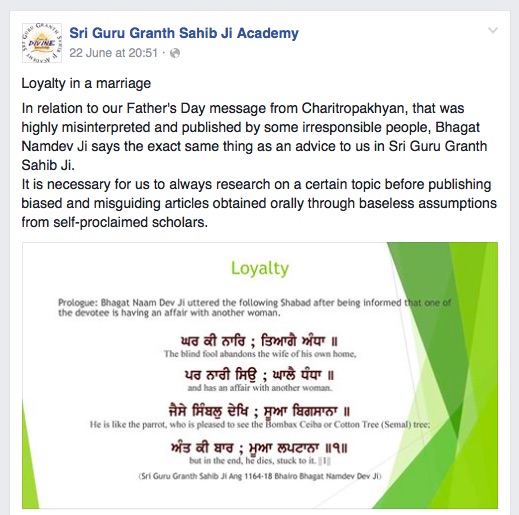
But the Academy [the Kuala Lumpur-based Sri Guru Granth Sahib Ji Academy] maintains it was about spousal fidelity and resorts to even more twisting. This time around however, they decided to twist Bhagat Namdev’s shabad from within the SGGS.
THE TWISTING CONTINUES
The following is the Academy’s response to my Dasam Granth and Father’s Day article.
“In relation to Fathers Day message in Chritro Pakhyan that was highly misinterpreted and published by some irresponsible people Bhagat Namdev Ji says the EXACT SAME THINGS as an adivice to us in the the Sri Guru Granth Sahib ji.”
Screenshot from SGGS Academy Facebook page – PHOTO / ASIA SAMACHAR
There are more twists and fabrications that one could discuss, but four are definitely in order.
Frist, Bhagat Namdev’s shabad does NOT say the EXACT SAME things as the CP couplet. That CP (DG) couplet is about a father telling his son not to bed other women in his dreams. Namdev’s shabad is about spirituality as will be made clear in succeeding paragraphs.
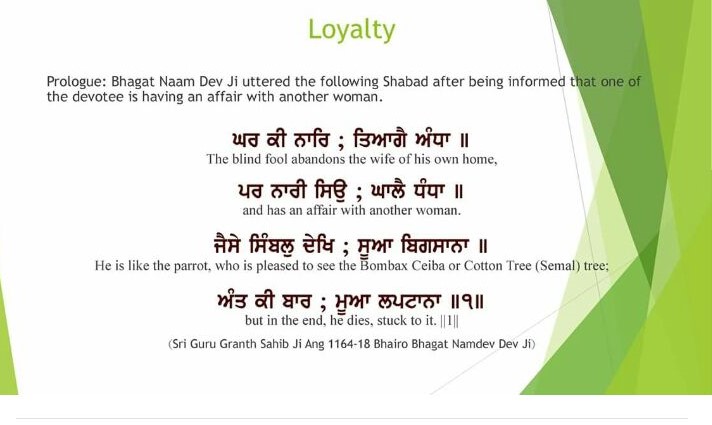
Second, the prologue is plucked from thin air and self constructed. It says “Bhagat Namdev uttered the shabad after being informed that one of the devotee is (sic) having an affairwith another woman.”
NOWHERE WITHIN this shabad is there any mention of ANY DEVOTEE or ANY AFFAIR with ANY woman, and ANY advice to that effect. Bhagat ji is talking about his OWN state of mind.
One wonders if reading too much of Chitro Pakhyan leads one to see nothing other than sexual affairs with another woman even where none exist. Worse, does CP condition one to see spiritually elevating Gurbani as being recited over sexual affairs of devotees?
Third, the words Ghalley Dhanda in the 2nd verse is translated as “having an affair.” Again seeing sex and woman where none exist. Prof Sahib Singh, in Darpan (page 4826), correctly translates these terms as “negative behaviours, lies.”
We use the term “Kum Dhanda” in our everday language to explain work related behaviours.
Fourth, the Shabad is titled LOYALTY. Twisting again. The title of a shabad ought to come from the RAHAO verse. The Rahao Verse in this shabad is: Papee Ka Ghar Agney Mahe. Jalut Rahey Mitvey Kab Nahe. Rahao.
Translation: This sinful mind of mine (papee ghar) is overcome by greed. The fire of greed does not show signs of getting extinguished (meaning the mind does not want to be CONTENT).
The shabad with the translation as provided by SGGS Academy
Readers can see that the word LOYALTY does NOT exist in this Rahao verse. The issue is thus of CONTENTMENT or lack of it.
Within the rest of the shabad, three examples are given by Namdev Ji in explaining the desire of NOT wanting to be CONTENT with things given to him by God.
In verse 1, Bhagat Ji tells his mind to be content with his God-given spouse.
In verse 2, Bhagat Ji says be content with the spirituality into which God has placed you.
In verse 3, Bhagat Ji says be content with the physique that God has blessed you.
In the final verse, Bhagat Ji tells us So Bhaj Par Hai Gur Kee Sarna. Come into the Sharan of God. Coming into His sharan is being CONTENT with all that He has given.
The message, therefore, from the Rahao verse is that “greed, and not being CONTENT with all that is given to me by God” is the root of my spiritual problem.
To say, therefore, that this shabad of Bhagat Namdev is saying the EXACT SAME thing as the CP couplet is utter nonsense.
CONCLUSIONS.
The Chitro Pakhyaan of the Dasam Granth is decadence personified. What is wholly immoral in narrative can never be moral in its message. It is as plain and simple as this.
The only way to super-impose morality on the 404 tales of sexual debauchery that constitute the CP is by plucking “moral messages” from thin air, by twisting the sexual narratives or by intentional mis-translations.
No prophet of any faith would want his followers to suffer such depravity. No prophet could thus have authored any such abhorrent writings. Certainly not any of our spirituality elevated and Godly Gurus. Certainly not Guru Gobind Singh ji.
Karminder Singh Dhillon, PhD (Boston) writes on Gurbani and Gurmat issues in The Sikh Bulletin, USA. He also conducts Gurbani Katha in local Gurdwaras. He is based in Kuala Lumpur, Malaysia.
This is the personal opinion of the writer or publication and does not necessarily represent the views of the Asia Samachar.
[ASIA SAMACHAR is an online newspaper for Sikhs in Southeast Asia and surrounding countries. We have a Facebook page, do give it a LIKE. Follow us on Twitter. Visit our website: www.asiasamachar.com]